
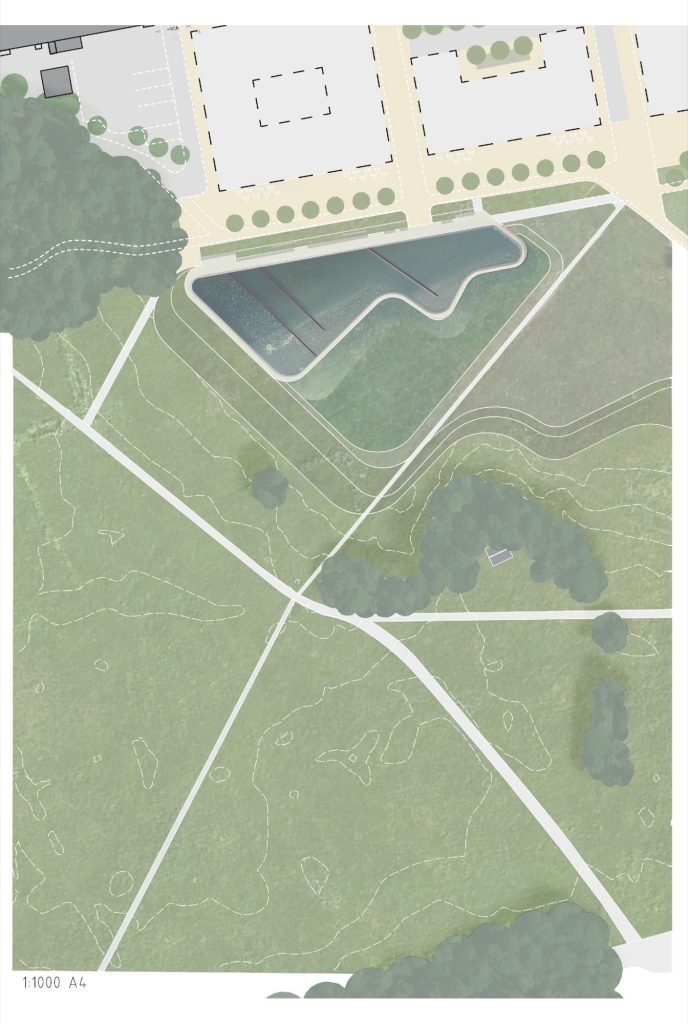

As our cities grow, so does the need to protect them from flooding, and to clean the dirty water they produce. The ttormwater pond at Exercisfältet in Uppsala solves both problems, while also contributing to biodiversity and creating a place for people. We had the ambition to turn a technical facility into a place for people and nature. The fact that the site is a sensitive cultural environment made the task even more complex.
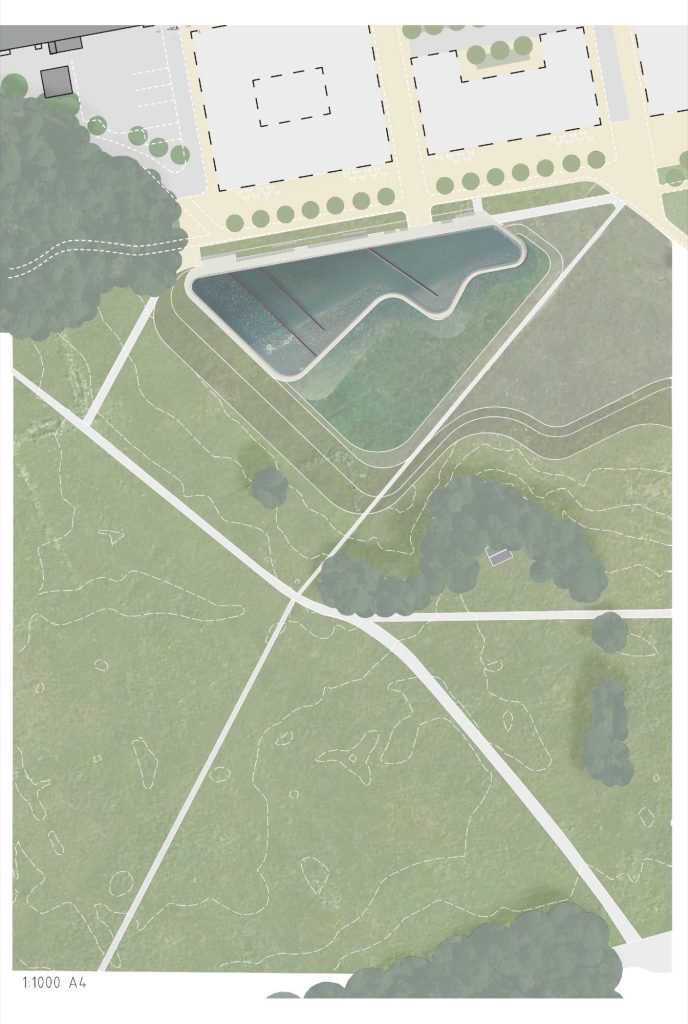
Stormwater ponds are a technical necessity to cope with new demands in urban development, due to reduced infiltration and climate change. In this project, commissioned by Uppsala Municipality and Uppsala Vatten, we have gone one step further to ensure that the pond will also create new social and ecological values for the area.
The city of Uppsala is growing and becoming more dense around Exercisfältet, a former military training area which has cultural and historical values. The assignment to design and plan the stormwater pond began as part of a more broad project to assess the entire field and its potential for development. The generous open space will become increasingly important for recreation in the denser cityscape of the future.
We have placed the pond in a natural low point and given it two contrasting sides: a “city side” and a “nature side”. Closest to the built environment, the pond has a sharp edge with a robust flood protection in the form of a concrete wall that follows the lines of the housing blocks. Towards the open field, the pond connects to the undulating forms of the landscape. This way, the facility lands very discretely in the historically sensitive environment.
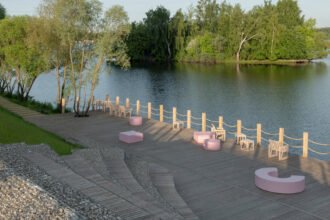
The development north of the pond is likely to continue, with more new buildings closer to the pond’s straight side with it’s generous wooden deck. The pond is designed to accommodate this development and to become an exciting interface between dense block structure and open landscape space – a place where people are invited to interact with other people, and to experience city and nature at the same time.
This waterscape is a good example of what will be the focus of landscape architecture in the future: combining new technological requirements in relation to climate change with solutions that promote biodiversity, while creating spaces for people to appreciate, socialize and enjoy.
Landing the design has required a lot of careful consideration and perserverence to piece together the competing factors: maintaining minimum water levels to connect to existing pipes; accommodating maximum water levels to protect the surroundings from flooding; achieving a minimum accepted permanent water surface to allow for purification; providing sufficient shallow zone in the permanent pond to ensure purification; and maximise volume retention for extreme rainfall events.
To preserve as much space as possible for activity and recreation on the field, the permanent pond has been made as small as possible. This also minimises the length of the necessary safety railings, which saves material.
When it rains heavily, the water will rise beyond railings and walkway on the south side, and water mirrors of different sizes and shapes, according to the amount of rain, will appear on the field. So in this project, even the flooding has been designed intentively. This has a pedagogical value: it highlights the consequences of climate change and society’s need to adapt.
The plantings and different water levels strengthens biodiversity, while attractive pathways and south facing seating provides a place for people to rest and recover, move, discover and play.
The planting areas around the walkway were modelled on native flora and designed to allow the greenery to interact with the changing water levels. We have established a wide variety of species, chosen for their ability to withstand different degrees of moisture: some are particularly tough and resistant to variable water levels while other species have particularly good water-purifying properties. The flat slopes on the southern side of the pond favour a variety of flora and fauna. The different moisture zones, which are flooded unevenly and intermittently, form an ecological edge zone with great potential to develop into a rich wetland biotope.
Water has obvious restorative qualities and is great for play, but also constitutes a risk, especially to children. We have created a space where people are protected from falling into the deep water and parents and teachers can feel safe about letting children explore the area. At the same time, the design allows visitors to come close to shallow water and vegetation via the curving pathway. This gives opportunities for children to play and interact with nature, and for schools to use the site for outdoor education in ecology and urban planning.
Client: Uppsala vatten och Uppsala Municipality
Landscape Architect: White Arkitekter
59.841780, 17.643263