

Joe Ireland revamps a McLean home he previously designed, instilling it with vitality and verve
A house should evolve and not stay stagnant,” maintains designer Joe Ireland, who has helped one like-minded couple put that belief into practice for the past 15 years. From an initial renovation to a recent refresh—and several artful acquisitions in between—he has guided the stylish progression of his clients’ McLean manse.
The now-empty-nest owners bought their ’80s-era, center-hall Colonial in 2000, when the wife’s two daughters were still at home. Years later, they were ready to address the functional gaps, character deficiency and decades-old décor that had become sore points. The duo started outside, hiring McHale Landscape Design to create a resort-like backyard oasis.
Enhancing the exterior, however, brought the interior’s shortcomings into sharper focus. “I was very frustrated with the house,” reveals the wife, a retired telecom exec whose husband recently hung up his hat from a career in technology. “It had little charm and didn’t reflect me.” She first enlisted Ireland in 2008 to overhaul the 8,500-square-foot abode, upgrade its original builder-grade detailing and finishes and remodel the kitchen.
The wife, who loves to cook for family gatherings, meticulously drafted the dual-island kitchen layout herself. An inspiration image torn from a catalog captured the clean, two-tone look she was after. Taking his cues from it, the designer wrapped white-painted perimeter cabinetry in dark-stained, quarter-sawn oak and repeated the charcoal-colored finish on the footed island bases, which are outlined in stainless steel.
Furniture planning came next. The wife sought to take the interiors in a “more contemporary but also warm and inviting” direction. She was eager to jettison the period reproductions she had picked out earlier. “When we bought this Colonial house, I thought I should buy Colonial things,” she discloses. “It really wasn’t about what I liked.”
A handful of pieces the owners had collected while living overseas, including the large living room sofa, made the cut. To supplement those, Ireland sourced new selections, designed several custom pieces to fit the spaces and scoured 1stDibs and antiques stores for special finds—many of which remain today. “The upgraded envelope pays homage to the home’s architecture, but everything else is a mix of styles,” he notes. “And it’s constantly evolving.”
Since the 2008 redo, Ireland and the owners have gradually added newfound treasures, particularly artwork. On a buying trip to Paris, for instance, he and the wife stumbled upon a century-old, gilded-plaster relief that now hangs over the dining room sideboard. The woodland scene it depicts is based on a drawing by Armand Albert Rateau, the late French interior designer who conjured the celebrated Parisian apartment of couturier Jeanne Lanvin, where a nearly identical tableau adorned a bathroom alcove.
By 2020, though, a larger-scale refresh was in order. The goal: to heighten the energy of the spaces. “With the first [design] round, there was a stopping point, a certain budget,” explains the designer. “This round was about taking some elements to the next level.”
The music room offers a prime example. Its original cherry millwork had never suited the wife’s fancy; lacquering it in a salmon hue proved just the answer. “We lacquered the room to give it a new life,” Ireland explains. “We wanted it to be livelier and become a destination.” Four vintage, floral chandeliers lend the space what he calls “a bit of a ballroom feel,” while a vivid, painterly rug provides an edgy counterpoint.
The bold combination expresses the owner’s newfound style assurance. “When I first started working with Joe, I was much more timid about how far to go,” she admits. “Over the years, I’ve become less afraid of color and pattern.”
The dining room bears witness to her burgeoning confidence as well. Initially, the walls were painted top to bottom in dark amethyst. “We started talking about how we could make this room feel even cozier,” recounts Ireland. “It was pretty before, but it needed more personality.” He remedied that shortcoming with flora-and-fauna wall covering from The Vale London, which now wraps around the upper portion. A glamorous, 1950s glass-and-brass chandelier ousted a conventional, candelabra-style fixture.
Spirited prints replaced more staid upholstery choices in places. For proof, look no further than the sunny Sanderson botanical fabric that now emboldens the living room’s Ebanista settee. “From the beginning, we’ve tried—and I think we’ve been successful—to purchase things that would remain relevant, then we tweaked them in this update,” says Ireland. “I really aim for longevity. That’s good design.”
The wife appreciates the element of surprise too. “When people see the house from the outside, they don’t expect to walk in and find something so fresh inside,” she says. “The interiors are a little more playful, not so conservative now. They reflect the evolution of my tastes.”
Interior Design: Joe Ireland, principal, J.D. Ireland Interior Architecture & Design, Washington, DC. Renovation Contractor: P.A. Portner, Inc., Gaithersburg, Maryland.
RESOURCES
FOYER
Art: Donald Baechler through paceprints.com. Rug: antique through galleriacarpets.com. Stair Rail: paportner.com. Art: adams.ie.
LIVING ROOM
Sofa: ebanista.com. Sofa Fabric: sanderson.sandersondesigngroup.com. Screen: Antique; antique mirror: jdireland.com. Art: purvisyoung.com. Small Coffee Table: tempoluxuryhome.com. Wall Covering: twindiamonds.com. Wood-Framed Chair: dessinfournir.com. Wood-Framed Chair Fabric: fortuny.com. Floor Lamp: Bell and Preston; 202-577-3070. Floor Lamp Shade Fabric: jimthompsonfabrics.com. Pedestal: Custom through jdireland.com. Vase: jasonjacques.com. Color Lithograph: Wall Barnet through doyle.com. Ceramic Bowl: Otto and Vivika Heino through lamodern.com. Twin Mirrors: Custom through jdireland.com. Chests: Owners’ collection. Art by Chest: kentonnelson.com through petermendenhallgallery.com. Occasional Chairs: Donghia through kravet.com. Occasional Chairs Fabric: jimthompsonfabrics.com. Sofa Fabric: zimmer-rohde.com/en. Art over Sofa: gilheitorcortesao.com through carbon12.art. Rug: ebanista.com; georgetowncarpet.com. Coffee Table: Owners’ collection. Coffee Table Wallpaper Inset: phillipjeffries.com through jdireland.com. Window Shades Fabric & Trim: dedar.com; samuelandsons.com. Window Shades Fabrication: designerworkroom.net.
LIBRARY
Paneling: twindiamonds.com. Pendants: Vintage through davidowski.nl. Piano: Owners’ Collection. Rug: galleriacarpets.com. Wall Covering: elitis.fr. Ceiling Paint: Chestertown Buff by benjaminmoore.com. Chair: Owners’ Collection. Ottoman: Custom through jdireland.com. Ottoman Fabric: calvinfabrics.com.
DINING ROOM
Table Design: jdireland.com. Table Fabrication: michaeljamesfurniture.com. Chairs: Custom through ferrellmittman.com. Chair Fabric: powellandbonnell.com. Rug: Custom through starkcarpet.com. Wall Covering & Trim: thevalelondon.co.uk; samuelandsons.com. Paint: twindiamonds.com. Sideboard: Vintage through 1stdibs.com. Chandelier: ledecostyle.com. Bowl: francespriest.co.uk.
EATING AREA
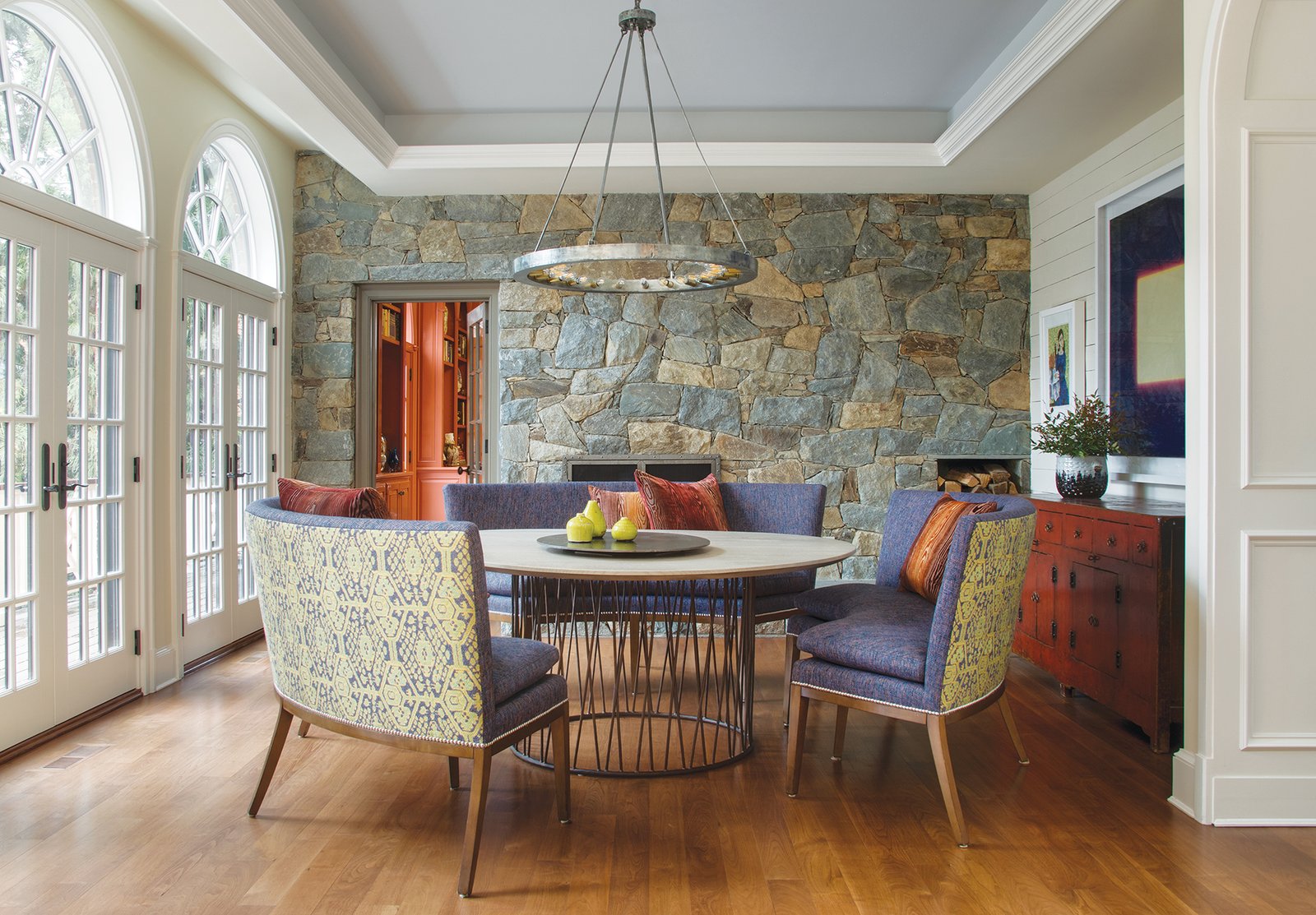
Table & Banquettes: Design by jdireland.com; fabrication by ferrellmittman.com. Banquette Fabric: jennifershorto.com; osborneandlittle.com. Sideboard: randomharvesthome.com. Chandelier: 1stdibs.com.
KITCHEN
Stools: bakerfurniture.com. Cabinetry: downsviewkitchens.com.
FAMILY ROOM
Chairs: Donghia through kravet.com. Chair Fabric: pierrefrey.com. Ottoman: kravet.com. Ottoman Fabric: thibautdesign.com. Rug: galleriacarpets.com.
UPPER HALLWAY
Wall Paneling: paportner.com. Art: juliewolfe.net through hemphillfinearts.com. Chandelier: davidweeksstudio.com. Stair Runner: georgetowncarpet.com.