

Imagining Best Products
The Branch Museum of Design
Richmond, Virginia
Through June 21
In the 1970s and ’80s, Best Products was among the nation’s premier retail showrooms. Their secret sauce? An American corporate aesthetic at an American scale: building, branding, and supply chain all wrapped into one bold vision.
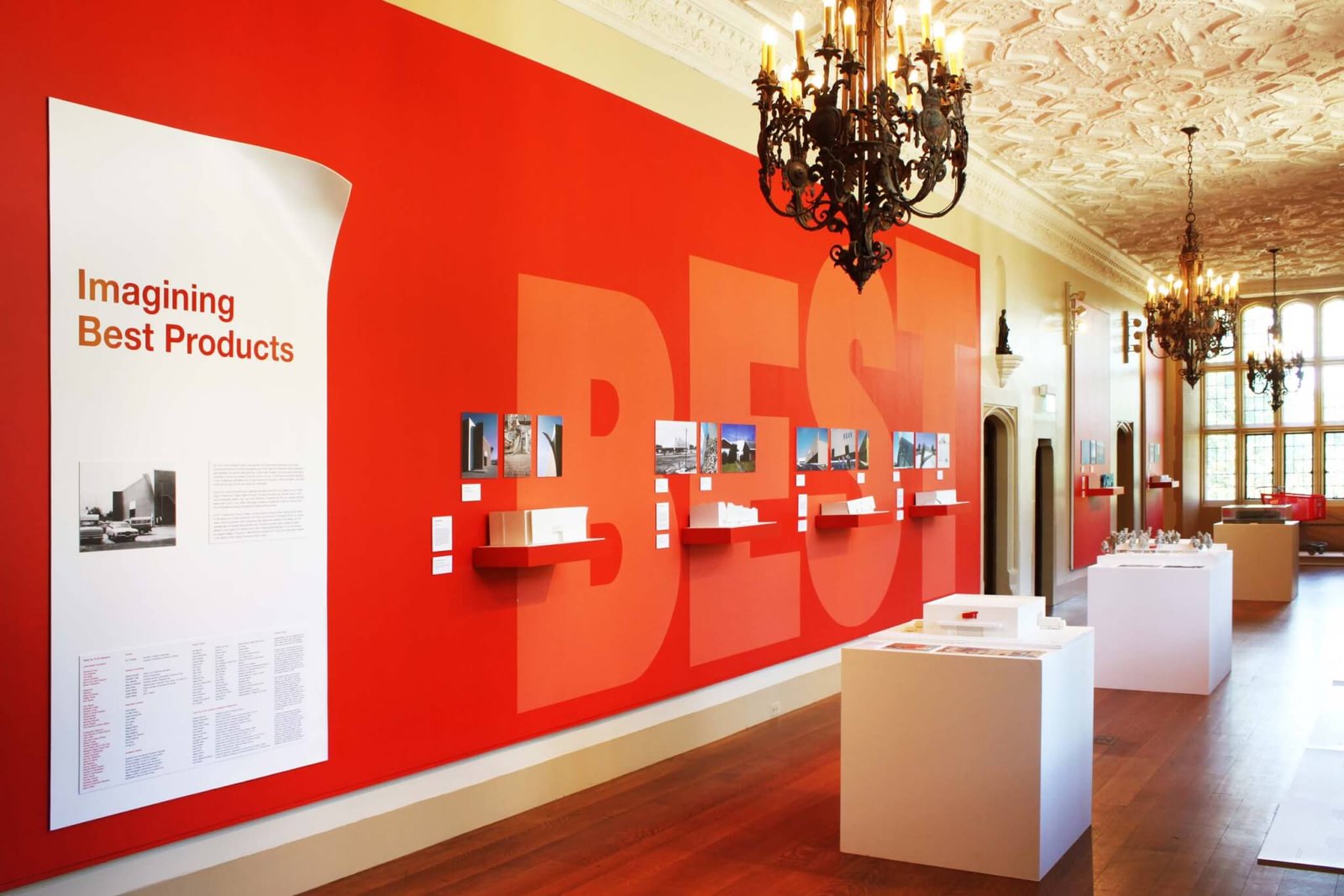
The company’s founders, modern art philanthropists Sydney and Frances Lewis, turned their business into a petri dish for a national design conversation. Let loose in the home, in parking lots, and on the highways, their brand was built on design bravado, which stood out in the suburban postwar landscape. Artful product catalogues came right to the doorstep, goods were transported by graphically bespoke big rigs, and the notorious nine showpiece buildings were national conversation starters. The entirety of the Best corporate project is on display for the first time in the exhibition Imagining Best Products, on view at Branch Museum of Design in Richmond, Virginia.
The exhibition offers a cultural timeline contemporaneous with the visual development of the company, tuning Best Products to the public consciousness. Pivotal moments in the company’s history are contextualized by benchmarks of the American political and media landscape, mass typographical evolutions, and hyper events such as the Three Mile Island nuclear incident. The curators posit the corporation’s visual identity as an ebullient and provocatively ambiguous response to its era, a reverberation within the surrounding milieu. The unabashed certainty of the consumer era filters through the graphic cheekiness of the catalogue’s offerings and reflected in the sartorial edge of the built and proposed showrooms. The result is an admirable throw of the dice by a company willing to engage the shifting sands of artistic ambiguity, in hand with the fiscal benefits of a raised national profile.
The through line is a constant engagement with the public, even down to the “Now It’s Your Turn!” build-a-showroom paper models of the ’70s and ’80s. As Andy Lewis, the second president of Best products, said in a 1980’s interview “If someone takes the time to write me a letter telling me that he doesn’t like our building, then that someone has done something unusual in the course of his day. He’s thought about form and function, and what our expectations are about commercial buildings, and I take that as our contribution to the community.”
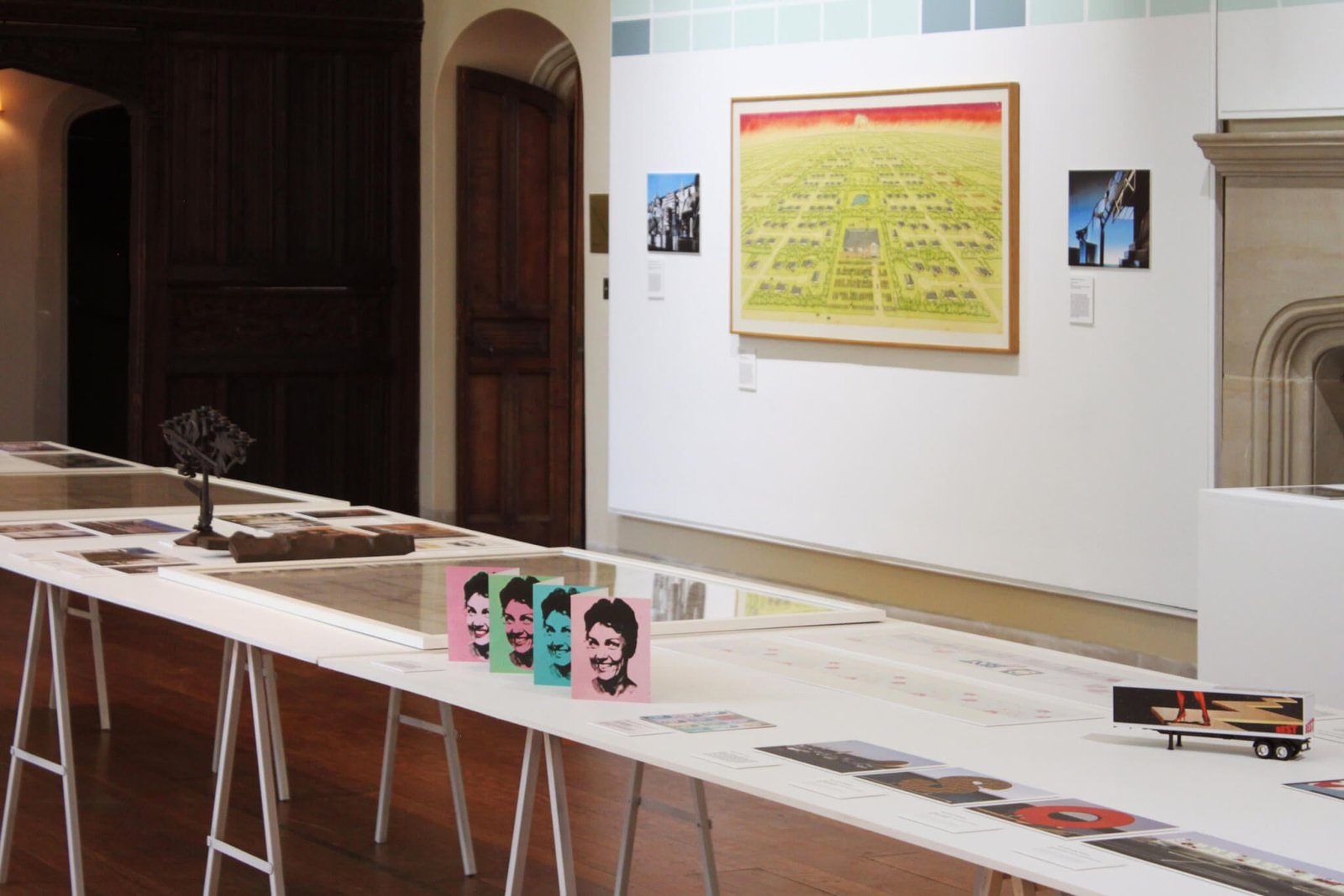
The exhibition’s curator Don O’Keefe, in partnership with Best’s former director of communications Edwin Slipek (now deceased), conceived of this exhibition as a celebration of Best Product’s sprawling design endeavor. Exquisite pen, colored pencil, and watercolor drawings from SITE, Robert A. M. Stern, and Stanley Tigerman (the latter two unbuilt proposals were solicited by the 1979 MoMA exhibition Buildings for Best Products) hang amid an abundance of graphic materials and ephemera. Some of those included were lent by the Virginia Museum of History and Culture, home to the Best Products archives.
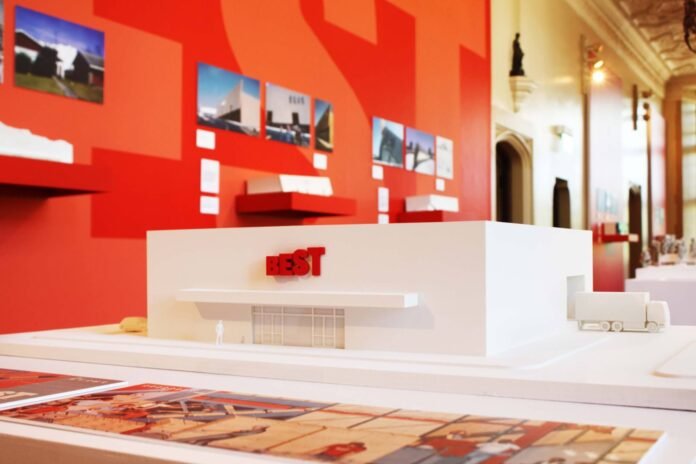
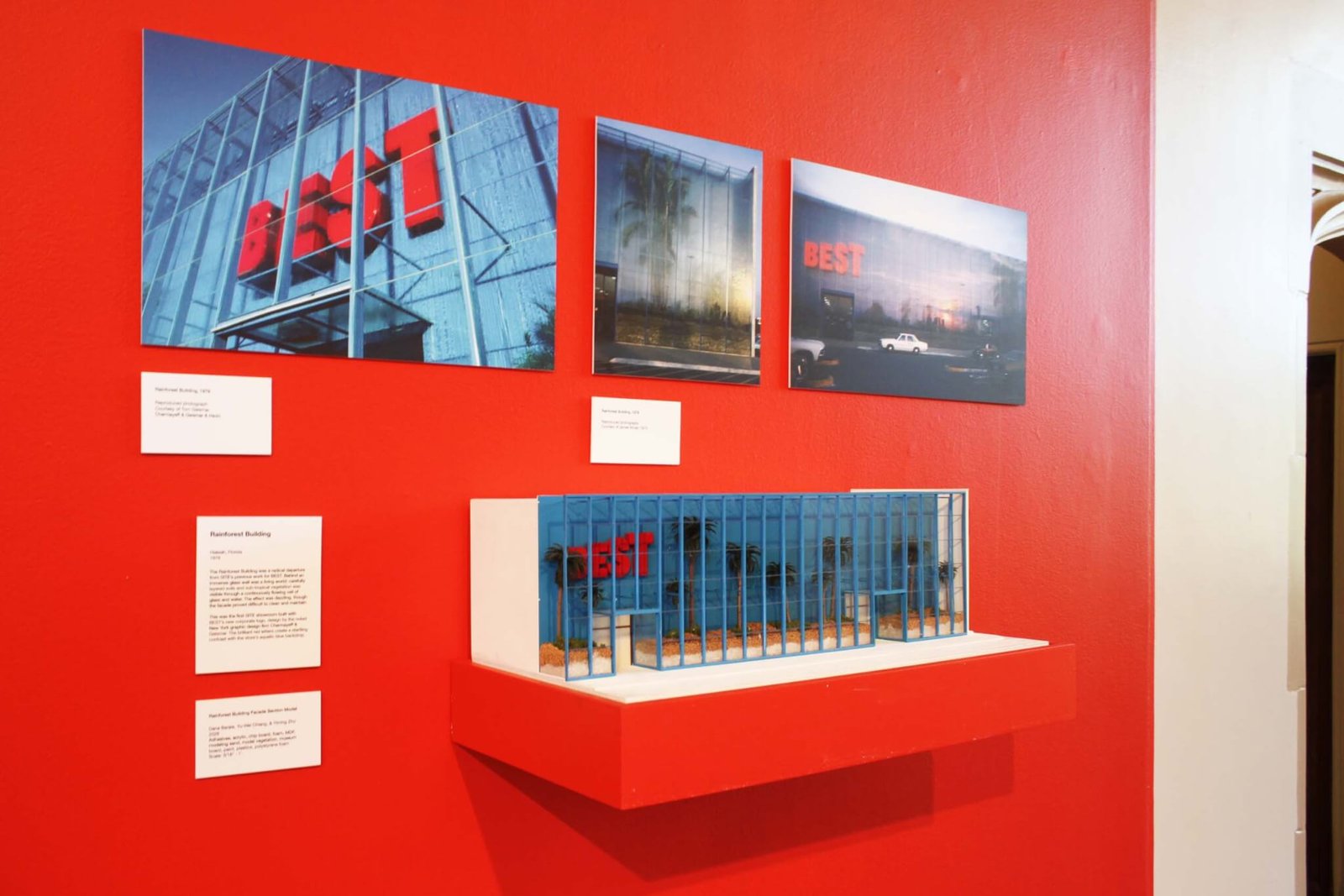
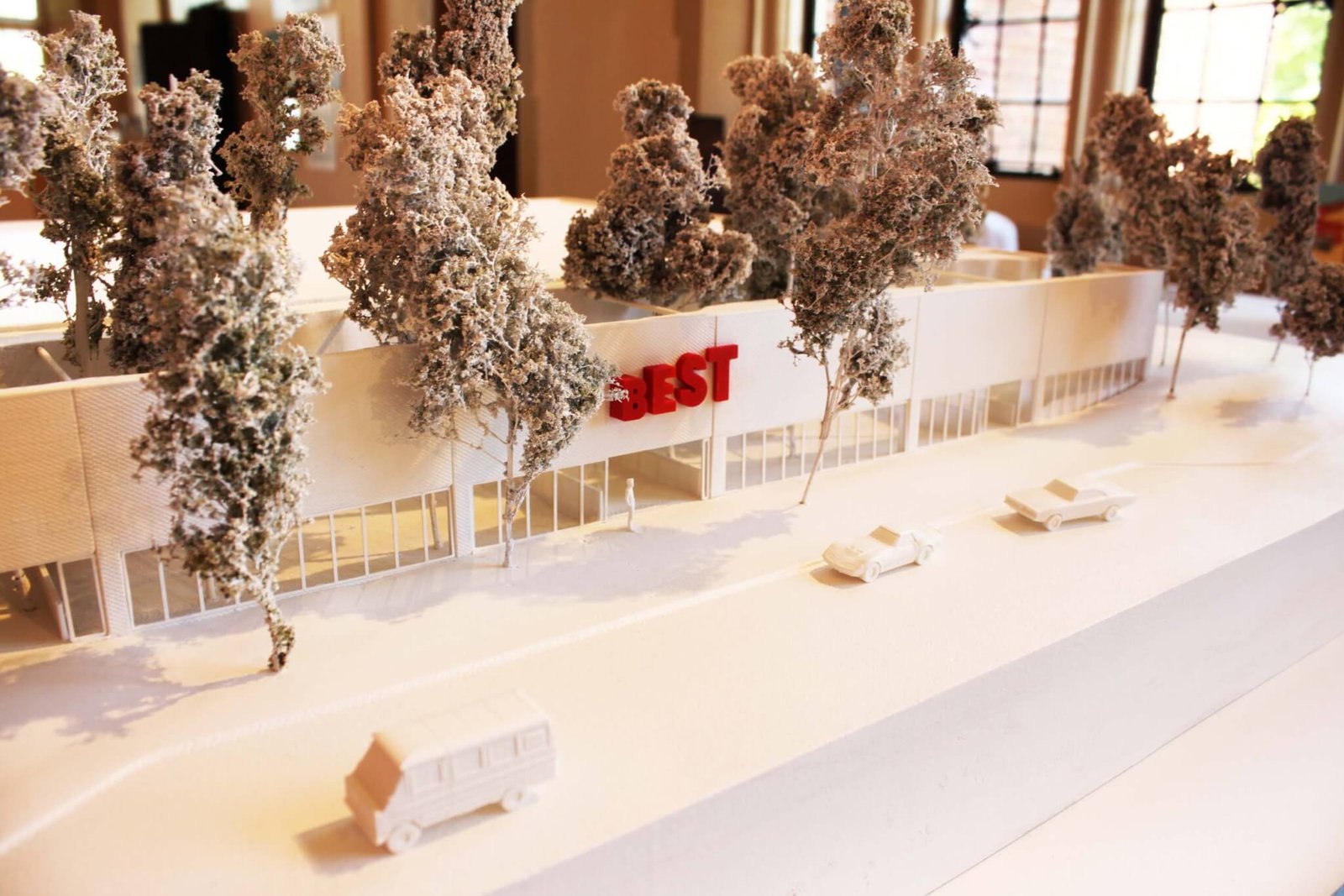
Literal pieces of the iconic Venturi Scott Brown 1979 showroom in Langhorne, Pennsylvania, and the Hardy Holzman Pfeiffer Associates–designed headquarters are displayed in the galleries alongside the iconic 3D Best letters, designed by Chermayeff & Geismar & Haviv. In the Branch Museum’s main gallery is a field of Best showroom models and scaled drawings, meticulously created by students from a Harvard GSD seminar on Best taught by O’Keefe.
In the same spirit of Best Product’s wry humor, a cheeky embrace of context characterizes the exhibition design. The Branch Museum of Design is a public-facing, modern cultural institution, housed within the chassis of distinguished 1916 John Russell Pope Tudor Revival. A Best Products shopping cart sits on a pedestal at the end of a grand lead panel windowed gallery along Monument Avenue. O’Keefe said that he and his student co-curators “…designed the exhibition to be in dialogue with the space. We tried to push this traditional space into a more contemporary terrain, just as Sydney and Frances Lewis pushed the city (of Richmond) in all kinds of ways, patronizing the arts and commissioning works of design.”
The curatorial vision also includes a robust line-up of programming; recently James and Suzan Wines spoke intimately on the design and processes behind SITE’s renowned showrooms. Concurrent to the exhibition, director Jim Venturi is screening his documentary Stardust on June 20 at the Byrd Theater, a chronicle of the 50-year love story and creative partnership between Robert Venturi and Denise Scott Brown. The show closes with a conversation with the Lewis family’s personal curator, Jay Barrows, on Sunday, June 21. He will discuss the Lewis’s rise as art-world juggernauts (and the sensibilities that led them to become collectors of Warhol, Close, and Oldenberg), and fine art’s ultimate influence on Best Product’s visual identity.
Though Best Products folded in 1997, its legacy continues. Andy Lewis explained the staying power of Best, “If it were an easy sales gimmick, a whole bunch of people would be doing it. There’s a lot of risk… There are a lot of less risky ways of promoting sales.” Today, only one building remains in recognizable form, the SITE Forest Showroom in Richmond (now home to the West End Presbyterian Church). Instead, the company lives on within design discourse, with much affection from its acolytes— former employees vividly recall their past retail lives on delightful online forums. Best continues to remain the best of its kind.
Emma Fuller is a principal of Fuller/Overby Architecture and native of Richmond, Virginia.