
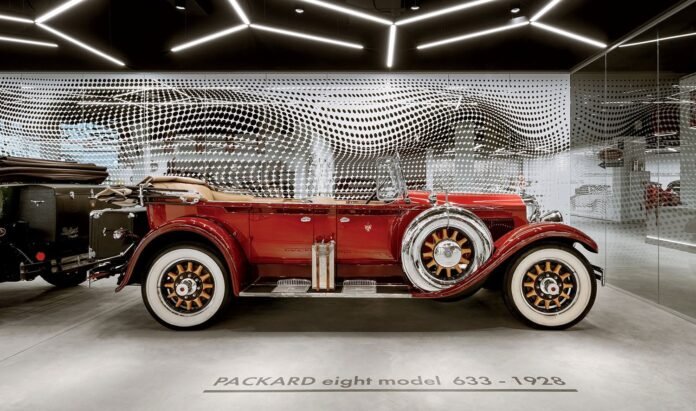

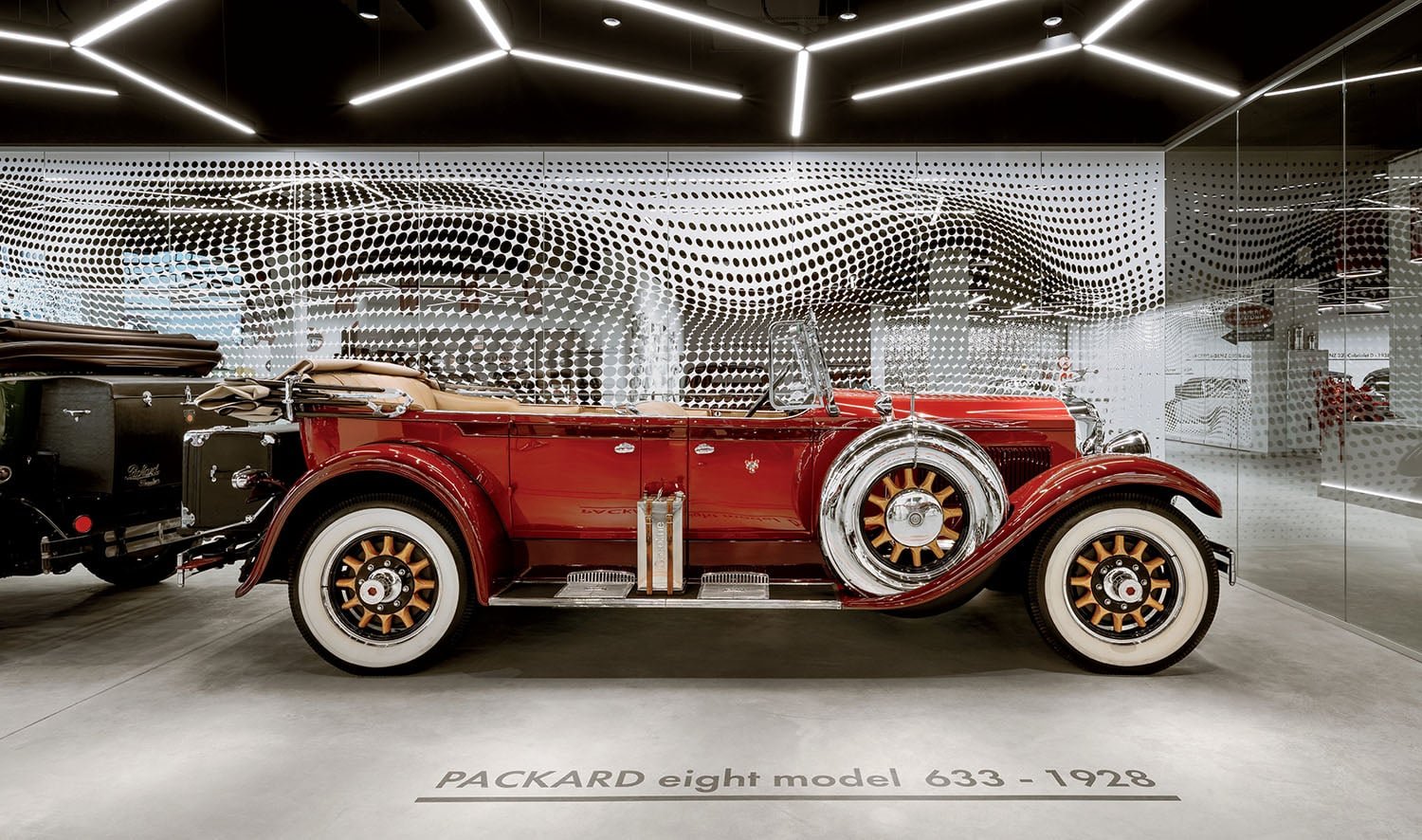
When Viktor Karachun, a prominent Ukrainian businessman and a cofounder and co-owner of the ATB-Market chain of discount grocery stores, hired the small local studio Koshulynskyy & Mayer to design his house, his passion for vintage automobiles came to light. Designer Karina Mayer, architect Danylo Koshulynskyy, and he were planning the home’s garage when it became clear that Karachun didn’t have just a vehicle or two; he owned over three dozen. His is an extraordinary collection of the finest autos ever produced, from a 1928 Packard to a 2001 Chrysler Prowler, and many are in pristine condition, despite their age, because he seeks out models that have barely been on the road. After Russia invaded Ukraine, Karachun kept these beauties in a warehouse, which he occasionally opened to the public. But while working with Mayer and Koshulynskyy, who’d heretofore specialized in residential projects, the trio began discussing what would become a whole new undertaking: Vik Cars Museum, which opened in Lviv late last year.
Vik Cars Museum Houses A Collection Spanning A Century
It’s no fanciful vanity project. The client made it clear from the outset that he wasn’t interested in a money-draining enterprise, that it should be a self-sustaining business. The kicker? He wanted the museum up and running in 60 days.
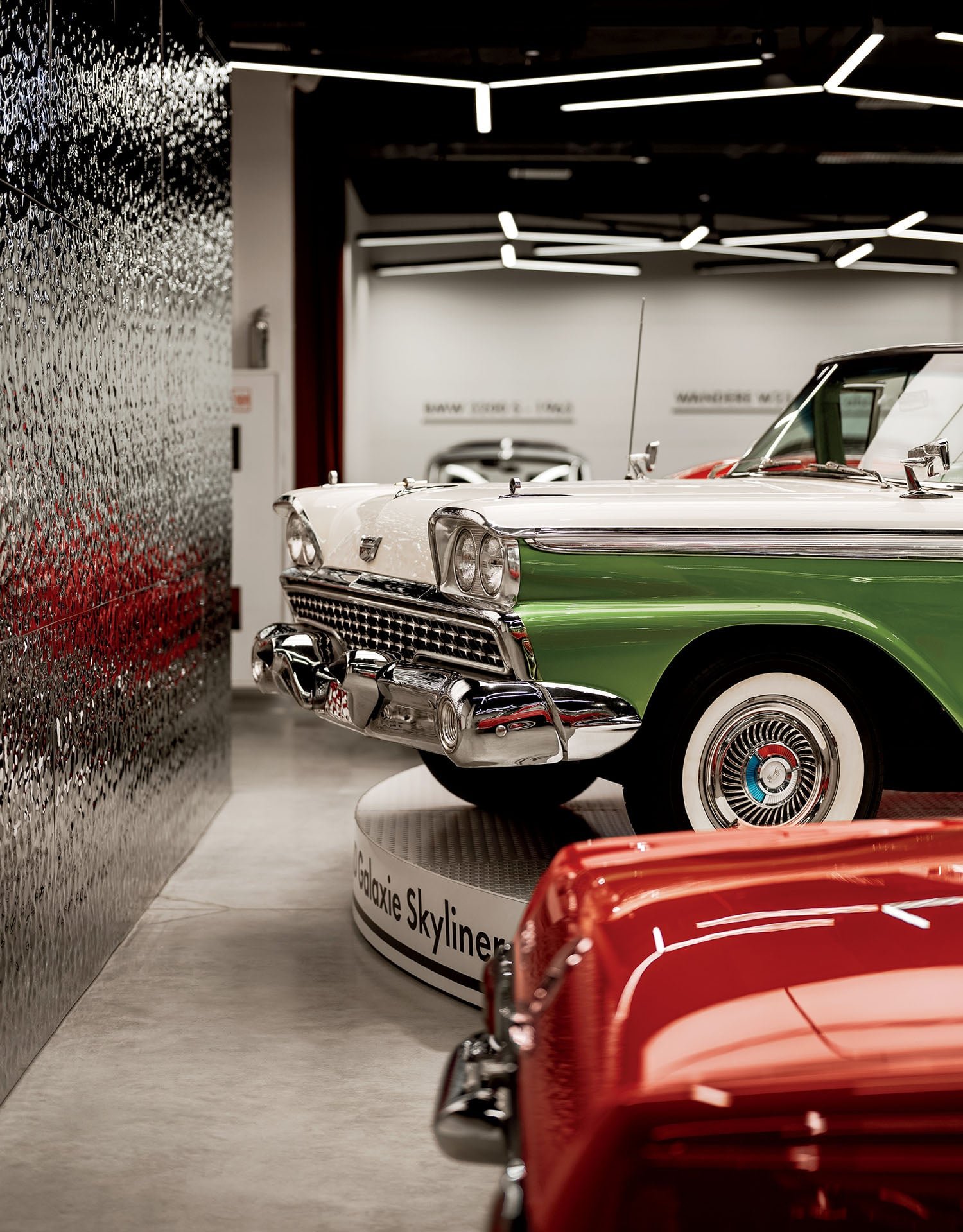
With Mayer and Koshulynskyy’s help, Karachun located, then purchased a two-story building that had previously housed retail stores. He put one of his ATB markets on the ground level, leaving the 16,000-square-foot floor above for the museum. An elevator that can carry vehicles weighing up to 3 tons was installed, as was a motorized circular rotating platform, where a single car can be showcased.
Showcasing Vintage Cars In A Gallerylike Setting
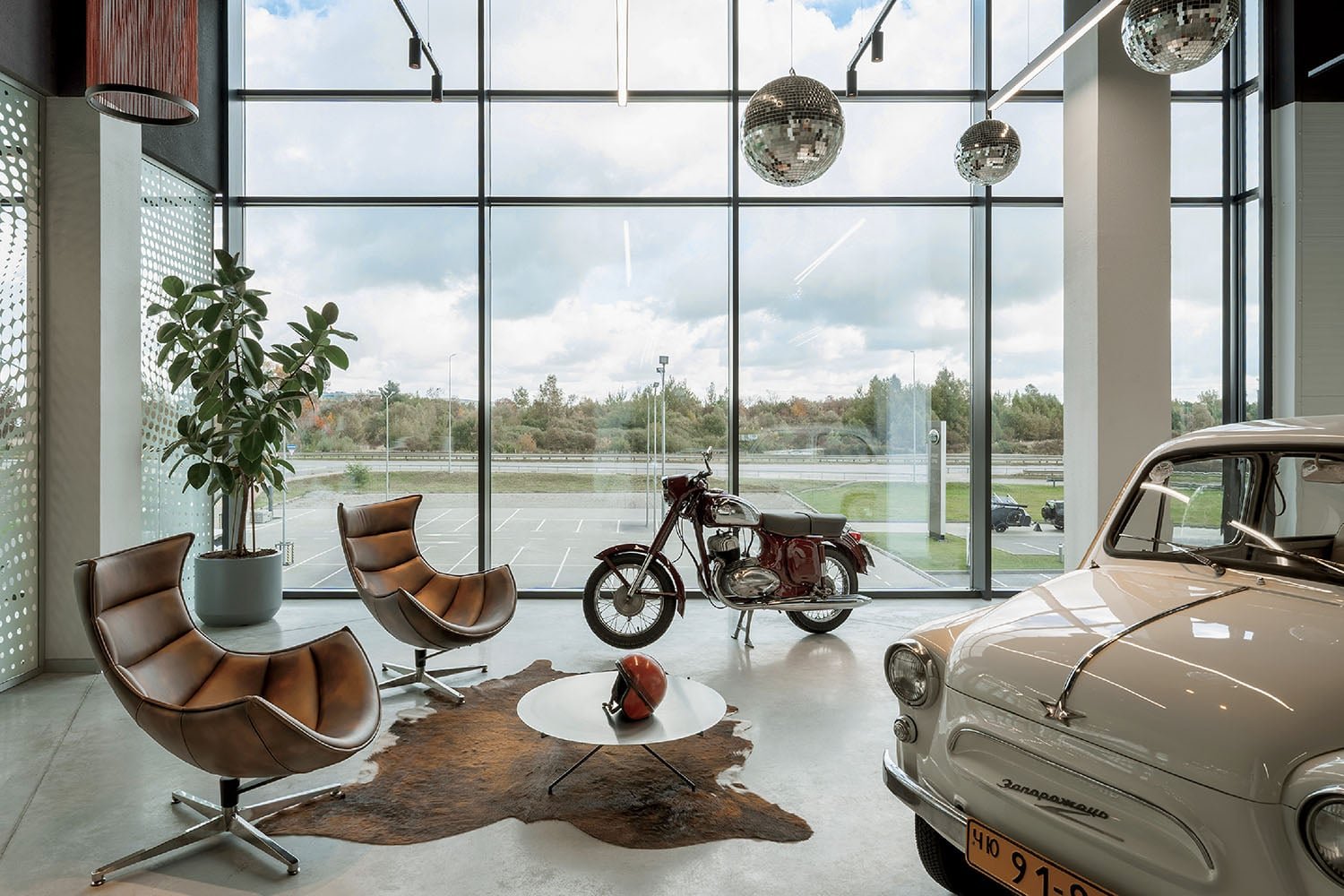
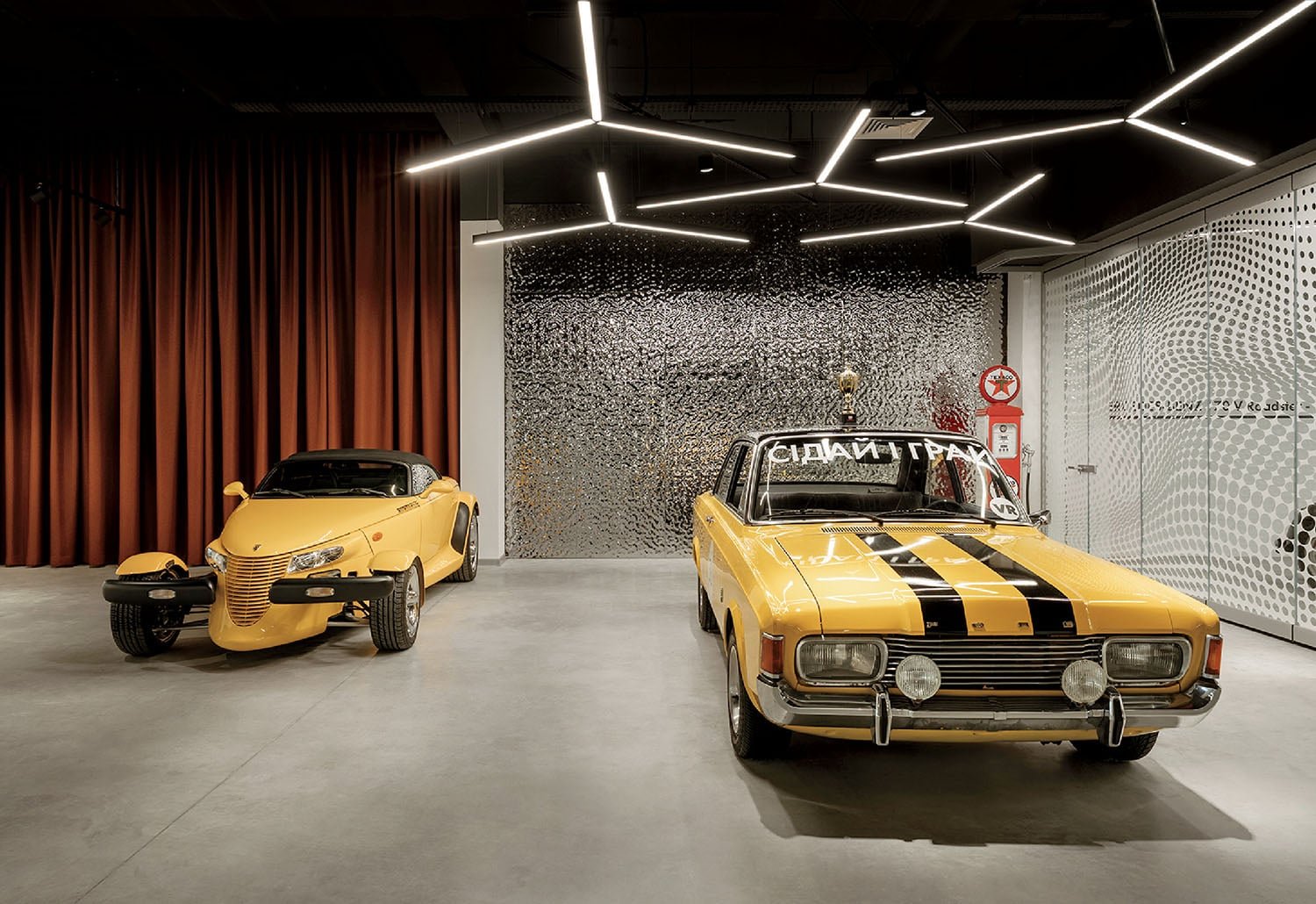
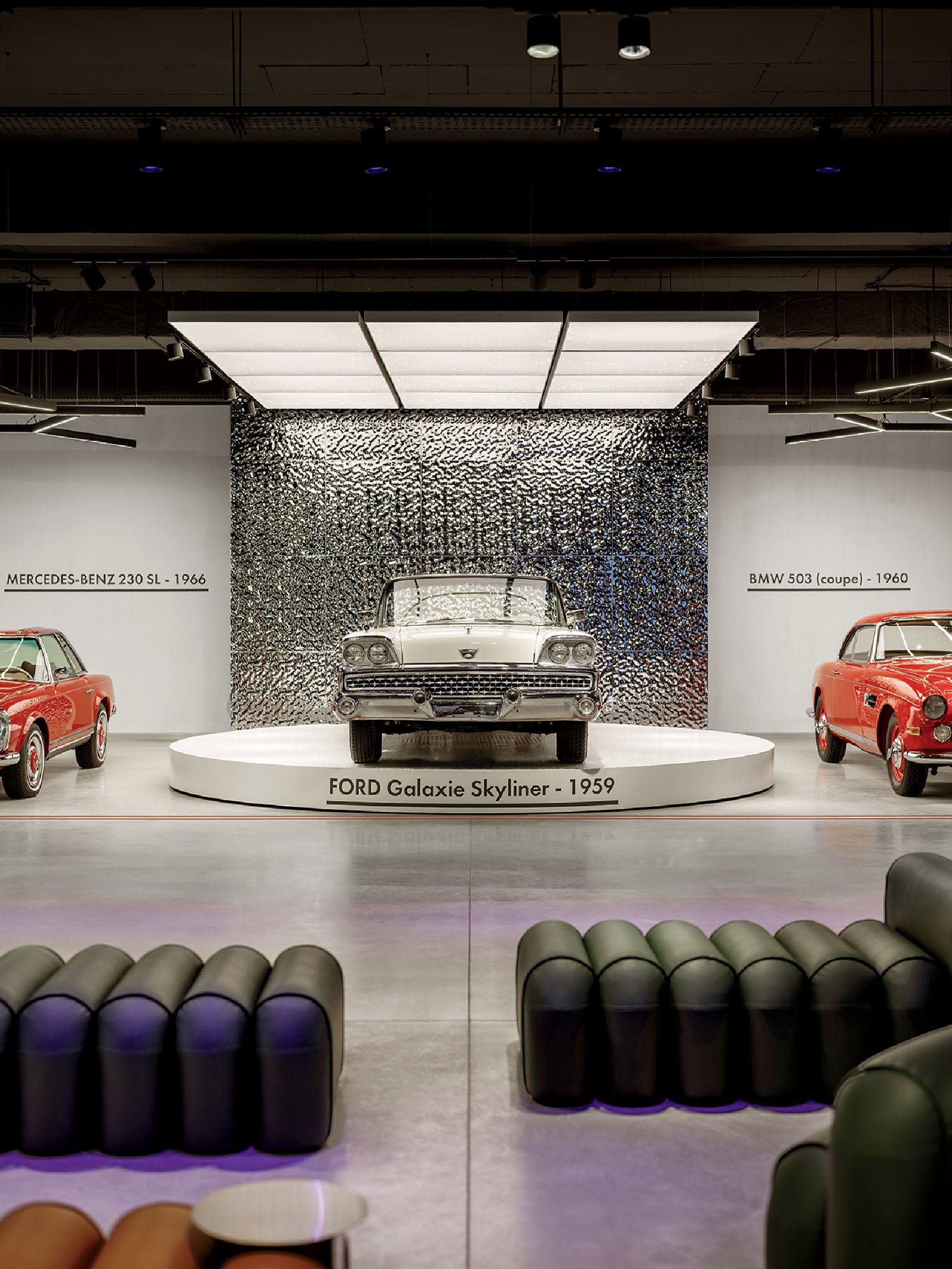
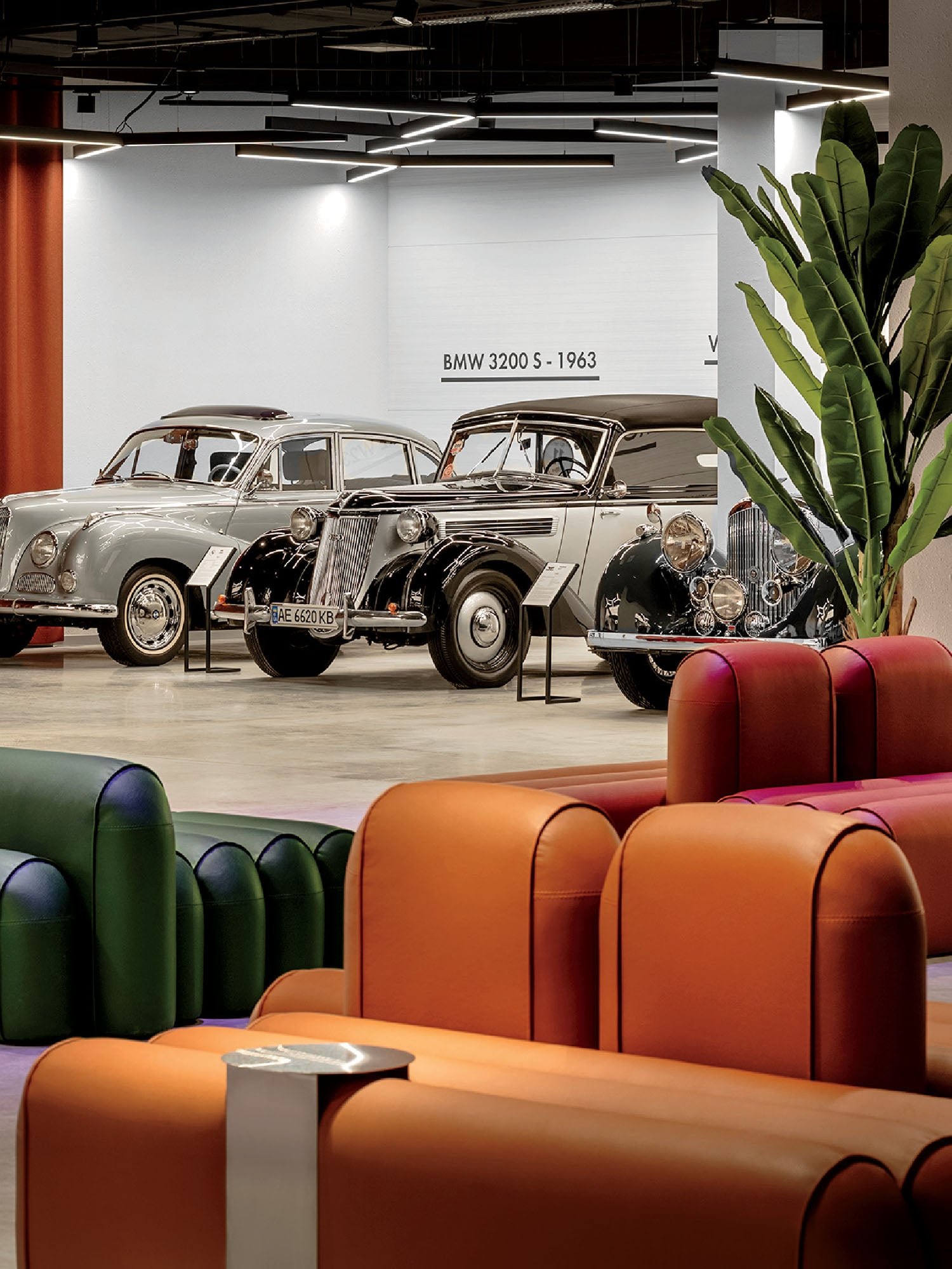
Disco balls dangle over 1960’s-style chairs of composite leather upholstery and powder-coated steel in a small lounge area. Visitors can climb into the 2001 Chrysler Prowler or 1974 Ford Taurus in the interactive zone. A custom fixture of LED panels casts no shadows on the rotating platform. Strips of automotive tape on the floor act as a barrier between visitors and vehicles.
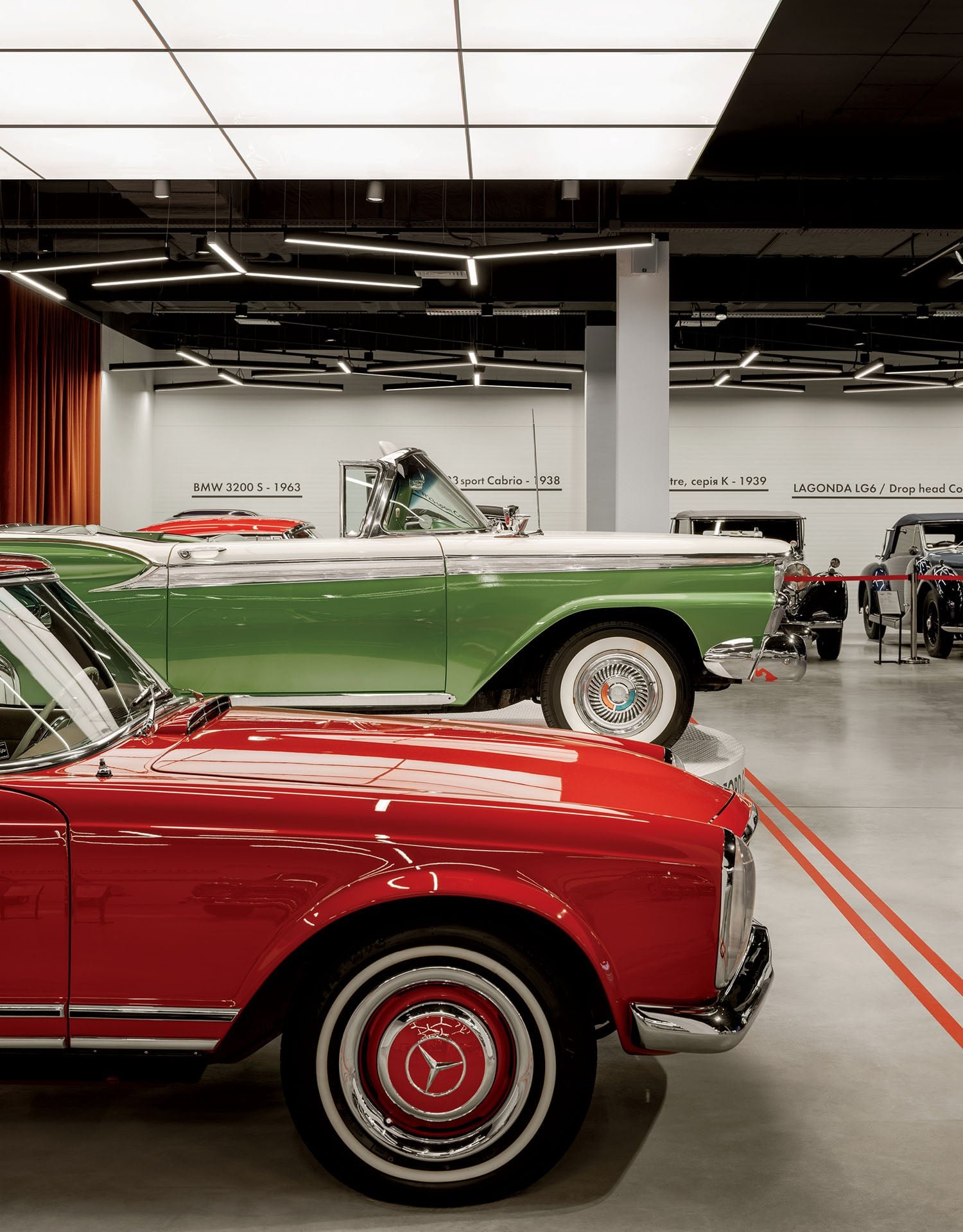
Mayer and Koshulynskyy, who too admire cars as design objects—they themselves own a 2017 Porsche they use on weekends and a 2024 Tesla for the workweek—sought to present Karachun’s prized possessions to their best advantage. “They’re time capsules,” begins Mayer, who approached displaying them the same way she does artworks belonging to her residential clients. Here, she formulated a neutral backdrop—black ceiling, white walls, gray poured-concrete flooring—so each model’s sinuous form and gleaming color would stand out. “Our goal was to create a stage for the cars, one where each curve, chrome detail, and reflection would receive maximum attention,” she continues.
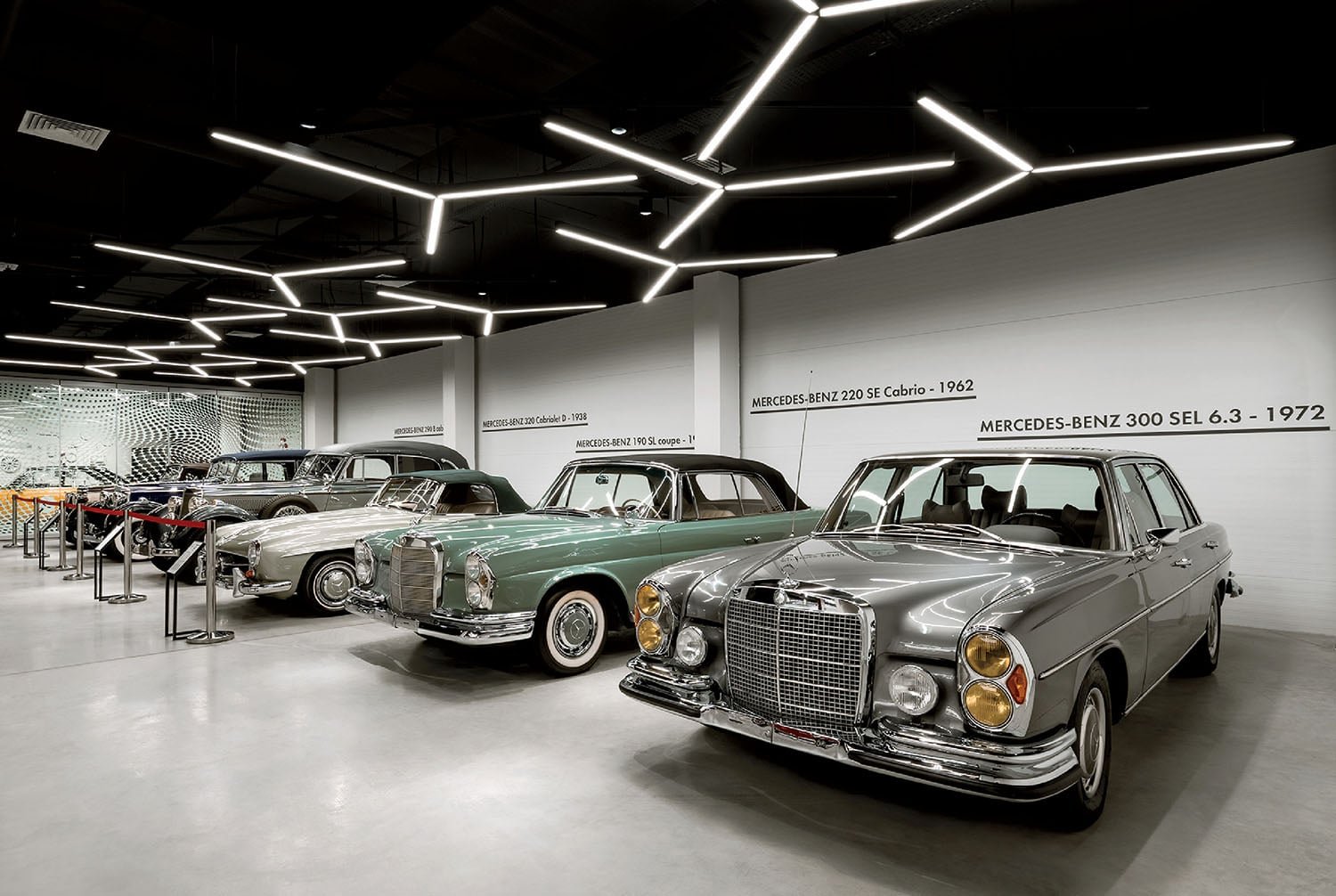
Around the perimeter of the rectangular plan, vehicles are organized to highlight their evolution in design and engineering—European cars from post WWII in one area, American cars from the 1960’s in another. The exception to that rule are Karachun’s favorites, the Mercedes, which are grouped by the manufacturer. These eight are the first visitors see when they enter Vik. The fact that the ceiling fixtures Mayer and Koshulynskyy conceived echo the star at the center of the Mercedes logo was a happy accident. “It wasn’t done on purpose,” Mayer notes, “but the client really liked it.”
Red stripes on the floor were a late-breaking addition to the scheme after a preopening event revealed that it was difficult to keep telling visitors to step back from the cars. The stripes—fittingly made with automotive tape—are “the perfect barriers and work like a charm,” Koshulynskyy adds, and allow boundaries to be easily changed when exhibitions are updated.
A Museum Lounge + Interactive Hub Invite Connection
To comfortably view the collection from a bit further afar, a main lounge area is situated across from the rotating platform. It’s furnished with contemporary modular sofas by Ukrainian industrial designer Rostislav Sorokovy, upholstered in luxurious leather in tasteful shades of tawny, olive, and russet, intended to evoke the seating inside the vintage vehicles.
A few steps away is an interactive zone, where there’s an old-school (nonfunctioning) gas pump and visitors can open the door of that Prowler or a 1974 Ford Taurus, climb in, rev the engine, grab the wheel, and, in the case of the Taurus, don virtual reality headsets to go for a simulated spin. For an extra fee, they can take the Prowler out on the road—for real. (The new elevator, concealed behind a terra cotta–colored velvet curtain, lowers the car to ground level.)
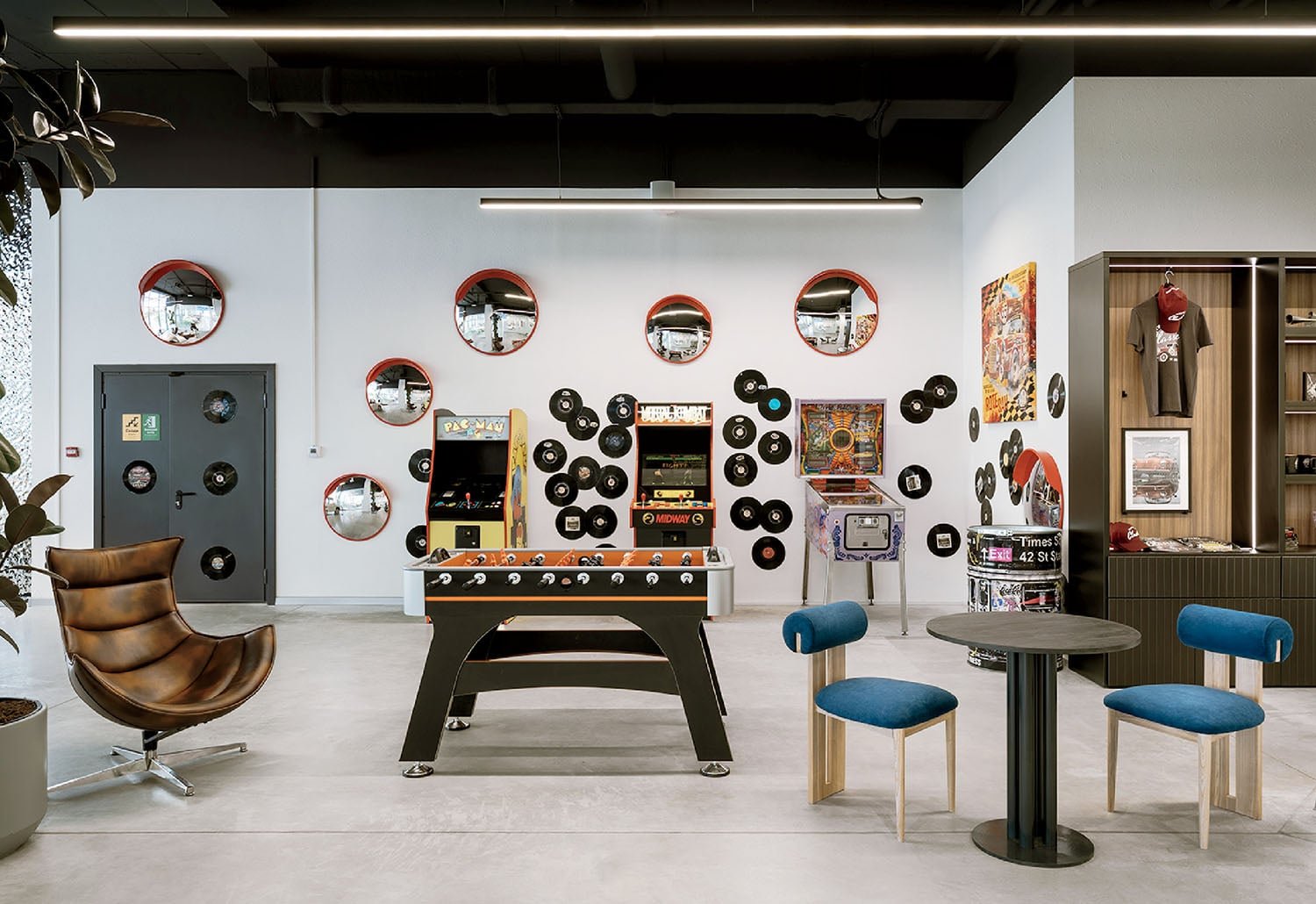
Flooring throughout is polished poured concrete. Near the shop, the game zone has vintage arcade machines and custom oak-framed chairs. The lounge’s custom tables are aluminum. The tubular LED ceiling fixtures are also custom.
This interactive hub is one in a series of grouped-together areas where visitors can partake in activities. For example, they can play vintage arcade and pinball machines or listen to music on a vinyl record player in the game zone, which further reinforces Vik’s retro atmosphere. They can purchase car miniatures in the gift shop or snap a pic backdropped by a wall installation of auto parts for social media posts.
Those posts have helped drive foot traffic to the museum as has the ground-level grocery. The museum also includes an event space equipped with a large LED screen so it can be used by Lviv-based business clubs for meetings or rented in its entirety for fashion shows or photo shoots. Vik has not only met and exceeded expectations for design, it has succeeded as a business venture, as well, earning a profit every month since its second month of operation.
PROJECT TEAM
LOMANINI: CUSTOM FURNITURE WORKSHOP. NPF PODYOMNIK: GENERAL CONTRACTOR.
PRODUCT SOURCES FROM FRONT
SIGNAL: CHAIRS (SMALL LOUNGE). KINT: SOFAS (MAIN LOUNGE). VELOURS LVIV: CURTAIN FABRIC (ADMIN AREA). THROUGHOUT VISION LIGHTING: CUSTOM LIGHTING.
Source: https://interiordesign.net