
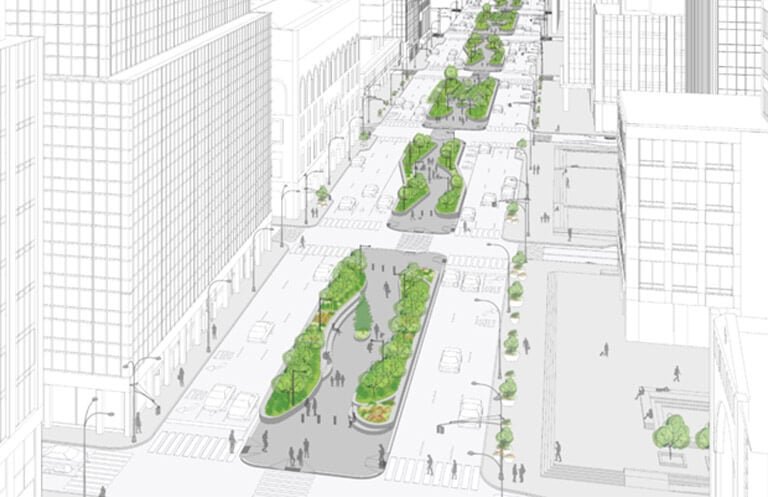

In 2024, New York City officials and the Department of Transportation announced plans to “put the ‘park’ back in Park Avenue” with an RFP. This week, two potential, and preliminary, designs from Starr Whitehouse for the 11-block expanse through the center of Manhattan were shared with the public.
The proposal concentrates on the streetscape between 46th Street and 57th Street, positioning it directly on top of the Grand Central Terminal train shed, which the Metropolitan Transportation Authority is currently “rehabilitating.” While the MTA works to reinforce the underground structure, the DOT will be working street-side to deliver a more pedestrian-friendly public green space.
The DOT tapped landscape architecture firm Starr Whitehouse for the job last June, as part of an 18-month contract. An RFP for the project was circulated in August 2024.
The latest drawings reveal one less traffic lane in each direction, delineated pedestrian and biking space, and swaths of new green space atop expanded street medians. It recalls the streetscape of the early 20th century—a time before underground train tracks and Midtown gridlock, when Park Avenue was more park than avenue thanks to ample seating and passable gardens.
Today Park Avenue is a busy thoroughfare with three lanes in either direction as well as a parking lane. In its current state, its medians aren’t much more than garden beds or a place to locate artworks.
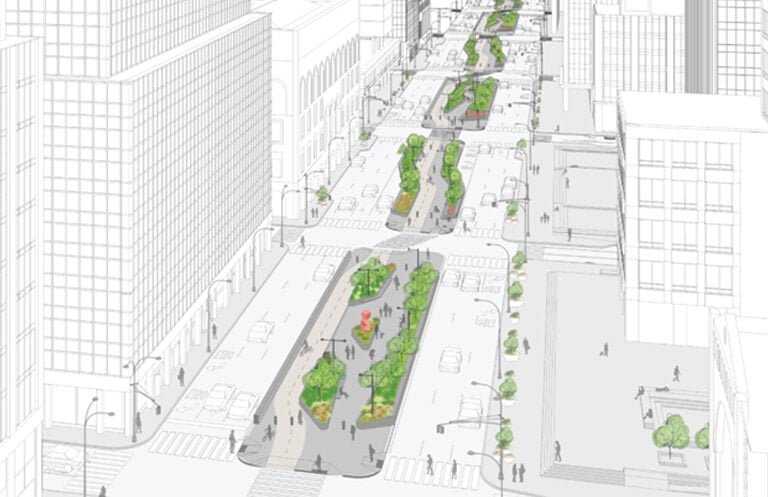
Under both of the proposed schemes, greenery is pushed to the sides of the medians, forming a buffer from the passing vehicle traffic, and pavers take up the majority of the median, allowing seemingly generous space for pedestrian movement. Benches are also incorporated into the designs and there is still space to accommodate public art.
The most obvious difference between the two designs is the placement of a bike lane. In one scheme, a pathway for cyclists takes up nearly one third of the median, relegating the rest of the median over to plantings and pedestrian and recreational use.
The designs shared this week are the result of extensive community engagement sessions, including surveys, stakeholder interviews, workshops and community board meetings. In the coming weeks, further sessions have been scheduled to solicit more feedback to inform the design’s evolution.