

本文由 至岸景观 授权mooool发表,欢迎转发,禁止以mooool编辑版本转载。
Thanks ZAN Landscape for authorizing the publication of the project on mooool, Text description provided by ZAN Landscape.
至岸景观:一个以“植物”为核心构建的园林综合体——至物。
场地以自然景观为主体,融合植物多样性、艺术展陈与生活方式体验,构筑出一个跨越地域感知、介于园林与文化空间之间的场域。
ZAN Landscape: A garden complex centered around “plants” –ZanLab.
The site, with its natural landscape as the main body, integrates plant diversity, art exhibitions, and lifestyle experiences, constructing a realm that transcends regional perception and exists between a garden and a cultural space.
▽项目视频

项目通过岩石、植被与地形的协调共生,呈现出“至于自然,观乎万物”的设计哲思——让自然成为主角,空间成为人与万物对话的媒介。
Through the harmonious symbiosis of rocks, vegetation, and topography, the project presents the design philosophy of ” To the core of nature, perceive all beings” – letting nature take the lead, and allowing space to become a medium for dialogue between people and all things.
▽让自然成为主角,空间成为人与万物对话的媒介

入口|几何的秩序与荒野开端
入口以巨石与耐候钢板构成,榫卯结构形成一种几何与自然并置的视觉关系。岩石的重量感与金属的光影折射,共同定义了“至物”的起点——在控制与野性之间寻找平衡。
Entrance | Geometric Order and the Beginning of Wilderness
The entrance is composed of massive rocks and weathering steel plates, with a mortise-and-tenon structure creating a visual relationship that juxtaposes geometry and nature. The sense of weight from the rocks and the refraction of light and shadow on the metal collectively define the starting point of “ZanLab” – seeking balance between control and wildness.
▽以巨石与耐候钢板构成的入口空间


穿过门洞,蜿蜒的花径引导前进方向,沿途以紫粉色为主调的植栽体系,与高大丛生紫薇交织,动线的延伸与转折让视线无法一眼望穿,在自然的节奏中,营造出层层递进的景深。
Passing through the gateway, a winding flower path guides the way. Along the route, a planting scheme dominated by purplish-pink tones intertwines with tall, clustered crape myrtles. The extension and turns of the circulation path prevent the view from being fully revealed at a glance, creating a progressively layered depth of field within the rhythm of nature.
▽蜿蜒的花径步道


前场|旱境之美,地中海的温度
前场景观以“旱境野美”为核心语言,选用西班牙油橄榄、昆士兰瓶干树、龙舌兰等银灰宿根植物,在暖色美拉德调的建筑背景下构筑出一种“野的秩序”。
Forecourt | The Beauty of Arid Lands, the Warmth of the Mediterranean
The forecourt landscape takes “the wild beauty of arid lands” as its core language, utilizing silvery-grey perennial plants such as Spanish olive trees, Queensland bottle trees, and agaves. Set against the warm, Maillard-toned architectural background, it constructs a “wild order.”
▽地中海调性的前场景观


建筑采用夯土般的岩石色莱姆岩,材质的自然肌理让其融入场地之中,使景观成为视觉的中心。
The architecture employs rammed-earth-like rock-colored lime stone. The natural texture of the material allows it to blend into the site, making the landscape the visual center.
▽建筑自然而然的融入场地


设计有意弱化建筑的体量感,使其如山体延伸的一部分,让植物在建筑间穿插、攀附、蔓生,不再作为装饰,而成为构图的主体。
The design intentionally weakens the sense of architectural volume, making it appear like an extension of the mountain mass. Plants intersperse, climb, and sprawl between the buildings, no longer mere decoration but becoming the main subject of the composition.
▽在这里,植物不再作为装饰,而是在建筑间穿插、攀附、蔓生,成为构图的主体


室内,空间延续了外部的“留白”逻辑。整石打磨的吧台、石板铺设的底板,以及极简的材料语言,共同延展了自然的野性与质感。阳光透过开窗折射进来,映照在石面上,成为自然介入室内的隐秘仪式。
Inside, the space continues the “negative space” logic of the exterior. A polished monolithic stone bar, stone slab flooring, and minimalist material language collectively extend the wildness and texture of nature. Sunlight refracts through the windows, casting onto the stone surfaces, becoming a subtle ritual of nature’s intervention indoors.
▽室内空间延展了自然的野性与质感


二层空间为小型植物展厅,陈列中古家具与艺术化作品,使自然与人文在同一空间语境中相互映照。
The second-floor space is a small plant exhibition hall, displaying mid-century furniture and artistic works, allowing nature and humanity to reflect each other within the same spatial context.
▽二层小型植物展厅


中场|杉林之下,水石相融
空间动线进一步收拢至中场核心——杉林之下。
Middle Court | Beneath the cedar forest, Where Water and Stone Merge
The spatial circulation further converges towards the core of the middle court – beneath the cedar forest.
▽中场空间以杉林置石,营造核心景观


水与石交融,构成了空间的精神轴心。
The fusion of water and stone forms the spiritual axis of the space.


杉木高耸的垂直线条与地形的起伏形成对比,光线穿透林冠后,在水面上产生微妙的光影变化,呈现出一种内向而静谧的氛围。
The towering vertical lines of the cedar contrast with the undulating terrain. After penetrating the forest canopy, light creates subtle plays of shadow and reflection on the water surface, presenting an introverted and tranquil atmosphere.


此处不仅是至物的视觉焦点,也是观者心绪放缓的节点,提供了一个由外向内、由形至意的空间转换。
This area is not only the visual focus of “ZanLab” but also a point where the viewer’s mind slows down, providing a spatial transition from the external to the internal, from form to meaning.
▽杉林夜景


后场|荒野终端,时间回响
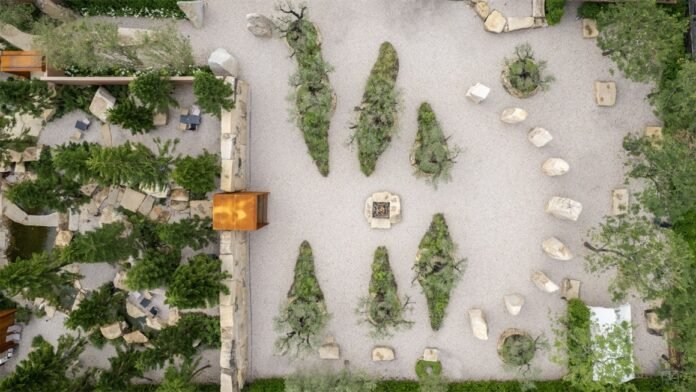
后场由百年油橄榄林与原始巨石阵构成,是整个场地最具时间厚度的片段。
Rear Court | Terminal Wilderness, the Echo of Time
The Backcourt, composed of a century-old olive grove and primordial megaliths, is the fragment of the site with the greatest sense of temporal depth.
▽由百年油橄榄林与原始巨石阵构成的后场空间


杉林与油橄榄林之间,由一面石墙将两个场域分隔,而耐候钢“时光之门”则成为连接两端的象征性装置。
A stone wall separates the cedar forest and the olive grove, while a weathering steel “Gate of Time” serves as a symbolic device connecting the two realms.
▽耐候钢“时光之门”是连接空间的象征性装置


穿行其间,观者于当下与久远之间往返,在空间的延续与物的重叠中,感知生命的循环与自然的永恒。
Moving through it, the viewer travels between the present and the distant past, perceiving the cycle of life and the eternity of nature through the continuity of space and the layering of objects.


自然冠橄榄的姿态古拙而沉静,枝干扭结如岁月的褶皱,与沉积数万年的巨石相互对望,构筑出一种跨越时空的秩序感。
The forms of the ancient, natural-crowned olive trees are rustic and serene, their twisted branches like the folds of time, standing in mutual contemplation with the megaliths deposited over millennia, constructing a sense of order that transcends time and space.

此处的空间不再仅是物理场所,而是一种关于“时间的风景”——岩石的静默与树影的流动,让人恍若穿行于古老文明的余韵之中。
The space here is no longer merely a physical place, but a kind of “temporal landscape” – the silence of the rocks and the flow of the tree shadows make one feel as if wandering within the lingering charm of an ancient civilization.


“至物”以植物为媒介,以空间为载体,探索自然景观与文化体验的边界。设计意在通过景观的秩序与物的生成,让人重新理解“至”与“物”的关系。走向自然的极致,亦是回归生活的本源。
“ZanLab” uses plants as a medium and space as a vessel to explore the boundaries between natural landscape and cultural experience. The design aims to allow people to re-understand the relationship between “Explore” and “all beings” through the order of the landscape and the presence of objects. Moving towards the ultimate state of nature is also a return to the origin of life.
项目名称:至物ZanLab
项目地址:广东佛山
设计单位:至岸景观
施工单位:至岸景观
公司网站:www.zaaan.cn
公司邮箱:info@zaaan.cn
设计师:许树杰、杨剑宝
摄影师:杨伟业
工作内容:概念设计、方案深化、工程施工
景观面积:3000㎡
完成年份:2025
Project Name:ZanLab
Project Site:Foshan Guangdong
Design unit:Zan Landscape
Construction:Zan Landscape
Company website: www.zaaan.cn
Email:info@zaaan.cn
Designer:Xu Shujie、Yang Jianbao
Photographer: Yang Weiye
Content: Conceptual design, in-depth drawing design, engineering construction
Design area:3000㎡
Completion time:2025
“ 走向自然的极致,亦是回归生活的本源。”
审稿编辑:Maggie
更多 Read more about:至岸景观 ZAN Landscape
Nguồn: mooool