

本文由 水相设计 授权mooool发表,欢迎转发,禁止以mooool编辑版本转载。
Thanks to Waterfrom Design for authorizing the publication of the project on mooool, Text description and photos provided by Waterfrom Design.
水相设计:「戴上饰品,生活就是假期」,接触到品牌Vacanza时,我们先被这句简单的理想触动,假期并非遥不可及,而是心境上的开放视野。
在假期国际的办公空间设计逻辑中,我们抛开办公室点到点、格状切割空间的形式,改以回绕、非定向的空间路线制造蜿蜒,让使用者行走间对环境产生「探索」之感,而非传统仅求效率、压缩个体感受的工作环境。我们希望透过回绕行走,即使座位至茶水间的片刻都能让紧凑生活得到喘息节奏,如同自我疗愈的仪式。
Waterfrom Design:”Put on your jewelry, and life becomes a holiday.” This simple ideal struck a chord with us when we first encountered Vacanza — holidays are not out of reach, but rather a mindset of open perspectives.
In the spatial design logic of Vacanza Accessory’s office, we discarded point-to-point, grid-like partitioning and instead opted for winding, non-directional pathways. These create a sense of “exploration” for the users as they move through the space, rather than adhering to the traditional focus on efficiency that compresses individual experience. We hope that through these meandering paths, even a brief walk from their desks to the breakroom can provide a moment of respite in a busy life, like a ritual of self-healing.

假期之始,扭转办公室格局的制式角度
品牌于现有的办公室旁拓展了新部门空间,盼能加强商品开发部门与设计总监的沟通强度,同时提供行政、仓储更具余裕的运作环境。基于对现址的熟悉度,业主首先提出大楼落地窗西晒的问题,因传统格局将会议间划于窗边,开会得忍耐曝晒之热;再者,会议间阻断落地窗采光,加上各部门常规隔间的墙体,使工作区域自然采光不足。
为此,我们将入口临窗西晒侧设定为短暂停留的动线区,让工作位置脱开日晒范围,别于传统接待柜台及等候区模组,我们设计几座高背座椅建构这段过度空间,这些看似随机的块面如雕塑错落于窗边,比固定隔间更具灵活性,其造型易于控制屏蔽比重又能遮阳,访客候位可于椅阴影乘凉,业主也能利用如墙形式配置品牌讯息。
The beginning of a holiday: reshaping the rigid angles of the office layout.
The brand has expanded a new department space adjacent to the existing office, aiming to strengthen communication between the product development department and the design director, while also providing a more spacious environment for administrative and warehouse operations. Based on the familiarity with the current location, the client first raised the issue of west-facing sunlight through the building’s floor-to-ceiling windows. Traditionally, meeting rooms are placed by the windows, making employees endure heat from sun exposure during meetings. Furthermore, the meeting rooms block the natural light from the floor-to-ceiling windows, and the walls of the regular department partitions further reduce the natural lighting in the work areas.
To address this, we have designated the area near the entrance, which faces the intense westward sun, as a transient circulation space. This approach keeps work areas out of direct sunlight. Instead of traditional reception desks and waiting areas, we designed several high-backed seating units to create this transitional space. These seemingly random, sculptural blocks are arranged along the window, offering more flexibility than fixed partitions. Their design allows for controlled shading while providing sun protection. Visitors can cool off in the shade of the chairs while waiting, and the client can utilize the wall like chair backs to display brand messages.
▽入口产品展示区 Import product display area


▽访客候位区 Visitor waiting area

45度转向度思维 回绕行走的空间路线
我们也开始思考空间的惯性是什么?办公空间的配置逻辑除了切割公私领域、有效率分割部门座位外,是不是有一些比较有趣的方式重新经营这段时间与空间?毕竟工作在一日生活中占有相当时间比例,我们又能透过场域改变哪些互动及感受?
制式的水平垂直座向的办公室动线,看似很有效率的沟通动线,却也会造成许多长廊。因此初始配置就希望突破惯性,将座位轴线转向成45度角对应整片落地窗,一方面遮挡西晒问题,也让整体进光量变得更多。加上室内不顶天花板的隔间手法,使用者身处不同角落能从梁下、天花板间隙透出的光线强度、背景色彩甚至声响动态,感知到后方二、三层空间的视觉延续,放大对空间尺度的感受。
在转向、不截断的立面之间,避开强光曝晒,仍使光线蜿蜒至环境后端,视觉自然带出流动与探索效果。抛开办公室点到点、格状切割空间的形式,改以回绕、非定向的空间路线制造蜿蜒。透过不到顶的隔间墙,让使用者从A点到B点的沟通动线拉长,透过绕与转产生更多行为,在行进的过程得以沉淀、喘息、释放,如同一场自我疗愈的仪式。
45-degree angled thinking: a winding spatial path for movement
We also began to wonder what the conventions of traditional spaces are. Beyond simply dividing public and private areas or efficiently organizing departmental seating, are there more interesting ways to rethink how we manage time and space? After all, work occupies a significant portion of our daily lives. How can we use spatial design to transform interactions and experiences within this context?
The conventional horizontal and vertical office layout may appear efficient in terms of communication flow but often results in long corridors. Therefore, we aimed to break from this norm by orienting seating arrangements at a 45-degree angle relative to the expansive floor-to-ceiling windows. This approach not only addresses the issue of westward sun exposure but also increases overall natural light intake. Additionally, by avoiding full-height partitions, users can experience varying light intensities, background colors, and even dynamic sounds from different corners of the room. This setup creates a visual continuity with the spaces behind and above, enhancing the perception of spatial scale.
By arranging the walls with angled turns and visual continuity, we not only avoid harsh sunlight but also allow light to meander to the back of the space, naturally enhancing the sense of flow and exploration. Moving away from traditional point-to-point, grid-like office layouts, we implemented winding, non-directional pathways. With partitions that do not reach the ceiling, we extend the communication route from point A to point B, encouraging more movement and interaction. This winding journey allows users to reflect, breathe, and release, much like a ritual of self-healing.
▽蜿蜒转折的空间布局 Twisting and turning spatial layout


藏与不藏的工作互动哲学
除了45度角改变视野,概分部门一段主要立面以不封闭动线的弧墙,渐次展开各区域工作动态。步入开放办公区,将先迎来商品展示区、商品开发部门及总监办公室。此区亦作为空间核心,水滴状曲面界定商开部座位与总监室的范围,却非完全截断动线、采光,由于商品开发部门是强调创意属性的空间,互动性跟关联性的需求强烈,也需比邻总监办公室,充分发挥讨论的即时性。在界定出面积范围后,商开部共用的办公大桌,兼顾工作与讨论会议的功能,并依人数局部内挖、斜切桌面,使这张轮廓特殊的桌子拥有不同坐向的边缘,而内凹的区域则作为商开主管的座位区,方便沟通创意并保有隐私,消弭硬体隔间带来的阶级性,视觉上亦延续整体突破框架的开放策略。
The Philosophy of Exposure and Concealment in Work Interactions
In addition to the 45-degree angle altering the perspective, a main partition dividing the departments is designed with a curved wall that does not completely enclose the pathway, allowing for a gradual unfolding of each area’s work dynamics. Upon entering the open office area, you will first encounter the product display area, the product development department, and the design director’s office. This area serves as the core of the space, with a droplet-shaped curve defining the boundaries between the product development department and the director’s office. However, it does not entirely block the flow or natural light. Given that the product development department emphasizes creativity and has strong needs for interaction and connectivity, it must be adjacent to the director’s office to facilitate timely discussions. Once the spatial boundaries are defined, the shared workbench for the product development department serves both work and meeting functions. The table is partially recessed and cut at an angle according to the number of people, giving this uniquely shaped table edges that accommodate different seating orientations. The recessed area is designated as the supervisor’s seating zone, facilitating creative communication while maintaining privacy. This design eliminates the hierarchical separation typically created by physical partitions, and visually aligns with the overall strategy of openness and breaking boundaries.
▽共享休闲交流区 Shared leisure exchange area


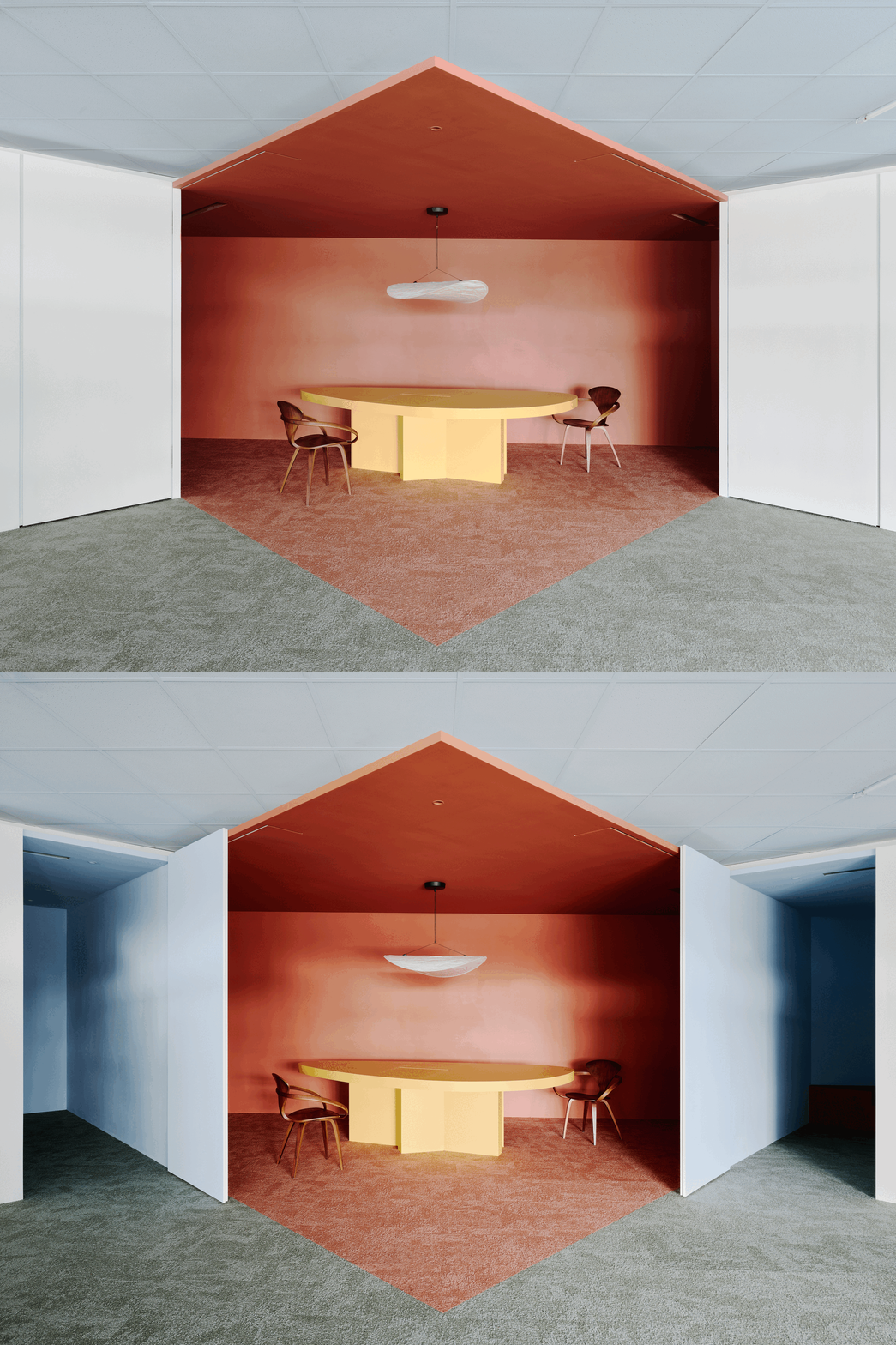
曲径引至似广场的留白位置,需要隐密性的会议间沿墙设置,并延续斜角的量体轮廓纳入自然光,像一完整方盒由外推入,量体之间局部、错位的层次遮掩,透过门片的移动控制开放程度。这些利用不同墙体的高度或是转折引导人的视线,像是格放一个个的片段,每个转折都是风景,转向度之余,也形塑出框景的视线,就如我们一直在探讨的看与被看的关系,也是整体空间配置的逻辑,如同菲林底片一样,菲林本身空出来的白,需要透过光线与人的行为才能产被赋予意义。
疏缓或凝聚,藏与不藏,是工作互动的哲学,也是旅程得以舒适的节奏。个体间的距离转为情绪或创作的正面能量,群体的凝聚及意见畅流交换,则是支撑共识与共感的强大核心。
The pathways lead to an open, plaza-like area, where private meeting rooms are placed along the walls. These rooms maintain the diagonal contours to incorporate natural light, resembling a complete cube pushed inward. Within the volumes, partial and misaligned layers provide concealment, with movable panels controlling the degree of openness. These walls, with varying heights and angles, guide the viewer’s sight as if they were placing individual scenes, each turn offering a new perspective. This setup reflects the relationship between seeing and being seen, mirroring the overall spatial logic. Just like a film negative, the empty spaces need light and human interaction to be filled with meaning.
The philosophy of work interactions involves both the dispersal and concentration of space, as well as the balance between concealment and exposure. This dynamic creates a comfortable rhythm for the journey. The distance between individuals transforms into positive emotional or creative energy, while the cohesion of the group and the free exchange of opinions form a strong core that supports consensus and shared understanding.


观看角度,以物理分割提供行为的灵活度
如此空间是全体相连、随个人或小群体再行分枝的型态,既非僵化也非松散,包容的连续性将带给使用者和缓、并能持续创造意涵的支持。而过往因理货作业总显杂乱的仓储区,在此移至空间最底端,虽然仍用开放层架方便作业,但有别于过往粗暴一分为二的方式,透过45度转向控制过滤较杂乱的部分,将前方座位区、隔板作为前景,保留局部理货动态,人的视线得以延伸穿透,即便是理货的端景也是有趣的画面。
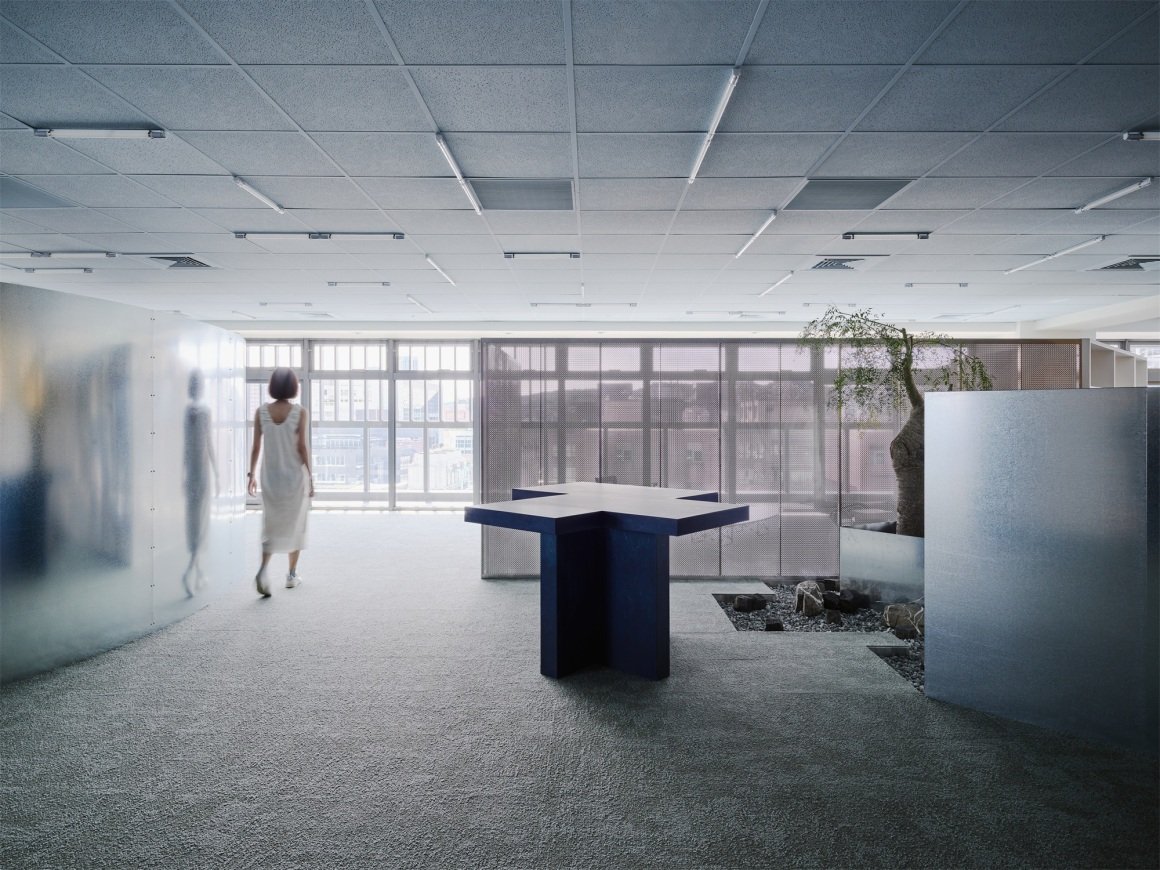
我们以非规则线条分流使用模式,而非依照部门人数僵硬圈地划分。非矩形、非制式划分的办公场域,色调与材质是界定工作范围的重要指标,或者区域属性的延续、转介。大块面冲撞色彩的变化也形成强烈感受,尤其商开部门是一个需要创意刺激的区块,就像饰品的多样性,提供工作伙伴更多刺激来源。像是工作区之一以冷冻PVC门帘替代传统隔板为界线,其透光、鲜明的黄色不仅视觉浓烈,光线穿透、晕染、渗透至他区的特殊效果,又与另一夹板染靛蓝色对比互映,形成工作路径上极具感官强度的端景。天花板及地坪则转用降低彩度的淡灰绿、粉蓝,延续配色逻辑也松动紧密度,使人感到气氛强弱转换。
Viewing angles and physical partitions offer flexibility in behavior.
In this space, the overall design is interconnected, with the ability to branch out for individuals or small groups, striking a balance between rigidity and looseness. The inclusive continuity provides users with a supportive and soothing environment that continually creates meaningful experiences. Previously chaotic storage areas due to inventory operations have been relocated to the far end of the space. While open shelving is still used for convenience, the new layout differs from the past’s stark division. By incorporating 45-degree angles, the design filters out more chaotic elements and uses the seating area and partitions as a foreground. This approach preserves some dynamic aspects of the inventory process, allowing visual extensions through the space. Even the end view of the inventory area becomes an engaging and interesting scene.
We use irregular lines to guide usage patterns rather than rigidly dividing spaces by departmental numbers. In a non-rectangular, non-standard office layout, colors and materials are crucial indicators for defining work areas or transitioning between zones. Large blocks of contrasting colors create strong impressions, especially in the product development department, which requires creative stimulation. Just like the diversity of jewelry, this approach offers more sources of inspiration for team members. For example, one of the work areas is separated by a cold storage PVC curtain instead of traditional partitions. Its translucent, vibrant yellow not only creates a striking visual impact, but also allows light to pass through, casting unique gradients and permeating into adjacent areas. This effect contrasts and interacts with another birch plywood panel stained in indigo, forming a visually intense focal point along the workspace path. The ceiling and flooring, on the other hand, use desaturated light gray-green and pastel blue tones, maintaining the color scheme while easing the intensity, creating a subtle shift in the overall atmosphere.


端详趣味,借材质替区域套换滤镜
为了在有效的成本控制中做出质感,我们也利用大量的原始材料,例如夹板染色取代贴木皮、镀锌板直接做隔间墙、地板选用色块地毯,因为这些都是趋近于本质的材料,毋需额外贴附材质修饰,包括原办公室的轻钢架也仅用色彩改变原先质地。在实际行进于空间中时,你会观察到不同时段的光线进来,反射到分界线的镀锌板因能折射光线,在环境中产生近似补光效果,并让背景色、人影又在其上反射叠染,那渐层也与木板染蓝效果相近,于是透过反射出来的光线和折射出来的色彩,每天都会有不一样的发现。让使用者在日常繁忙的工作中,在行进间感知到一些不一样的地方,而非被关进日复一日的循环中。藉由不一样的工作风景,让人的感知能力持续进行。
Carefully appreciating the aesthetics: using materials to apply a filter to different areas.
To achieve quality within effective cost control, we utilize raw materials extensively. For instance, we use dyed plywood instead of veneer, galvanized steel for partition walls, and colored carpet tiles for flooring. These materials are close to their essence and do not require additional surface treatments. Even the original lightweight steel frames in the office are only modified by changing their color. As you move through the space, you’ll observe how the light changes at different times of the day. The galvanized panels along the dividing lines, which reflect light, create an effect similar to fill lighting within the environment. Background colors and human shadows are reflected and layered onto these panels, and the gradient resembles the effect of the stained blue plywood. The interplay of reflected and refracted light creates a dynamic environment, offering new discoveries each day. This approach allows users to experience subtle changes in their surroundings amidst their busy routines, breaking the monotony of daily cycles and continually stimulating their perceptual abilities with varied work vistas.
▽空间布局设计 Space layout design

▽舒适温暖的办公空间 Cozy and warm office space




不同区域衔着的色调和材质感受,也恰如纪录假期的各式镜头,有日光下如数位影像聚焦清晰的会议桌;如旧胶卷成像的鲜黄滤镜,也有冲孔铁片看出去、轮廓模糊如低像素时代的画面,透过不同观景窗和媒介,相遇或偶遇的感官被放大、标注或格放记载。如同电影《The Secret Life Of Walter Mitty》传达的讯息:在日常琐碎里,应该勇敢跳脱惯性,追求属于自己的「25号底片」。在工作中,即便是平易近人的细节,一旦打破僵化日常,就是实践旅行的开始。
The color tones and material textures transitioning between different areas of the space are akin to capturing various scenes of a vacation. There’s a conference table sharply focused like a digital image under daylight; a bright yellow filter reminiscent of old film rolls; and perforated metal sheets offering views that blur like low-resolution imagery. These varied perspectives enhance and annotate sensory experiences, much like frames captured through different lenses and mediums. As The Secret Life of Walter Mitty conveys, amid everyday trivialities, we should boldly step out of our routines to seek our own “Film No. 25.” In the workplace, even small, approachable details, when they disrupt the monotony, signify the beginning of a journey.
▽明亮的色彩划分出不同的空间使用场景 Bright colors divide the different use scenes of the space


▽平面图 Plan

项目名称:工作即假期
空间设计:李智翔、葛祝纬、汤传亚、曾芷薇/水相设计
品牌:Vacanza假期国际
空间性质:办公空间
座落位置:台北
室内面积:476平方米
空间格局:接待柜台、小型展间、商品开发部门、员工休息区、活动讨论区、会议室、总监办公室、行政部门、仓储物流部门、采购部门、机房、影印室
设计时间:2024.02~2024.04
施工时间:2024.05~2024.07
主要材料:桦木夹板染色、镀锌板、C型立柱、仿涂料壁纸、方块地砖、塑胶地板、 塑胶帘
平面摄影:揅空间工作室 Studio Millspace
Project Name: Work feels like a vacation
Designer:Waterfrom Design
Brand:Vacanza Accessory
Category:Office
Location:Taipei
Area:476 m2
Layout:Reception Desk, Small Showroom, Product Development Department, Employee Break Area, Activity Discussion Area, Meeting Room, Director’s Office, Administration Department, Storage and Logistics Department, Purchasing Department, Server Room, Copy Room
Design Period:2024.02~2024.04
Construction Period:2024.05~2024.07
Materials:Stained Birch Plywood, Galvanized Steel Sheet, C-shaped Columns, Faux Painted Wallpaper, Square Floor Tiles, Vinyl Flooring, PVC Curtains
Photography:Studio Millspace
“ 打破传统办公空间,在舒适的空间场所中轻松自如。”
审稿编辑:Maggie
更多 Read more about:水相设计
Nguồn: mooool