


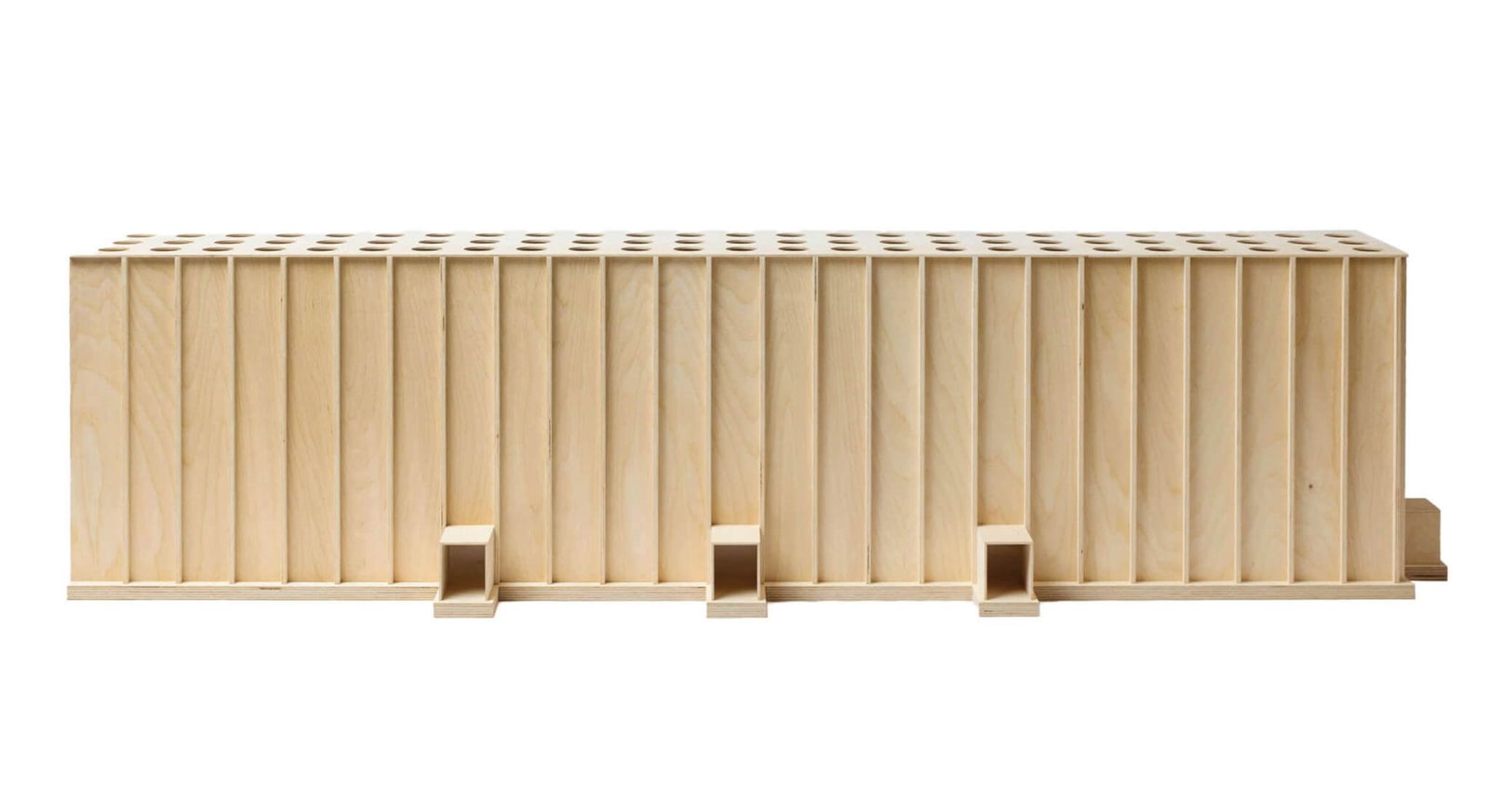
In 2022, architect Ben Waechter received a Wood Innovations Grant from the U.S. Department of Agriculture, Forest Service for a building he had actually wanted to make out of concrete.
Waechter first honed his skills and interests at firms like Renzo Piano Workshop and Allied Works, designing projects that were often poured into place. So, when he founded his own firm, Waechter Architecture and bought a property in Portland, Oregon, to build his headquarters on, he had a vision: “I just wanted to make a building out of one material.”
“My interest didn’t start with mass timber,” he told AN, “I wanted to explore simpler ways of making architecture.”
Other ambitious goals, among them sustainability and cost-effectiveness, quickly forced a change in plans. But as he looked to mass timber, chasing the single-material grail offered new frustrations. No mass timber manufacturer in Oregon or even British Columbia would provide all the materials, from the walls and floorplates to the beams and stairs—only panels
“Everything was hybrid systems,” he explained. “For the building to be one thing and to look like it,” he added, upping his own ante, “I wanted it to be one species.”
Waechter completed the firm’s headquarters in 2022. Soon after, the team successfully applied for and received the $124,084 grant nominally to study the results.
“We wanted to prove that all-wood construction isn’t just a niche idea,” Waechter said, “that it is a viable, accessible future for almost any building.”
To fulfill the grant’s specific obligations, Waechter’s team analyzed every facet, from the tilt-up assembly, to energy use and acoustics, to a series of arduous fire code appeals. But then his team took the analysis and the grant money into novel territory: a series of typological studies for three other mass timber buildings.
Plenty of Wood Innovations grants fund post-occupancy reports. Others go to a vast array of promotions, technical analysis, and funding boosts for projects advancing the wood industry. Waechter’s team stretched theirs into pure architectural research. William Smith, then with the firm and now at Drawings Studio developed a studio at the University of Oregon’s College of Design that he and other Waechter team members Alexis Coir and Judson Moore co-taught. Then, working with KPFF Engineering, Smith and Waechter designed a trio of all-wood mass timber structure prototypes driven by three distinct structural logics: tilt-up panels, offset panels, and cantilevers.
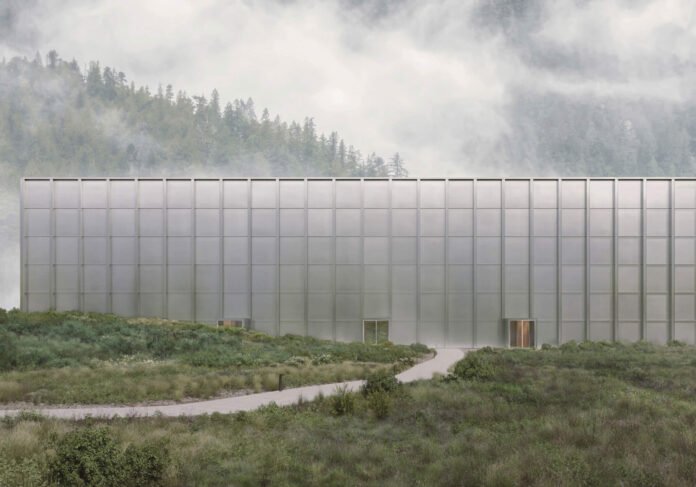
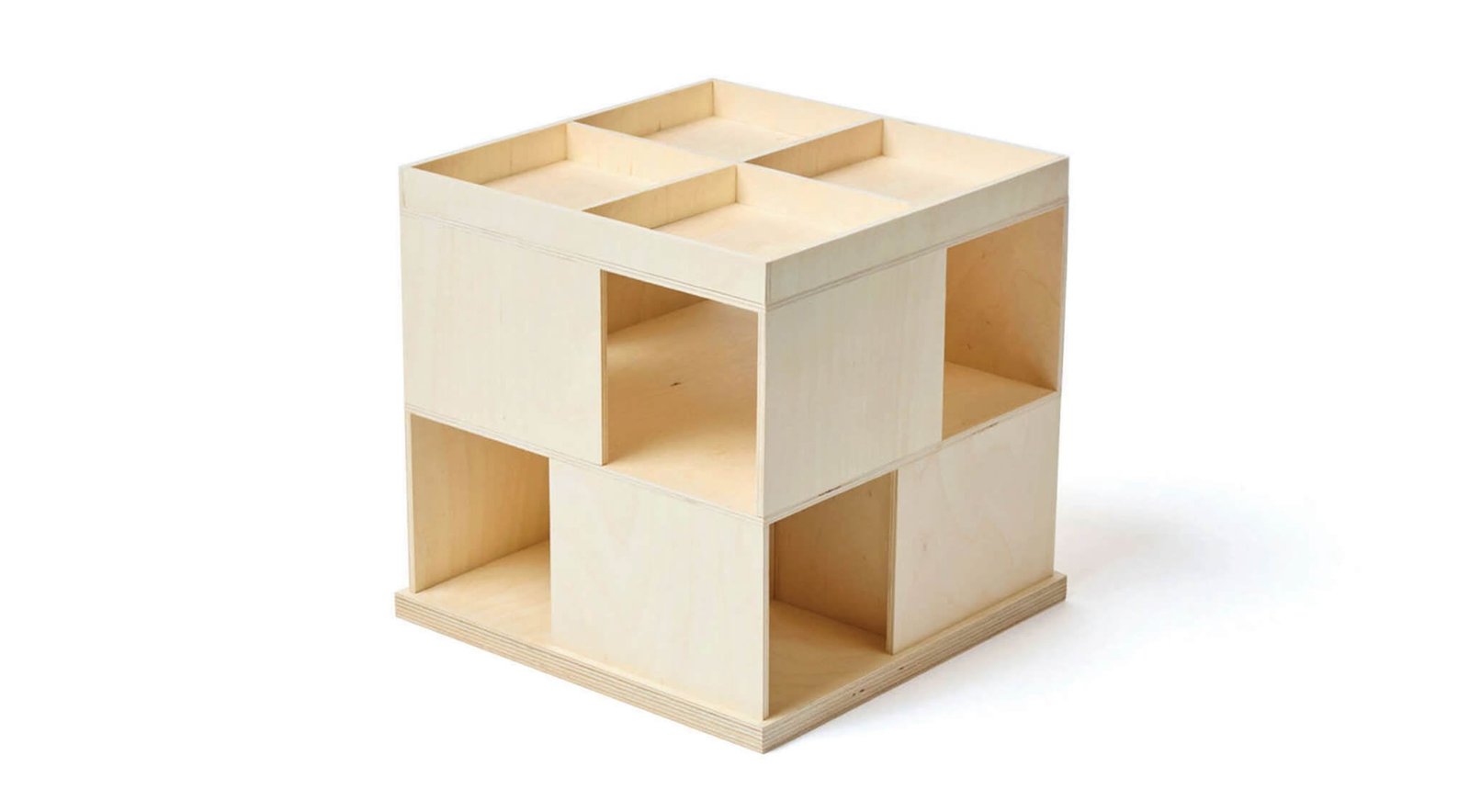
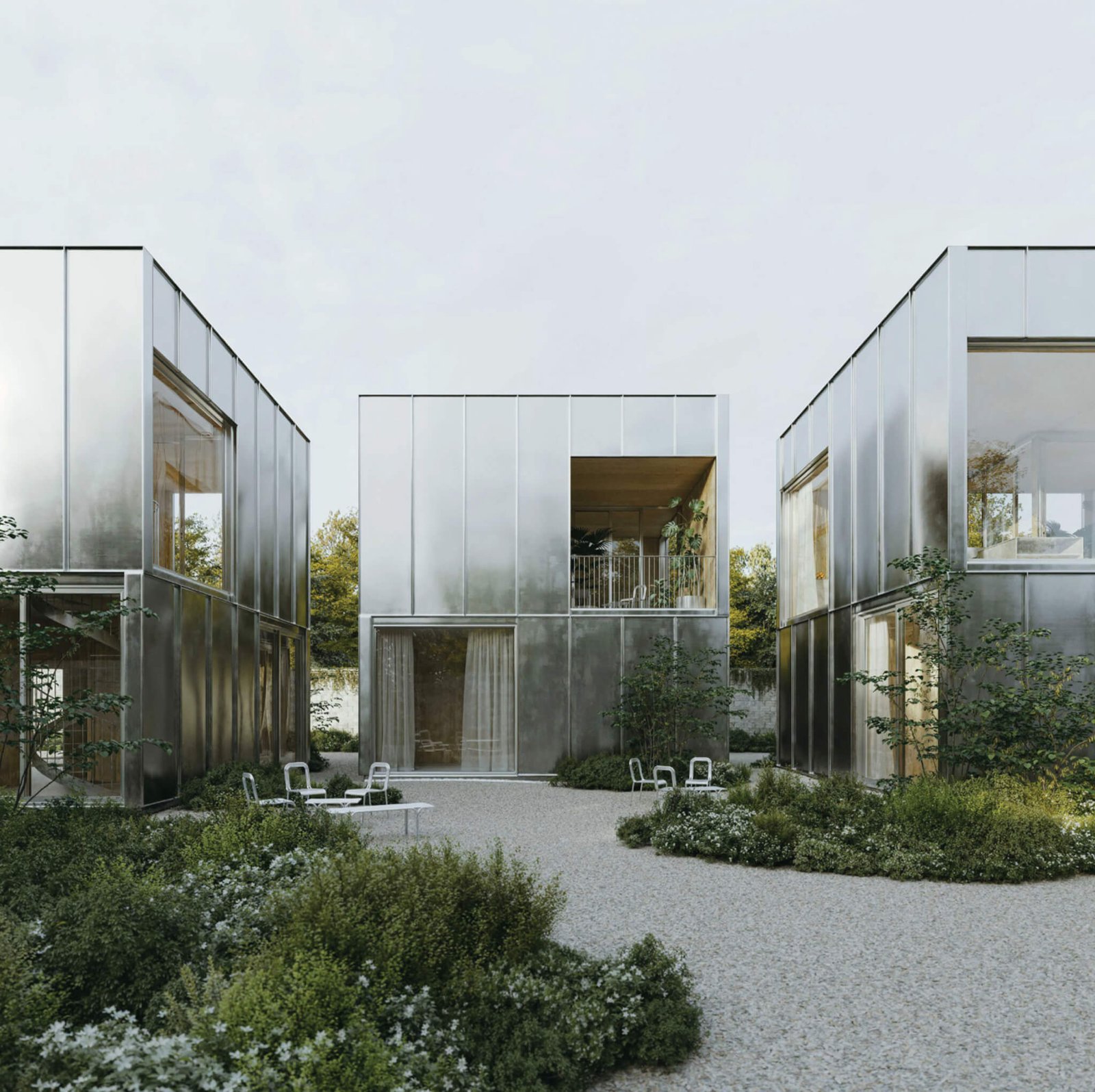
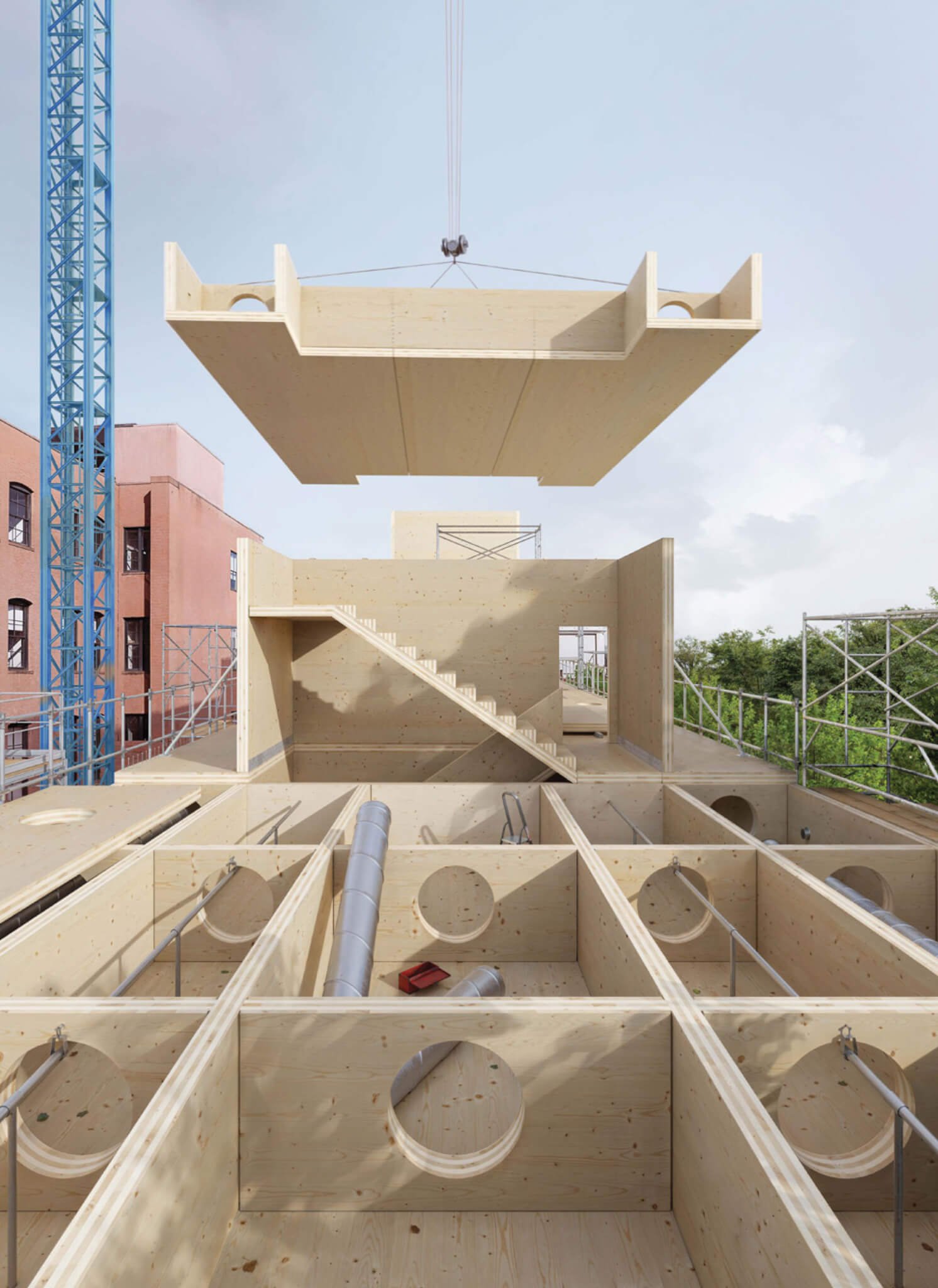
Their smallest structure, the 1,400-square-foot, 2-story, 2-bedroom “micro-residence”, is a tilt-up, a “house-of-cards” scheme for a standard 50-by-100-foot lot that can stand alone or be stacked. The second structure, a midrise “office building” that Waechter calls his favorite of the trio, is more complex with what he describes as a “hollow skeleton”— three vertical cores and 5-foot-thick hollow floors that are like box beams—all the “bones” are large enough to crawl in. Lastly, their largest project, which they describe as a “civic building”, can be constructed of soaring 55-foot, mass timber lengths topped by struts that Waechter described as a “trellis” which lets light cascade in from the top.
“You could retrofit the building,” he said, “with new plumbing, mechanical and data power, without interfering with any of the occupants.”
They commissioned Artefactorylab to create an evocative series of renderings illustrating each type’s construction process, its exterior, and interior.
The original grant, of course, was to analyze the building they built. So, they went to work analyzing the 3-story, 9,550-square-foot building they had built.
The “Mississippi Workshop” (dubbed for the Portland street it sits on) is a piece of tight assembled cabinetry. Waechter’s quest for one material and species ironically took him to Austria where KLH pre-engineered and precut every puzzle piece, harvested from its managed forests of mono-farmed spruce, and shipped them in 45-foot containers. That lead to a building built from 45-foot panels that serve a combination of walls and frame, joined at the corners with routed half-laps that are bolted together from the outside.
Blow tests and thermal imaging done by the University of Oregon’s Energy Studies in Buildings Lab found the joinery, with no caulking or gaskets at all, performed as well as the solid walls. Waechter’s single concession (besides the windows and rain screen) to the one-material rule was a 4-inch topping slab on each floor to further house radiant-heat flooring , and enhanced the building’s energy performance. For acoustics, however, not so good. The mass timber walls and concrete floors proved to channel sound “like a tin-can-and-string telephone” through the frame, known in acoustics as “flanking.” The report also documents the firm’s successful challenges to fire code so other architects and builders could use the building as a precedent.
Waechter said without the grant, his 10-person firm could never have afforded such a deep post-occupancy analysis, much less hired the university to do their work. The pure research, he added, “built a roadmap to challenge our own team, but more importantly, to inspire anyone ready to embrace a simpler, smarter, and more sustainable way to build.”
“I’m trying to look at architecture through the lens of how you make a building last indefinitely,” he noted, “like thinking of the building as a vessel.”
Randy Gragg is a longtime writer on architecture and urban design and is co-director of Design Portland.