

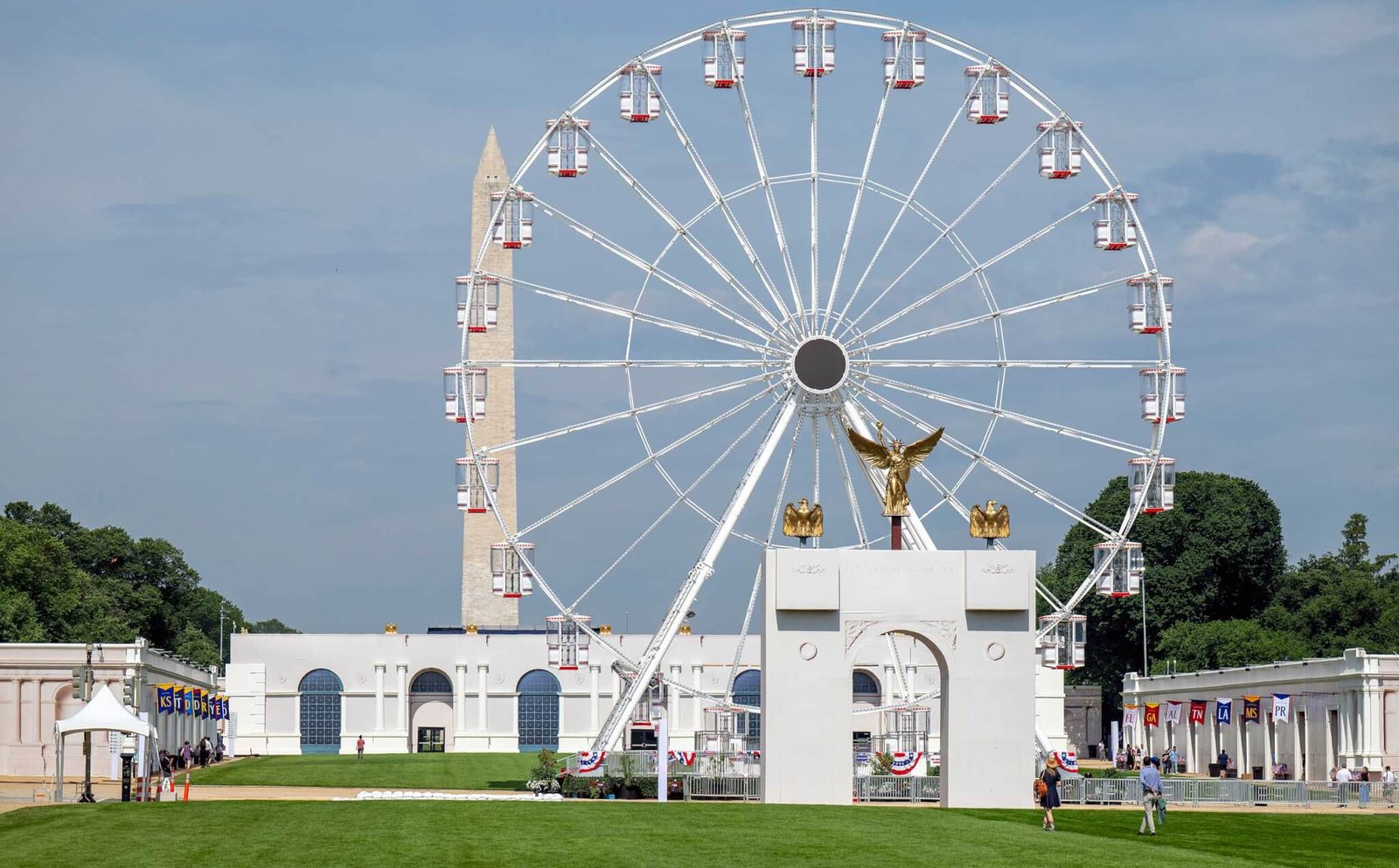
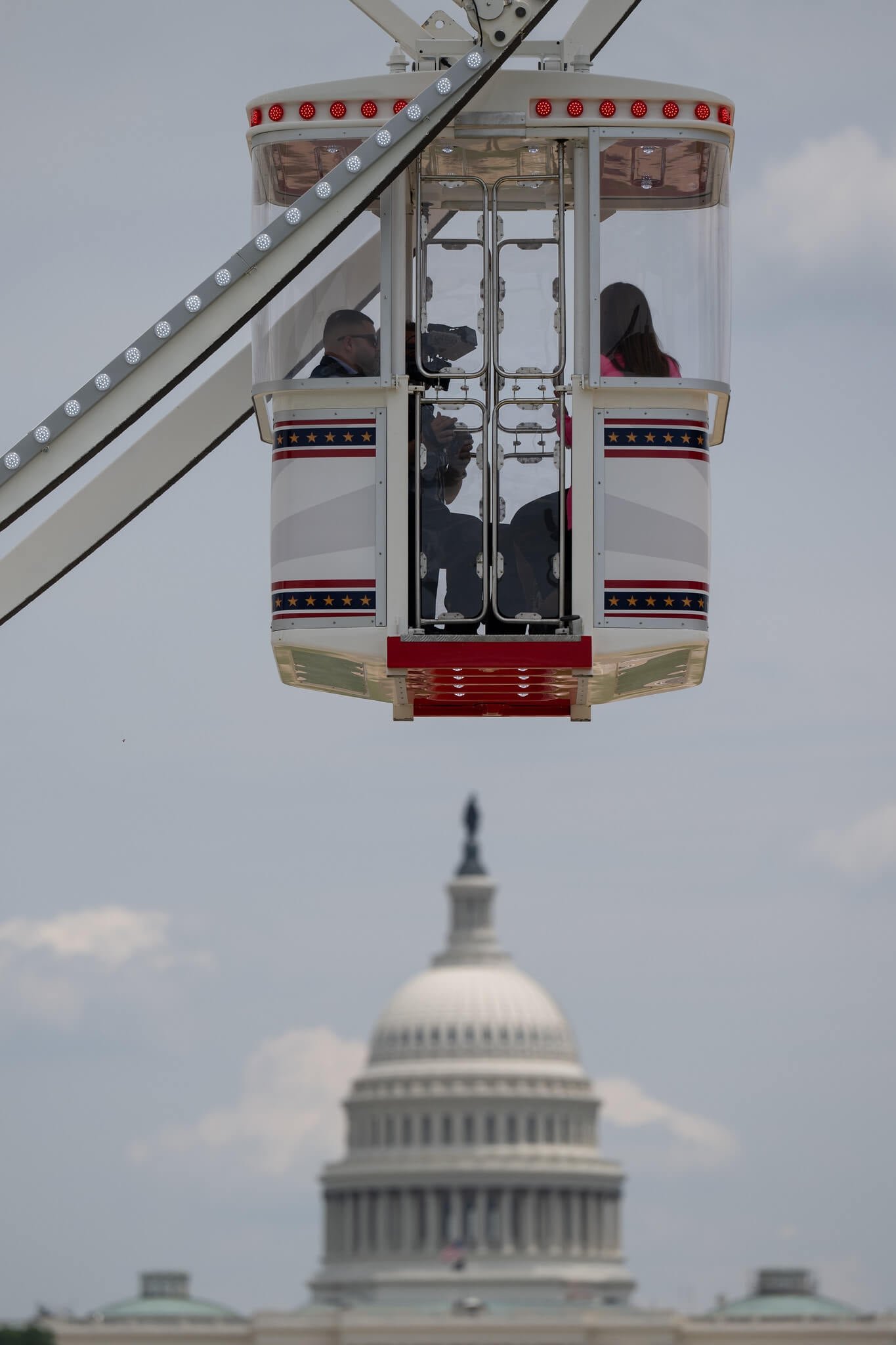

To celebrate the United States’s 250th anniversary, our semiquincentennial, President Trump is hosting the Great American State Fair on the National Mall. From State Pavilions and a giant Ferris wheel, to a cow named Melania, the spectacle arrives amid a deeply divided national political landscape and in a capital that the President has quite literally taken a wrecking ball to.
At face value, the state fair is just about as American as apple pie—which, as it turns out, isn’t all that American after all. The utterance “Great American State Fair” conjures images of hot, dusty summer days of agricultural recreation: One might be chilling out by refrigerated butter sculptures after watching the birth of a calf from a bleacher stand. The state fair as we know it today started in the 19th century as a banner child for promoting agriculture, and even with the number of farms in the country on a slowing decline, this history and connection to land is not forgotten.
For many, Trump’s Great American State Fair cheapens Congress’s plans to honor this moment in American history. America250, a bipartisan commission, was established in 2016 to work on the commemorative event. Through an executive order, just days after he took office for his second term, Trump created Freedom 250, an unrelated group tasked with programming the nation’s capital for July 2026. Last July, the administration formally kicked off the festivity at the Iowa State Fair and looked ahead to activations at other State Fairs. The fervor culminates in the Great American State Fair that is set up on the National Mall through July 10.
Life, Liberty, and the Pursuit of Controversy
While plans for a state fair appear innocuous—how controversial can cows and cotton candy be?—as with just about everything Trump touches, controversy and pushback have entered the scene. The Smithsonian Institution took a brunt of it earlier this year when it clashed with the Trump administration over how America’s history should be presented. The Smithsonian, and its museum and research entities, rely on federal funding for exhibitions, so when the Trump administration shared a list of objectionable exhibits within its collection, the threat of pulled funding stunted planned programming that incorporates diverse histories.
The Smithsonian’s semiquincentennial programming centers on In Pursuit of Life, Liberty & Happiness, an exhibition at the Smithsonian’s National Museum of American History displaying 250 artifacts, 174 of which were previously exhibited. Objects include a red MAGA hat and a hot dog cooker circa 1904.
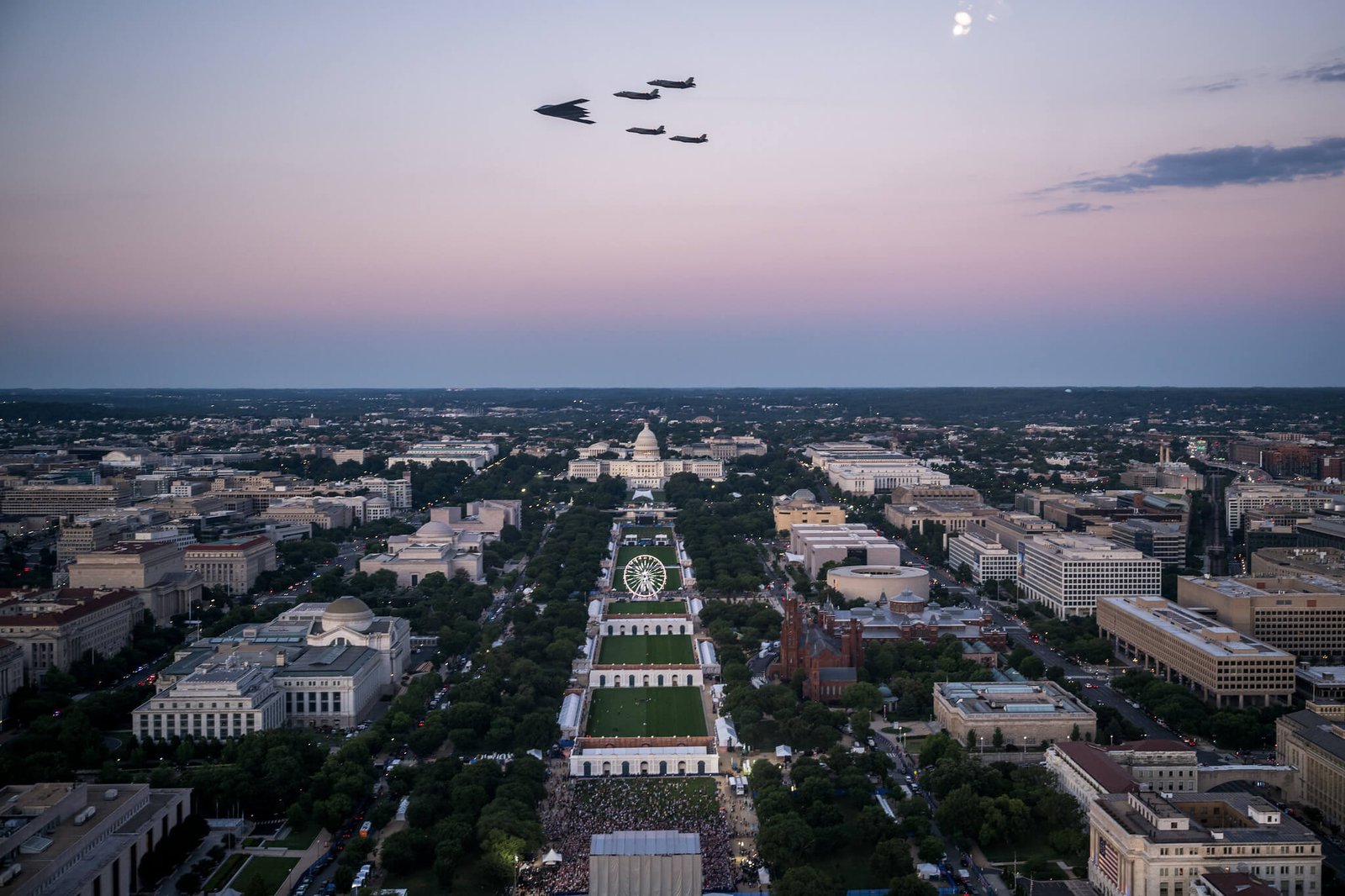
A carousel with 55 horses, and one dragon, that the Smithsonian restored and revealed back in April, sits nearby other recreational attractions on the fairgrounds. The 1947 relic pales in size to the looming, circular frame of the Great American State Fair’s pièce de résistance, a 110-foot Ferris wheel, supplied by Talley Amusements. Patrons ride up and around inside enclosed pods, which offer elevated views of the National Mall.
Rally On
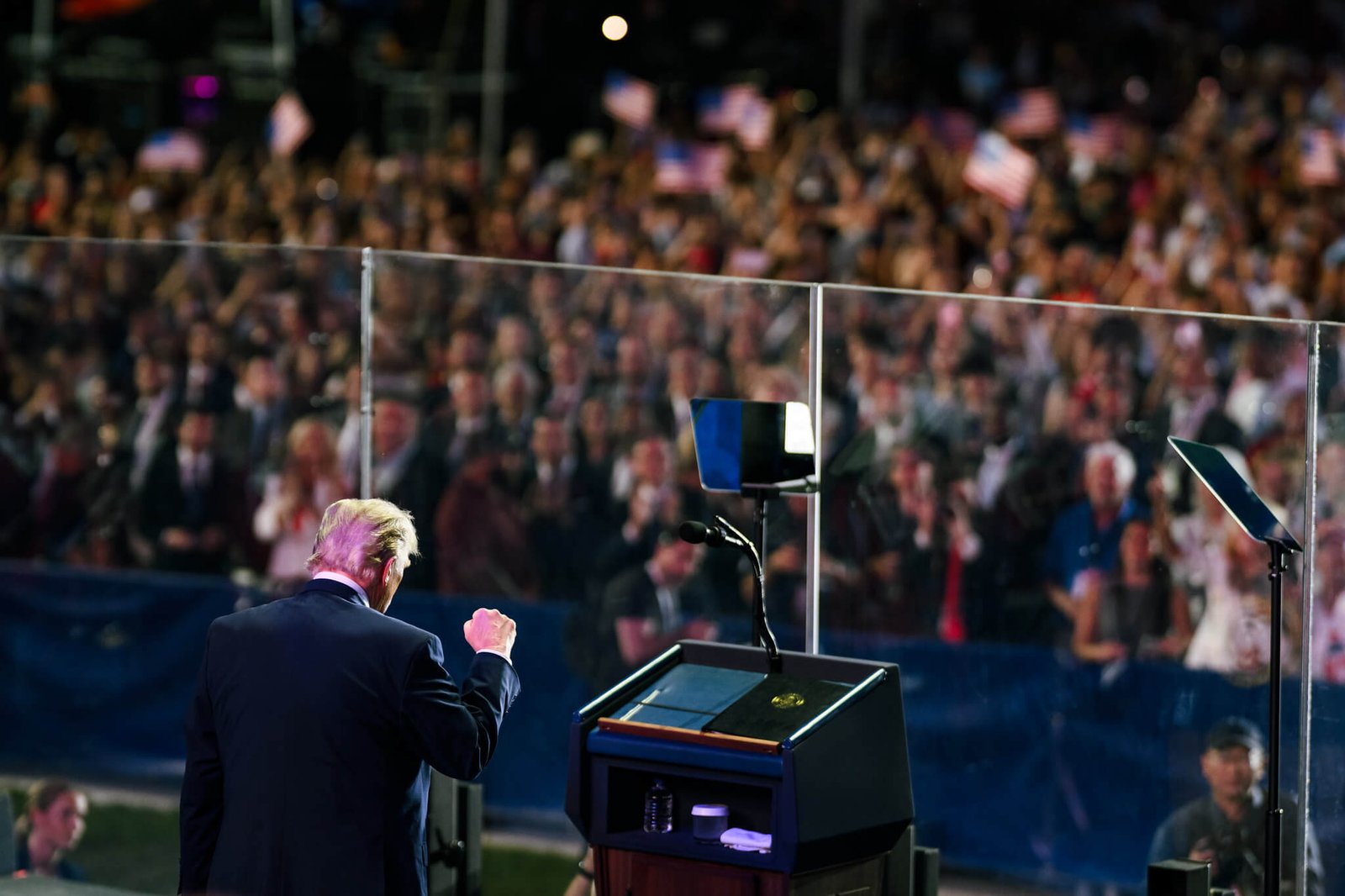
With a scheduled lineup of musical artists, the Trump Administration leaned into another quintessential aspect of the state fair. However, one by one musical acts that had signed on for the event announced they would no longer participate, with many citing the event’s supposed nonpartisan nature as misleading. Without Bret Michaels and Martina McBride, Trump canceled the fair’s musical performances, and instead hosted a rally, which he headlined.
Trump took the stage on June 24 at a podium behind bullet-proof glass. With his well-known oratory style (known as “the weave”) he riled up those gathered, while behind him digital screens flashed promotional messaging advertising “The Great American State Fair.”
Other musical acts were booked, but one of these inadvertently revealed the low attendance at the event: A guitarist’s sunglasses showed only a handful of revelers taking in the tunes. “There are more people at Chick-fil-A on a Sunday,” offered one internet commenter. (For the uninitiated, Chick-fil-A is closed on Sundays.)
An Architectural Display
At the center of the commemorative event, a scaled-down version of Trump’s proposed triumphal arch has been built on axis with the Ferris wheel. It is built from plywood and covered in a white vinyl wrapping that was stapled on that has online discourse dubbing it as a “Temu” arch. Humidity and rain this past weekend are causing the mock-up to warp and peel. Harrison Design, the architecture firm Trump has been working with on the full-size arch, shared visual renderings of this smaller-scale, scaled-back version in April. In the video rendering, the detailing on the fair arch is more dimensional and the gilding on its sculptural crowning more glistening.
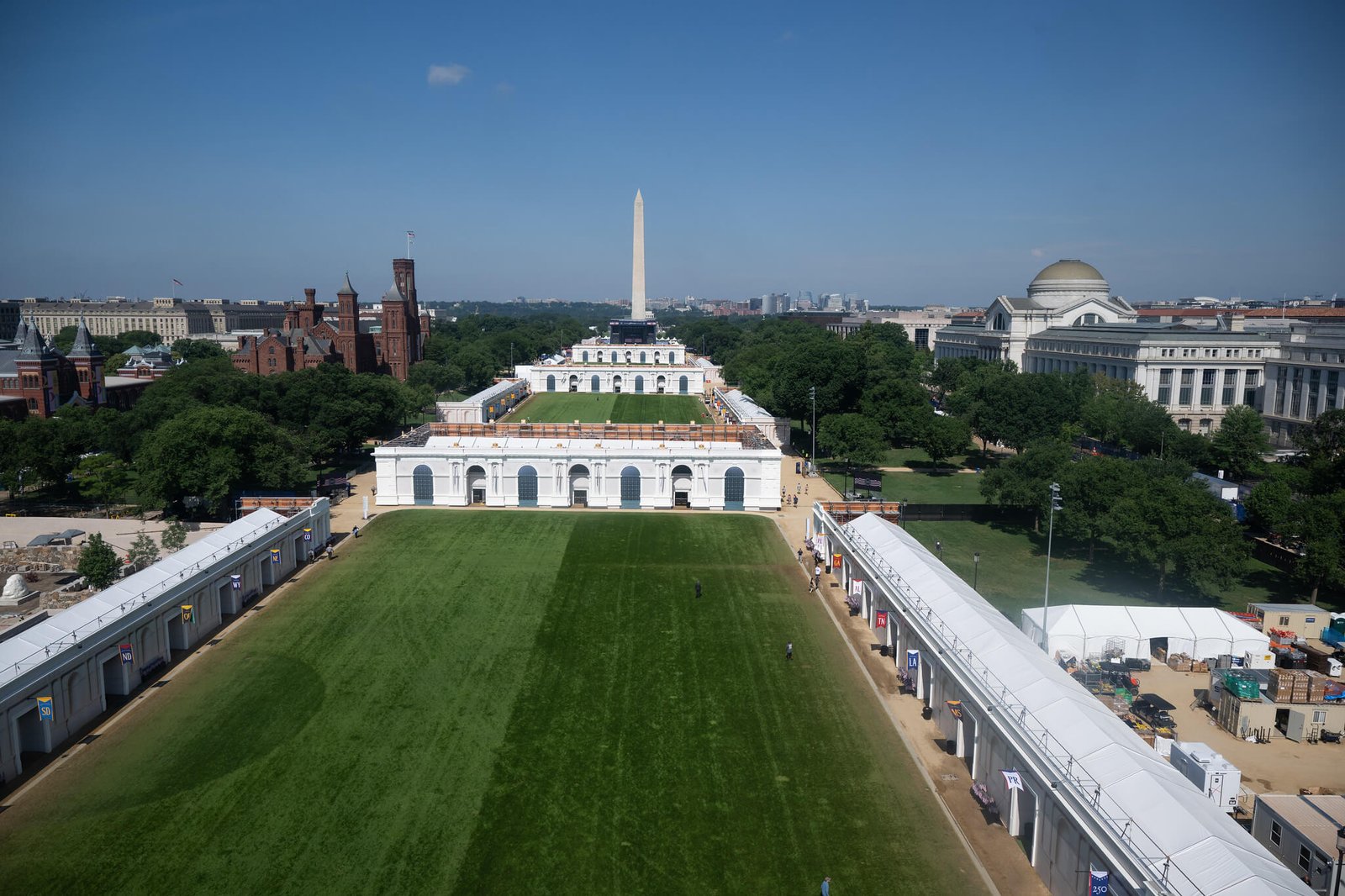
Other architectural elements staged on the pseudo-fairgrounds are in the low-lying rectangular volumes flanking the lawn. In line with mandates put forth by Making Federal Architecture Beautiful Again, the edifices exude the principles of classical architecture with symmetrical arches, rustication, and lines of columns. But the vinyl enclosure compresses what are typically 3D ornaments into a single surface. And there are conundrums like a floating column, noticed by the likes of Molly Jong-Fast and AN contributor Shane Reiner-Roth. Perhaps this is an homage to Peter Eisenman’s hanging column at the Wexner Center for the Visual Arts?
The pavilions house the 56 booths allocated for the U.S. States and territories to exhibit their own slice of exceptionalism, not unlike the State Department’s brief for the next U.S. Pavilion in Venice. One problem: At least 10 state commissions declined invitations to exhibit. States not sending their own government-backed contingents are instead represented by private companies or civic associations. New Jersey, under the curation of Cape May County, staged a sand sculpture and life-like boardwalk in its alcove, Florida filled its space with the scent of oranges, and North Carolina, under the management of several private companies, was asked to remove a Confederate flag staged in its exhibition.
A History of Gathering
Since it was first laid out in 1791, the National Mall has played host to some of American history’s most memorable, hopeful, and politically charged moments. In 1963, Martin Luther King Jr.’s “I have a dream” speech was delivered overlooking the Lincoln Memorial Reflecting Pool, a recent pet project of Trump’s, though it seems he is losing his war on algae. Following King’s assassination, Resurrection City, a staged protest put on through The Poor People’s Campaign saw 3,000 wooden tents that protesters camped in for 42 days—26 days longer than the Great American State Fair. It was in part advised by architect John Wiebenson.
Another intervention with a charged history was the installation of the AIDS quilt. The massive art piece remembering individuals who passed away from AIDS was first installed in 1987. The 1,920 panels comprising the blanket-like object covered a span of lawn larger than a football field. When it was installed again a year later in 1988, it expanded to feature 8,288 panels.
The Department of Energy’s biannual Solar Decathlon, now the Build Challenge, turned the National Mall into a laboratory for building and housing construction. Student groups descended on the lawn to design and build “complete, functional houses” that consider “real-world issues.” (Starting in 2013, the exhibition decamped from Washington, D.C. to California and, more recently, Colorado.)
In 2021, with the artwork In America: Remember, artist Suzanne Brennan Firstenberg blanketed the mall with “over 701,133 white flags” that showed “the magnitude of our loss as a nation, while honoring each person who has died from COVID-19.”
Public spaces like the National Mall are sites for people to protest and celebrate; they are unavoidable places of exchange and dialogue. By nature, a state fair draws crowds to exhibit the productive yields of American land and culture. With the Great American State Fair, Trump is shaping an important moment in our history as the world’s longest-running constitutional democracy. But even as we remember 250 years of fragile governance, it lands as a bit empty. Trump flattens what should be an introspective moment into a veneer that attempts to hide his capacity for self-enrichment. Rather than an enduring experience of national reflection, we are offered cheap printed tarps that flap in the wind.