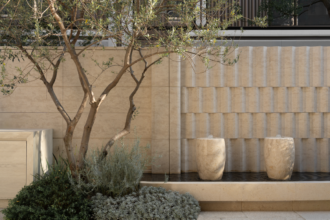


The patio is located as an enclosed garden within the Hillel Yaffe Medical Center in Hadera, at the heart of the maternity ward.
The project was designed by architect Pazi Tal Or in collaboration with landscape architect Zvika Kanonich, whose field of expertise is architectural design for populations with disabilities, from both mental and physical/functional perspectives.
The design is based on a thesis written in 2013 at the Faculty of Architecture at the Technion, in cooperation with the Tirat Carmel Mental Health Center, which compiled a guideline manual for architects and landscape architects designing spaces used by at risk populations in particular, and by people with disabilities in general.
The main body of work was carried out using a “research through design” methodology, which applies several reference layers to the design. The central paradigm underlying the research is the perception of nature as restorative (Ida Breed, 2009; Abraham et al., 1990; Ulrich, 2002; Ulrich, R. S., 1984).
The understanding that time spent in nature, or in environments that simulate nature—such as enclosed gardens—improves human health and mental well being has existed for thousands of years. However, it was only in 1984 that the first empirical study was published examining the effect of environmental design on human well being, and for the first time it was proven that physiological indicators measured in patients improved as a result of exposure to a garden environment (Ulrich, R. S., 1984).
Today, research focuses less on the question of “whether” and increasingly on the questions of “how” and “why”:
In what ways does the environment operate and influence a person’s physical and mental state?
At present, three schools of thought attempt to answer this question, two of which are relevant to our design context:
The Healing Gardens School
• Self Regulation Theory – Carpman & Grant
• Bio Ecological Model – Bronfenbrenner
• Relaxation Response – Stephen Mitrione
• Containment Theory – Johan Ottosson
The Cognitive School
An integrative approach that attributes importance to the garden space, activity within the garden, and the background and character of the visitor. Together, these elements lead visitors to experience memories that recall their active lives—particularly childhood and adolescence—thereby strengthening their sense of identity and belonging to the world. In such an environment, the person feels capable of growth and development.
The patio is enclosed by surrounding buildings on all four sides and is visible both from office windows and from staff and maternity circulation corridors.
The patio area is approximately 250 square meters and was designed so that the planted mass would dominate the built mass, thereby creating a therapeutic space that contains and empowers its users.
Approximately 200 species of plants were planted, offering a range of seasonal blooms, including unique varieties of plumeria with intoxicating blossoms in both color and fragrance.
The garden includes varied spaces suited to different types of encounters—from staff meetings to solitary sitting, from seating around a reflecting pool to paired seating in small niches.
Fifteen types of trees were planted, including fruit trees such as citrus and lychee, allowing for harvesting and eating. A reflexology path made of carefully selected river pebbles provides pleasant walking surfaces with varying pressure points on the sole of the foot. A unique ergonomic seating system was developed, with chairs of varying heights and seating positions, based on recommendations from the medical staff.
A floating pergola provides full protection from rain.
Concrete walls were replaced with transparent glass façades to ensure optimal visual accessibility.
At night, the patio is illuminated with soft lighting from the reflecting pool and surrounding vegetation.
A green wall was installed on the western façade, creating a planted backdrop with substantial vegetative mass and a diverse selection of adapted plant species.
In summer, a misting system is activated to create a high quality microclimate and refresh the vegetation.
The project uniquely elevates landscape architecture as a mediating discipline between philosophy, theory, and practice, translating conceptual planning principles into precise design execution. The resulting environment achieves a synergistic balance between refined aesthetics and potent empowering spatial cues, intentionally designed to support, strengthen, and restore vulnerable user groups.
32.450603555882495, 34.89594863244315