
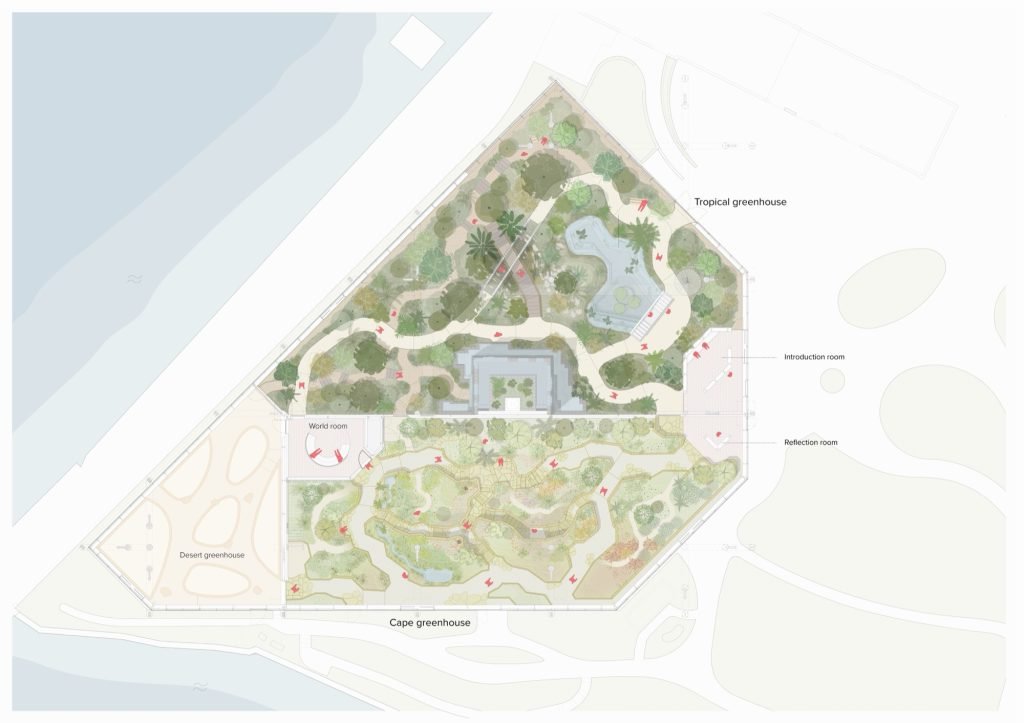

BOOM Landscape designed the landscape for the ‘Klimatenkas’, the climate greenhouse of the Hortus Botanicus Amsterdam. It tells the story of the emergence of biodiversity in relation to climate. The story is told underneath the renovated roof of the greenhouse that, since ZJA’s innovative renovation, no longer contributes to climate change.
Prologue
Originally built in the 1990’s, the greenhouse required a technical upgrade. This provided the opportunity to reorganize the spatial structure and visitor experience into an integrated educational environment where biodiversity takes center stage.
A story through plants
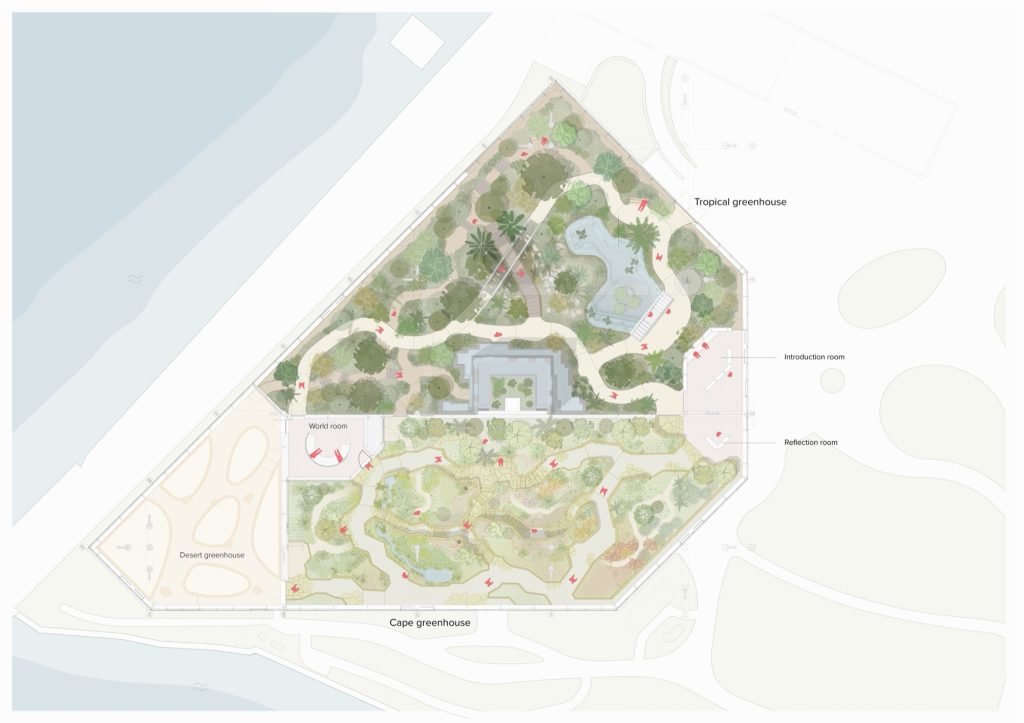
The visit begins in the Tropical greenhouse. The narrative tells the ways in which plants compete to reach sunlight, and how they develop strategies to capture light filtering through the dense canopy. This struggle is one of the driving forces behind the vast biodiversity in these climates. Visitors encounter plants that survive with minimal light, species that spread widely to catch every glimpse, and epiphytes that live high up in the trees, not needing their roots in the soil.
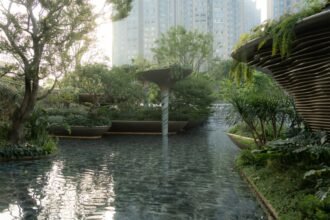
Moving through dense vegetation, visitors experience a variety of textures, leaf shapes, and colors. The route leads from a shaded lower zone to an open vantage point overlooking a pond. The water vegetation can be observed both above and below water via an underwater window. A staircase then leads to a skywalk at treetop level, reaching the so desired sunlight and offering a new perspective on the vegetation below.
Desert before intermezzo
From here, visitors enter the Desert greenhouse, where they discover how plants from different regions demonstrate similar adaptations to extreme dryness. Agave and aloe illustrate this phenomenon: although visually alike, they evolved independently on opposite sides of the Atlantic.
The route continues through the World Room, an informative intermezzo where the story is presented through educational multimedia installations.
Third act: the Cape
In the Cape greenhouse, inspired by South Africa’s Western Cape, the focus is on biodiversity in a highly dynamic environment. Constant change can lead to extraordinary biodiversity. This garden showcases plants that cope in inventive ways with conditions like heavy rainfall, drought, wind and wildfires. Take the fire lily: it awaits dormant underground for years and is only activated by the heat of a wildfire, blooming shortly afterward, in a charred landscape.
The Cape region has around 450 different species of Erica, a type of heather. Although similar in appearance, they’ve developed subtle differences over time. By comparison, only two species of Erica can be found naturally in the Netherlands, reflecting a far less dynamic climate.
The ‘fynbos’ vegetation is fine-grained and structurally complex, with many plants featuring small, needle-like leaves to reduce evapotranspiration. Due to frequent wildfires, vegetation in the Western Cape remains relatively low. Reflecting these characteristics, the Cape greenhouse is open and spacious but with a flowing landscape that’s enhanced by the path structure and its materialization. The paths, constructed with intricate stone patterns, sink into the ground and emerge again. This brings visitors on eye level with the vegetation, offering a close view on the subtle differences between these delicate plants.
The message
Along the way, visitors experience how biodiversity emerges through adaptation to local conditions. Designwolf designed the three key spaces that help this message to resonate: the Introduction Room at the entrance; the intermezzo at the World Room; and the Reflection Room before the exit.
Visitors leave with an understanding of how delicate the balance between biodiversity and climate is, and thereby with a sense of urgency regarding today’s rapidly changing climate.
A new icon
In the Tropical greenhouse an unexpected feature rises among the plants: an eye-catching waterfall, sheltering a five-meter-high installation box housing the technical systems required to regulate the three distinct climate zones within the greenhouse.
BOOM utilized what was initially necessary as a functional element, to create something unique. The massive waterfall displays an intricate pattern of tiles along which water drips and trickles in surprising ways. This shell is made from one of Amsterdam’s most common materials: sidewalk tiles. These tiles were donated by residents who participated in depaving their gardens to help make the city greener. The structure adds extra wet surface to the greenhouse which helps regulate temperature and humidity.
The waterfall captures the essence of BOOM’s philosophy: places can be beautifully shaped through collaboration, respecting existing conditions and creating meaningful change through collective actions. This way, overwhelming global stories like climate change, become tangible, and something to act upon.
52.36679444326739, 4.906927277235244