
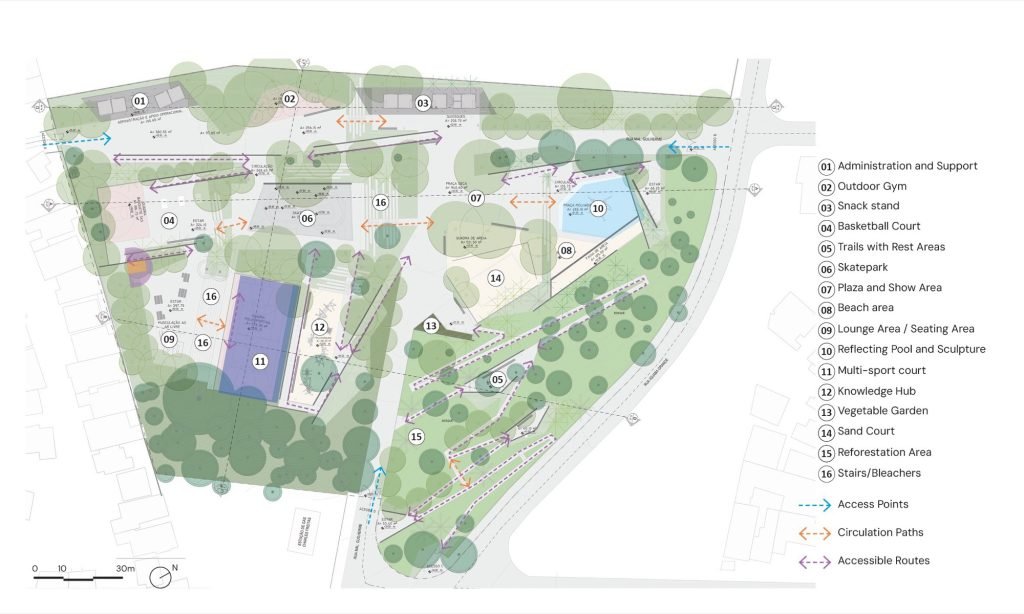

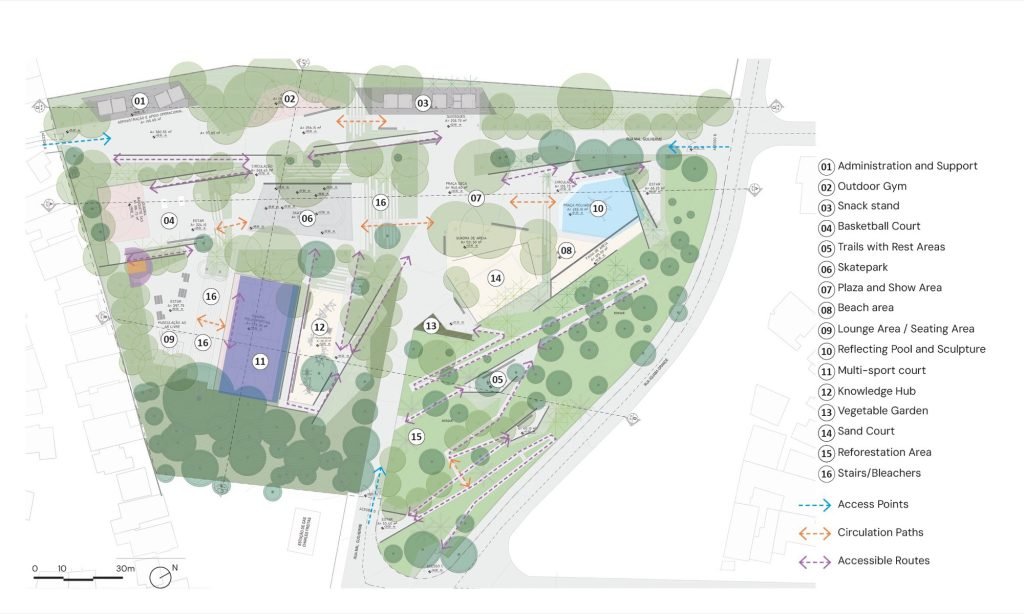
Parque Pavuna is situated in the North Zone of Rio de Janeiro, Brazil, on the Complexo do Chapadão. In a locality characterized by one of the city’s lowest social development indices, the park was conceived as an open, high-quality urban amenity: a green, inclusive gathering space.
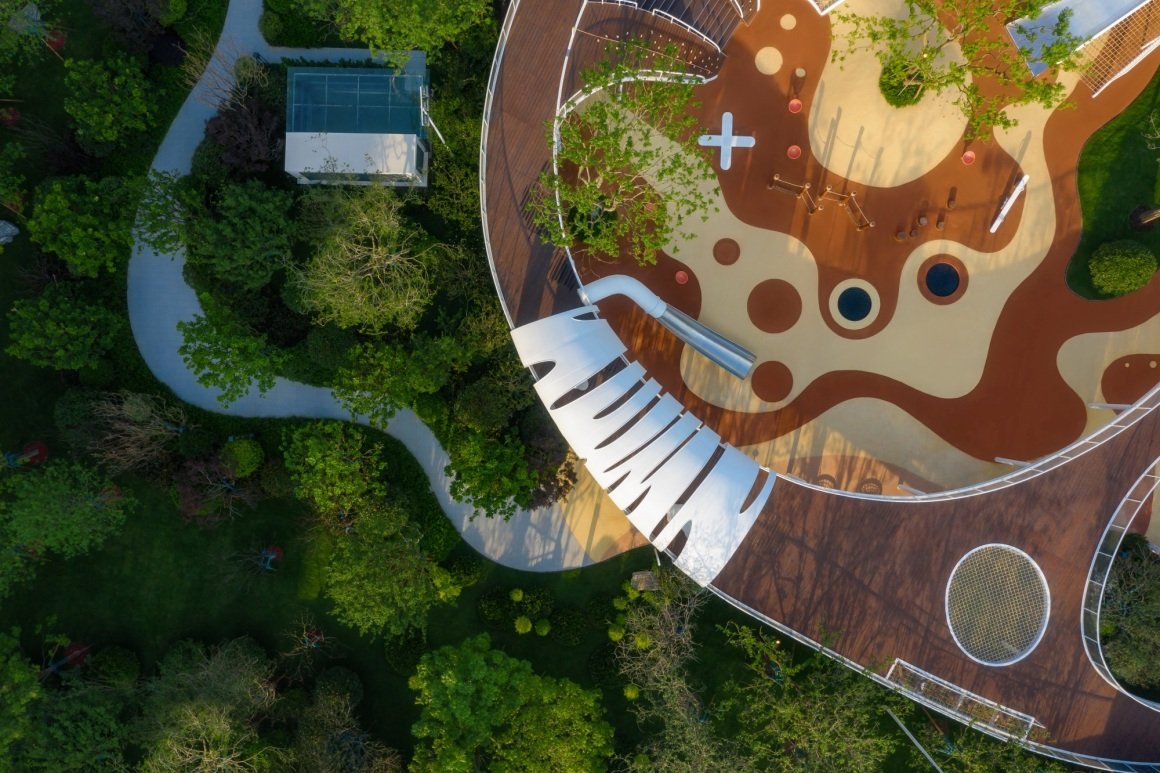
It encompasses sports, leisure, and educational uses, including soccer, volleyball, and basketball courts, a skate park, a children’s playground, an outdoor gym for older adults, and food kiosks.
To optimize land use, the project takes advantage of the existing sloping terrain, distributing the program across plateaus and resolving level differences with stairs, bleachers, and accessible ramps. New constructions are integrated with native shrub and tree species of the Mata Atlântica biome, while existing vegetation is conserved in landscaped zones to enhance rainwater infiltration and optimize thermal comfort.
The project’s distinguishing feature is the water plaza, centered around a 22-meter-high sculpture that evokes the image of mangrove roots. Water jets flow from it during the day, and beams of light emerge from it at night. The plaza alludes the chuveirão na laje (a shower on the rooftop slab), a common element in local homes, reinterpreting it from the domestic to the public realm. Adjacent sand-covered areas recreate a beach-like atmosphere beloved by cariocas, providing a playful complement to the children’s water play.
The park’s paved sections work as an additional design layer. In a simple yet dynamic solution, gray concrete pathways and social areas are painted with graphic elements in colors taken from the surroundings, such as terracotta from exposed brickwork and blue from the water tanks that cover the rooftops of Rio’s suburban homes.
Parque Pavuna employs landscape architecture principles to balance pre-existing elements, challenging topography, carefully selected native vegetation, and a versatile program, resulting in a unique identity. It fosters integrated coexistence, enhancing and strengthening the community’s bond with its surroundings.
Project Credits:
Location: 22°49’01.7″S 43°22’32.8″W | Rua Marechal Guilherme, 9 – Pavuna, Rio de Janeiro – RJ, 21650-590
Project year: 2021
Completion year: 2022
Year of construction: 2024
Client: Rio de Janeiro City Hall
Authors: Duarte Vaz Guedes e Silva, Elena Geppetti, Bruno Amadei, Victor Huggo Fernandes, Isadora Riker
Co-authors: Gustavo Martins, Pedro Riveira
Collaborators: Maini de Oliveira, Danielle Inocencio, Elvina Martins, Vanessa Galvão, Mylenna Linares, Larissa Scheuer, Fabio Arruda, Rodrigo Bleque
Photo source: Embyá + Douglas Lopes
22°49’01.7″S 43°22’32.8″W