
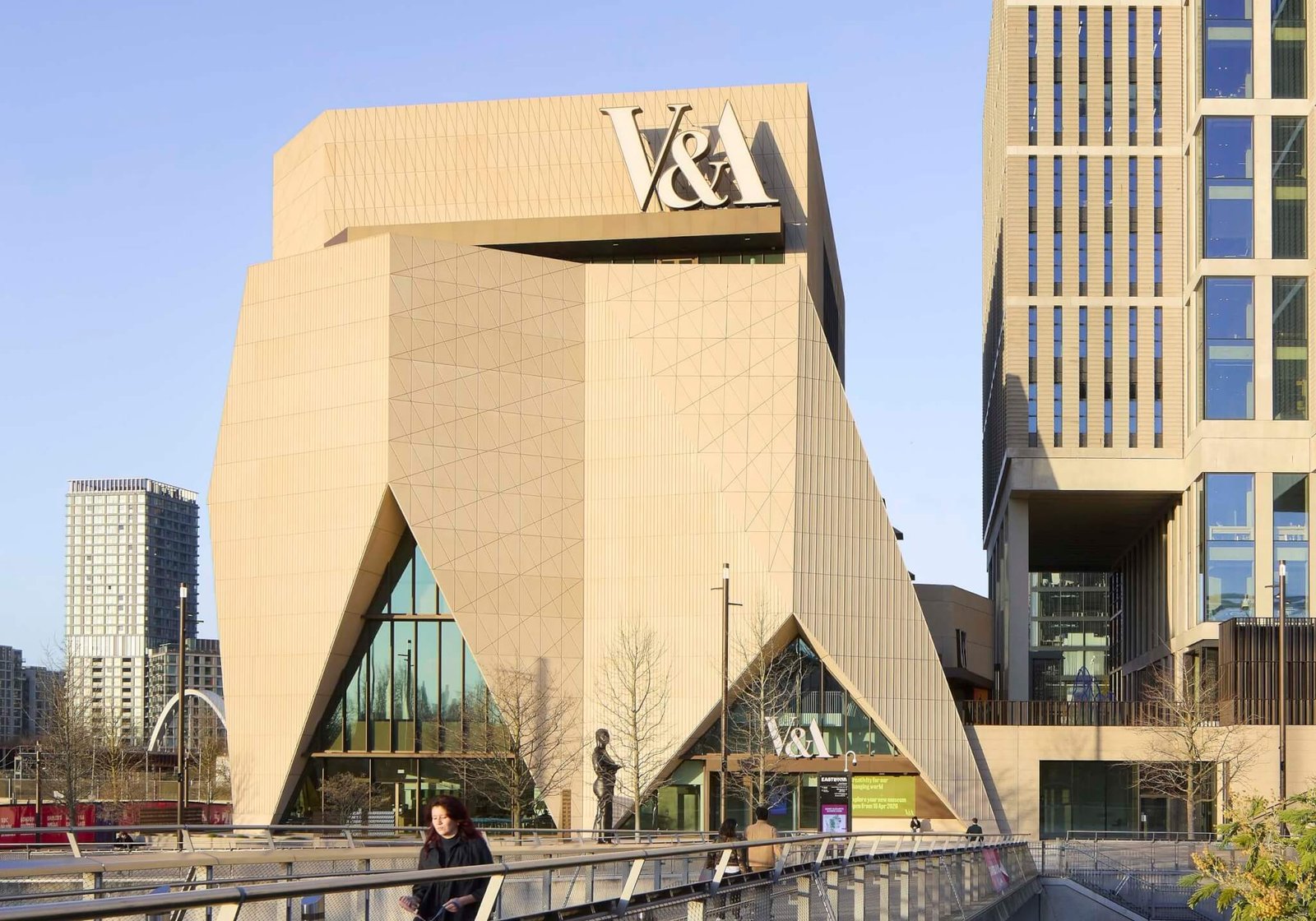

After the 2012 Olympics, London Mayor Boris Johnson reportedly told V&A chair Nicholas Coleridge he envisioned “a cross between the British Museum and the V&A in South Kensington” for Olympic Park. “We want Corinthian columns. We want Ionic pillars. We want the Babylonian Palace of Tiglath-Pileser!,” Johnson added. That post-Olympic mood produced the idea of a new cultural quarter in Stratford, one that is now arriving in full with the opening of the the O’Donnell + Tuomey–designed V&A East Museum.
“The V&A were approached in 2013 along with UCL to see if we would be the founding partners of what was then called Olympicopolis,” recalled V&A Deputy Director Tim Reeve speaking outside V&A East Museum ahead of its public opening on April 18.
London’s 2012 Olympics came with promises of urban transformation on a Babylonian scale. The grandiosity was Johnson’s, but the outcome has been disappointing. The games cost over $12 billion (£9 billion), and a whole section of the city was cleared to host them. Up to 40,000 homes were slated around the Olympic site, yet by 2022 only around 13,000 had been built, and just 11 per cent were affordable. Meanwhile the former Athletes’ Village was sold off in 2011 at a loss of roughly $370 million (£275 million) to the taxpayer. This is a different London, shaped by Brexit, COVID-19, and a churn of political turmoil and scandal that has unsettled the capital’s sense of itself as a global and outward-facing city. In Stratford, the promise of legacy has been folded into a more familiar landscape of lackluster retail and housing. Londoners have, in all honesty, become used to things just being a bit rubbish.
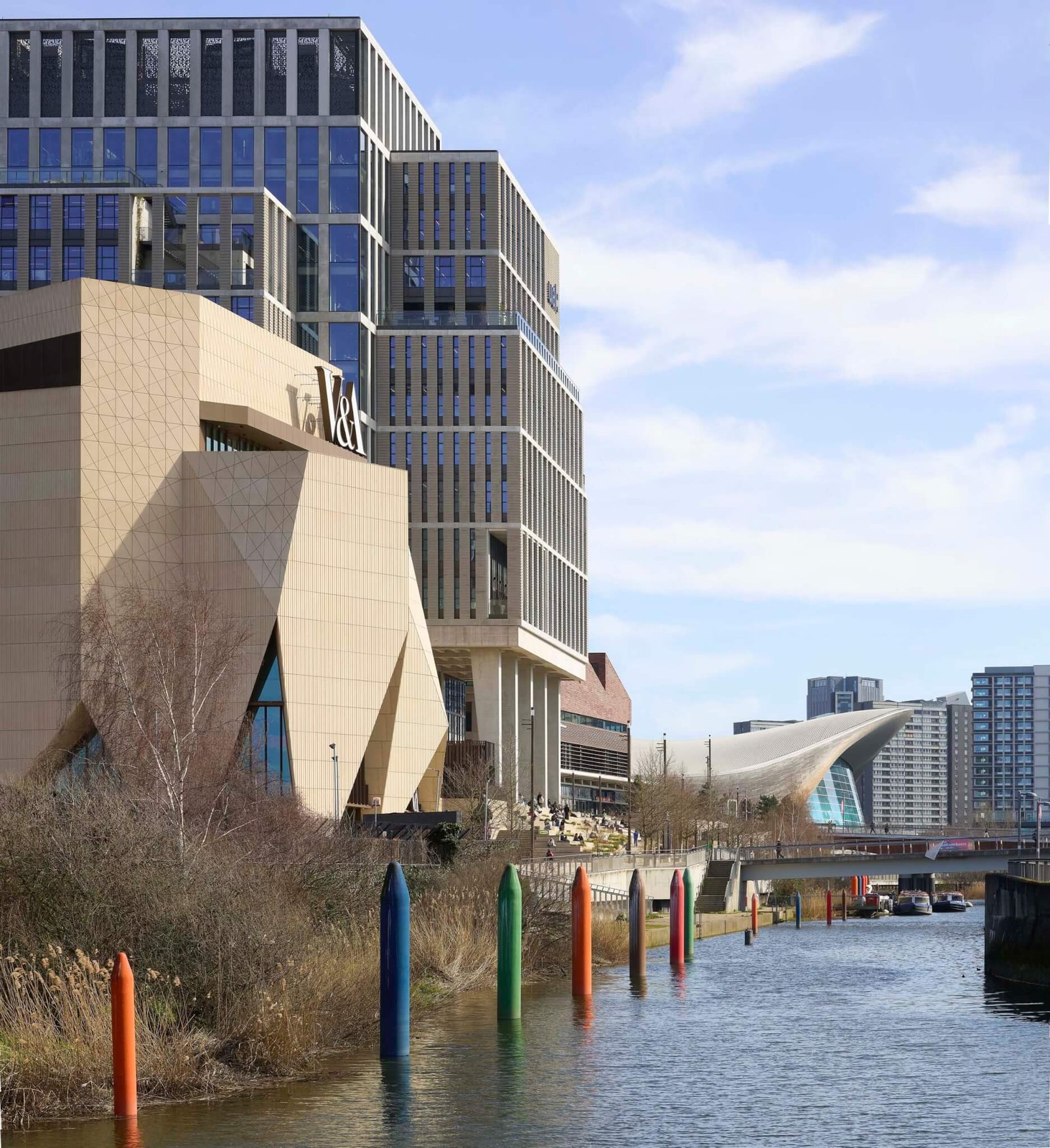
At the new East Bank, that air of mediocrity could be about to change. V&A East Museum completes the V&A’s two-part Stratford proposition after Storehouse opened last year, and takes its place in the Olympic legacy quarter masterplanned by Allies and Morrison with O’Donnell + Tuomey. The latter also designed the new Sadler’s Wells East, three doors down, with Allies and Morrison’s London College of Fashion and BBC Music Studios in between, and Stanton Williams’ UCL East Marshgate across the river.
Eimear Hanratty, associate director at O’Donnell + Tuomey, describes East Bank as “this terrace of buildings where each building has a completely different use and therefore they look different.” They all sit along the same curved waterfront, their fronts angled so they can all be taken in together. More than a decade on from the Games, V&A East Museum has to speak to a London less convinced by spectacle, less trusting of institutional grandstanding, and more alert to who a new cultural building is really for.
Jen McLachlan, project director at the V&A, said the V&A East Museum is aimed at “young people that live, work and study in East London in these four local boroughs.” For that reason, it was important that “it was welcoming, it was inviting, it was porous and that’s spoken to in the design.”
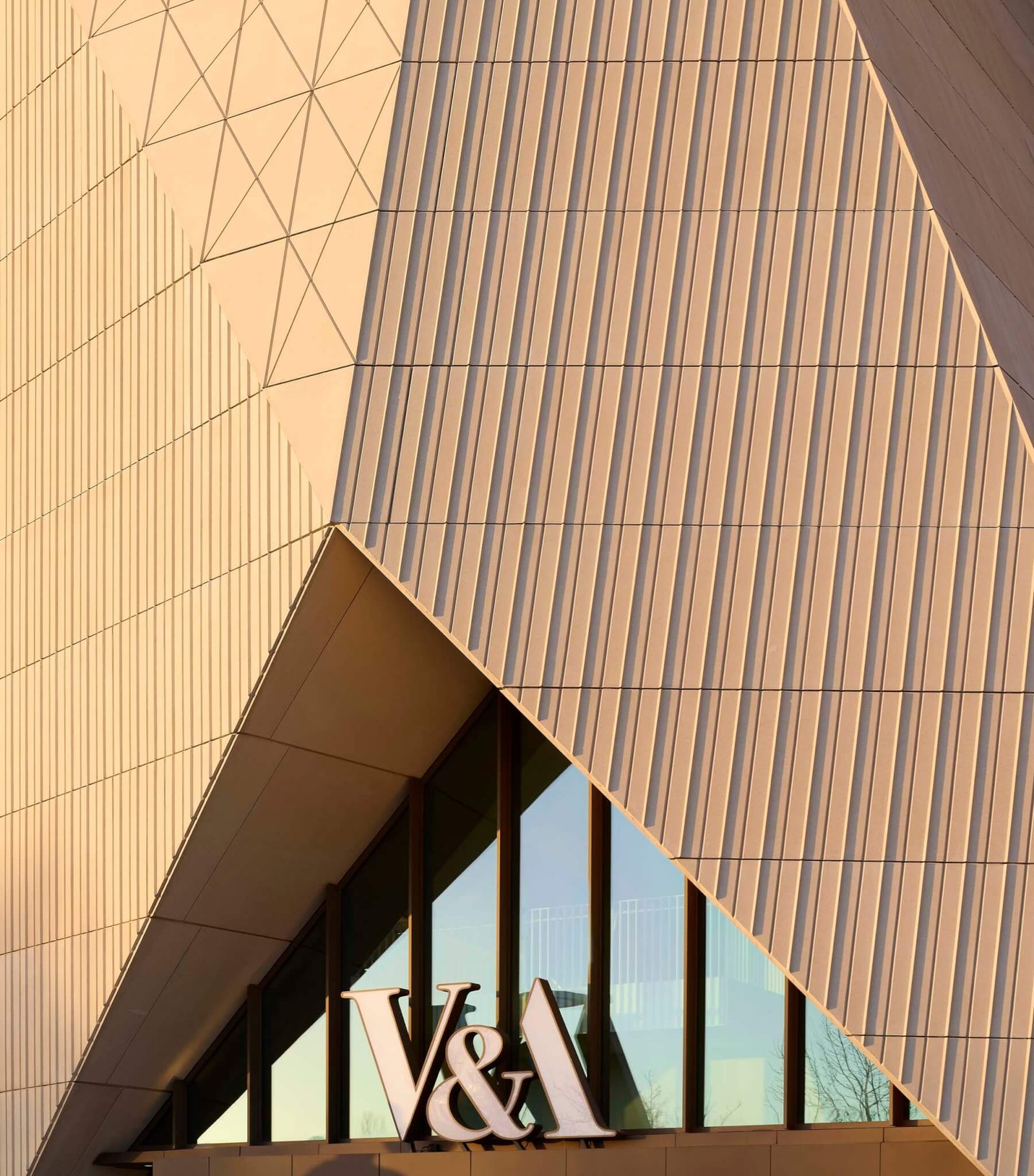
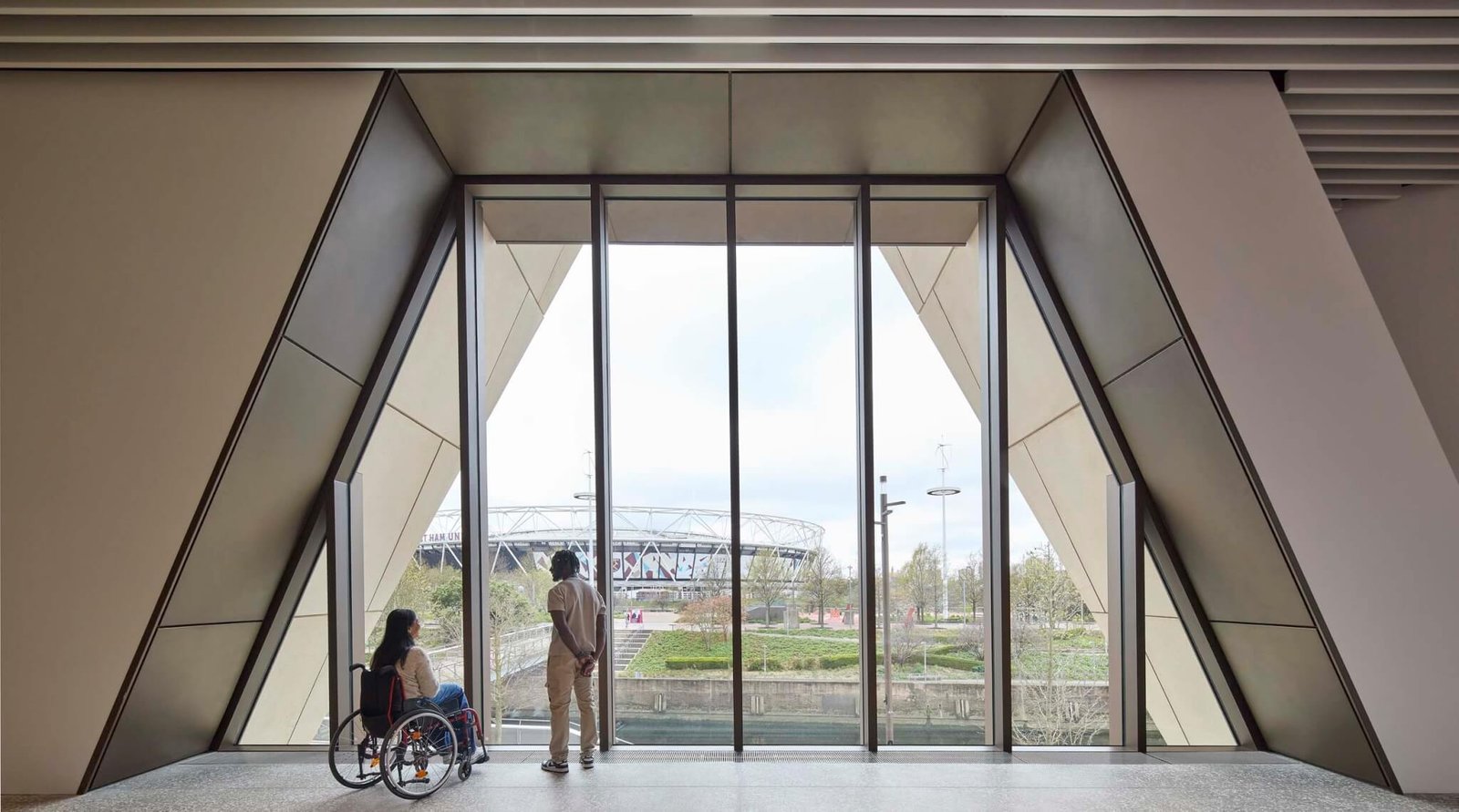
East Bank’s string of institutions are connected through their front-of-house spaces at podium level and terraces down to the waterfront. Next to Allies and Morrison’s Stirling-shortlisted college, V&A East Museum is another hulk of concrete, but where the college is muscular and gridded, O’Donnell + Tuomey’s is softer, folded. Hanratty said the office knew London College of Fashion would have “a different tone,” so if V&A East Museum was to hold its own against a much larger neighbor it needed a warmer register. The architects’ answer is 479 unique precast concrete panels made with natural sand and stone dust, each panel acid-etched so that the aggregate rises through in different intensities and the whole thing often passes, at first glance, for stone. The “V” and “A” are gridded into the profile of some of the panels, and the deep, pointed folds demonstrate this on a larger scale. A bespoke oversized bird’s-mouth joint lets those precast pieces turn the corners without losing their heft, while the panels span from column to column rather than floor to floor, so the pattern keeps moving, and the seams are not obvious.
O’Donnell + Tuomey arrived at that form through a line of references that feel very V&A: a ballooning sleeve in a Johannes Vermeer painting, Balenciaga’s sculptural dresses, the logic of seams and fabric held away from the body. Hanratty describes the building as a kind of protective cloth, a sleeve or cape wrapped around the galleries, shielding the collection while still opening to the public. That is what gives the museum its odd poise. “It had to keep the objects safe, but it had to let the public in,” she said. The thickness of these sculpted walls allows a staircase to swoop through, its polished concrete floor winding up the building and widening at points into concrete benches. Hanratty said they “really want this to feel almost like an outdoor material, so the circulation feels a bit like a street.”
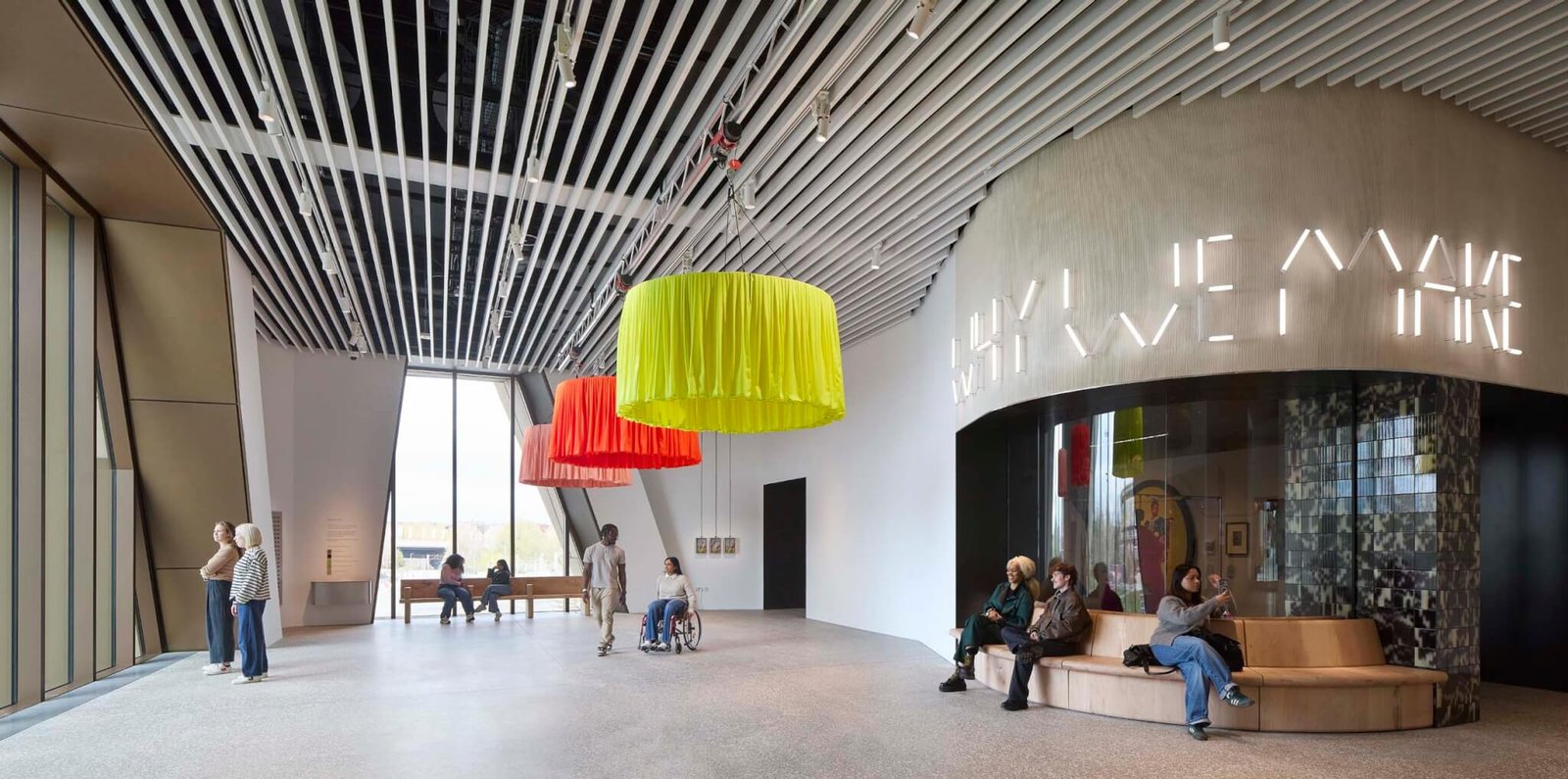
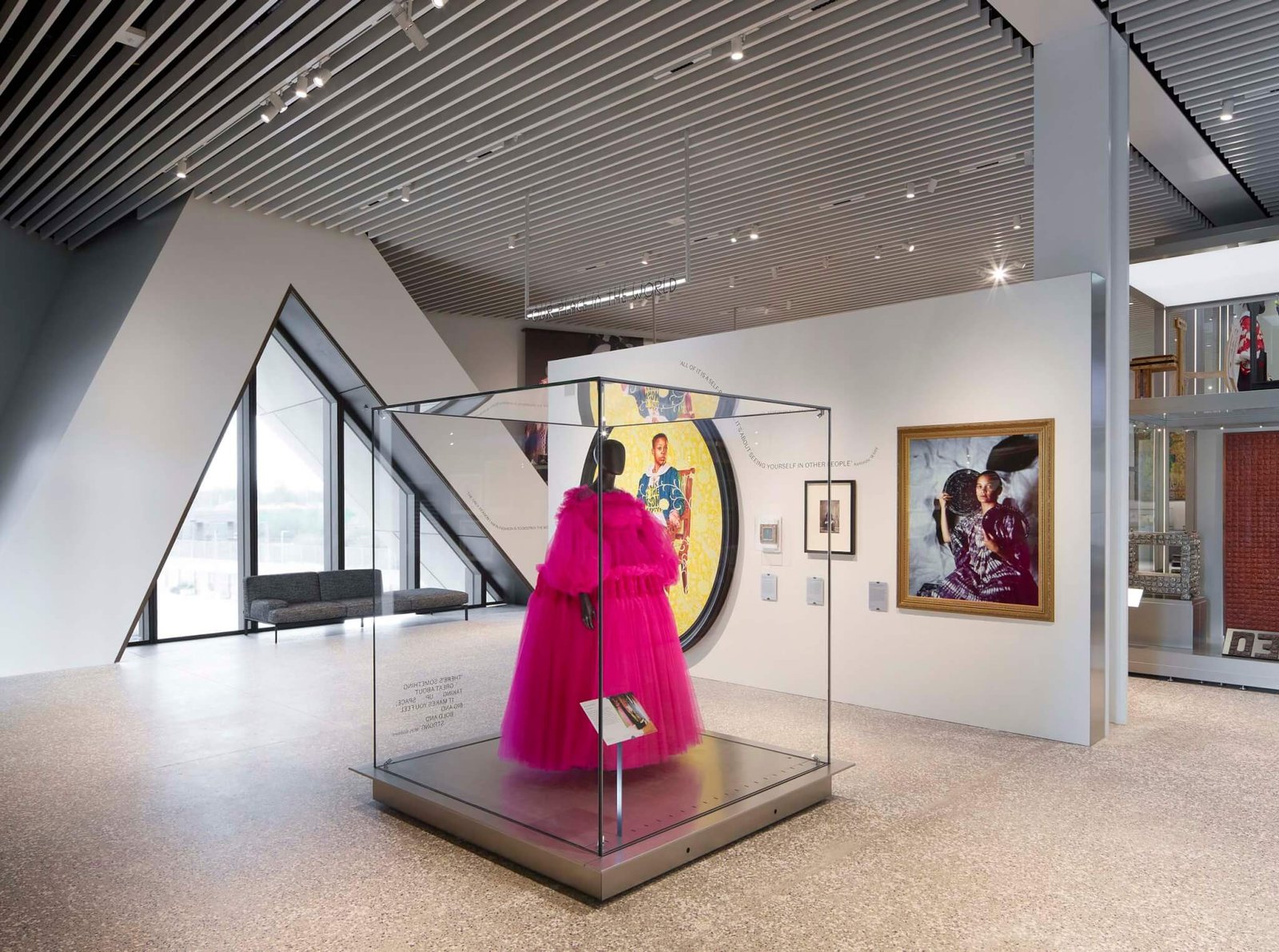
Inside the museum, the V&A starts to flatten its own hierarchies. “There are no security guards, no ticket desk, no bag check,” McLachlan said. The street-like staircase draws people in, while the lack of thresholds and stop points common to contemporary gallery spaces keeps them moving. Necessary thresholds are introduced between the gallery spaces for environmental control, but in the free permanent Why We Make galleries, designed by JA_Projects in collaboration with A Practice for Everyday Life, Larry Achiampong, and the V&A East Youth Collective, these have been softened with a double-sided red oak bench either side of the glazed partition, by east London maker Andu Masebo. As JA_Projects’ Jayden Ali puts it, this is “a museum that invites people in, supports different ways of being, and allows everyone to find their own place within it.”
Ali explains how the galleries draw on the spaces young people know best, “high streets and parks, showcases that are referential towards shop fronts, and markets or the way people display textiles.” The two floors bring together more than 500 objects, most of them drawn from storage, into ten sections organized around “agendas and motivations for making past and present,” V&A curator Chloe Kellow explained. This arrangement allows works from different media, geographies, and histories to sit in new constellations.
Museums are built to watch society change, even when they might appear above it. McLachlan says the V&A East Museum is “a building that demands people. It demands the audience.”
There are none of Johnson’s Corinthian columns here, no Ionic pillars. The V&A East Museum arrives to serve a generation that will have little memory of the Games beyond the city that followed them. What does it mean for the V&A to become legible to a generation that did not inherit the optimism of that summer and is far less willing to take institutions on trust? Perhaps this: to make a version of the V&A that does not simply arrive in East London, but is altered by it, made more porous, more contingent, and less certain of its own authority.
Ellen Peirson is a London-based writer, editor, and designer.