
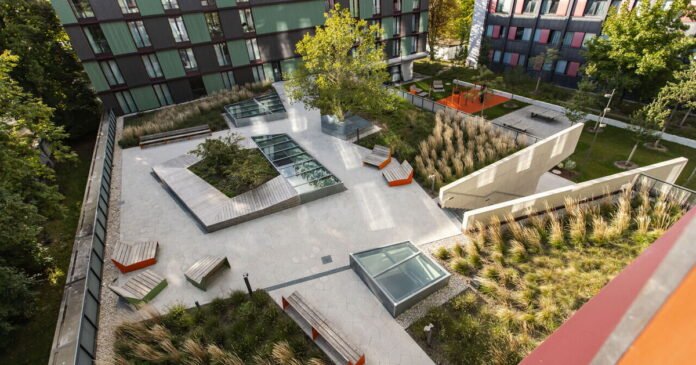


The new student residence at Schwere-Reiter-Straße 35 in Munich-Schwabing is a pioneering example of sustainable housing construction in an urban context. Commissioned by Studierendenwerk München and designed by hirner & riehl architekten, the building complex was completed in 2025 and represents both an architectural and technological milestone: with eight storeys, the larger of the two buildings is the tallest timber building in Munich. The Landshut-based firm lab landschaftsarchitektur brenner is responsible for the design of the green roof terrace that connects the buildings. For the outdoor furniture, they opted for benches and loungers from Vestre.

Community as a spatial concept
The hall of residence provides 241 homes for students. They range from small studios and shared flats to barrier-free apartments and parent-child flats. The flexible mix of private rooms and communal facilities forms the basis for a thriving social life. The roof garden offers sun decks, lawns and raised planting beds, making it a green retreat in the heart of the densely populated city. At the centre of this oasis is a mighty sycamore tree that rises up from the ground floor. Around it, the roof terrace has been designed to offer natural shade for relaxing hours outdoors. In addition, an open kitchen-diner and rooms for music, art and events create a multifunctional space for communal living and learning.
BLOC as a defining element of the outdoor area
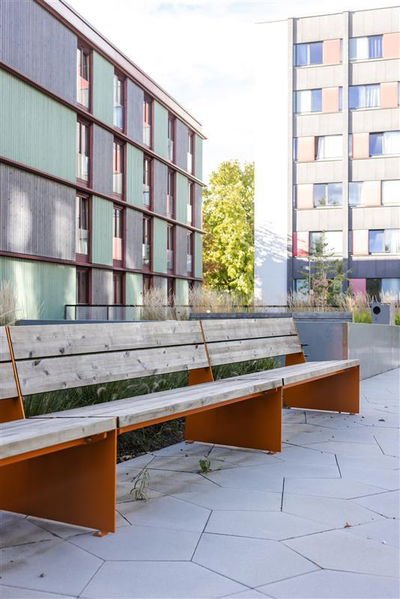
Various designs from the BLOC series enhance the quality of life on the communal roof terrace. In a bold red-orange tone (RAL 2001) and a soft, soothing medium green (RAL 6011), they create clear visual accents that blend perfectly with the materiality of the wooden structure. The robust, modular structure of BLOC is perfect to create seating or lounging areas or to convene for informal meetings – an important aspect when the outdoor space of a hall of residence is also used as a place of learning, a meeting place and a retreat. ‘Vestre’s outdoor furniture lends our project the desired casualness and lightness. Its climate-friendly production and the use of natural and durable materials support our commitment to sustainably designed outdoor spaces,’ says Christoph Brenner, architect, urban planner and partner at lab landschaftsarchitektur brenner, when explaining the choice of Vestre furniture.

Hybrid timber construction for sustainable urban living
The two buildings, with five and eight storeys respectively, are connected by a ground floor unit, the roof of which is designed as a communal garden. The load-bearing walls and ceilings are made of spruce cross-laminated timber, supplemented by ceilings made of a wood-concrete composite for additional stability. The ground floor unit and stairwells are made of reinforced concrete – an intelligent hybrid concept that combines safety, efficiency and sustainability.
The 1,840 m³ of wood used in the construction of the buildings bind over 1,600 tonnes of CO₂. Hence, this project demonstrates how climate-friendly residential building can work on a large scale. The project relies on district heating and a resource-saving mobility concept that does not need an underground car park. Instead, residents have access to 496 bicycle parking spaces and 49 car parking spaces.
Products used:
BLOC
Ral colours:
2001
6011
Source: vestre.com