



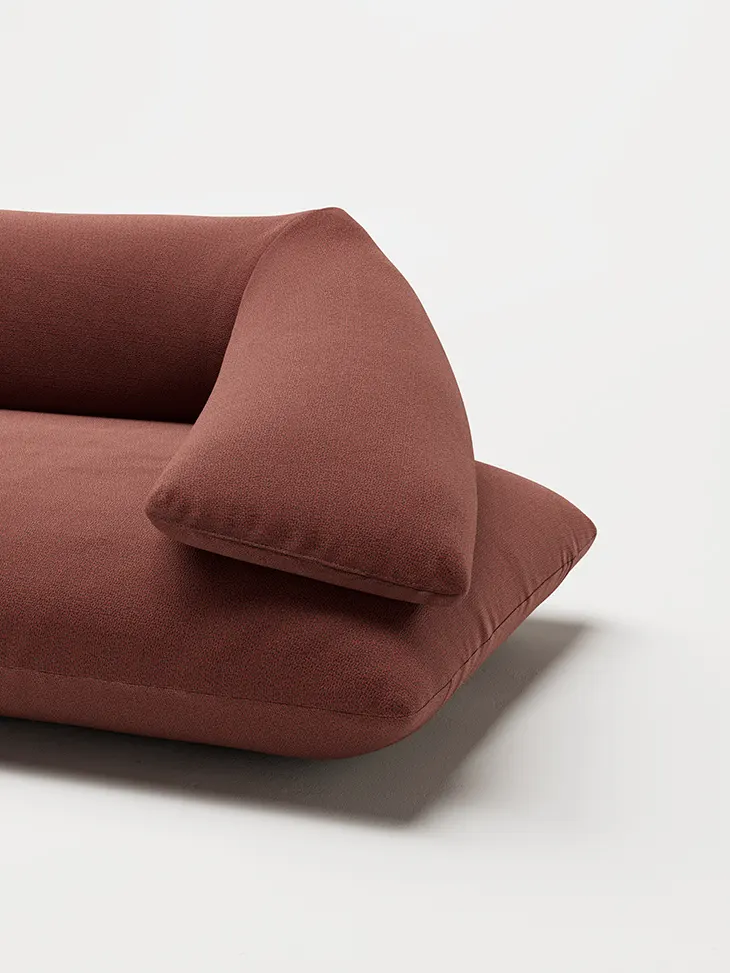

Most interior design and architecture studios have at least one project they would rather photograph than revisit. The handover images are still doing good work in the portfolio: the palette reads exactly as drawn, the seating holds the room together, the fabric looks like a decision rather than a default. Walk back in eighteen months later and the architecture is untouched. The joinery is intact, the lighting still models the space the way it was meant to. What has changed is the surface. Arms have gone grey where hands rest, seat cushions carry the shadow of everyone who has used them, and the pale weave that once made the scheme feel calm now just looks tired.
Nothing failed in any technical sense. The specification held, the warranty was never called on, the client never complained in writing. And yet the room no longer says what the drawings promised. That gap between the designed condition and the lived one tends to open at a single point in the process: the moment materials were chosen.
However, fabrics are an important part of every project – and so is the upholstery maintenance. ARCHISCENE editors investigate:
Why Material Decisions Rarely Account for Their Own Lifecycle
Material specification carries an enormous amount of a project’s character, and it is usually resolved against two questions: does this serve the concept, and does it fit the procurement budget. Both can be answered on the day, with a sample in hand and a number on a schedule. When it comes to the upholstery maintenance, the maintenance alone cannot. It asks what the material will look like after four winters of sunlight, a thousand sittings and one spilled glass of red, which is a question nobody in the room can answer with any precision while the FF&E package is being closed out.
The technical data that does exist points in a particular direction. Abrasion counts, lightfastness ratings and pilling grades all describe how a textile resists wear. None of them fully explain how it responds to routine care or professional upholstery cleaning, how often that can happen before the hand changes, or what occurs when a facilities contractor applies the wrong method to a solvent-only weave. Performance is measured as endurance, not as serviceability.
There is also a simple structural reason. For most practices the contractual relationship ends somewhere around handover and snagging. The consequences of a material decision arrive two to five years later, in a building the designer no longer visits, and are absorbed by an operator or an owner who was never part of the conversation. Feedback loops that short are not loops at all. This is not carelessness on anyone’s part. It is a gap built into how the process is sequenced.
Real Cost Shows Up After the Project Is Delivered
Many other disciplines on a project routinely account for lifecycle considerations. Facade consultants talk about cleaning cycles and recoating intervals. Services engineers budget for filter changes and plant replacement. Interiors, and upholstery in particular, are still largely procured on capital cost, as though the day of purchase were the only transaction that mattered.
It rarely is. For example, a lounge chair that costs less upfront but needs replacing after four years may have a higher lifetime cost than a more expensive chair that remains in service for nine. Replacement can also bring additional costs, including procurement, specification work, and delivery. Cost of ownership is not an exotic idea in construction; it is simply applied unevenly, and soft furnishings sit at the end of the queue.
What makes this hard to catch is that the decline is gradual and nobody logs it. There is no failure event, no defect report, no moment at which somebody says the material has stopped working. There is only a slow drift in how the space reads, noticed first by the people who use it daily and never traced back to a line on a schedule. Clients experience that drift as disappointment, and disappointment attaches itself to the design rather than to the maintenance regime that was never set up. Replacement then becomes the reflex response, partly because it is the only remedy a client already knows how to buy.
Where This Matters Most: High-Use and High-Visibility Spaces
In a lightly used private study, a forgiving material and an attentive owner will carry a scheme for a decade without anyone thinking about it. The stakes change completely once occupancy and visibility rise together.
Hospitality is the clearest case. A lobby armchair may be occupied for eight or ten hours of a single day by a dozen different people, none of whom have any relationship to the object. A banquette in a restaurant absorbs food oils, hand creams and denim dye on a nightly cycle. Guests read that wear instantly, and they read it as a statement about the operator rather than about the textile. The interior is doing brand work whether or not it was briefed to, and worn upholstery undermines it faster than almost any other visible element.
Workplace interiors have moved the same way. Breakout seating and soft collaboration settings now take the load that task chairs used to carry alone, usually without any of the maintenance planning that was quietly attached to contract furniture.
Residential projects fail differently. The brief says low maintenance, the lifestyle conversation stops at a general nod toward children and a dog, and the specification proceeds on an idealized picture of how the room will be used. Pets bring body oils that bind to fibers and claws that find every loop in a textured weave. Small children bring everything else. None of this is unusual, and almost none of it is interrogated closely enough at the point where a fabric is being chosen.
What It Looks Like to Design With Maintenance in Mind
None of this calls for a different aesthetic. It calls for a few additional questions asked at the stage where they still change the outcome.
The first is to specify against real use rather than the brief’s description of it. How many hours a day will this piece be occupied, by whom, with what in their hands. A sofa in a show apartment and the same sofa in a serviced-residence lounge are not the same product decision, even though they are the same purchase order.
The second when it comes to upholstery maintenance is to treat cleanability as a performance criterion sitting alongside abrasion and lightfastness rather than beneath them. Cleaning codes matter here, and so does fiber behavior. Some performance fabrics are designed to withstand frequent cleaning, but actual cleanability depends on the fiber composition, fabric construction, finish, and manufacturer’s care instructions. Construction matters as much as the cloth. Removable covers, zipped cushions and accessible seams determine whether a piece can be restored or only replaced.
The third is access, which is a spatial decision as much as a material one. A banquette fixed to the floor, a window seat with a stapled cover and a built-in headboard all commit their owner to in-situ methods for the entire life of the installation. That is a perfectly reasonable commitment to make, provided it is made knowingly rather than discovered later.
The fourth is handover. A care label is not a maintenance strategy. A short schedule that names the method, a realistic interval and who performs the work turns an assumption into something the client can actually act on. It is worth being specific about that last part, because this is the point where the design intent passes into other hands. Routine vacuuming and prompt spot treatment belong to the operator, while periodic deep upholstery cleaning is specialist work, and whether it happens on a sensible cycle or only once a scheme already looks defeated is largely decided by whether anyone planned for it at specification stage.
And the last, which matters most for credibility: be honest about the limit. Some materials will not survive their setting no matter how well they are looked after. A delicate chenille may be poorly suited to intensive commercial use, even with a consistent maintenance plan. In such cases, the appropriate response is to plan for replacement in the operator’s budget rather than rely on a maintenance regime to solve a problem it cannot fix.
Maintenance as Part of the Design Narrative, Not a Compromise
There is a quiet assumption worth dismantling, which is that needing care is a weakness in a material. Nobody reads a facade cleaning schedule as an admission that the stone was a mistake. Nobody treats a recoating interval as evidence that the timber was wrongly chosen. These are understood as the terms on which a good material performs over time, and specifying them is part of the craft.
Interiors deserve the same vocabulary and depend on regular upholstery maintenance. A textile that is cleaned on a sensible cycle and reaches year eight still looking like the decision it was has not been propped up; it has done exactly what it was specified to do. The useful shift is from the material deteriorated to the material lived its cycle the way it was designed to. One of those sentences ends a relationship with a client. The other describes a building being looked after.
A project does not end at handover. Its long-term success also depends on how materials are maintained, how they age, and whether those needs were considered during specification. Designing for the fifth year, not just the first photograph, should be part of the design process from the beginning.
Find more furniture stories on ARCHISCENE.
Source: https://www.archiscene.net