
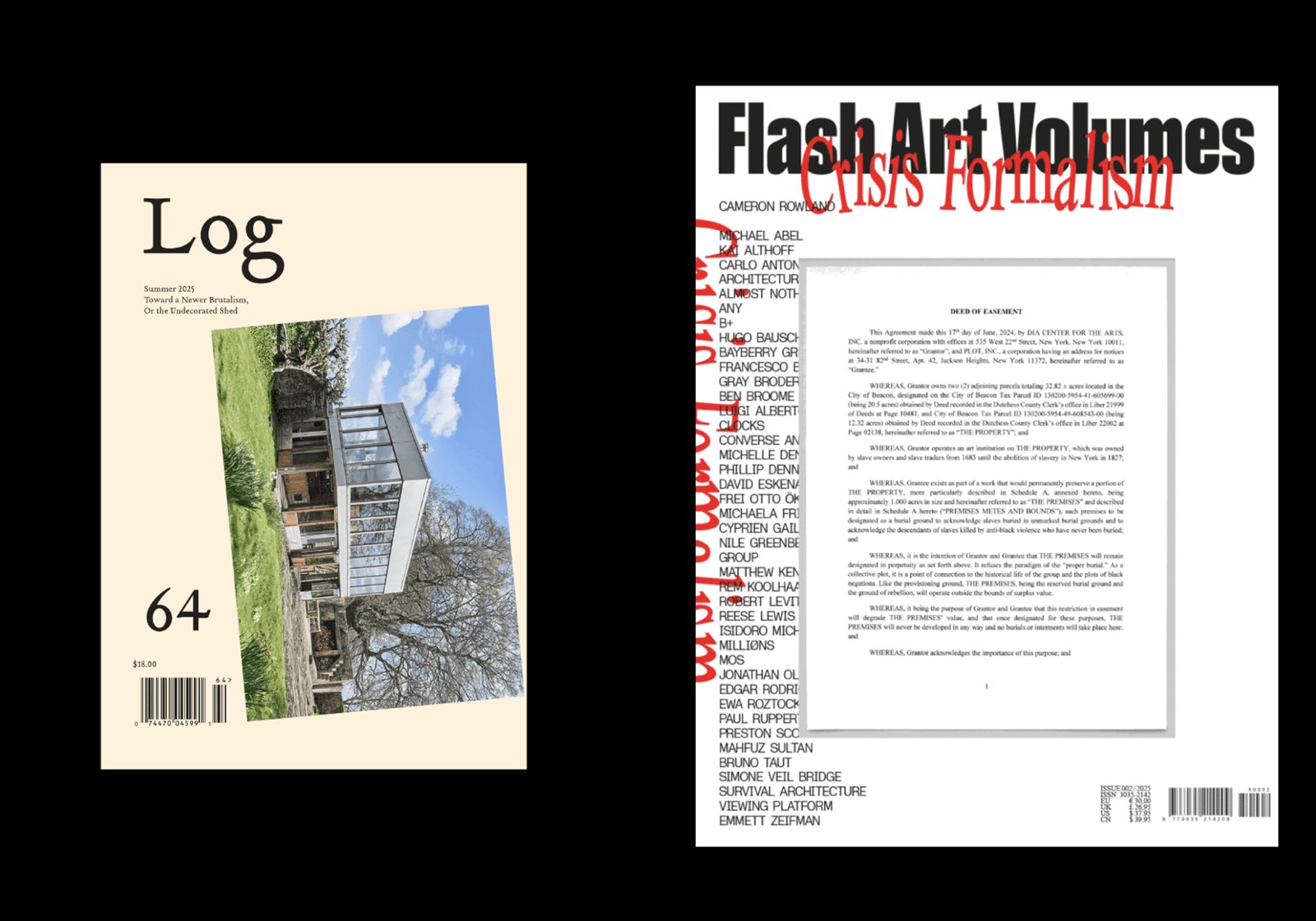

Last year, two publications corralled big ideas about architecture discourse. Crisis Formalism, Volumes 002 of Flash Art, edited by ANY’s Nile Greenberg and Michael Abel Deng and premiered last spring, collects projects that respond to a need for “a fundamental rethinking of form itself, not as an outcome of crisis but as its very cause.” Meanwhile Log 64: Toward a Newer Brutalism, or the Undecorated Shed, released over the summer and guest edited by Emmett Zeifman, revisited the 1950s moment of New Brutalism as a way to assess contemporary thinking about form and materials to propose “a found theory of architecture that looks like exactly what it is made of.”
The publications share some aesthetic sympathies and contributors—Greenberg and Abel Deng appear in Zeifman’s issue, while Zeifman profiled ANY for Crisis Formalism—but diverge on topics of legibility and approach. AN’s editor in chief Jack Murphy spoke with the editors to sort out how they agree and disagree.
AN: Nile and Michael, what is Crisis Formalism?
Nile Greenberg (NG): Crisis Formalism is a framework to allow architecture to absorb the complexity of our world. I thought architectural discourse was losing relevancy and gravitating away from architectural issues. This is understandable because we’re faced with a massive amount of dread, crisis, and pessimism—people are afraid to design. Crisis Formalism was an attempt to reify the position of architecture and crisis. That was starting from the idea of having to operate with a working definition of crisis, which we opted to do with the polycrisis. Then it was an attempt to understand how architectural form had to take on qualities of the inscrutable, illegible, and complex system of crisis that it was reacting to. For instance, rather than miniaturization and abstraction of the 20th century, it has to do with densification. Rather than objecthood, it had to do with disappearance, or fog.
Emmett Zeifman (EZ): How do you distinguish Crisis Formalism from the techno-positivism of the late 1990s and early 2000s, wherein complex forms could be read as the emergent expressions of the complex mixture of forces they were aiming to resolve? You seem to be after something different. What distinguishes crisis formalism from other recent approaches to architecture and complexity?
Michael Abel Deng (MAD): We’re not techno-optimists. We think architects are already conditioned by these crises, and we’re trying to show how these crises and forces can be read into the architecture itself. Architecture has often tried to synthesize complex and contradictory forces into a coherent whole. But these two things are at odds with each other. My argument is: What happens when you consciously embrace this conflict? What does that produce?
EZ: There’s a spectrum from the formal resolution of Patrick Schumacher’s parametricism to something that’s probably closer to your interests, like OMA’s idea of bigness, in which complexities are laid bare in more awkward, provisional building forms.
NG: But we’re interested in illegibility, which is different from OMA’s diagrammatic architecture. I admire architecture that is monumental, but in a failed and compromised way. But some projects are just not understandable.
MAD: I would call one position indexical optimism. That is the version you see in architects like Bjarke Ingels or Jeanne Gang, where buildings register forces from outside themselves but do so in a confident, affirmative way. At this point, that approach is basically the status quo. What interests me more is another model, where architecture registers incompatibility without smoothing it over. OMA’s Casa da Música gets closer to that. I do not think many projects are working in that way anymore.
NG: Emmett, how does Casa da Música fit in your issue? I find it contradicts your premise because it is really fake.
EZ: I think you’re interested in how architecture expresses the forces acting on it—gravity, program, regulations, climate, labor, construction—but in a way that isn’t resolved in terms of tectonics and part to whole relationships. Casa da Música is an example of a singular ungainly artifact. It expresses its seeming non-composition, as opposed to its geometric perfection or tectonic articulation. That interest in an anti-aesthetic or non-composition is one through line between our issues: We both share contributors who are committed to architecture that resists idealization, geometric clarity, and politeness in expression. All three of us see the value in that approach as a means of responding to the conditions of architecture today.
NG: But we’re different in terms of aesthetics. Emmett, your Log issue repeatedly goes back to Reyner Banham’s idea of the memorable image, which in your case has to do with revealing the assemblies that constitute the building. There is really none of that in Crisis Formalism. We have a lot of monolithic characters that relate to forces that aren’t easily modeled in the computer or assembled and are hard to draw. Crisis Formalism is full of strong buildings that are compromised.
MAD: One of our provocations under Crisis Formalism is something we call Hollow Architecture. It responds to a basic condition of building in the U.S., where more and more demands are loaded into the envelope. Our contribution to Log’s Newer Brutalism issue, the Shell House, exaggerates that condition and turns it into a formal proposition.
AN: Emmett, what is Newer Brutalism?
EZ: After 50 years of experiments in form-making, we need to acknowledge that the substrate of architecture remains the modern building. As the formal project has exhausted itself, it has become clear that there is another project happening, which is about revealing that basic structure and therefore opening it to transformation. We see architects doing that to respond to the climate crisis, but also to reimagine the labor and economics of the construction process itself to open it up to different aesthetics and programs.
I adopt the New Brutalism, a term that arose when the fundamental technologies and programmatic paradigms of contemporary architecture began to coalesce in the 1950s, as a readymade theory of the present. The New Brutalists demanded the honest expression of these conditions, against the academicization of modern or traditional styles. After World War II, modernism went from theoretical project to hegemonic condition, and the building technologies that we continue to grapple with became ubiquitous. That era is relevant because architects began to work at a global scale on the issues we still confront today: industrialization, the climatization of the interior, programmatic flexibility, automotive culture, and so on.
AN: Why was it important to keep the name from the 1950s as a reference instead of finding a new vocabulary for what is happening today?
EZ: This produced a lot of confusion, actually. Obviously there’s a popular understanding of Brutalism, but I’m referring to its earlier usage as the term coined by the Smithsons and used by Banham to describe that moment in the 1950s. This was before Brutalism came to mean “monumental concrete architecture.” So much of the discourse related to New Brutalism anticipated the present desire for an honest reckoning with the realities of the construction and use of buildings, and also the structural and cultural challenges of doing so.
NG: This original version of Brutalism was funny because in my mind it was the first modern movement to recognize its own history, or history in general. The Smithsons were already mining the depths of what modern architecture had been, and in early versions it was explicitly about recombination rather than heroic invention.
EZ: Yes, it reflects the moment when modern architecture becomes history and therefore subject to a historical critique. I think it anticipates how we work today, within the longer history of modern architecture. We can’t escape it; there’s no alternative paradigm, we have to work through it.
AN: How did you identify who should be in the issue and select the contributors? What format of practice emerges when you consider these individuals?
EZ: I didn’t always select people because of their practices, but rather because I think they have something to say about the topic. I’m not sure many of the people in the issue would identify their own practices this way.
There could have been a version of the issue that was more direct about the recent history of the discipline that inspired it. It would be an issue full of b+, de Vylder Vinck and Jo Taillieu, Lacaton & Vassal, etc.—this new wave of European architecture that has swept the American academy and is influencing a generation of students and younger practices. That was very much the context of the related show I organized at the GSD in the fall of 2024, which included those firms, as well others such as Abalos & Herreros, Ensamble, Office of Political Innovation, OMA, and Rotor. There were also some American experiments in literalism, from Mark Linder, Wes Jones, Andrew Zago and Mark Anderson, all put in dialogue with work and texts from the Smithsons’ archive. The show was really about charting an alternative history of the contemporary period, in parallel to the dominant American design culture that came out of the generation of MoMA’s 1988 Deconstructivist show and their subsequent digital turn. In some ways, the issue picks up where the GSD exhibition left off, particularly in interrogating the American context.
I see this work as an attempt to engage directly with the material basis of construction. It leads to the underlying ethical framework that motivates the work we’re talking about today. Reckoning with the climate crisis and material scarcity; work that formally expresses consuming less energy, using less material, reusing more existing buildings.
MAD: Emmett, do you think Newer Brutalism is a style?
EZ: I believe in a synthetic project oriented toward making buildings. This requires that architects pursue shared knowledge and build collective agency. The modern project suggested a way in which expertise and constraints could be synthesized into a coherent, replicable, everyday language of architecture. There is a potential for a collective project that brings to bear engineering, climate science, economics, construction and expresses them in the material form of architecture.
Brutalism was an attempt to direct modernism in a self-conscious and critical way, and similarly Newer Brutalism can be read as both exposing the reality of contemporary construction and proposing alternatives from within that reality.
NG: I think one of the reasons why radical practices from the 40 years of architecture—basically from MoMA’s Deconstructivist show onwards—are largely the same is because their unifying idea is that they make something visible that you are not supposed to see.
Crisis Formalism focuses on the ways that architecture can be non-legible and non-optical. It’s like the polycrisis; you literally can’t see it by definition. We need to work in a way that doesn’t rely on legibility as being the only way to understand if architecture is successful or not. Some of the best architecture has the least legibility as an architectural object. This is a place where we diverge, because I think Newer Brutalism requires an image of a building.
MAD: Nile and I completely disagree on this point. There are two of us in this practice and so there are two editorial positions within the Crisis Formalism issue. I am interested in projects that register conflict rather than smooth it over, where incompatible demands remain present in the work and are still legible. There are geometers who offer a kind of pedagogical legibility by tracking the process of geometry and showing the operations that produce form. But that can also slide into a dangerous formalism, where geometry becomes self-justifying.
EZ: Nile, what you’re describing is basically high formalism, in which architects produce inscrutable objects through idiosyncratic techniques that are potentially radically open to interpretation. I was teaching at SCI-Arc during the height of architectural interest in object-oriented ontology (OOO). In that moment, architecture mostly took the form of monolithic masses traced with fissures and failures; its power was that it evaded your capacity to understand how it had come to be. Because people were interested in an object’s withdrawn, hidden qualities, they ended up with these broken, fractured, complex things.
Newer Brutalism is not about interpretive games or individuated techniques. It is about a clarity of meaning and the expression of a different disciplinary politics. In putting “formalism” in the title of your issue, you’re knowingly joining a history of formalism that goes back to at least Complexity and Contradiction or Le Corbusier’s Purist compositions. You want these rich, inscrutable objects that emerge from the tension between the ordinary forces architecture has to negotiate and the desire for virtuosic composition. As we’ve seen, in the American academy, that could quickly turn into a set of codified formal techniques with little substance behind them.
NG: You’re both making good points.
MAD: (Laughs.) We’re going to break up our firm after this.
NG: I think it’s smart to try to code this with the idea of formalism being the starting point. I’m interested in interwar modernism as the most productive place to think about architecture. At that moment, objectivism and abstraction were aligned. What I’m describing is a call for a new form of abstract production in architecture, which is basically done through the total integration of parts rather than the technique of stripping things back. You’re right to mention OOO, as my thinking is indebted to it. Hollow Architecture boxes coated in complexity. I think this act of superimposing stresses—cultural and technical factors—and letting them play out as conflicts within the form of a building creates an objective type of abstraction.
It’s funny that we’re both calling out some kind of plateau in the arrival of new architecture paradigms, and we’re both trying to find a way out.
EZ: What you’re describing is in the spirit of Newer Brutalism. In Banham’s essay on the Smithsons’ early work, he calls on them to exceed Miesian abstraction and allow more forces to register in and distort the formal types of their projects. He wants to move from the rarified, typological work of Mies to an architecture of topology and informality. Theoretically, it’s a bridge to Koolhaas. OMA made this jump most explicitly in the Kunsthalle and the Dutch House, which tie the symmetrical, universal space of Mies’s pavilions into knots. The tension between abstraction and functionalist problem-solving is also at the heart of the work in my issue. You’re right that interwar modernism simultaneously produced seductive abstract objects while maintaining the presumption that it was rationally solving problems.
That’s why Lacaton & Vassal is interesting to me, because their work is geometrically imperfect. They are different from practices like OFFICE KGDVS or Dogma, which are both in search of typological abstraction. Today you can look at young practices and studio work and see plenty of antiseptically clean grids or rooms made with curtains without registering any actual material friction.
The unifying figure across both issues is probably Arno Brandlhuber’s b+. They allow things to get weird but under real material constraints. The period of OMA’s work that we’re all interested in was perhaps similar. Programmatic, structural, and site complexities drove extremely formally specific solutions that did not solely emerge out of an abstract, formalist lineage.
NG: Emmett, your issue advocates for what others might call the “return to the real.” Newer Brutalism uses reality as the basis of design. I think I’m still looking for how, with enough realness, you can achieve abstraction.
It’s worthwhile to play Newer Brutalism forward. What happened to your original Brutalism? A lot of buildings didn’t make it past 20 years of age because they functioned so poorly, right? There’s this poverty in Newer Brutalism that is both beautiful and dangerous. I think the desire for an image of poverty, or an image of economy, is a major issue today.
What would society be like if everything was Newer Brutalist buildings? It could end up being worse than what we have now. An image can become so potent and romantic that everyone wants to copy it, which is what happened with the later form of Brutalism. Plastic winter gardens for everyone! Can you imagine…
EZ: Sure, but Newer Brutalism could also learn from history to avoid that outcome. You could also flip this around to argue that the last 50 years of architecture predicated on the unreal, virtual, and digital have produced a reality of absolute, abject mediocrity in the built environment. I think this means our working ethics need to change.
NG: But it’s not dangerous in an immediately life-threatening way.
MAD: I think Patrick Schumacher is more dangerous than Boston City Hall.
EZ: Boston City Hall is 58 years old and looks great. But you know what I mean. So many techniques that defined the pedagogy of the past 30 years—like single-surfaces or sophisticated Booleans or stacks of heterogeneous volumes—are now just mindlessly stamped into curtain wall patterns that mask conventional buildings. If all that the discipline can create in everyday practice are impoverished images of once-vibrant avant gardes, then to me that’s a problem.