















grateful Guangzhou Duo Architecture Studio Share the following content with gooood. For more information about them, please go to:Multi-Architecture on gooood
Appreciation towards Multi-Architecture for providing the following description:
At the invitation of the Nanhai Land Art Festival, Duoduo Architecture designed a work in the Yugeng Yue Yun area. Nanhai has been famous for its “mulberry-based fish ponds” since ancient times. People planted mulberries and raised silkworms beside the fish ponds, and raised fish in the ponds. Water and land nourished each other, forming a cyclical production and lifestyle. In such an environment, fishing nets are tools for fishing and are often hung up to dry, becoming a familiar and natural sight of daily work.
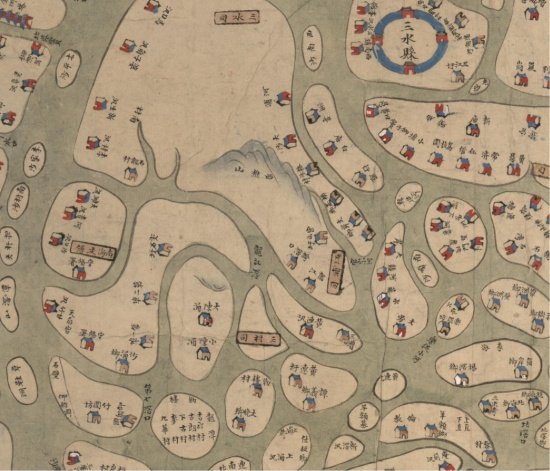
▼1816 Guangdong Provincial Water Channel Map (detail),
Guangdong Province Waterway Map (partial), 1816 ©Network
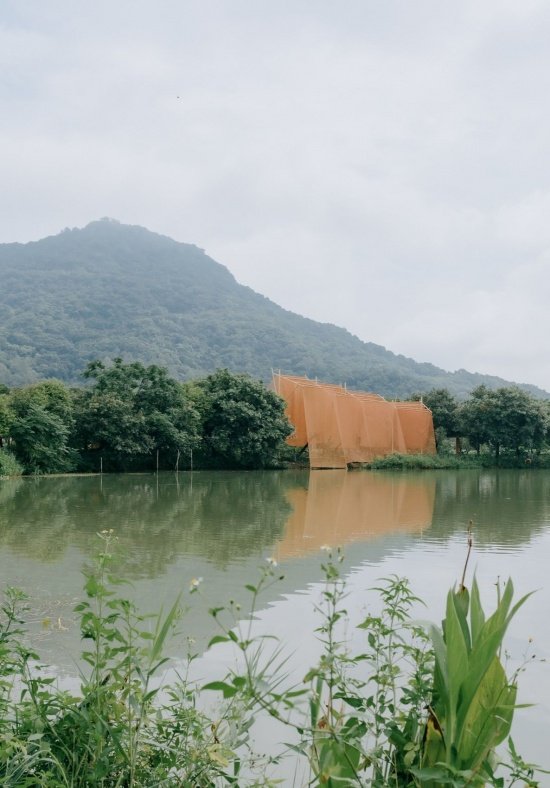
At the invitation of the Art at Qiaoshan – Art Field Nanhai, Multi-Architecture designed an installation for the “Yugengyueyun Section – Fishing and Farming Cabanas 2.0” zone. Nanhai has long been renowned for its “mulberry-dike-fish-pond” system—a cyclical mode of production and living where mulberry trees are grown and silkworms raised on the dikes, while fish are cultivated in the ponds, with land and water mutually nourishing one another. In this setting, fishing nets serve not only as tools for the catch but also as familiar, natural elements of daily labor when hung out to dry.
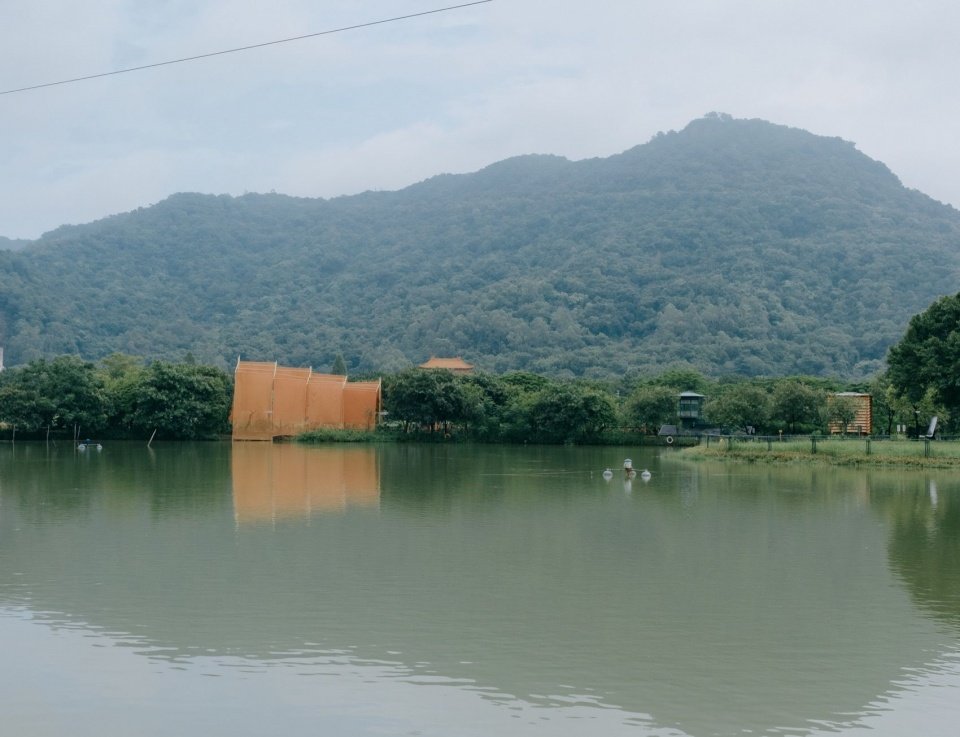
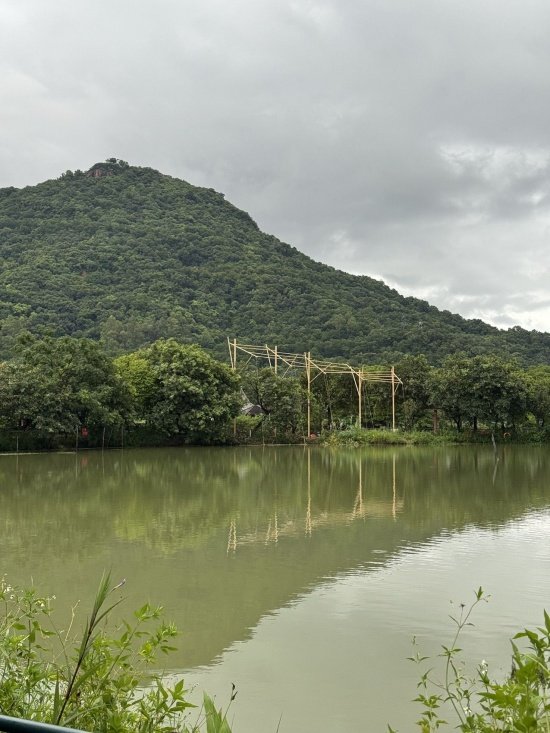
▼The drying nets and Xiqiao Mountain © Zhu Yumeng
.
1 The internal nature of water shadow winter melon
The Interiority of “Water-Shadow Winter Melons”
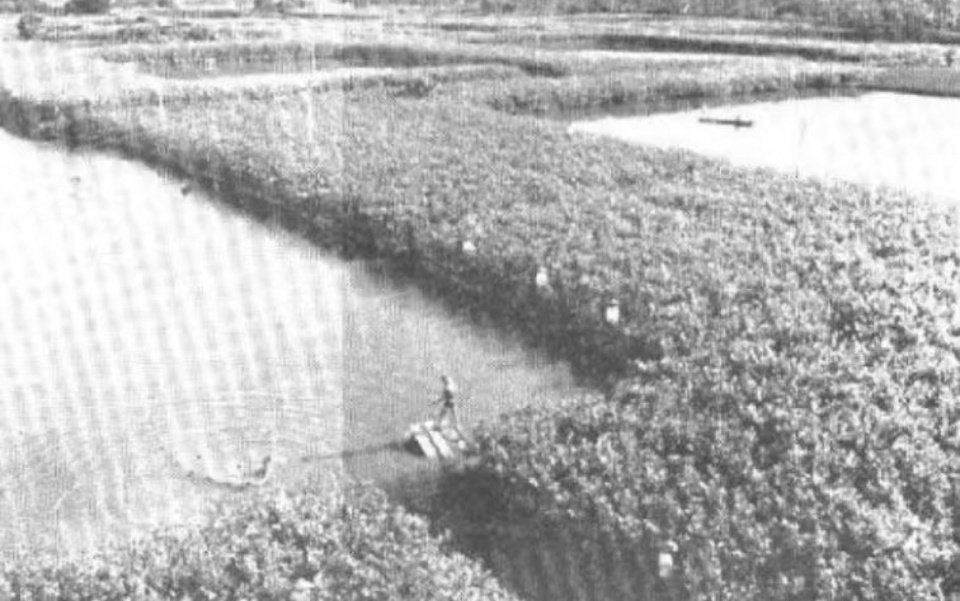
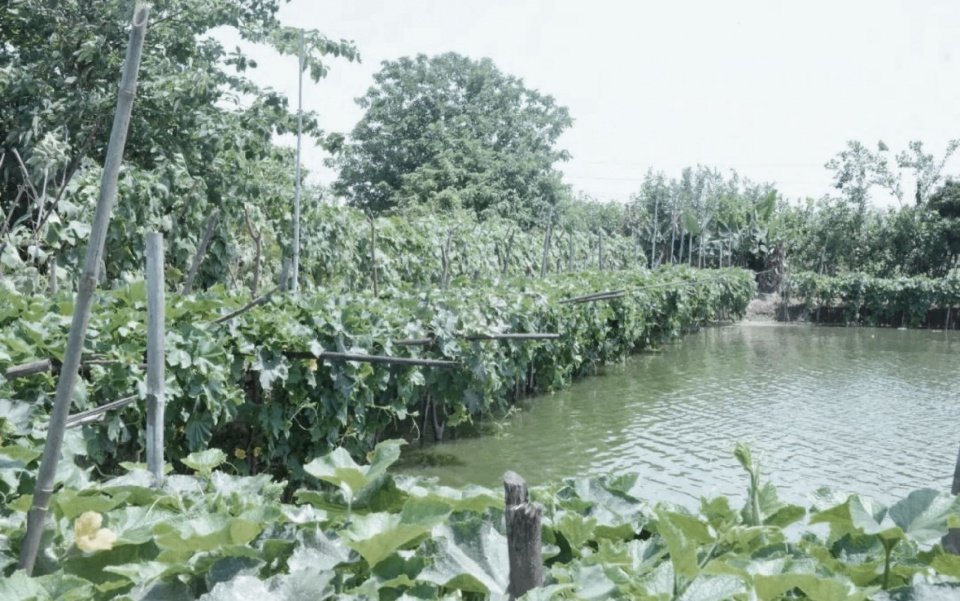
The site has always been a continuous mulberry fish pond in the past and now. A few decades ago, the appearance of the mulberry-based fish ponds and the fruit-based fish ponds was not what we see today, but rather lush. The base stems were planted with continuous water-shadowed winter melons that covered the sky and the sun, creating an interiority that gave people a strong sense of envelopment. The physical sense of the place must be extraordinary.
▼Mulberry-dike fish ponds and water-shadow winter melons, Mulberry-dike fish ponds and water-shadow winter melons © Duan Jiahui, “Research on the Landscape Characteristics of Traditional Villages in the Three Major Han Core Areas of Guangdong”, South China University of Technology & Internet
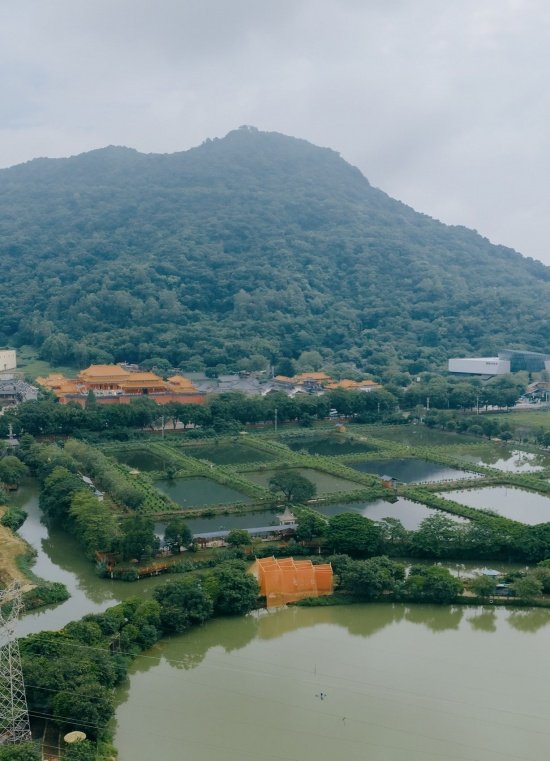
Throughout history and into the present, the site has consisted of contiguous mulberry-dike-fish-pond landscapes. Decades ago, the appearance of these ponds differed significantly from what we see today; the landscape was lush and dense, with “water-shadow winter melons”—a local variety—growing on the dikes and forming a canopy that blocked out the sky. This created a distinct sense of interiority and a powerful feeling of enclosure, offering a unique bodily experience of the space.
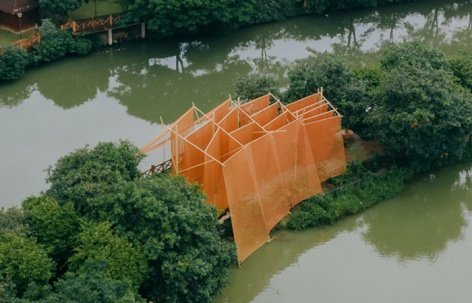
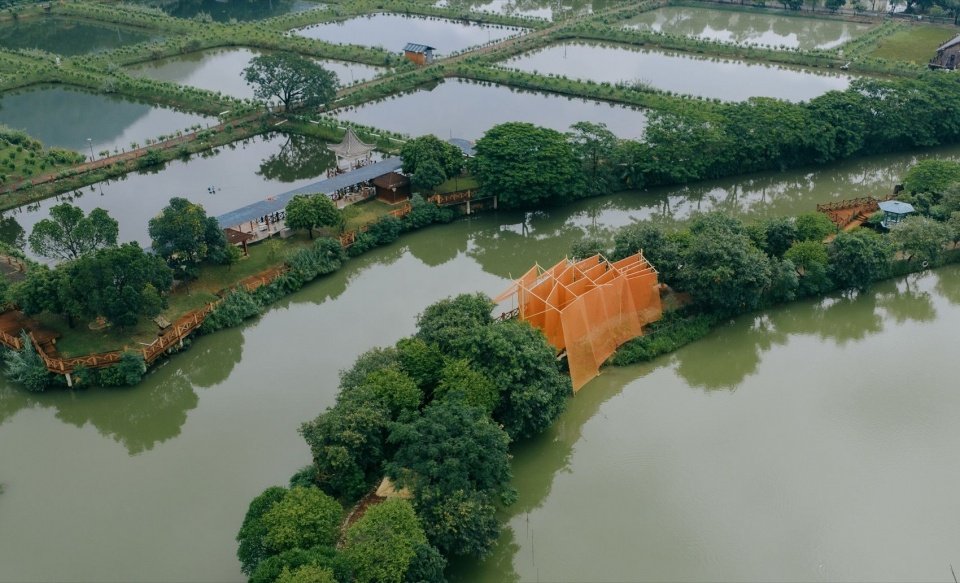
▼Aerial view of the site © Zhu Yumeng
.
2 The need for sunshade and fishing nets
The Need for Shade and the Drying of Nets
Fishing nets are the most familiar and most economical labor tools in the mulberry fish pond system. On the other hand, the site was originally a veranda in the park. Fishing nets have the potential to provide basic sunshade function, and they have become the language of this wrapped place.
Fishing nets are the most familiar and cost-effective tools within the mulberry-dike-fish-pond system. Furthermore, as the site was originally a section of a covered walkway within the park, the nets offered a potential solution for basic shading, naturally becoming the architectural language for this enclosed space.
▼Aerial view of the site © Zhu Yumeng
.
3 Volume calculation and dialogue with Xiqiao Mountain
Volumetric Calculation and Dialogue with Xiqiao Mountain
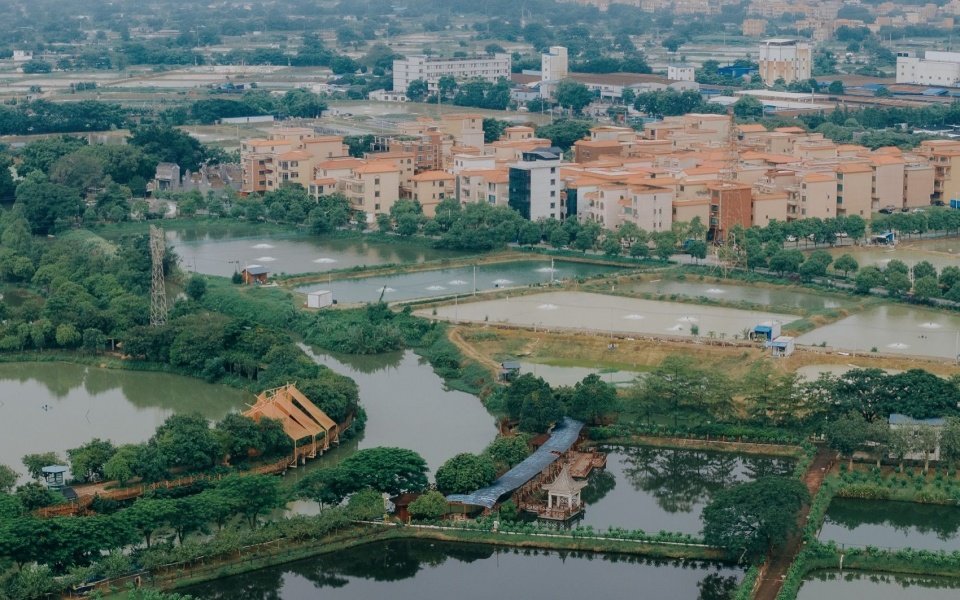
Under the construction conditions of limited cost and the inability of the pond foundation to carry large-scale construction equipment, we conducted volume calculations with the iStructure structural team. Our consensus is to maximize the volume at a low cost. Volume is the most critical factor in land art creation. The low-cost fishing nets allow us to move from small sites to large sites: extending to the waterside and talking to Xiqiao Mountain, making the mountains and water our real sites.
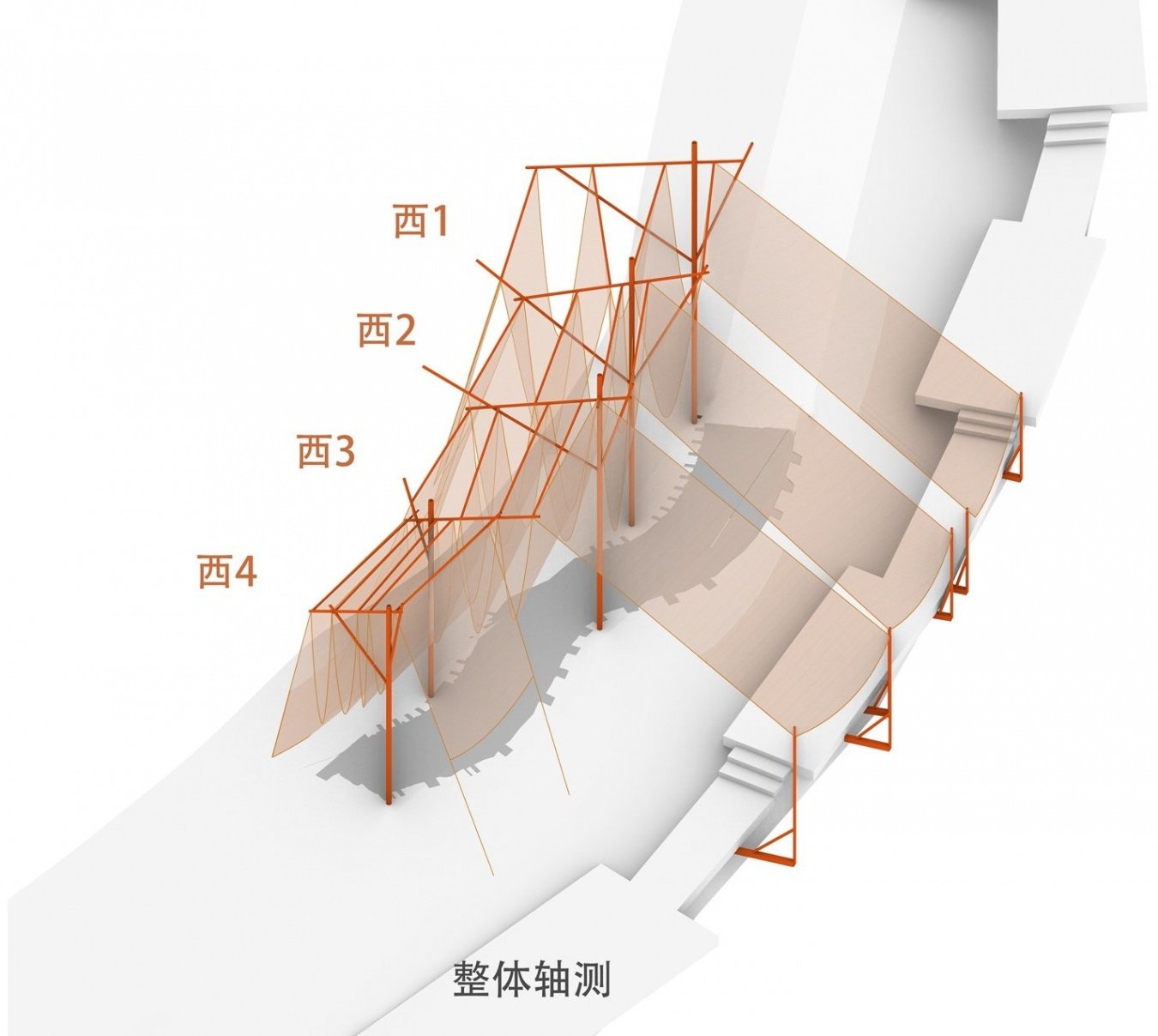
▼Overall axonometric ©Multi-Architecture

Constrained by a limited budget and the inability of the pond dikes to support heavy construction machinery, we collaborated with the structural team at iStructure to calculate the installation’s volume. We reached a consensus to maximize the volume despite the low budget. Scale is a crucial factor in land art; the affordability of fishing nets allowed us to expand from a small footprint to a larger one—extending to the water’s edge and engaging in a dialogue with Xiqiao Mountain, effectively making the mountain and water integral parts of our site.
▼Aerial view of the site © Zhu Yumeng
4 Folk structure
Vernacular Structure
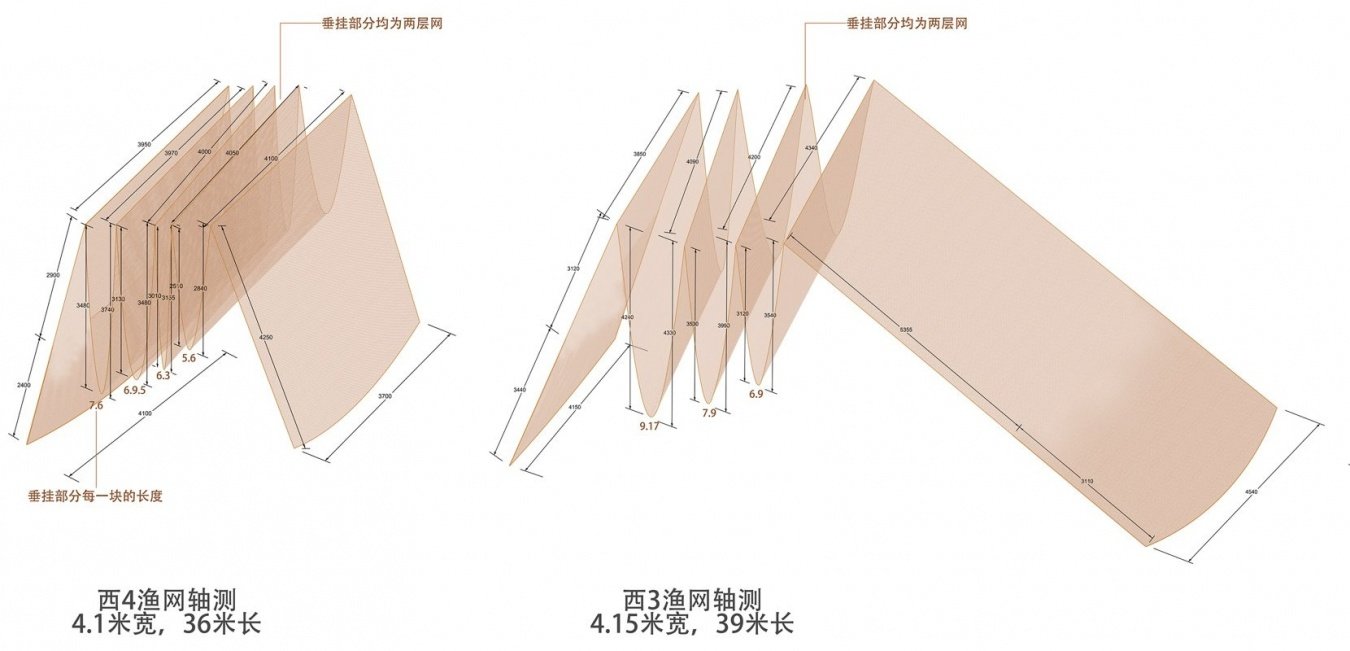
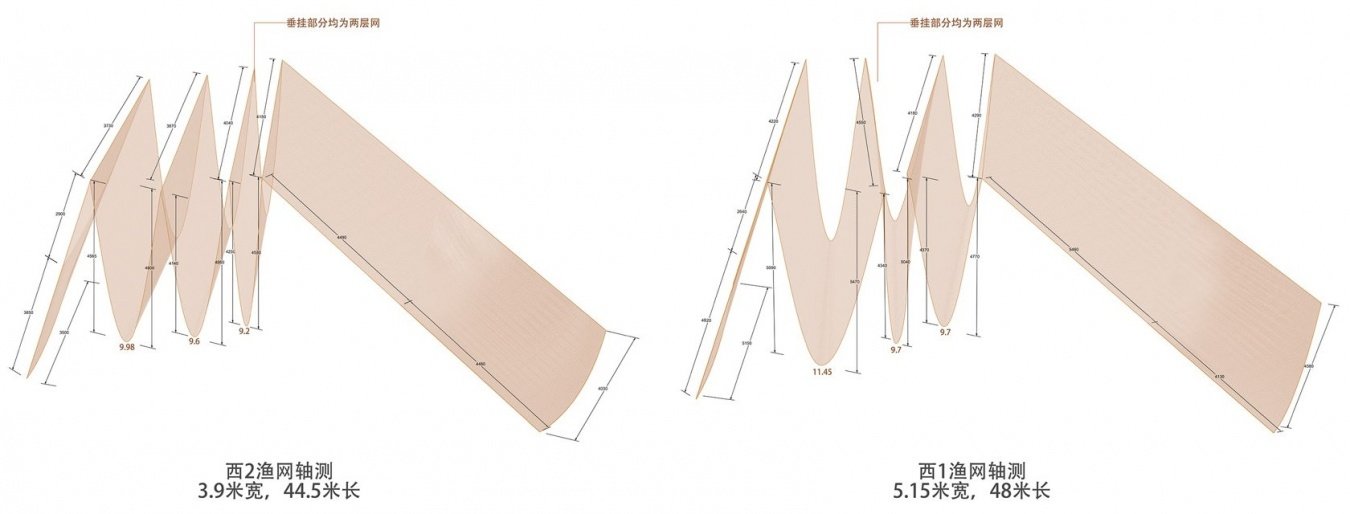
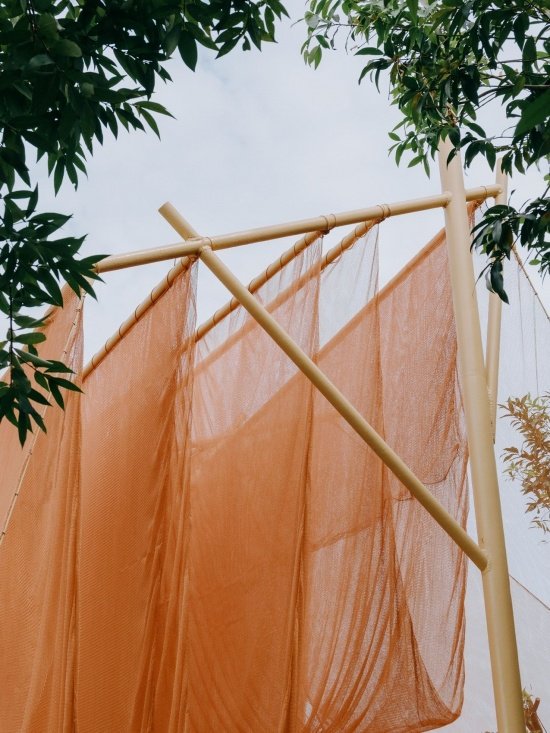
The steel structure supporting the fishing net is inspired by the triangular zēng net, a folk fishing tool. The fork shape presents a random and folk feeling, between calculated rationality and rural freehand brushwork, and is arranged from high to low along the mountain.
▼Axonometrics of West-4 and West-3 nets ©Multi-Architecture

▼Axonometrics of West-2 and West-1 nets ©Multi-Architecture

The steel structure supporting the nets draws inspiration from the sanjiao zeng (triangular lift net)—a traditional tool used for fishing at sea. The fork-like forms evoke a sense of randomness and vernacular charm; balancing structural rationality with a rustic, expressive aesthetic, the structures are arranged to follow the terrain, descending from higher to lower elevations.
▼Structure of the drying nets © Dong Jingyu
▼Structure of the drying nets © Zhu Yumeng
▼Structure of the drying nets © Zhu Yumeng
5 huge things
An Object of Immense Scale
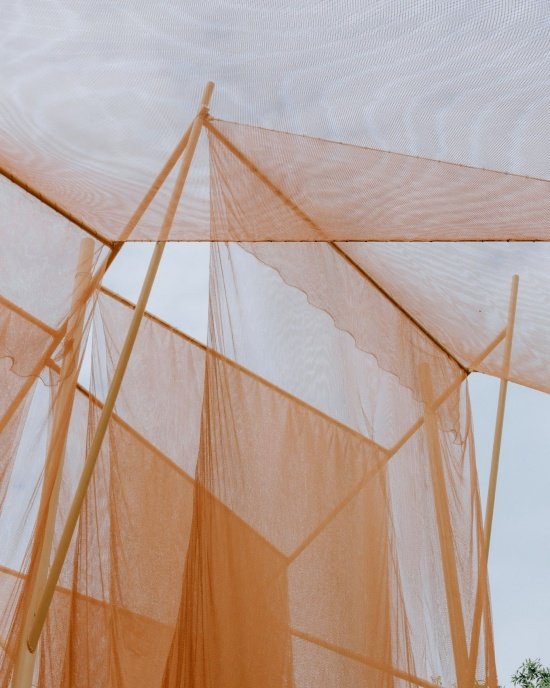
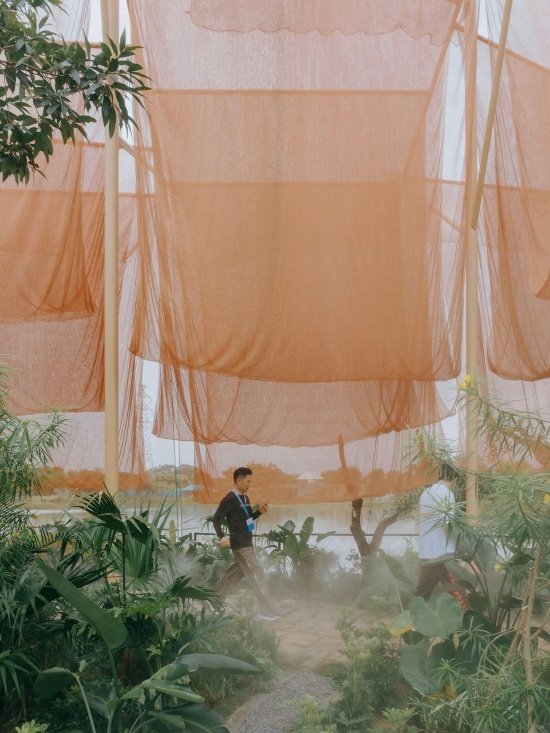
On the structure, the fishing net realizes the dual modes of “dynamic” and “static” through the two actions of “folding” and “hanging”. The stacked nets on both sides are stretched and fixed, and the top is hung high in the form of a hanging curtain. When the wind blows, the fishing net curtain floats and moves slowly above the head, like a huge breathing thing.
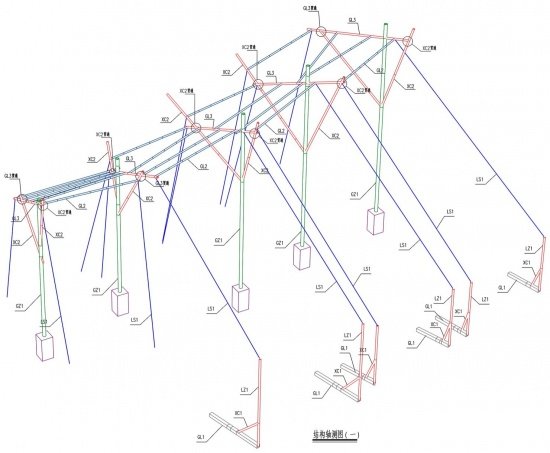
▼Structural axonometric drawing, Structural axonometric drawing © iStructure
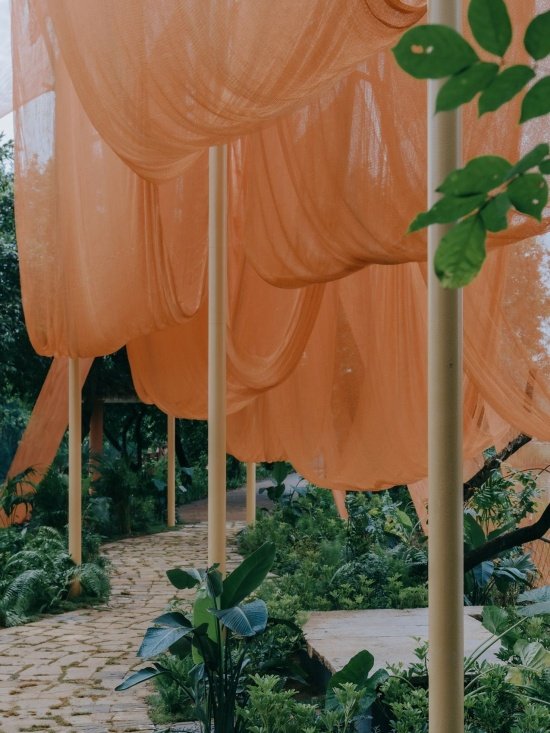
Above the structure, the fishing nets are manipulated through actions of “layering” and “draping,” creating a dual mode of both “movement” and “stillness.” The layered nets are tensioned and anchored on both sides, while the top section hangs high like draped curtains; when the wind blows, the net canopies drift slowly overhead, resembling a massive, breathing entity.
▼The top is hung high in the form of a hanging curtain.
the top section hangs high like draped curtains © Tian Fangfang
▼The top is hung high in the form of a hanging curtain.
the top section hangs high like draped curtains © Zhu Yumeng
6 Growing interiority
An Ever-Evolving Interiority
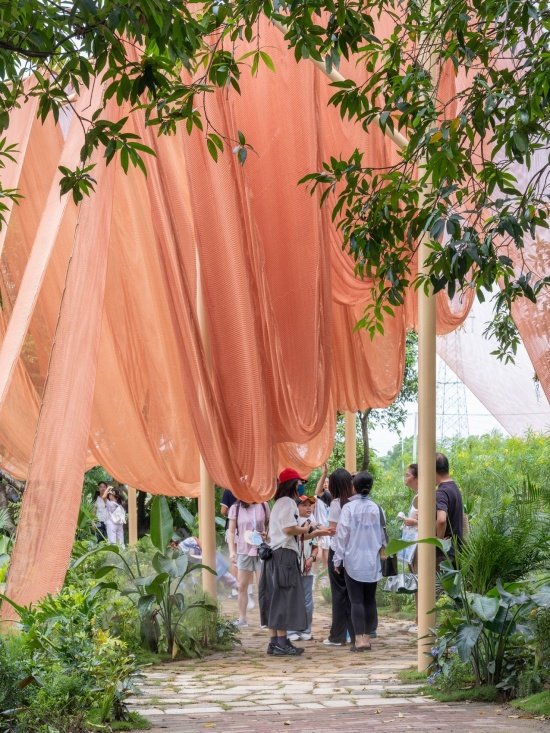
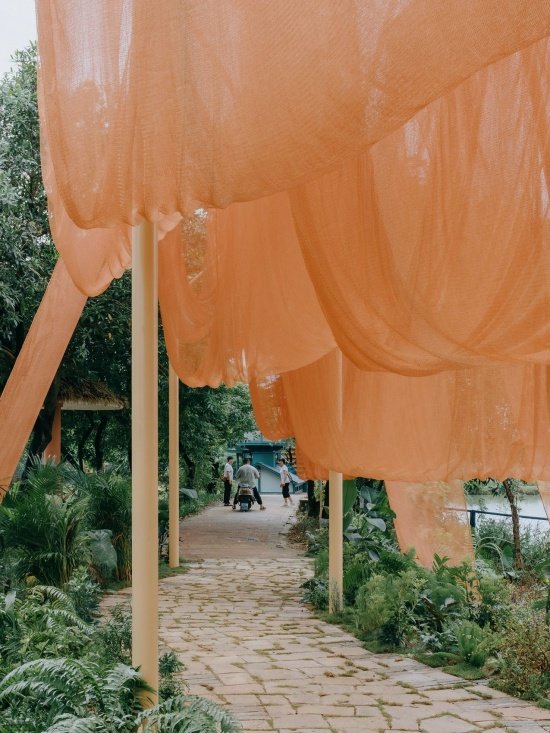
The internal trails follow an S-shaped trend according to the fallen pillar points, and are paved with old blue bricks and gravel slabs. It should not only be simple and natural, but also ensure that the uncle who manages the park can drive a tricycle through. Tropical plants are planted at different heights on both sides, and together with the fishing nets, they form a stronger sense of wrapping, echoing the memory of labor in the mulberry fish pond period. We also “moved” the slate beds that are often found by the waterside in Foshan villages here.
The interior path winds in an S-shape, following the placement of the structural columns. Paved with a mix of reclaimed gray bricks and broken stone slabs, the design balances a rustic, natural aesthetic with the practical need for maintenance workers to navigate the area on three-wheeled carts. Tropical plants of varying heights are interspersed along the sides; together with the fishing nets, they create a heightened sense of enclosure, evoking memories of the traditional “mulberry-dike-and-fish-pond” agricultural era. We also “relocated” the stone slab platforms—common sights by the waterside in Foshan villages—to this space.
▼ Together with the fishing net, it creates a stronger sense of wrapping.
create a heightened sense of enclosure © Zhu Yumeng
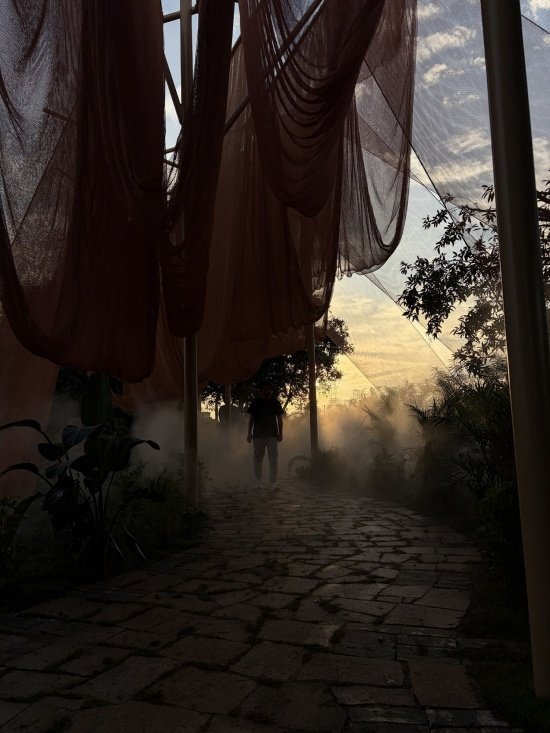
The addition of the Wusen system comes from the intuition of the southern body. Guangdong is often in a state of constant switching between exposure to dryness and rain and dew. Spray is both watering and landscaping, echoing the southern climate and bringing a hazy and warm feeling. As the seasons change, humidity, light and vegetation continue to change, making this space always in a state of slow growth.
The inclusion of a misting system stems from an intuitive, embodied understanding of the South. Guangdong frequently oscillates between scorching, drying heat and damp, dewy humidity. The mist serves a dual purpose—irrigation and landscape feature—echoing the southern climate and evoking a hazy, gentle atmosphere. As the seasons shift, the interplay of constant humidity, light, and vegetation ensures the space remains in a state of, gradual evolution.
▼ Together with the fishing net, it creates a stronger sense of wrapping.
create a heightened sense of enclosure © Zhu Yumeng
▼The drying nets in the mist © Jin Yuan
Here, when the fishing net is suspended, unfolded, leaves the water and unfolds at a more unusual scale, its original purpose is abstracted, but the experience related to it gradually emerges: the shape changed due to wind resistance, the moist smell that often remains after the rain, the imagination of labor brought by the fishing net itself, and the recurring relationship between people and water. Tour guide volunteer Xue Gu said that this place is a bit like the Guangdong she remembered when she was a child. The ambiguous linkage between this “kind of likeness” and our perception is exactly what we hope for.
Here, as the fishing nets are hoisted, unfurled, and lifted from the water—expanding to an extraordinary scale—their original utilitarian function falls away, yet the experiences associated with them emerge: the shapes sculpted by wind resistance, the lingering dampness after rain, the evocative imagery of labor, and the enduring relationship between people and water. Xuegu, a volunteer guide, remarked that the place reminds her of the Guangdong of her childhood. This subtle resonance—where a sense of familiarity intertwines with our immediate sensory experience—is precisely what we hoped to achieve.
▼Recalling Guangdong when I was a child,
reminds her of the Guangdong of her childhood © Zhu Yumeng
Project name: “Drying Fishing Nets”
Project Type: Landscape/Land Art
Designer: Guangzhou Multi-Architecture Studio
Company website: multi-architecture.com
Contact email: media_multiarch@foxmail.com
Year of completion: 2026
Project architects: Jin Yuan, Chen Li, Ji Shaomin
Design team: Zhang Zhiyi, Tan Zexi, Zhou Xinyang, Liu Bina, Zhang Zehong, Xue Tong
Project address: Yugeng Yueyun, Xiqiao Town, Nanhai District, Foshan City, China
Building area: 180㎡
Photography copyright: Zhu Yumeng, Tian Fangfang, Dong Jingyu, Jin Yuan
Material: fishing net
Project background: Art in Qiaoshan—Guangdong Nanhai Dadi Art Festival 2026
Chief planner: Sun Qian
Curator: HUBRAT
“Fishing Cantonese Rhythm” Section · New Building in Qiaohu Lake
Curator: Wang Zigeng
Executive Curator: Ren Yuqing
Project name: Under the Drying Nets
Project type: Landscape / Land Art
Design: Guangzhou Multi-Architecture Studio (Multi-Architecture)
Website: multi-architecture.com
Contact e-mail: media_multiarch@foxmail.com
Completion year: 2026
Project architects: Jin Yuan, Chen Li, Ji Shaomin
Design team: Zhang Zhiyi, Tan Zexi, Zhou Xinyang, Liu Binna, Zhang Zehong, Xue Tong
Project location: Yugengyueyun, Xiqiao Town, Nanhai District, Foshan, China
Gross built area: 180㎡
Photo credits: Zhu Yumeng, Tian Fangfang, Dong Jingyu, Jin Yuan
Materials: fishing nets
Background: Art at Qiaoshan – Art Field Nanhai 2026
Chief curator: Sun Qian
Curation: HUBRAT
“Yugengyueyun” Section · Qiaohu New Architecture
Curator: Wang Zigeng
Executive curator: Ren Yuqing
More:Guangzhou Duo Architecture Studio. For more information about them, please go to:Multi-Architecture on gooood
Source: gooood.cn