
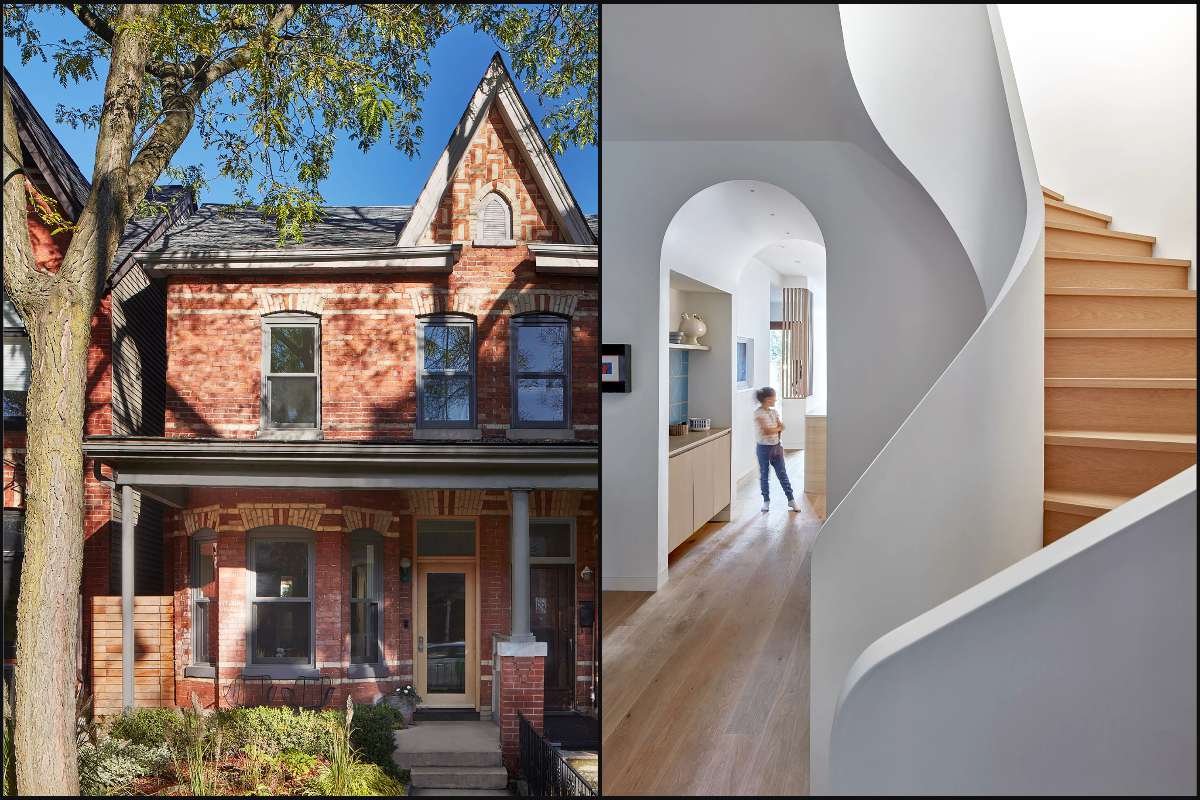

Built during the latter part of the nineteenth century in various middle-class neighborhoods, Toronto’s tall and narrow Victorian homes are known for their staid and somber exteriors that are typically clad with brick and outfitted with a bay window and gable roof (or known locally as a “bay-and-gable”). Many of these century-old homes still remain, some of them protected with heritage status, which typically means their front facade must remain untouched.
But preserving these historic homes doesn’t mean they can’t be updated to suit modern needs and tastes—and that’s an approach that is actually better for the environment if one takes into consideration all the upfront carbon emissions that can be avoided with renovating, rather than demolishing and building anew.
In overhauling a semi-detached Victorian house located near the University of Toronto’s Spadina campus, Toronto-based Dubbeldam Architecture + Design (previously) walked a fine balance between preserving the old and expanding the new. Nicknamed The Flow House, the two-story heritage home’s appearance has been carefully maintained out front, but at the back, a barely visible rear extension and third floor have been added to augment the space for the family of five that resides here.
Riley Snelling
Most notably, the architects say that home’s interior has been beautifully redone to include curvy and brightly minimalist elements, offering a welcome contrast to the buttoned down exterior:
“The rectilinear exterior gives way to fluid forms on the interior, to create a feeling of expansion within the small footprint and bring an element of surprise to an older home. As a professional ceramicist, the client’s connection to sculpture and pottery influenced the flow of the home and was a source of inspiration for the design. [..] Underpinned by an aesthetic of fluid lines, the house’s interior elements appear as if they have been sculpted rather than built, the result of combining traditional construction methods with more innovative solutions.”
We get a hint of that sculptural quality from the sidewalk, where the home’s main feature, a swirling staircase can be glimpsed through the window of the front door. The entry hallway is covered with warm terracotta tiles laid out in a subtle but visually stimulating herringbone pattern, while the built-in cabinets here offer space to hang up coats and put away shoes.
Riley Snelling
A gap above the cabinets and a series of wooden slats permits natural light to easily illuminate this narrow area.
Riley Snelling
The sitting room on the other side of the entry is well-lit, with the wooden flooring amping up the feeling of warmth that such natural materials bring.
Riley Snelling
From here, we catch a peek into the kitchen past the arched doorway, which the architects explain:
“Curvilinear forms are employed throughout—arched openings between rooms incite anticipation as they frame views of what lies beyond, resonating with curved walls, display nooks, the kitchen island and banquette—further enhancing the house’s sculptural sensibility.”
Riley Snelling
Nevertheless, the voluptuous stairway takes center stage, and is described thus:
“The stair functions as a light tunnel, drawing natural light from the skylight down three stories, filling the narrow house with light throughout the day. The curves of the stair cast graceful shadows onto the otherwise pristine and reflective white finish of the stair and surrounding walls, a constantly shifting and contrasting play of light that adds an additional layer of tactility.”
Riley Snelling
Before going up, we move into the dining room, and get a peek through the arched doorway here.
Riley Snelling
A blue-tiled nook serves as the bar area, and delineates a transition between dining and kitchen.
Riley Snelling
The kitchen has been completely redone with clean, flowing lines and a whitewashed palette to declutter the senses. All that white is offset with accents of oak wood cabinetry, ceramic pendant lamps, and natural stone countertops, including the curvy kitchen island with its own secondary sink.
Riley Snelling
A mix of built-in cabinets and open shelving creates a nice play between hidden and visible elements. The marble sink is an intriguing insertion that still stays close to the pale palette but diverges just enough to make it stand out.
Riley Snelling
The kitchen has been redesigned to feel much more connected to the backyard, thanks to a large set of sliding glass patio doors. Another built-in alcove here echoes the same arched form as the preceding doorway.
Riley Snelling
The breakfast nook embodies many of the same design ideas about flow and curvilinearity, creating a cozy space to eat and sip a morning drink.
Riley Snelling
The garden now has a new pergola to shield one from the sun. A variety of distinct outdoor zones are designated for eating meals, playing, and lounging around. The exterior has been clad with gray-toned cement board to give a modern look without the heavy carbon footprint of concrete.
Riley Snelling
Back inside, we go up the helical stairway, which is brightly lit from above with a skylight.
Those undulating lines help to enliven an otherwise pared-down space.
Riley Snelling
The second floor is where the children’s bedrooms are, plus a large bathroom too.
Riley Snelling
The staircase terminates on the third floor with this comfy, window-lit reading nook.
Riley Snelling
On the top floor, the parents have their compact but well-illuminated bedroom due to the massive sliding glass doors and the small outdoor terrace that extends the indoor space farther out.
Riley Snelling
Flow House is a great example of how the reuse imperative makes sense in a world where we must be mindful not to overspend our carbon budget by building shiny new things. After all, we now know that a lot of upfront carbon emissions can be emitted when replacing a demolished building—and that’s why we should try to save every old building. More over at Dubbeldam Architecture + Design.