

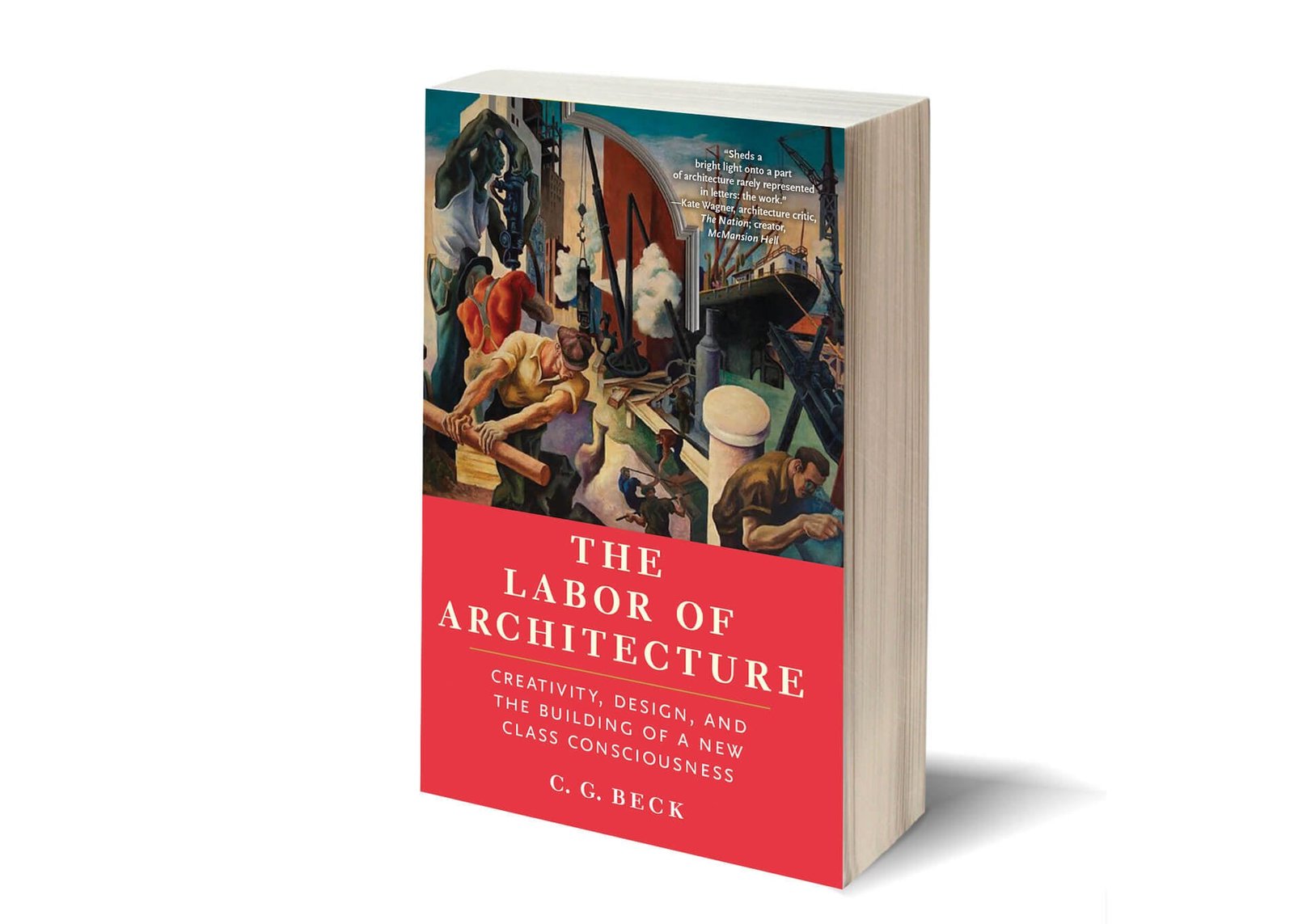

The Labor of Architecture: Creativity, Design, and the Building of a New Class Consciousness by C. G. Beck | Monthly Review Press | $22.00
There is a specter haunting the field of architecture, and that specter is called “Fuck the bosses”—or class consciousness.
This year began with a few powerful instances highlighting the complicity of architectural firms in schemes of exploitation and oppression. This wave may finally be delivering the necessary permission structure for architectural workers to rise up together and reclaim the power of creativity in delivering social change. At least there seems to be a systemic recognition that architects not only can be, but actually are, workers, despite whatever illusions of prestige and authorship their project managers tell them now and their studio professors proposed back in their education.
In January, the National Labor Relations Board (NLRB) filed a formal unfair labor practices (ULP) complaint against the prominent and decorated firm Snøhetta for likely firing employees who took place in a failed unionization effort in 2023. Although the vote for unionization failed by 35–29, the closeness of the outcome seemed to induce firm principals to engage in retaliation illegal under American labor law (even under the reheated Reagan policies of the Trump administration). One month later, the Bjarke Ingels Group (BIG) announced the layoff of 70 employees as “redundancies,” sparking not the typical acceptance of managerial abuse but mass protests at BIG’s London office.
These anti-labor moves by big firms could easily be chalked up to the shortcomings of specific leaders. Ingels has raved recently about the potential of artificial intelligence to allow one architect to have the power of 700 designers, so the starchitect’s stance against the value of the worker is pretty easy to spot. Many architects will avoid reckoning with such problems by recounting their mentions in award announcements and publications by their firms, raises and bonuses, and conviction that their creative input can be seen in their projects.
Enter C. G. Beck’s recent book The Labor of Architecture: Creativity, Design, and the Building of a New Class Consciousness. Beck arrives not as a wistful theorist of revolution but an accomplished architectural worker and organizer who helped realize the first U.S. unionized architectural firm. Beck was a lead organizer in the unionization of Bernheimer Architecture in 2022, which was voluntarily recognized by firm leadership.
Since then, he has been a coordinator of Architectural Workers United (AWU), which is affiliated with the International Association of Machinists and Aerospace Workers (IAMAW). These experiences pepper the book’s introduction with the fruits of activist praxis. Since the Bernheimer union was created, AWU has supported a second successful union drive, at Sage & Coombes Architects in 2023. Lest anyone envision the AWU as a scorched-earth campaign against architecture itself, consider the mission statement: “We are committed to the success of our industry, the advancement of our profession, and the improvement of our shared built environment.” This seems like it could be the mission of the American Institute of Architects (AIA), except that the AIA exists mostly to advocate for the owners of firms and practices, not their workers.
AWU comes in at a vital moment to coordinate what may soon be a wave of office union drives. The NLRB decision against Snøhetta also looms large. If the U.S. government punishes the firm, then architectural workers will have found another key to widespread permission to go after what they deserve.
Reclaiming Creativity
Beck roars back against the current state of architectural work with a passionate defense of the profession’s core value of creativity, arguing that the call for architecture workers to unionize is inherently tied to the reclamation of architecture’s social power. Beck consistently relates the labor struggle to the force of human creativity that architecture should express and avoids any easy demonization; he doesn’t waste time railing against specific architectural firms or starchitect bad bosses but instead remains focused on the project of reclaiming the social power of architectural labor. This is the ability to not simply produce material forms—drawings, plans, models—but to intangibly change social relations through design.
One of Beck’s early arguments is that architectural workers are alienated from their own creativity through the technological shift between architecture as a craft—producing material forms—to a profession working almost exclusively in digital modeling. Beck’s structural analysis of architectural firms is succinct and useful, especially for students and allied professionals. However, he insinuates that the industrialization of architecture could be a key locus of worker alienation and draws a few times on the English socialist designer and theorist William Morris, active in 19th-century decorative craftand historic preservation movements, to underscore that point.
In Morris, Beck finds a precedent for the sort of designer whose consciousness has been liberated from capitalist exploitation of individual skill. Visionary and capable, Morris advocated for the appreciation of the divisions of labor that made works of architecture possible, from the draftsperson to the stone mason. According to Beck: “We have the explicit call for historians to not attribute great works of architecture to single men, deceptively following the individual genius model, but rather the countless men, and today we should say people at large, whose hours of collective labor made possible such great works.”
Beck’s consideration of Morris could set up a romantic opposition between craftand modernity and lead to a dreamy project of the restoration of architect as precapitalist artisan, a figure that never existed. In The Origin of Capitalism, Ellen Meiksins Wood argues that industrialization is an effect of the marketization of society based in property relations, not the cause. The worker’s dependence on the market for self-reproduction thus arrived not through the industrial division of labor but through the inception of property crafted but not owned by the laborer. Beck makes the case, however, that capitalism’s late stage neoliberal turn did transform the consciousness of architects like never before.
He argues that the transition from craft to profession robbed architecture of its countercultural and radical aspects, especially in larger workplaces where specialization is the norm. However, he maintains a cautious optimism that unionization can build not only better working conditions and possibly stave off mass precarity in the field wrought by AI. Yet key is what Beck terms “imagining a new society through our unionization efforts,” so that collective bargaining is not just a utilitarian cudgel but a process of realizing mutual aid, interdependency, and de-alienation among designers. Beck also repeatedly states that while this will require a class struggle, given the differentiation between architecture and building trades, this will need to be rooted in cross-class solidarity.
Beck counters my critical scrutiny with an unexpectedly beautiful defense of academic architectural studios. The studio’s dialogic culture, in which students learn by working instead of memorizing and reproducing knowledge, suddenly soars as a space of liberation in this narration. Anyone expecting Beck to demolish conventions of architectural pedagogy will be thwarted in the early passages extolling the studio as a space of discovering the potential of personal creativity. Beck makes a compelling argument that the studio becomes one part of the dialectic alienation of the architectural laborer who finds a professional position after leaving academic training. The architecture schools insinuate that the architect is a visionary, synthesizing design ideas into practice, and an artist. At work, the same person is just a tool of the company.
While Beck’s book is a clarion call to office unionization, it also presents a stunning defense of architecture’s social potential. There are passages where Beck narrates Marx and other theorists like a literature review, which will be very useful to architects who have not read those sources. After all, the author invites architects to“class consciousness”and demonstrates a sensitive commitment to developing just that. Beck never loses sight of architecture itself, which he champions as a tool of creative thinking that will be necessary for a wider, worker-led confrontation of capitalism.
Beck leaves his readers in a place of great imagination, with his retelling of the legacy of the Tennessee Valley Authority (TVA), which provided the federal government with the tools to manage deforestation, agriculture, electrical power and hydrology. The TVA employed an understudied architect, Roland A. Wank, who pushed for matching giant infrastructural programs with small acts of design beneficial to social coherence. Beck makes this point to underscore that even from within highly bureaucratized and deeply professionalized practices, design needs not always adulate capitalism’s inhumane structures.
The culprit is not the architect. The problem is not architecture. The barrier is capitalism. There may be no more optimistic assertions of architecture’s social capacity than Beck’s new book and the unions it may inspire.
Michael R. Allen is a historian, writer, and architectural educator who has taught at the Sam Fox School of Design and Visual Arts at Washington University in St. Louis and West Virginia University. He is coeditor of Peripheries: A Journal of Place and Position.
This post contains affiliate links. AN may have a commission if you make a purchase through these links.