

Mayor Michelle Wu is investing significant resources to flip office buildings into housing, as vacancy rates in downtown Boston remain relatively steady. The Wu administration’s efforts have been accelerated by the Affordable Homes Act, passed by Massachusetts Governor Maura Healey in 2024.
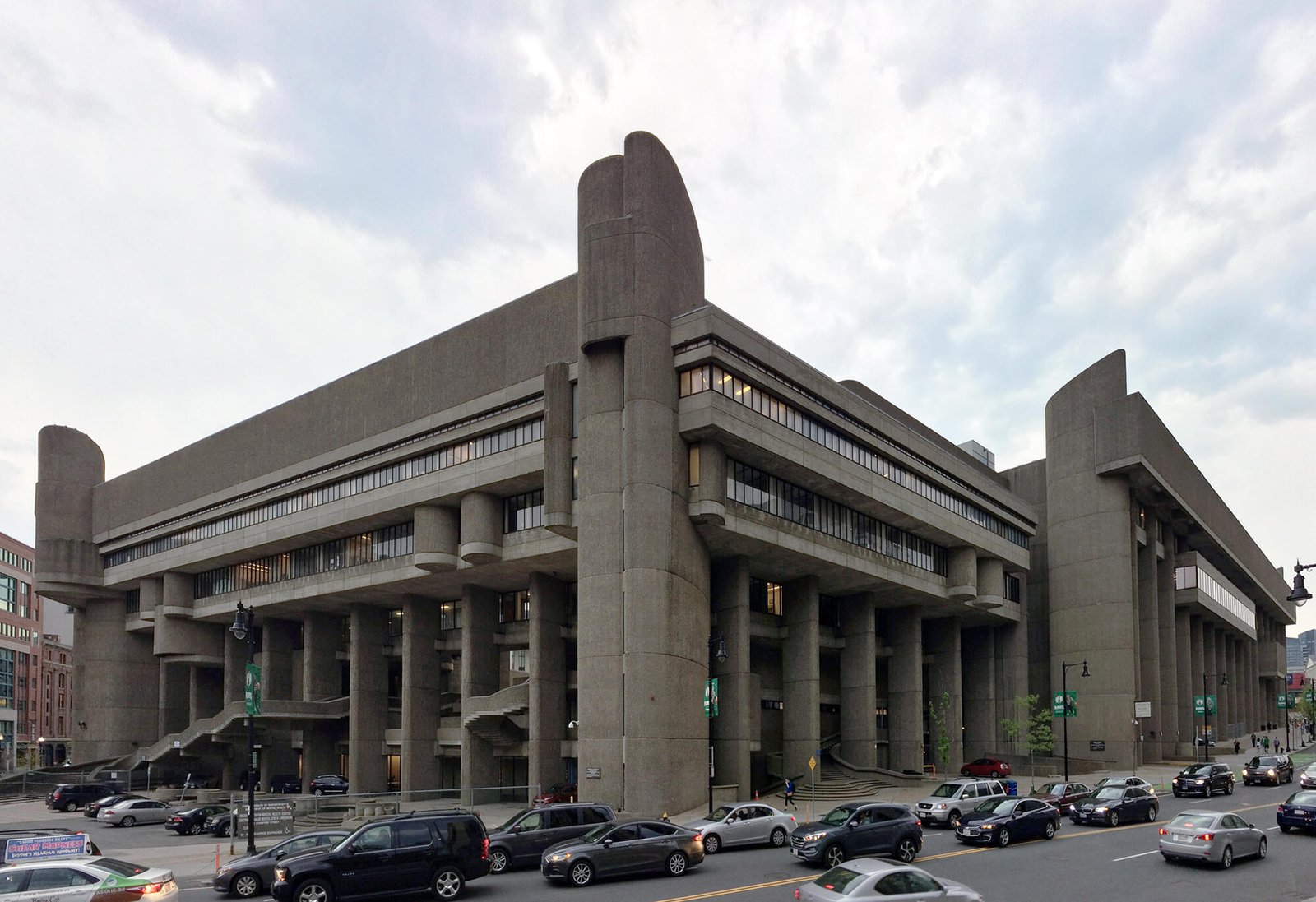
The largest project stemming from this office-to-residential conversion initiative to date is now advancing out of the Charles F. Hurley Building and the Erich Lindemann Mental Health Center, in Boston’s Government Services Center planned by I. M. Pei and Henry Cobb.
The Hurley Building was designed by Shepley Bulfinch Richardson & Abbott with Paul Rudolph. And the Lindemann Building was designed Desmond & Lord and also Rudolph. Both were built in 1971.
On June 10, Massachusetts Governor Maura Healey issued an Offering Memorandum (OM) to redevelop the Lindemann-Hurley site.
Governor Healey first expressed interest in transforming the complex into housing in 2024. The OM will get the ball rolling through legislative action. I
In 2020 Bruner/Cott Architects published a Historic Preservation Report, outlining design guidelines for architects active at the Lindemman-Hurley site.
Now, proposals for the Lindemman-Hurley site will have to adhere to design guidelines set in 2021 by the Division of Capital Asset Management and Maintenance (DCAMM), and updated in 2026, based on the report by Bruner/Cott Architects.
The design guidelines call for proposals that complement the site’s “monumental scale with additional elements at human scale,” and seek “ways to activate the ground floor, sidewalks, and public spaces,” among other directives. Proposals should also enhance “the connectivity of the Central Courtyard to improve its linkage to the city surrounding it,” per the design guidelines.
The Massachusetts Governor’s office affirmed in a press release that “historic preservation and adaptive reuse will be key considerations for this project.”
“Developers are encouraged to think creatively about reuse to preserve architecturally significant aspects of the site as a whole, in addition to better integration of the site with the surrounding community,” the statement adds.
City officials shared plans in 2020 to tear down the complex, causing an uproar. Chris Grimley, co-author of Heroic: Concrete Architecture and the New Boston, made an argument in AN for why the Lindemann-Hurley site needs saving.
In 2022, the state issued an RFP calling for ideas to transform the complex into lab and office space. Renderings of a proposed redesign for the Lindemann-Hurley site by NBBJ followed, showing the complex reimagined as a mixed-use hub flush with lab and office space, housing, and parkland.
Demand for office and lab space in Boston dried up during COVID-19, although there are signs of a reversal taking hold. The pivot from lab and office space to housing is in response to this economic reality.
“The past couple years have been a difficult environment for real estate development, with construction costs and borrowing costs both well above pre-pandemic averages, alongside other challenges,” per a DCAMM report from 2025 that outlines the Lindemann-Hurley site’s development potential.
“Both construction costs and borrowing costs remain high, but trends indicate that this project is likely to benefit from a more favorable environment going forward than has existed recently,” the report continues.
DCAMM is aiming to have selected a development partner for the Lindemman-Hurley site by 2027.