

Love Bank Park began with a simple act: in 2015, neighbors placed a temporary basketball hoop on a vacant lot along Cherokee Street, instantly creating a community gathering point. Cherokee Street is a vibrant and diverse corridor with many Latinx, Black, and immigrant-owned businesses, but one historically shaped by disinvestment, poverty, and violence. Despite the neighborhood’s high concentration of cultural and economic anchors as well as the presence of a high number of multi-generational families, as of 2015 Cherokee Street and the surrounding neighborhood did not host a single public space of any kind. With its arrival, that hoop became the seed for a park-for-all, rooted in local culture, play, and community belonging.
In 2016, the Community Improvement District (CID) engaged the landscape architect to begin conceptual design for a robust community park, as well as support a substantial grant application for stormwater capture through the Metropolitan Sewer District’s Project Clear program. That program provides reimbursement funding for projects which demonstrate their ability to capture and usefully redirect stormwater away from the combined sewer system.
Over the next eight years, residents, youth groups, business owners, and the CID worked collaboratively with the landscape architect to co-author the design. Iterative, diversified, and sustained engagement ensured that the park would serve and reflect the interests of the neighborhood.
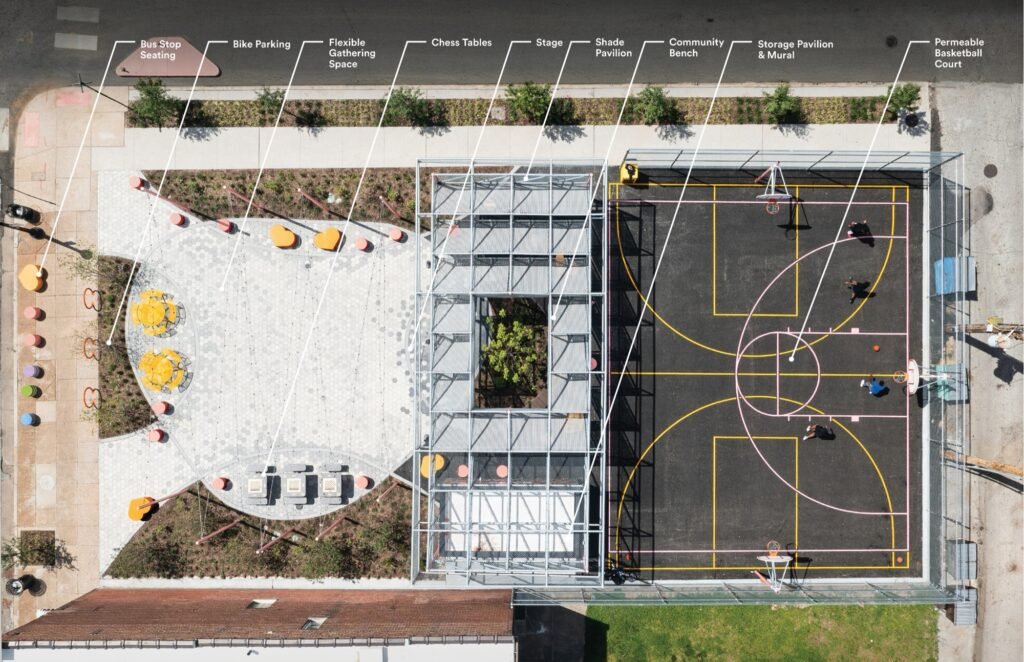
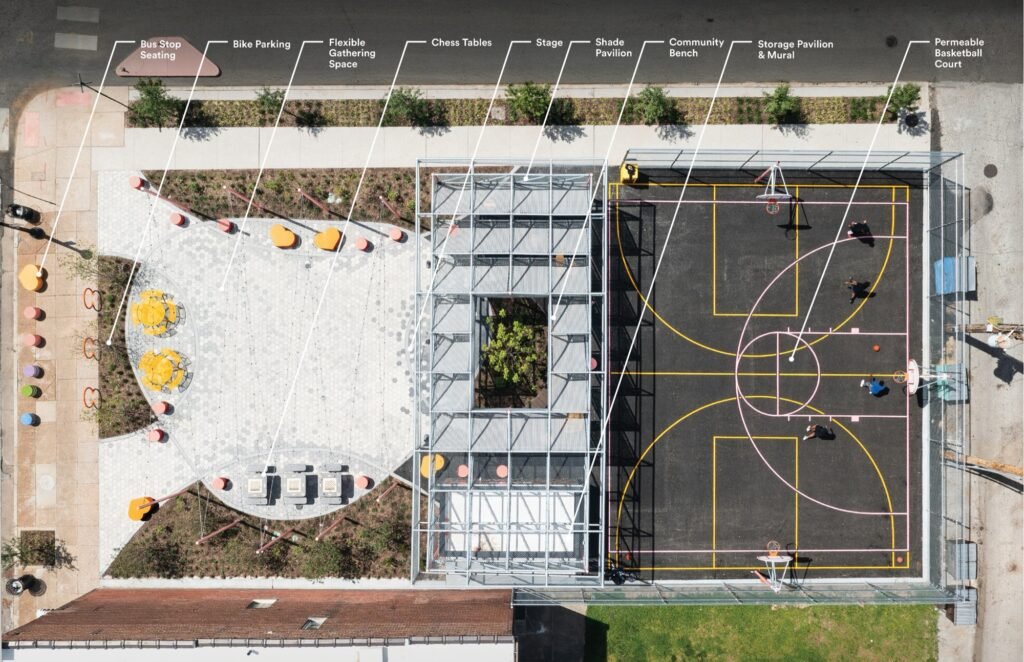
The park’s layout is inspired by Venn diagrams, translating the power of public spaces to create common ground between diverse people into an organizing park design framework that overlaps diverse program areas to create multi-functional, inclusive, and interconnected spaces. A permeable plaza, referencing Latin American plaza design, offers seating, chess tables, flexible open space, and a stage area under a lattice of catenary lighting and framed by shade trees and planting beds. The northern half of the park features the region’s first permeable basketball court, supporting both full- and half-court play.
Connecting these zones, a central shade pavilion pierced by a specimen Catalpa tree provides dual-facing shaded seating, programmed lighting, and a visual anchor that encourages pause and gathering. The shade pavilion is comprised of a series of galvanized steel trusses and clad in a chain link fabric skin, the canopy picks up on the language of the urban basketball court and personifies the park’s grassroots character in its unique use of simple materials. The multi-layered effect of the chain link cladding creates a delicate overhead condition, framing the performance area below. During the day, the canopy and tree cover provides shaded respite. In the evenings, the character of the canopy evolves into a backdrop for performances and events through a careful lighting strategy which highlights its structural features.
Love Bank Park is designed for simultaneous uses. During opening weekend, local food carts sold lunch, youth played pick-up basketball and swung at piñatas, and neighbors played chess and danced to live mariachi musicians. Two months later, a Shakespeare company performed to a standing-room-only crowd while basketball play continued uninterrupted just feet away. These overlapping programs demonstrate the park’s flexibility, its ability to accommodate everyday and event activity, and simultaneously serve a diverse community’s needs in a compact space, year-round.
Stormwater systems, capturing stormwater across more than 90% of the park, are seamlessly integrated: bioswales, permeable paving, and native plantings manage runoff while creating habitat and moderating microclimate. Plants were selected for medicinal, edible, seasonal interest and wildlife value – and it’s become common to see pollinators fluttering about, neighbors harvesting serviceberries from the site when they are in season, and sidewalk strollers reaching out to brush the native grasses while walking by. These ecological measures support neighborhood health and resilience and provide a seasonally dynamic background for the park’s social experiences.
Today, Love Bank Park is a trusted, vibrant gathering place and a visible symbol of what co-authored public space can achieve. A formerly vacant asphalt lot now hosts daily play, cultural celebration, and community connection, showing how thoughtful design and sustained engagement can create enduring civic vitality.
Project Credits:
Cherokee Street Community Improvement District (Client)
Arbolope Studio (Landscape Architecture)
Patterhn Ives (Building Architect)
KPFF (Structural)
Introba (MEP)
Civil Design, Inc. (Civil)
Lighting Associates (Lighting Design)
E.M. Harris (General Contractor)
38.59446726563616, -90.232085164418