
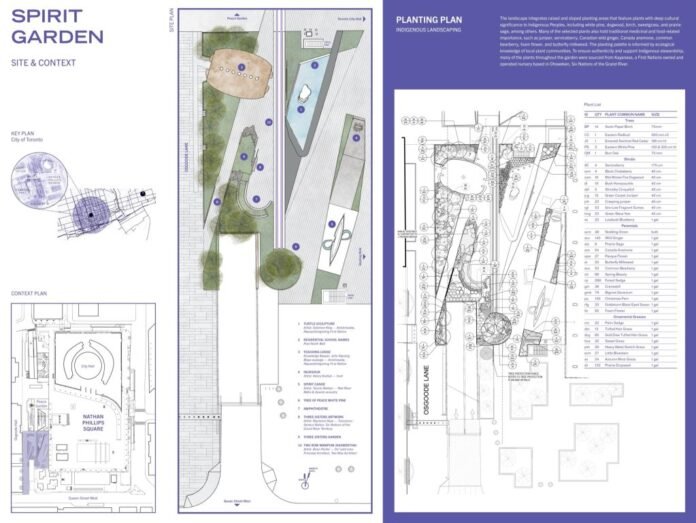
Located in the civic heart of Toronto at the iconic Nathan Phillips Square (NPS), the Spirit Garden is an urban landscape dedicated to Indigenous culture; a gathering place for contemplation, celebration and ceremony. A partnership between the City of Toronto and Toronto Council Fire Native Cultural Centre (TCFNCC), it is a public project of deep cultural significance, local and national value. Between 1870s and the 1990s, some 150,000 Indigenous children were forcibly removed from their families and communities and sent to Canadian Residential Schools. The garden was developed in response to the Truth and Reconciliation Commission of Canada’s Call to Action 82 mandating each capital city installs a publicly accessible, highly visible monument to honour Survivors and all the lost children.
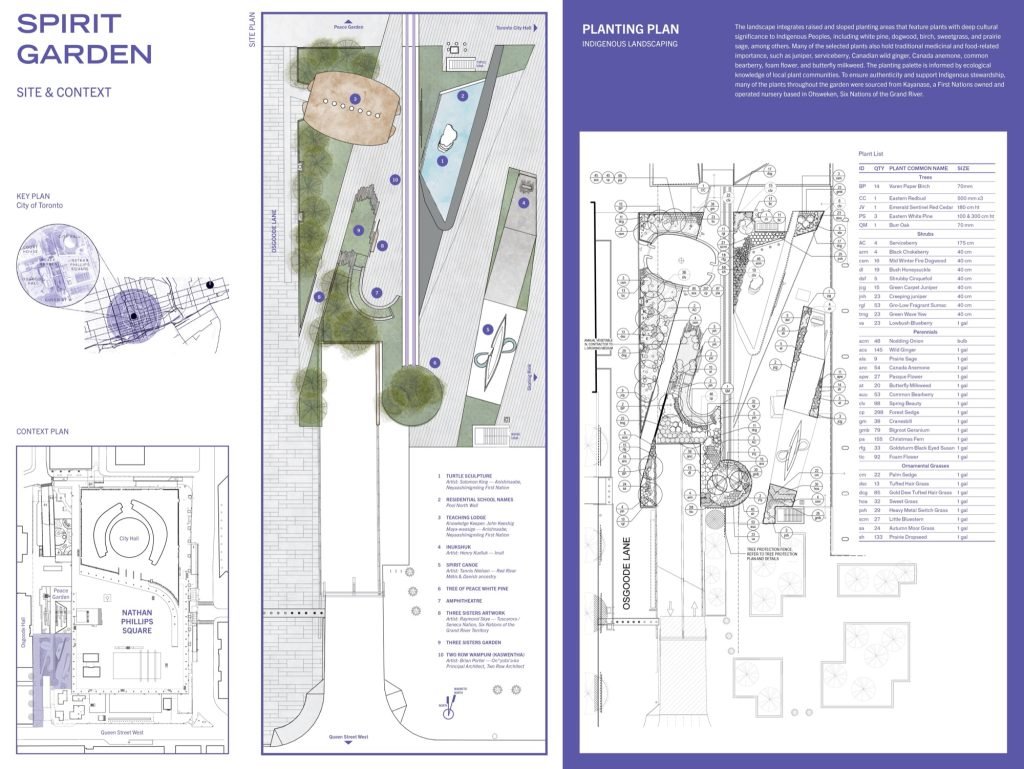

The design team worked closely with TCFNCC to reinterpret the call as more than a monument; to create an active public space that acknowledges the past, honours the present and reimagines the future. It was a tremendous collaboration between artists, architects and landscape architects, Indigenous and non-Indigenous, involving engagement with Survivors, intergenerational members, local Indigenous groups, Chiefs Assemblies, Faith Groups and other Nations represented. Drawn from Indigenous values and narratives, the Spirit Garden features a series of installations, ranging from landscape to artwork to built form, that facilitate teaching, learning, healing, sharing and moving the dialogue forward between Indigenous and non-Indigenous communities.
Completed in 2024, the 1,918 sqm Spirit Garden is the last missing piece of the 2015 revitalization of NPS, home to Toronto City Hall. It renews life at the southwest quadrant, formerly run-down and unwelcoming. The underused gravelled area was transformed to be inviting, functional and versatile with amenities for city dwellers and visitors alike. It is part garden, outdoor gallery, mini agora and learning commons. Focused on the visitor experience, thoughtful architecture and landscape design work in dialogue to choreograph visitors’ movements through the site where they can engage with Indigenous stories and symbols in different ways, but each at an intimate, human-centred scale:
• gathering in the open-air Amphitheatre next to the Tree of Peace;
• playing in the Spirit Canoe, admiring its intricate craft;
• learning from the Three Sisters’s example of land stewardship and sustainable agricultural practices;
• measuring themselves against the life-size Inukshuk;
• contemplating the origin of Turtle Island (North America) at the Turtle Sculpture;
• reading the engraved names of Residential Schools at the reflecting pool; and
• walking the Kaswentha, a two-row continuous path the length of the site embodying the mutual relationship between Indigenous and non-Indigenous people.
The Spirit Garden is anchored by the Teaching Lodge, a golden-hued, oval-shaped ceremonial and cultural space with seating for 60. Modelled after the Haudenosaunee longhouse, its design was guided by an elder Knowledge Keeper; embedded in its form and function are Indigenous teachings and key beliefs — the importance of family, life’s journey, and a spiritual home. Like the rest of the garden, it uses a restrained palette of wood, stone and copper, materials significant to Indigenous culture; it is made of a laminated timber frame enclosed by copper metal panels.
Centring Indigenous placemaking, the Spirit Garden evokes a deep relationship with the land in keeping with Indigenous ecological knowledge of and respect for the earth. The landscape integrates natural elements in the urban hardscape. The planting palette consists of local plant communities, many holding traditional medicinal and food-related importance. Most plants were sourced from a First Nations-owned and operated nursery to ensure authenticity and support Indigenous stewardship.
Since opening, the Spirit Garden has impacted the city in measurable ways. It adds another layer to Nathan Phillips Square’s richness as a public realm by fostering exchanges across cultures and generations. It has hosted school children engrossed in outdoor lessons; Indigenous Veterans and government officials joined in solemn remembrance; observants welcoming the summer solstice at sunrise; to name a few of its multiple uses and users. The Spirit Garden is a living reflection of Indigenous voices, knowledge, resilience and aspirations, alive with art, activity and meaningful interactions that enhance the experience of Toronto’s signature civic space.
Client: City of Toronto; Toronto Council Fire Native Cultural Centre
Design Lead: Gow Hastings Architects
Indigenous Architect: Two Row Architect
Landscape: PMA Landscape Architects
Artists: Solomon King (Anishinaabe); Henry Kudluk (Inuit); Tannis Nielsen (Red River Métis & Danish ancestry); Raymond Skye (Tuscarora & Seneca Nation)
Knowledge Keeper: John Keeshig (Anishinaabe)
43.65212678854593, -79.38455270610402