
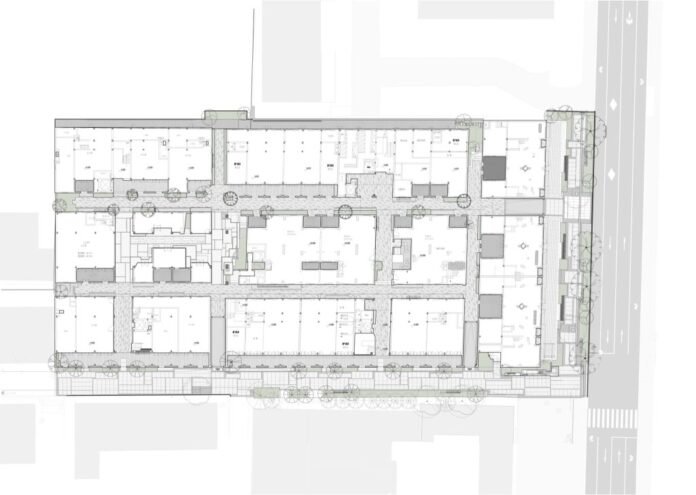
Yanqingli is a landscape-led regeneration of a 92-year-old “Lifen” block in Hankou, Wuhan. Built in 1933, this red-brick row-house compound embodies a distinct spatial DNA: a gradient of collectivity from public lanes through shared courtyards to private interior. By the 2020s, ad-hoc occupation had sealed courtyards, severed sightlines, removed all planting, and tangled overhead power lines across the sky. The landscape intervention recovers this eroded logic, reanimating a historic residential typology as collective civic space.
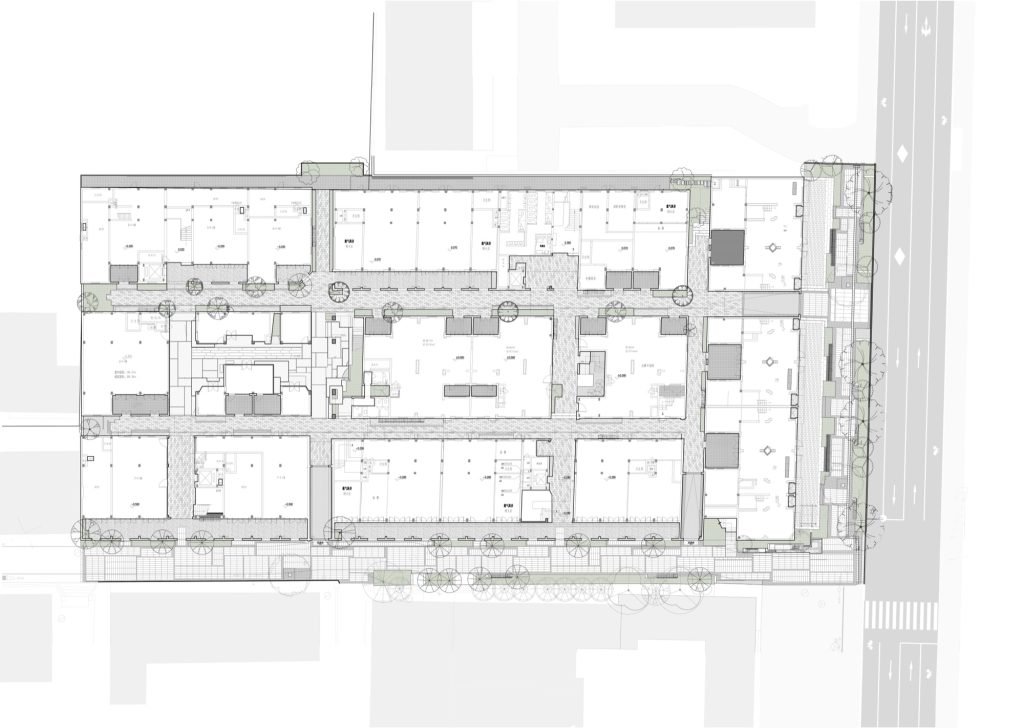

We read the site as a thickened manuscript—a palimpsest where every historical layer, even rupture, carries value. The design sought “enduring structures”: the lane-to-courtyard-to-interior sequence, the intimate alleyway scale, the tradition of climbing plants. One layer proved unexpectedly generative: a 1944 wartime air raid had severely damaged buildings at the block’s heart. We saw in this scar the seed of collective territory.
Design Strategy
The strategy operates across four registers:
Spatial Logic Restructured
The original Lifen offered a monotonous gaze—interiors facing barren, over-scaled lanes without planting. We recalibrated them into garden lanes for lingering and shaded lanes with tensile canopies for Wuhan’s summers. Eryao Road, formerly a vehicle-priority asphalt strip, was reclaimed as a pedestrian green street.
The Central Garden: A Void Becomes a Heart
Where wartime bombing left its deepest scar, non-historic partition walls were selectively opened to carve a micro-public clearing: the Central Garden. Rather than build upward, we excavated. The sunken, tiered design registers historical rupture through downward stratigraphy, producing an enclosed, inwardly focused space. It resolves the oppressive low headroom of former ground floors while creating a flexible amphitheatre—terraced levels accommodate performances, gatherings, and solitary pause. Porosity extends into adjacent alleyways, generating grey spaces where the street market can spill and pool.
Materials: Shadow, Stone, Craft
Moulding profiles from original stone gateways were adopted to lend visual depth across the paving. Recovered granite flagstones were reintegrated into the ground plane. Traditional water-washed sand finishes sit alongside reclaimed materials, establishing continuity over contrast.
Groundwork: Grading and Invisible Infrastructure
Uneven thresholds had rendered the site inaccessible; failing drainage left alleys waterlogged. We recalibrated thresholds into one continuous flush ground plane, enabling barrier-free access for the first time. Power lines were buried, restoring the red-brick skyline. Renewed drainage, discreetly tucked into the stone paving, channels both water and movement. These buried systems measure success through invisibility—lanes dry after rain, sky clear, ground easy to walk. The block now performs as 21st-century public space while retaining its 1930s neighborhood character.
Planting: Biography and Belonging
Every surviving mature tree was retained, including London planes and established ivy. Climbing plants that once characterized Lifen living were systematically reintroduced to re-sheath brickwork in green. The planting palette draws exclusively from Wuhan’s historic lane species. For planters, locally produced terracotta half-pots, split vertically and deployed against walls, allow planting in the narrowest residual spaces where soil depth is insufficient for conventional containers—a small tactical gesture with large spatial consequence.
A Living Ground
Yanqingli refuses static preservation. The landscape cultivates ground for everyday life—where historic brickwork is touched, leaned against, woven back into living routines. No prescribed route governs movement. Lanes widen into gardens, narrow into shaded passages, spill unexpectedly into the Central Garden’s sunken clearing. The rhythm is loose, closer to a neighborhood ramble than a curated promenade. This informality invites the unscripted encounter that defines Wuhan’s street life.
A continuous recessed ledge between main lane and shopfronts provides a shaded zone for pause—the spatial courtesy of the Qilou arcade translated into the grain of the Lifen: narrower, more intimate, shaped by red brick.. Here, coffee cups rest on the ledge mid-conversation; passersby lean against walls and watch the lane’s slow theatre. Courtyards can be claimed for afternoon markets; grey spaces become design talk venues by evening. The landscape does not predetermine these uses. It holds space for them. The block breathes because it has been left open—for people, for time, for the ordinary life that makes a city.
Client: Wuhan Construction Investment Development Group Co., Ltd./ Wanhua Group
Architecture: Mix Architecture
Interior Design: FANAF(Fan Architectural Firm)
Signage & Wayfinding: Liangxiang Design
Photography: IAM Photography/ Chill Shine
No. 287 Shengli Street, Jiang’an District, Wuhan, Hubei Province, China