

What kind of park would best serve a community as active, rooted, and diverse as Sembawang? The answer, at Bukit Canberra, was not a park at all — but a living commons. From meals, to movement, to medical care, it integrates essential neighbourhood functions into a seamless landscape experience, all in one.
Bukit Canberra is a 12-hectare integrated development completed in 2025, designed to serve the livelihood of approximately 100,000 residents in the Sembawang heartland, most of them young families and elderly. Incorporating hawker centres, fitness zones, therapeutic gardens, and community gathering spaces within a single topographic gesture, it is envisioned as something more than a weekend getaway. It is a living commons for residents to inhabit, traverse, and rely upon daily — a place where everyday routines happen within nature. Its challenging topography had historically reinforced physical and social disconnection for surrounding residents, and Singapore’s land scarcity demanded a shift away from conventional civic planning, where facilities are grouped but operate independently, toward something more ambitious: a landscape that synthesises rather than merely co-locates.
The project is guided by the principle of Caring for Nature and People. Conceived around a Fairshare concept, it seeks an equitable balance between community use and ecological stewardship, reviving the Sembawang kampong spirit and reimagining the site as a commons where neighbourliness and shared ownership are woven into daily life. Architecture and landscape operate as interdependent systems, forming a “park of many parks” that residents can navigate intuitively and make their own.
Nature is the connective tissue throughout. The site’s hilly topography was retained to structure movement, views, and microclimates, with the national monument at the summit honoured as an anchor point. Of all the trees identified on site, 461 native and healthy trees were conserved, complemented by over 2,000 new native trees to restore canopy continuity and intensify biodiversity. Habitats were reconnected into a continuous ecological network rather than isolated green pockets. During the COVID-19 construction pause, the landscape flourished without human intervention, a demonstration of the resilience of a self-sustaining passive ecology.
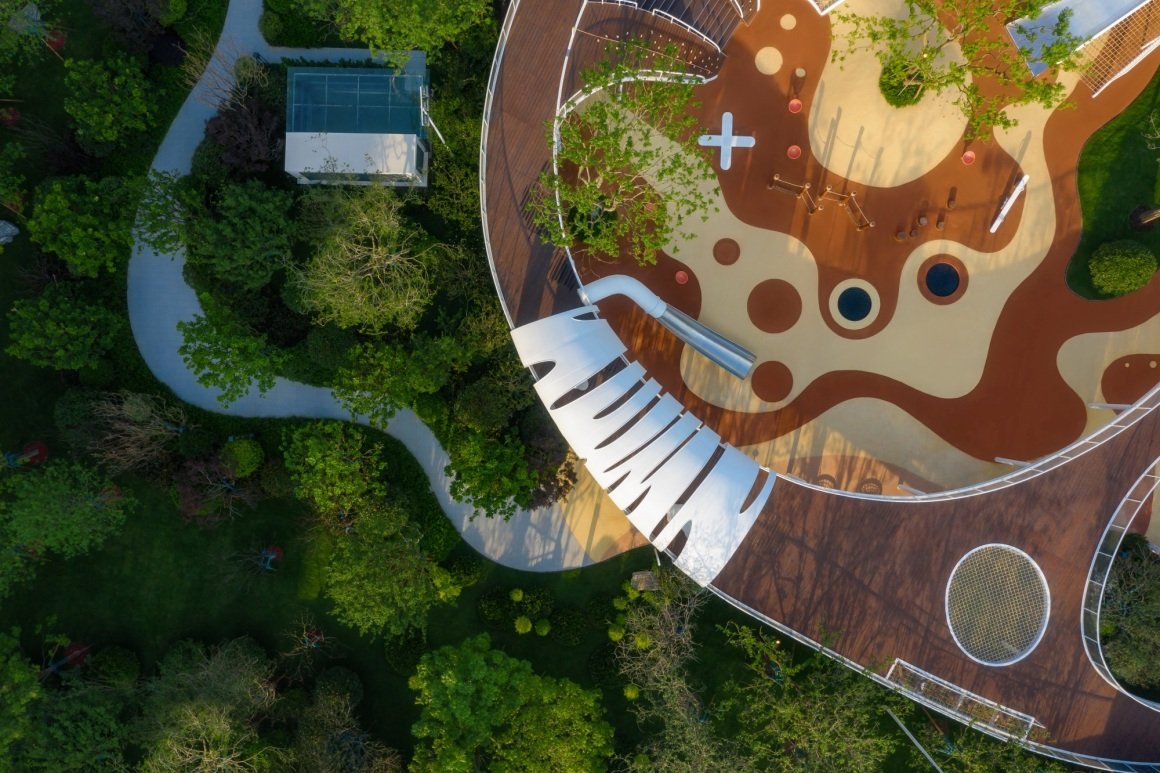
Water, food, and health are woven into this ecological foundation as living systems. A Green and Blue Network integrates ABC Waters principles through green roofs, eco-ponds, riparian edges, and bioretention basins. Rainwater harvesting and greywater recycling sustain irrigation. Food forests and fruit orchards reconnect residents to cycles of growth, supported by food waste recycling that closes material loops within the park. An accessible forest gym and graduated trail network accommodate rehabilitating seniors, families, and recreational users, flanked by healing gardens and contemplative spaces at ground level and on the rooftop.
The healing gardens are organised not by aesthetic effect but by sensory encounter, following evidence-based therapeutic garden principles. Fragrant species such as the Bread Flower (Vallaris glabra) and Cape Jasmine (Gardenia jasminoides) are placed along arrival sequences to orient and calm. The Bamboo Orchid (Arundina graminifolia) rustles at path edges in the prevailing breeze, layering sound into the experience of walking. In a tropical climate where shade and sensory modulation are inseparable from wellbeing, these gardens do not treat nature as scenery: they put it to work.
The park sustains community life across every hour. Mornings bring exercise along the jogging trails; midday draws residents to the hawker centre; afternoons see caregivers guiding rehabilitation walks; evenings fill the water play areas and pavilions with families. This constant activation is not incidental. It is the design’s deepest ambition.
Bukit Canberra demonstrates that urban density need not come at the expense of ecological richness. By weaving preserved forest ecology with social amenities across 12 hectares, it aspires to move beyond placemaking toward place-loving: cultivating long-term attachment and collective stewardship. Here, the landscape is not decoration but destination, not backdrop but the binding force that holds a neighbourhood together. In protecting what was there and carefully adding what was needed, Bukit Canberra offers a model of how cities can grow while deepening their ecological and social resilience, a place where people and nature don’t just coexist, but co-thrive.
• Developer/Owner: Sport Singapore
• Landscape Architect: Henning Larsen
• Architect: DP Architects
• ESD Consultant: DP Sustainable Design
• M&E Consultant: Aecom Singapore Pte Ltd
• C&S Consultant: T.Y.Lin International Pte Ltd
• Builder: Rich Construction Company Pte Ltd
• Quantity Surveyor: Aecom Cost Consulting & Project Management
21 bukit canberra link