
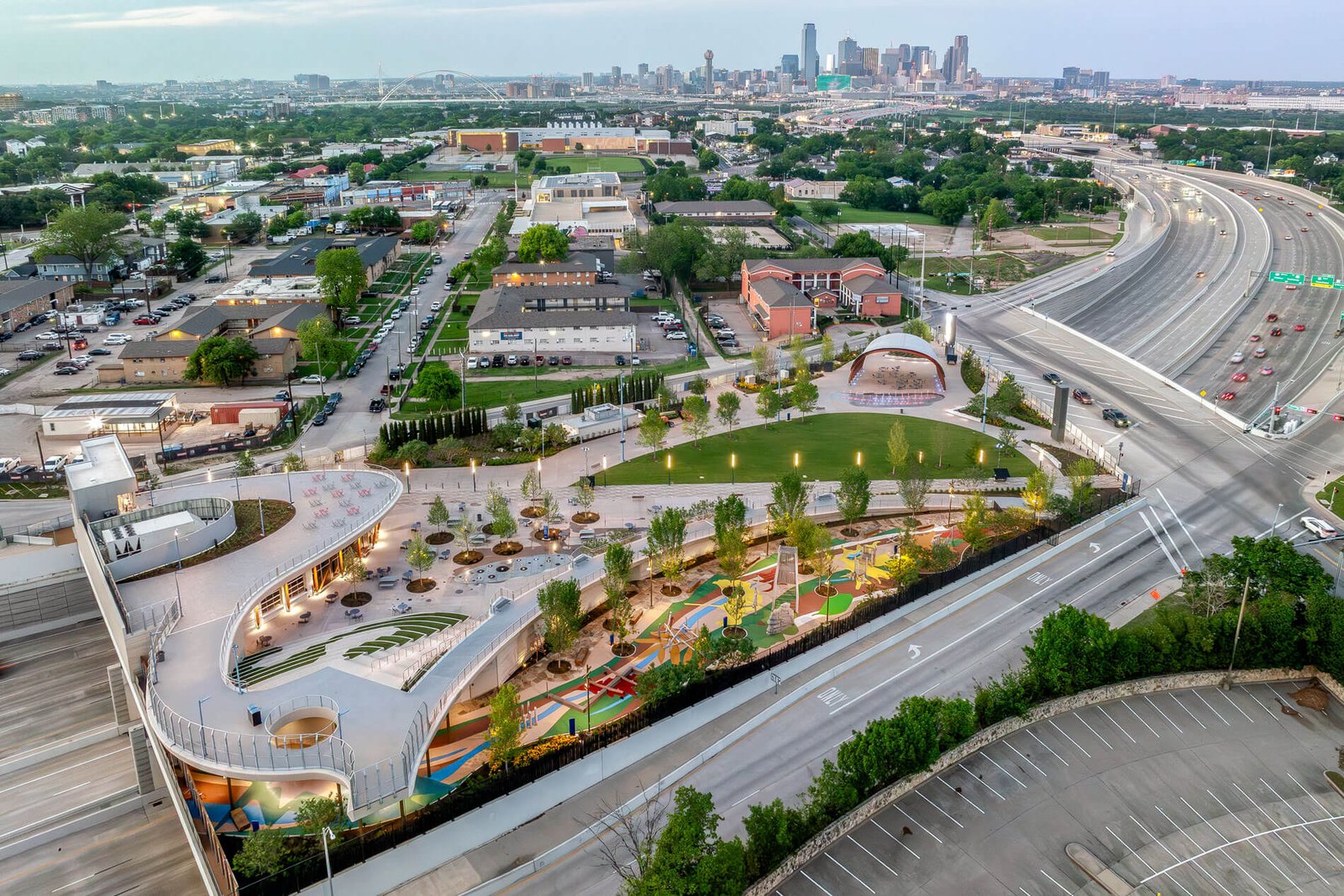

A new cap park in Dallas by HKS and SWA reconnects the historic neighborhood of Oak Cliff, after the community was divided by Interstate-35E in the 1950s. With Halperin Park, HKS and SWA realized a new structural deck that spans the interstate and stitches together Ewing and Marsalis Avenues.
The park has space for large gatherings, keeping cool, lounging, and of course, play. City officials say that Halperin Park will serve as an economic catalyst for the community and the Dallas Zoo which is just down the road. University of North Texas at Dallas conducted an analysis and estimates in the first five years, phase one alone could attract more than two million visitors annually and generate over $1 billion.
At the new park the still-maturing tree canopy is heavy, which is fitting for a neighborhood named Oak Cliff. Recreational buildings were built alongside water features and shaded seating to offer much-needed respite from the Texas sun.
Sculptural landforms were interspersed across the deck, creating what SWA calls an “escarpment” that echoes the “chalk, shale, and limestone strata” underground. These formations were constructed from glass fiber reinforced concrete panels. They are a reference to the region’s topography, but also block sound and views of the busy highways.
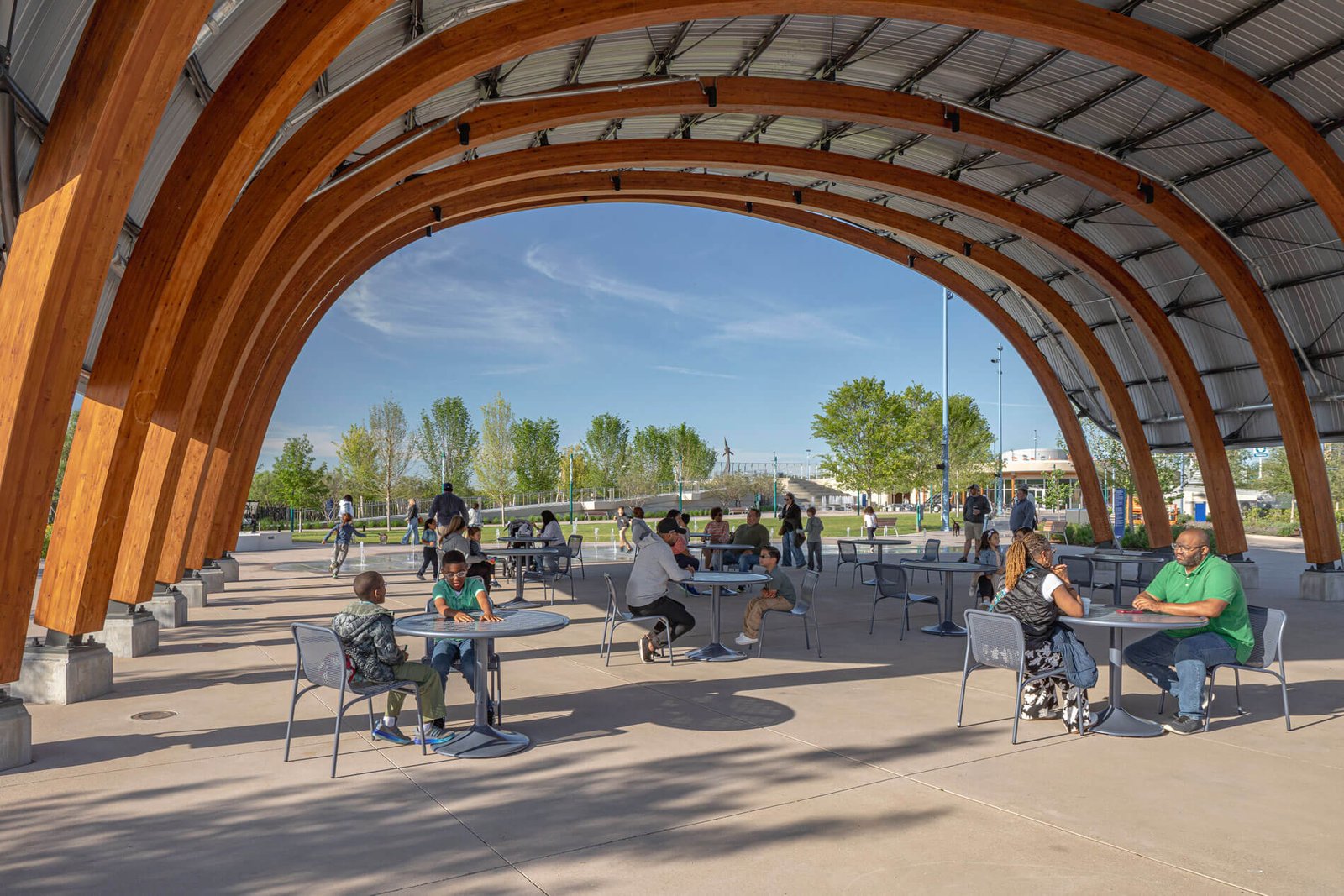
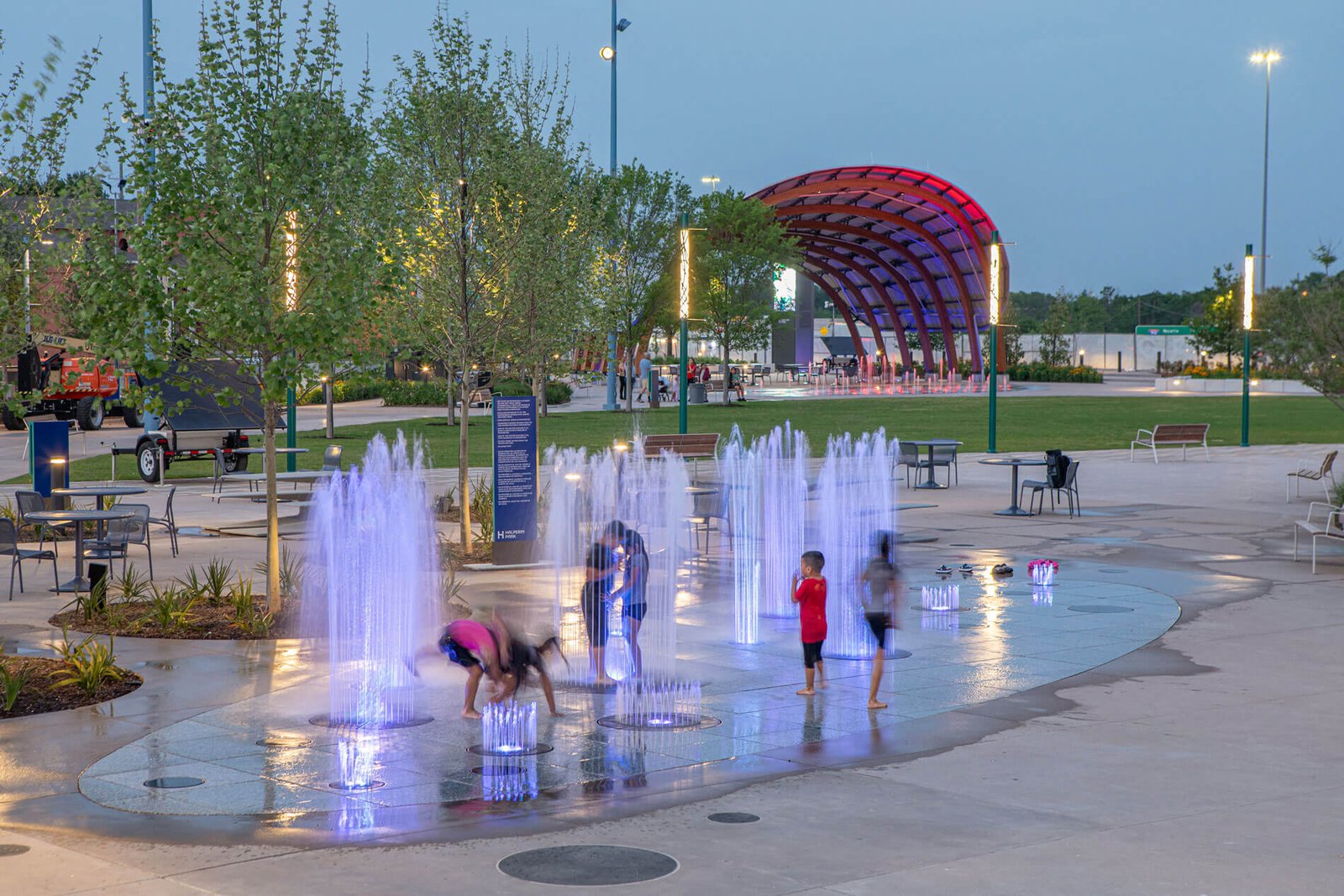
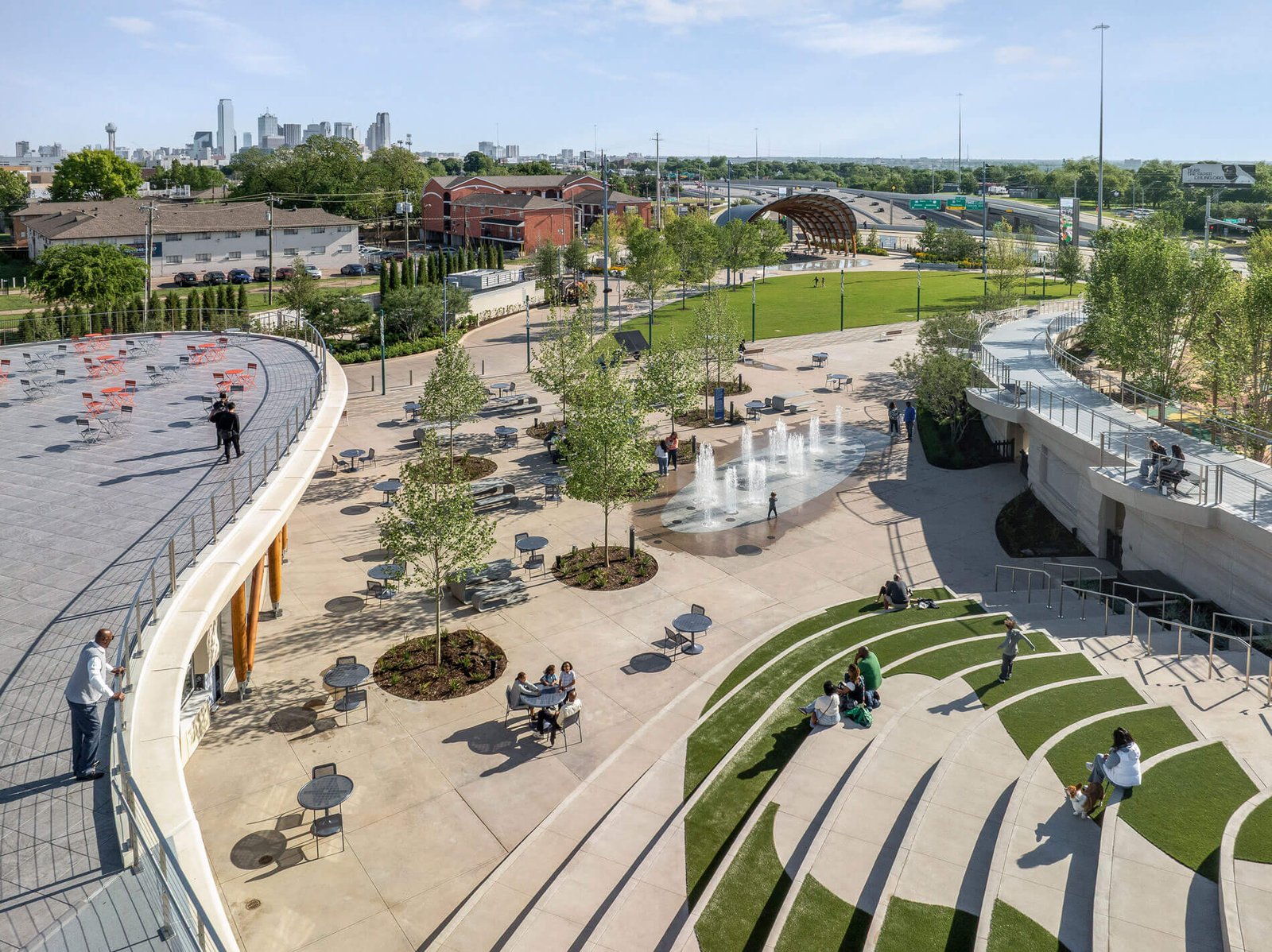
A promenade at 12th Street restored walkability to the neighborhood. The pathway runs directly through the center of the park abutting the Great Lawn and a central plaza. The Great Lawn is anchored by a glulam performance shell for hosting concerts and civic events. Using mass timber for the structure was a sustainable choice that lowered the project’s embodied carbon, but it was also a structural one.
The material is much lighter than concrete or steel, and using it reduced the structural loads sited upon the highway.
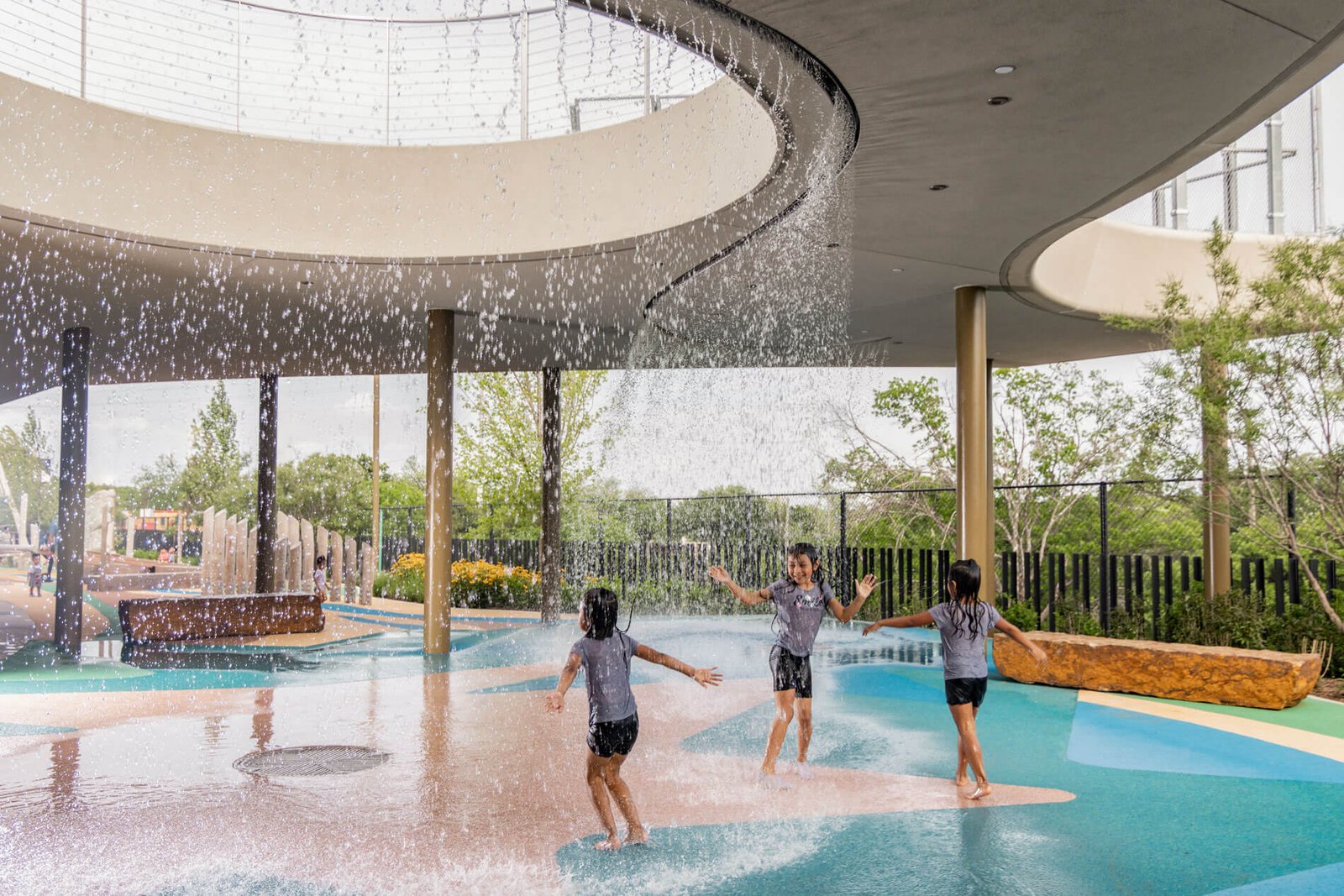
A shaded plaza will host markets, vendors, and community gatherings. A pavilion with a large footprint faces and extends its arms out to the play area. The building was constructed with wood, similar to the bandshell. A water feature was integrated into its design; it showers a splash yard located adjacent to the playground. A walkable roof spans atop the multipurpose pavilion. From this perspective park-goers can cast their eyes across the expansive lawns and at the city beyond. There are plans in a future phase to extend this roof terrace as the park footprint grows larger in subsequent phase.
Amphitheater seating with capacity for 300 guests was built into the pavilion structure and can serve as an outdoor classroom and additional performance space.
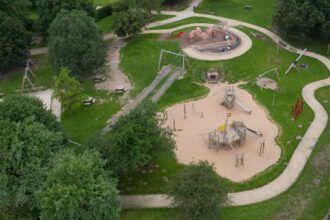
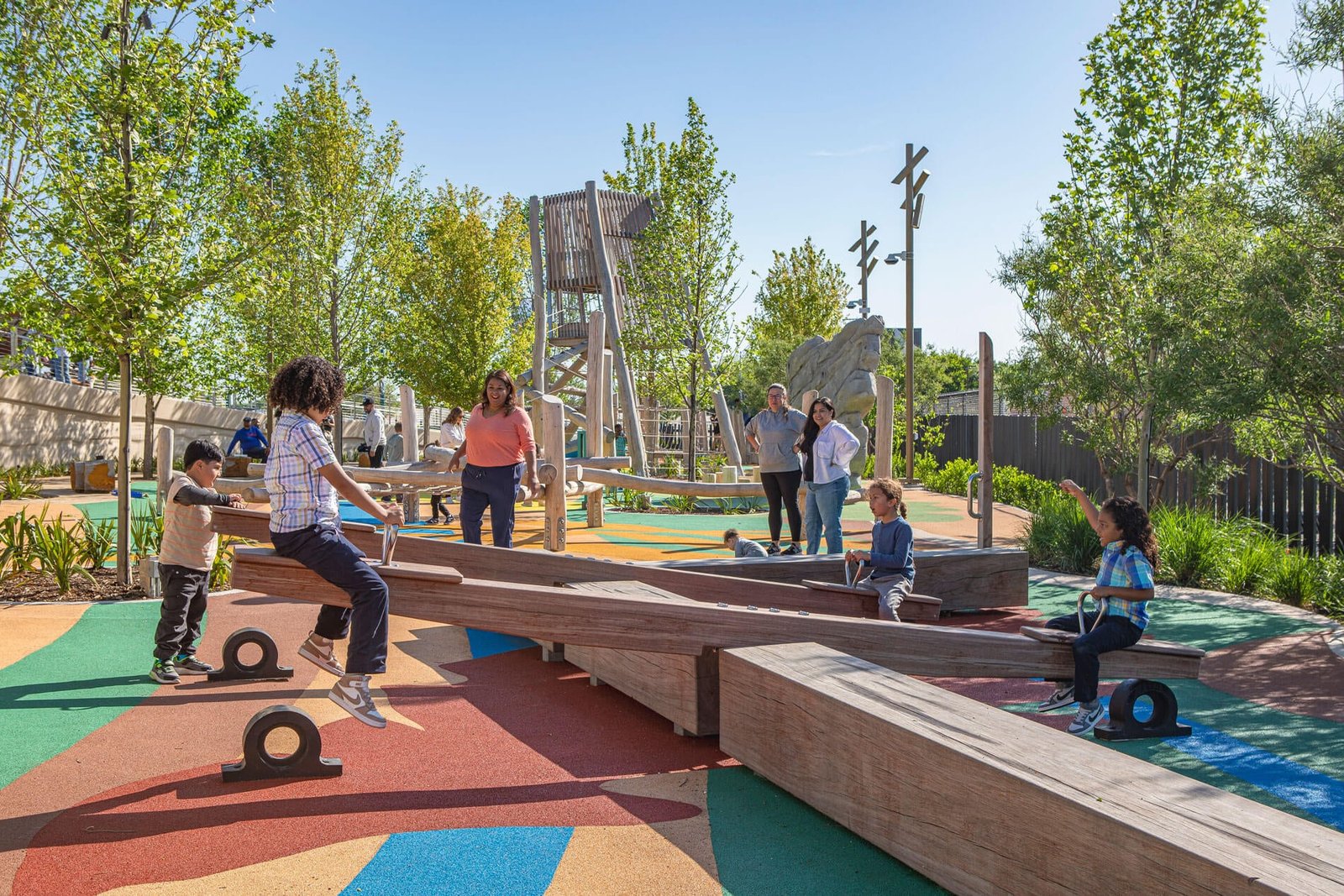
Like the park’s buildings, playground structures are made of wood, specifically Robinia wood. Illustrations across the playground floor depict scenes from nature, such as plant leaves. Trees spaced amid the play structures and lining the area’s perimeter will mature over time, adding more shade cover.
“Above all, this is a moment to celebrate the people who make up Oak Cliff and Southern Dallas,” said Todd Strawn, managing principal of SWA’s Dallas studio. “Halperin Park shows it’s possible to right a past wrong, stitch a neighborhood back together, and center that community’s culture and history throughout the process.”
The project was a public-private partnership by the Southern Gateway Public Green Foundation, city of Dallas, and Texas Department of Transportation. It started in 2017 when the Southern Gateway Public Green Foundation convened an Equitable Development Plan Task Force for the cap park. Project renderings were shared in 2023.
“We believe Halperin Park will be a model for other communities reclaiming spaces torn apart by highway construction, to create meaningful gathering places that instill local pride and connectivity,” added Russell Crader, HKS Global Director of Arts and Culture.
The completion of the deck between Ewing and Marsalis Avenues denotes the end of phase one of the project. Phase two will extend the deck to a total of five acres, out toward Lancaster and Marsalis Avenues.
Other highway-capped parks and public spaces that make use of transportation infrastructure in Dallas include Klyde Warren Park and a vision to redesign Dealey Plaza and the Triple Underpass.