

Vulkaneifel Garden – Flowing transition into the vast Landscape
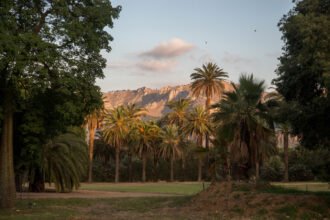
Volcanic activity shaped the Eifel. Magma erupted through the earth’s surface before cooling, creating craters like the one in the Brohltal-Laacher See volcanic park. Lava flowed northeast and solidified into basalt. A house sits on its ridge, its garden cradling the former farmstead. The landscape offers a 360-degree panorama of forested mountain ridges and meadows. Bausenberg, a cinder cone and nature reserve, stands out on the horizon to the southwest. Peaks polished by wind and weather rise in all directions. Green corridors slope down into the valleys. In this environment, unobstructed views are rare and special. They need to be orchestrated and staged. The borrowed landscape must be made tangible from the vantage point of this sheltered island location.
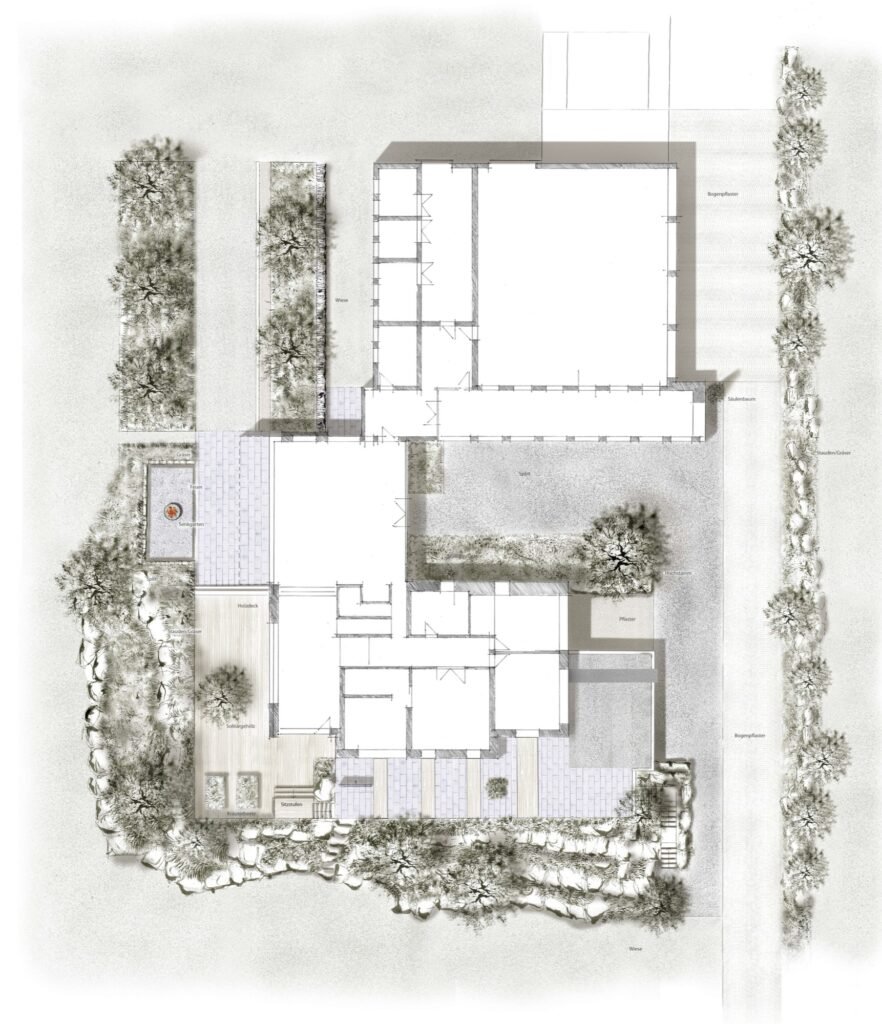
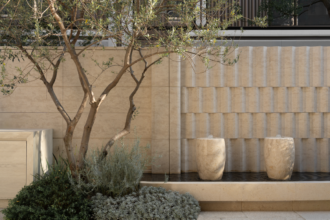
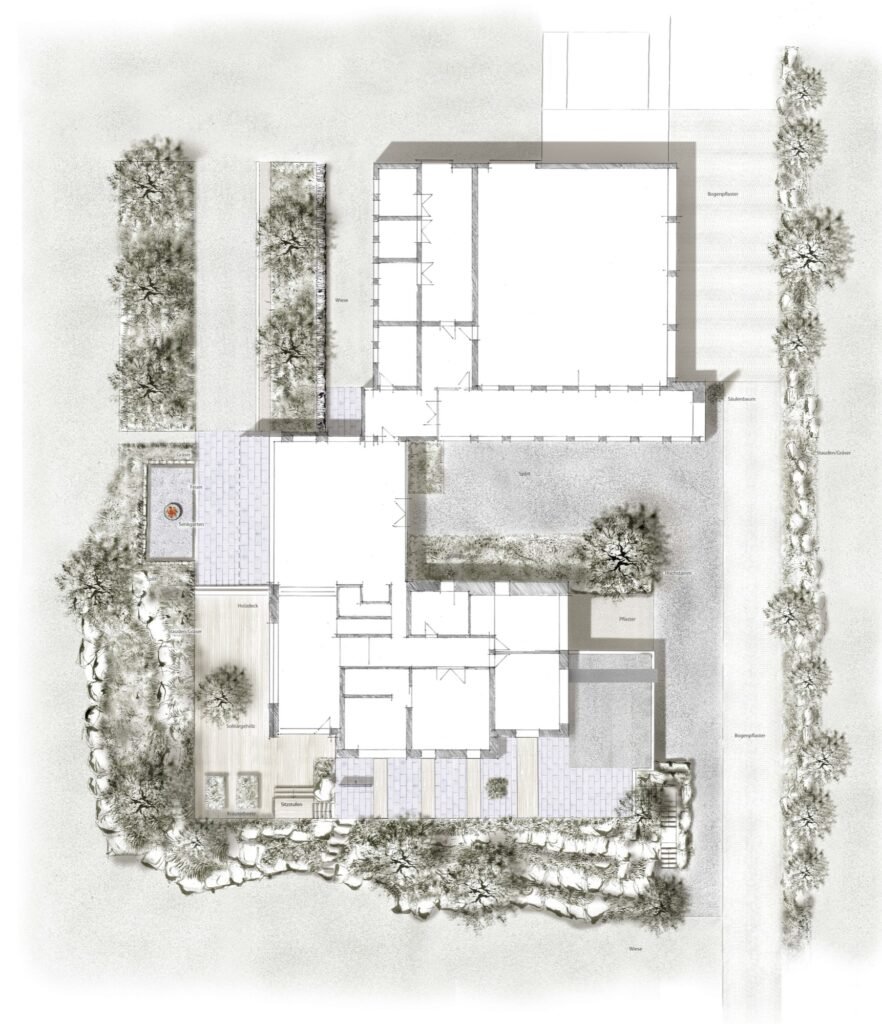
The property sticks out like an atoll from its isolated position, surrounded only by paddocks and orchards, due to its geology. “The 1965 building couldn’t be set lower in the ground because of the hard lava subsoil”, explains the owner. Garden designer Peter Berg connected the side terraces to the wider topography by creating a rocky landscape crowned with plants. The generous planting areas have enough space for shady trees, which slow down the wind that sweeps over the plateau. The choice of natural stone was inspired by the residence, which is clad with local greywacke. The genuine collaboration with the owner was key to the project’s success.
The former farmstead at the Bausenberg is an angular, three-sided reflection of the same shape when viewed from the entrance. The family has converted the old buildings to merge indoor and outdoor spaces. The left wing of the house has large windows. The old dairy kitchen and garages have been converted into a glass linkway for the living room. The right guest house has a portico in front, marking the former barn. The property is accessed via a 60-metre-long driveway lined with walnut trees. A strip of stones, shrubs and grasses runs alongside the driveway to connect the outside space with the adjacent meadows and the access road with the garden. How do you access this exciting space, which is L-shaped and wraps around the west and south of the house?
Peter Berg’s garden design is orchestrated with tension in mind. A small band or chamber orchestra is enough for a small room, or a full symphony orchestra is needed for a garden to truly resonate with its surroundings. On the driveway side, there are several solitaire trees, from sweet gum to crab apple, with a large miscanthus grass soundbox. To the homely terrace, the designer adds a multi-stemmed Persian ironwood to accentuate the Bausenberg view, alongside a cast of perennial species that weave a carpet of sound for the soloist. The viewer can drift over them.
Contrasting open and closed environments makes a garden a cultural achievement. This one juxtaposes intimate seating with the size of the landscape. From outside, the raised beds look in line, but if you move through the rocky landscape, you find they descend three steps. The three levels in the house can be seen in the garden. From the highest terrace in front of the bedroom, you go around the corner of the house to the lower veranda in front of the kitchen. The flooring reflects this, with pea gravel from the Moselle covering the top terrace, and wooden planks covering the sunken garden terrace. When the weather is nice, life happens in front of the kitchen. The interior is covered with historic clay tiles. The dining room has views of the greenery and an outdoor lounge. The outdoor area has been lowered with the same number of steps. The basalt slabs from the indoor living room have been carried over. The weatherproof seating and tables are on Moselle pebbles. The garden is screened from the sun by a tall paper mulberry.
The family’s warmth, framed by grey rock, is similar to the harsh climate of the Bausenberg crater. It has an unobstructed view of the Stromboli of the Eifel. The lines of sight and rock structures are cleverly worked out. The natural stone expert also uses grey rock to make furniture. You can sit on it or put something down on it, like on a table. You can view it as a geological sideboard displaying fossils, or even make it look like a sculpture. Peter Berg preserves them like precious stones. “We save the natural stones from being turned into gravel,” says the garden designer. The material is far too good to be shredded and dumped into gardens, or added to asphalt and concrete to seal surfaces, as greywacke often is. It is much more sustainable to use them as Peter Berg does in his garden designs. Instead of allowing the natural stone to disappear into the ground, they are raised up as art and evidence of the eventful history of our earth.