
















grateful Waiting for Drinking Design Studio Share on gooood. For more information about them, please go to:Waiting for Booze Design Studio on gooood
Appreciation towards Waiting for Booze Design Studio for providing the following description:
From the experience of stringing to the composition of space
From the pull of a line to spatial form
“Traction 1: Combination” and “Traction 2: Oblique” are two temporary public art installations created by Ren Shuang at Yanqi Lake in Huairou, Beijing. The work is composed of steel components, steel wire ropes and white non-woven yarn to form an open space, while also providing a background for music performances. The two works use the same structural unit, and respond to different sites and viewing directions through the combination between units and the steering within the units. The programming of video light strips and gauze projection further change the lines, surfaces and spatial levels visible at night.
Traction 1: Assembly and Traction 2: Reorientation are two temporary public art installations by Ren Shuang beside Yanqi Lake in Beijing. Steel members, steel wire ropes and white nonwoven gauze create open spatial forms that also serve as backdrops for music performances. The works share a structural unit but respond to different viewing conditions through assembly between units and reorientation within a unit.
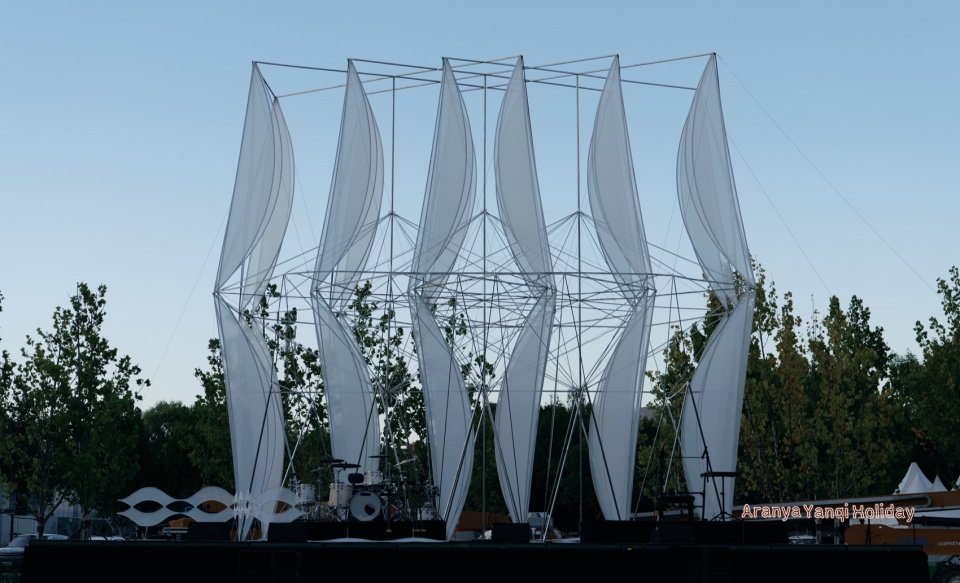
▼Assembly, frontal view and surrounding vegetation during the day © Ren Shuang/ Waiting for Drinking Design Studio
The creation originated from the scene of kite flying on the autumn grass in Beijing. The string puller continues to watch the kite in the distance and senses the tension and direction through the string in his hand. Ren Shuang pays attention to this experience of focusing on a single movement, transforming the traction, tension and lightness of being held up into fixed component relationships. The work maintains a fixed form during use, and the sense of suspension comes from lines, surfaces and their spatial relationships.
Form deduction starts with free hand drawing. Ren Shuang selects visually appealing fragments among the intertwined lines, and then uses SketchUp digital modeling to transform them into adjustable straight lines and curves. After a complete unit was formed, it was copied into three groups; cohesion problems in the combination prompted the creator to go back and adjust the original unit. The back-and-forth deduction between the part and the whole gradually transforms the intuition in painting into a spatial form with scale, connection and support relationships.
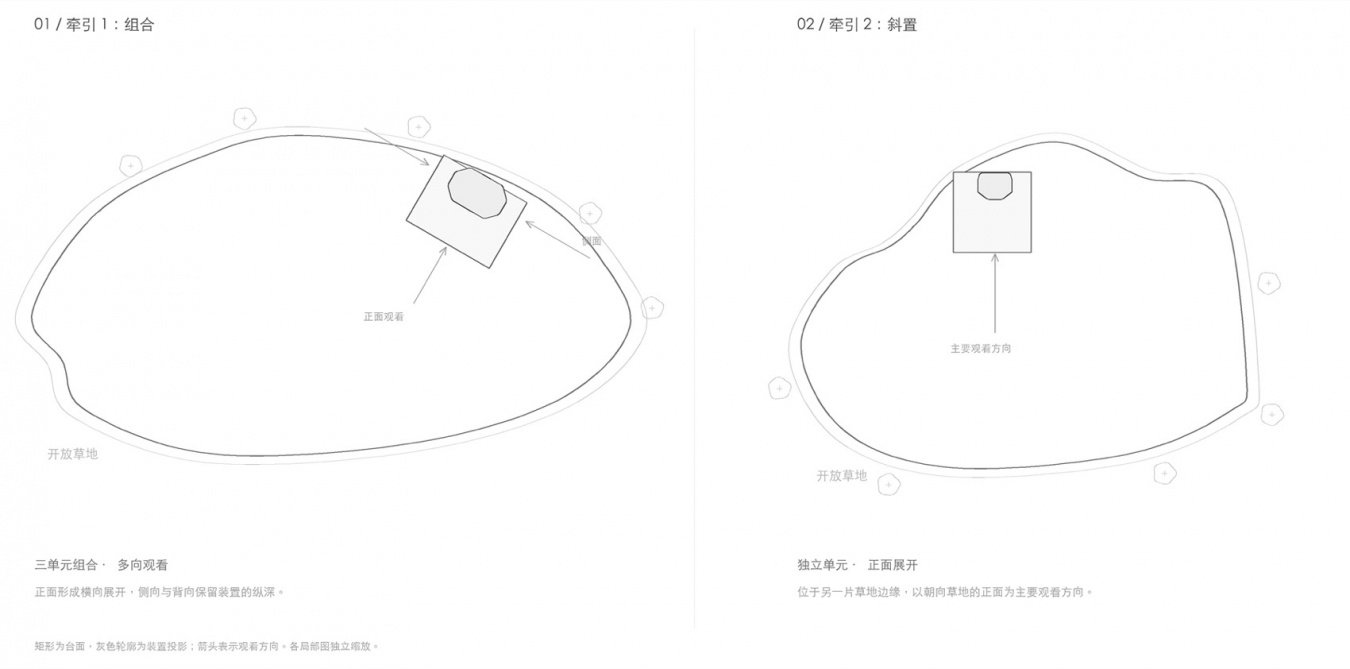
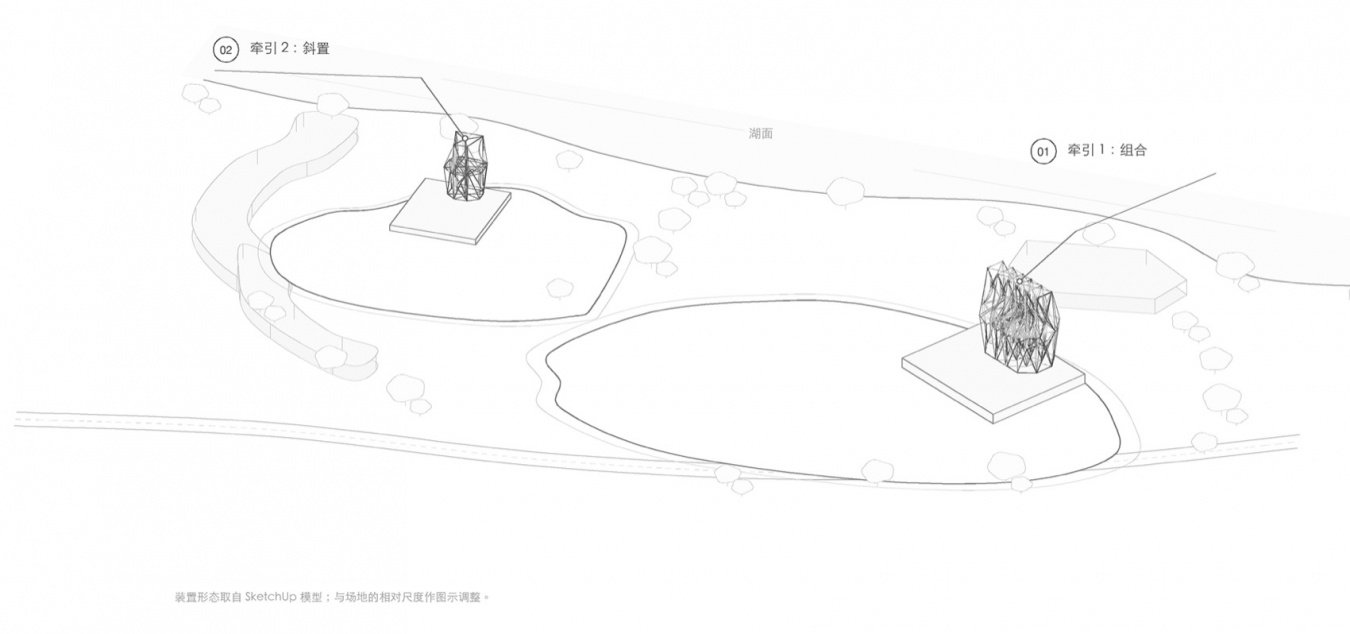
▼Site perspective drawings of two installations,
The two installations, site perspective drawing © Ren Shuang/ Waiting for Drinking Design Studio

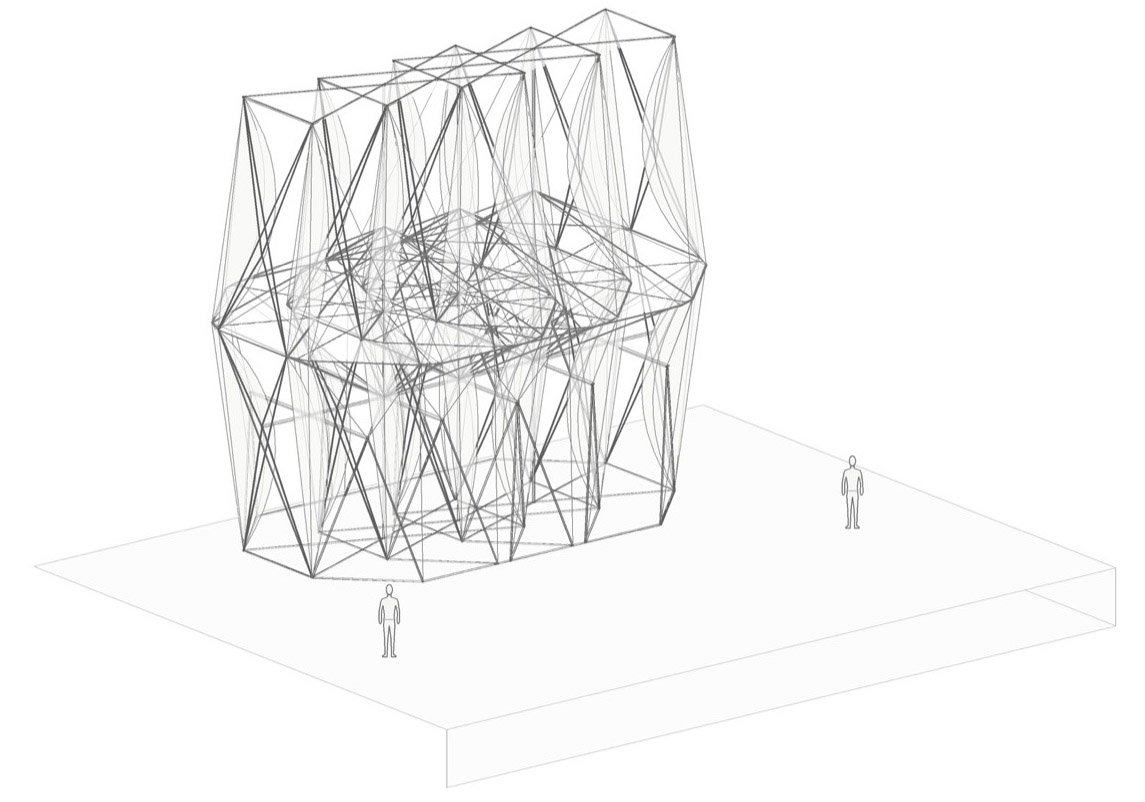
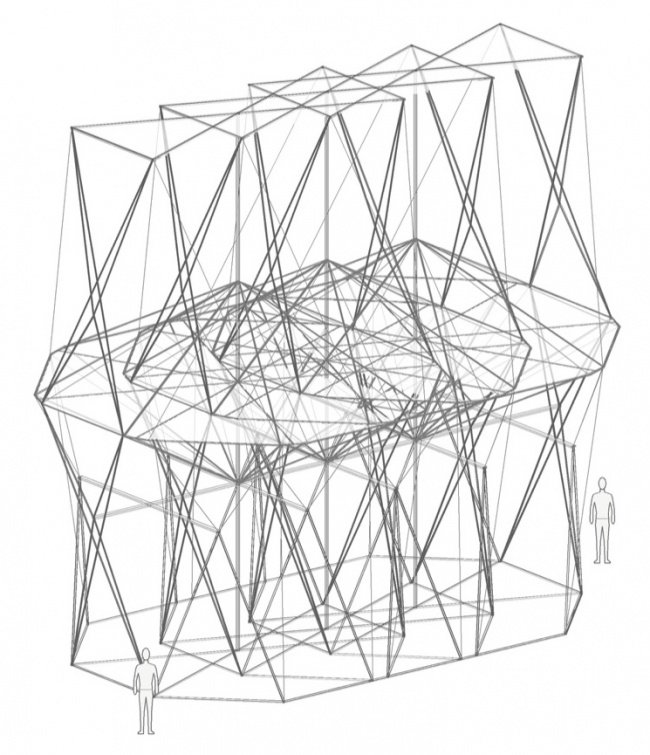
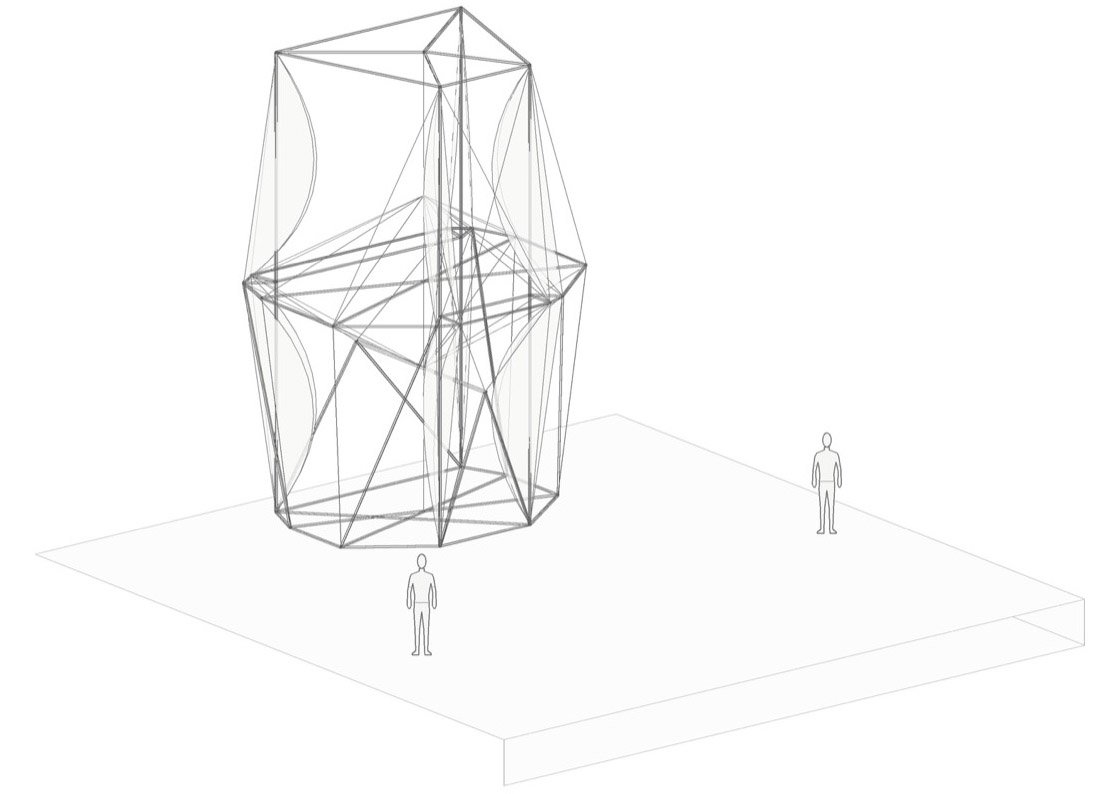
▼Assembly, axonometric drawing © Ren Shuang/ Waiting for Drinking Design Studio

The starting point was kite flying on a grassy field in Beijing in autumn. Holding a line, the flyer watches the kite and senses changes in pull and direction. Ren translates this experience of sustained attention, tension and apparent suspension into fixed relationships between members. The installations remain stationary throughout their use; their sense of lightness comes from the spatial relationships between lines and surfaces.
The form developed through freehand drawing and SketchUp modeling. Selected fragments of interwoven lines became adjustable straight lines and curves. A complete unit was copied into three, then revised as the connections between them were tested. Moving between part and whole turned intuitive drawing decisions into spatial relationships with scale, support and connections.
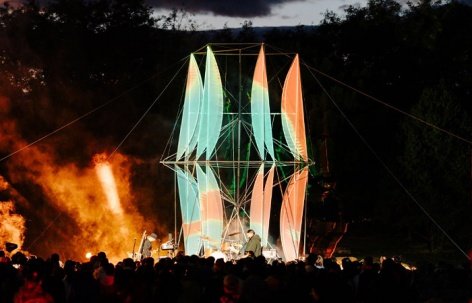
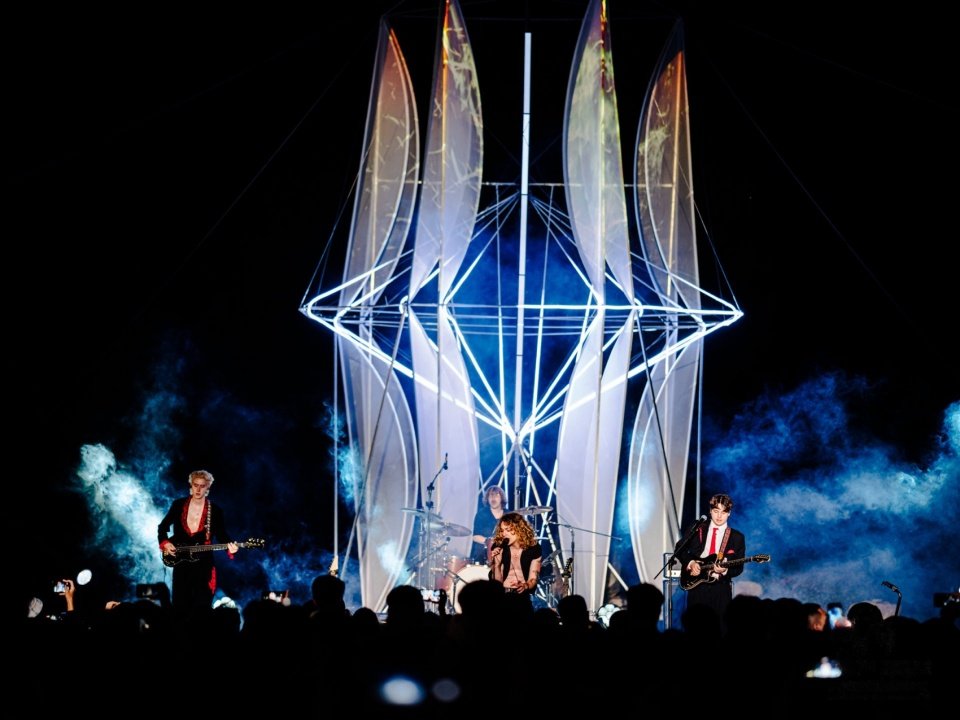
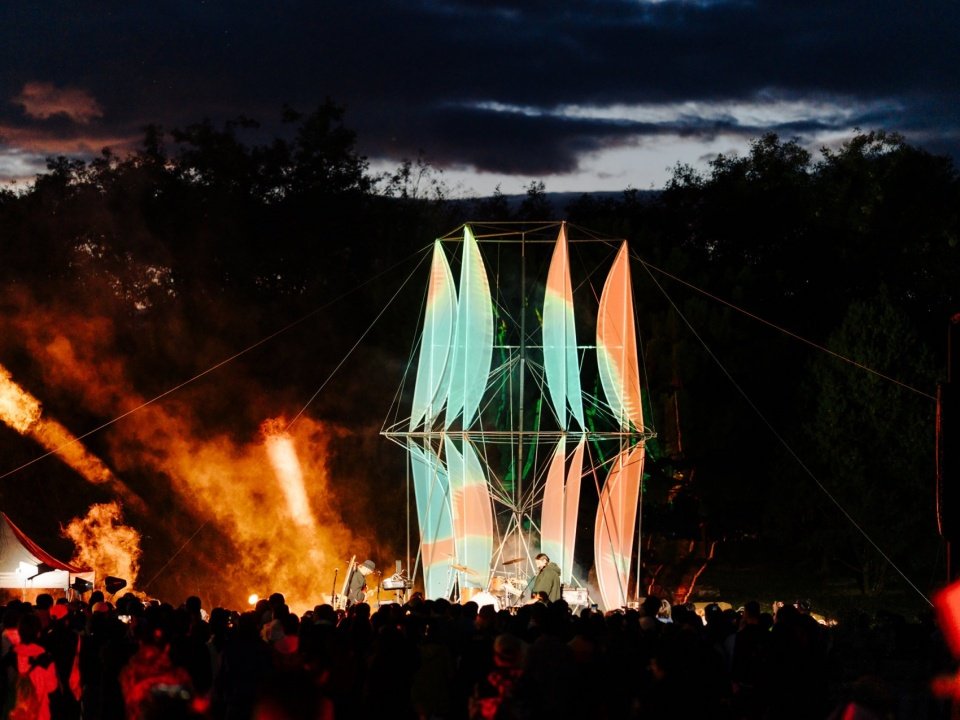
▼Reorientation during a night-time performance of the tilted device © Ren Shuang/ Waiting for Drinking Design Studio
Traction 1 combination
Traction 1 Assembly
“Composition” consists of three groups of repeating units unfolded horizontally. The steel components establish the main outline, support, and connection relationships, and the tensioned steel wire ropes participate in the overall composition through pulling. The thickness, direction and density of the rods and cables simultaneously form a hierarchy of viewing: from a distance, you can first read the whole, and when you get closer, you can identify the local intersections and pulls. The structural responsibilities and visual effects of various linear components support each other in the same system.
▼Line draft of the disassembly of the steel structure of the combined device,
Assembly, steel-framework drawing © Ren Shuang/ Waiting for Drinking Design Studio

Assembly extends three repeated units horizontally. Steel members establish the main outline, support and connections; tensioned steel wire ropes participate through pulling. Different thicknesses, directions and densities create a hierarchy of perception. The overall form is legible from a distance, while closer views reveal individual intersections and tensile relationships. The structural tasks and visual roles of the linear elements support one another.
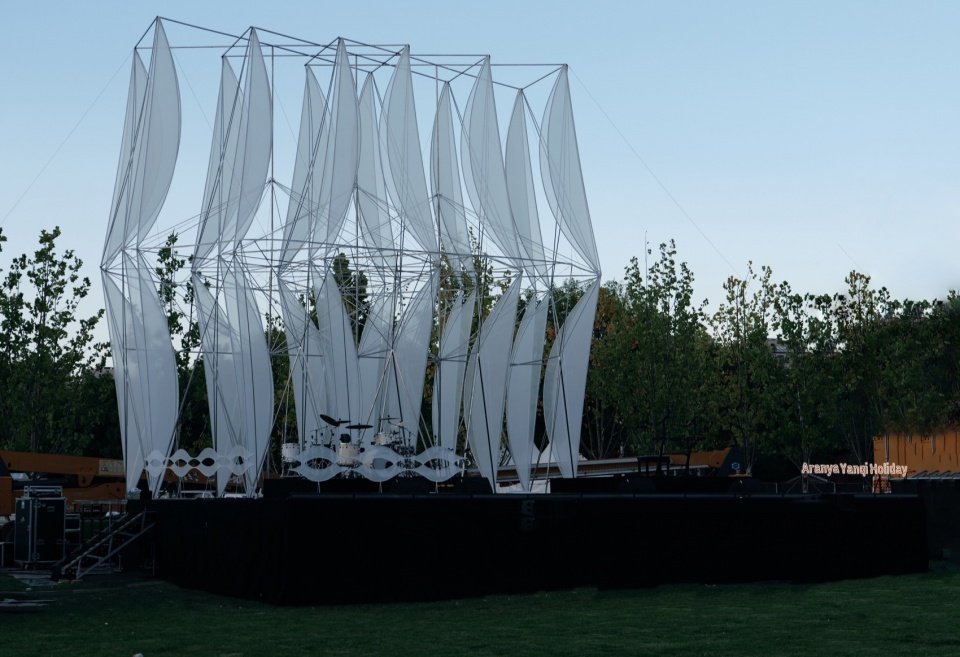
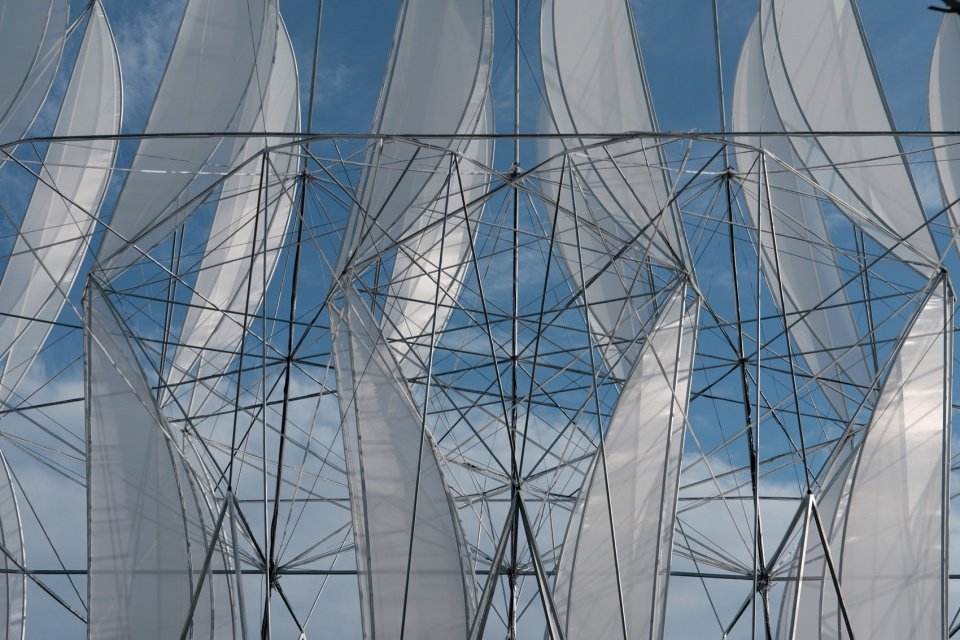
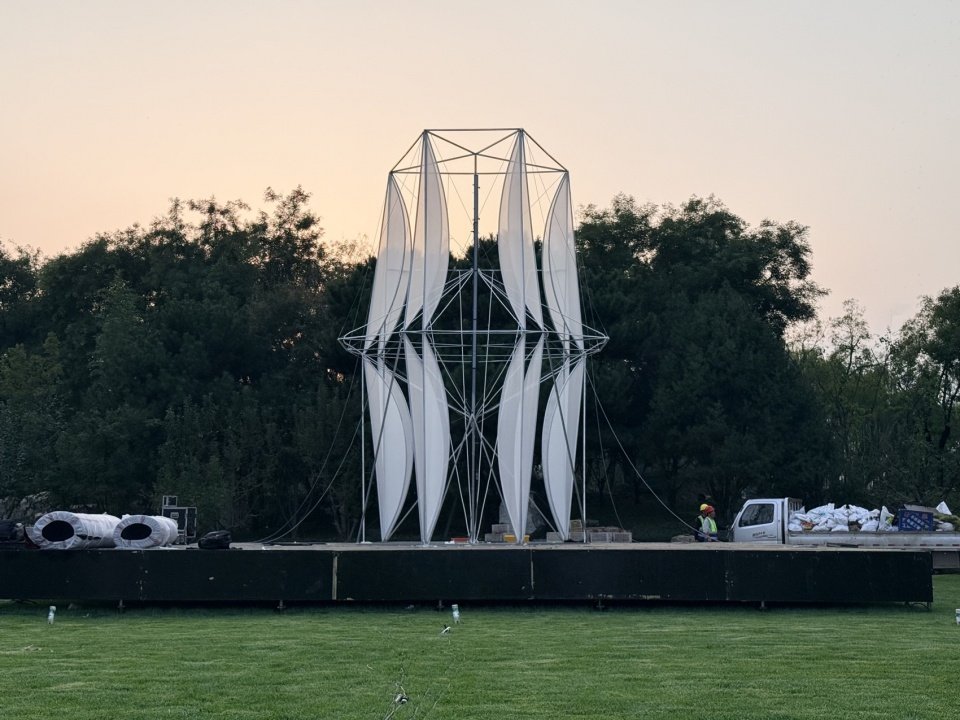
▼Assembly, frontal view in daylight © Ren Shuang/ Waiting for Drinking Design Studio
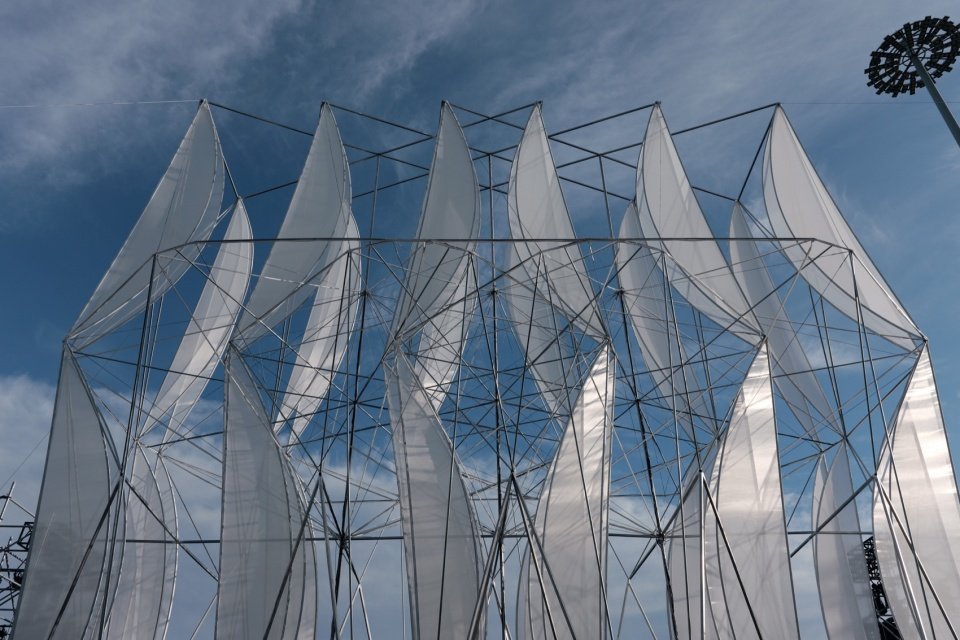
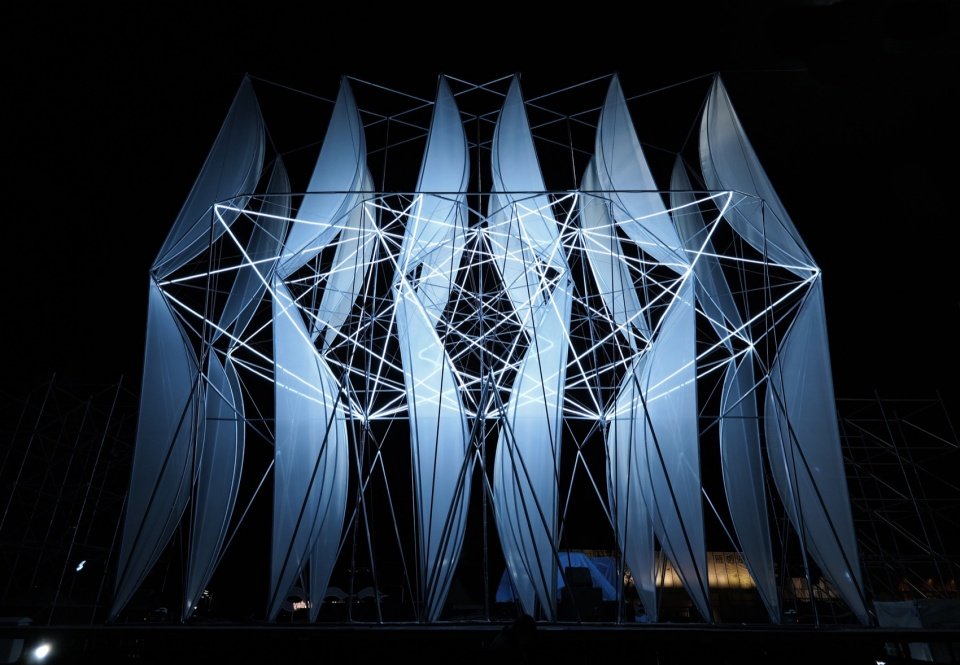
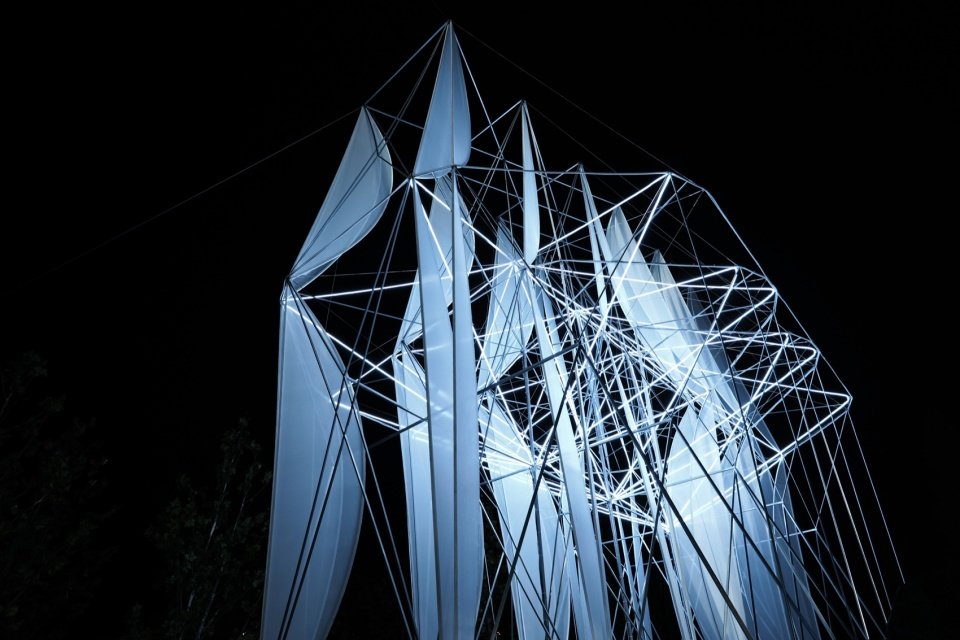
White non-woven yarn is stretched between linear components to form a segmented curved surface that extends vertically. When viewed from the front, the continuous sail surface creates a wide background required for stage scale, resulting in partial occlusion; the gaps between the curved surfaces allow trees, sky and surrounding environment to enter the field of view. When viewed from the side, the horizontally unfolded components are superimposed one after another, and the work presents a narrow and towering outline. The network of repeating units and cable lines enhances depth and order. The three-quarter view reveals both the overall width and the depth of the components, making the repetition of the curved surfaces and the density of the central network clearer.
The device body is about 11 meters high, and the site floor to the top is about 13 meters. Spectators can approach and walk around from the ground, observing from the side, back and different directions. The stage surface is not open to the audience. The change of viewing position allows the public to connect different views while moving, and gradually identify the distance between components and the level of cable lines obscured by the superposition of the facades.
Nonwoven gauze stretches between these elements to form segmented vertical curves. From the front, the surfaces provide a broad backdrop and partial screening, while gaps retain views of trees, sky and the surrounding landscape. From the side, successive members overlap to create a narrow, tall profile with pronounced depth. A three-quarter view reveals the width and depth together. The installation itself is approximately 11 meters high, reaching about 13 meters above the local ground. Visitors can approach and walk around it at ground level; the performance platform is not open to the public.
▼Assembly, structural layers seen obliquely © Ren Shuang/ Waiting for Drinking Design Studio
▼Assembly, steel wire ropes and nonwoven gauze © Ren Shuang/ Waiting for Drinking Design Studio
Traction 2 inclined
Traction 2 Reorientation
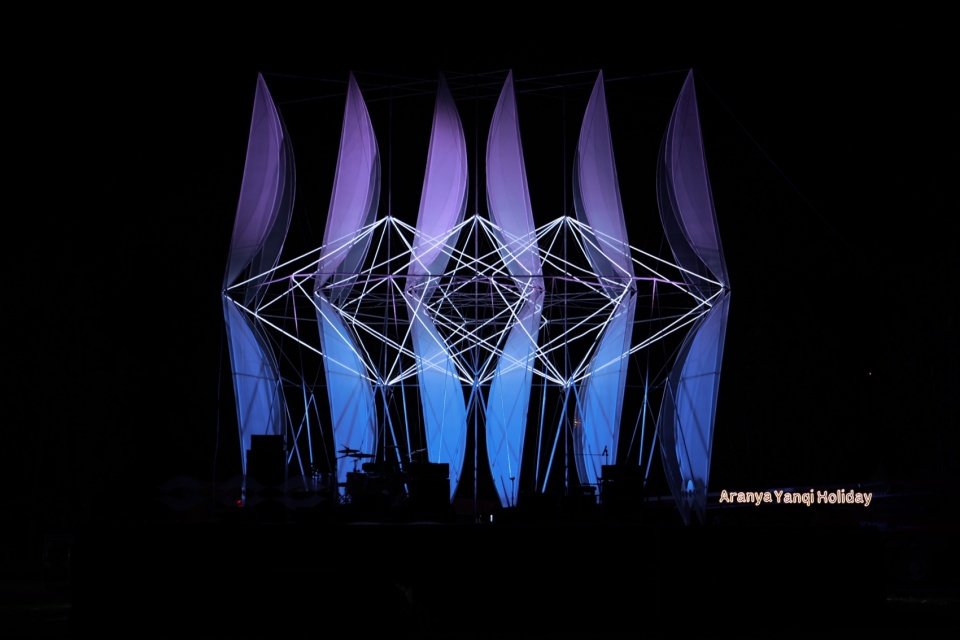
“Oblique” extracts a structural unit from the three groups and reorganizes the front and rear sail surfaces according to the site that is mainly viewed from the front. The rear layer rotates forward 45° and extends to both sides, forming an approximate inverted T shape when viewed from above. The steering reduces excessive overlap of the sail surfaces in the main view, making more of the surface and its gaps visible simultaneously.
This adjustment redistributes the visibility of each surface. Units are generated from the whole and form independent forms through changes in internal relationships. “Composition” organizes the rhythm with continuous repetition and dense superposition, while “Oblique” presents the difference in direction between the two layers inside the single body. Steel components, steel wire ropes and non-woven yarns continue to play the role of support, tension and curved surface organization, allowing the two works to maintain a common structural language.
▼Axonometric line draft of the inclined device,
Reorientation, axonometric drawing © Ren Shuang/ Waiting for Drinking Design Studio

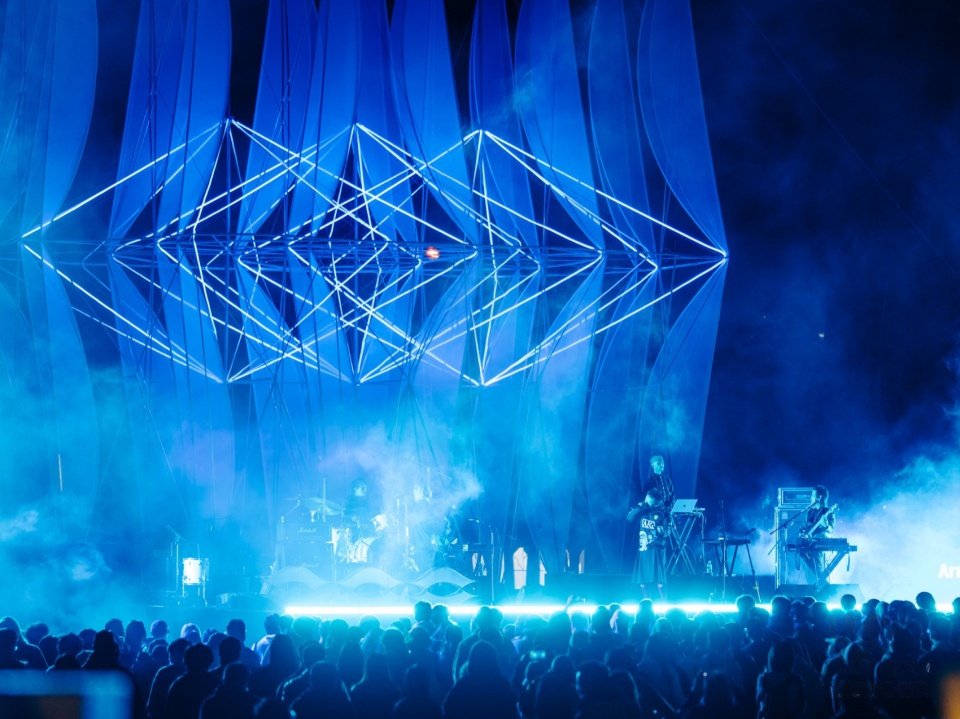
Reorientation extracts one unit from the three-unit assembly. For a site where frontal viewing predominateds, its rear layer of sail-like surfaces rotates forward by 45 degrees and extends laterally. The resulting plan approximates an inverted T. Reducing overlap makes more of the curved surfaces and their intervening gaps visible within the principal view. Changes within the unit produce an independent form while retaining the material and structural language of Assembly.
▼Reorientation, programmed LEDs and performers at night © Ren Shuang/ Waiting for Drinking Design Studio
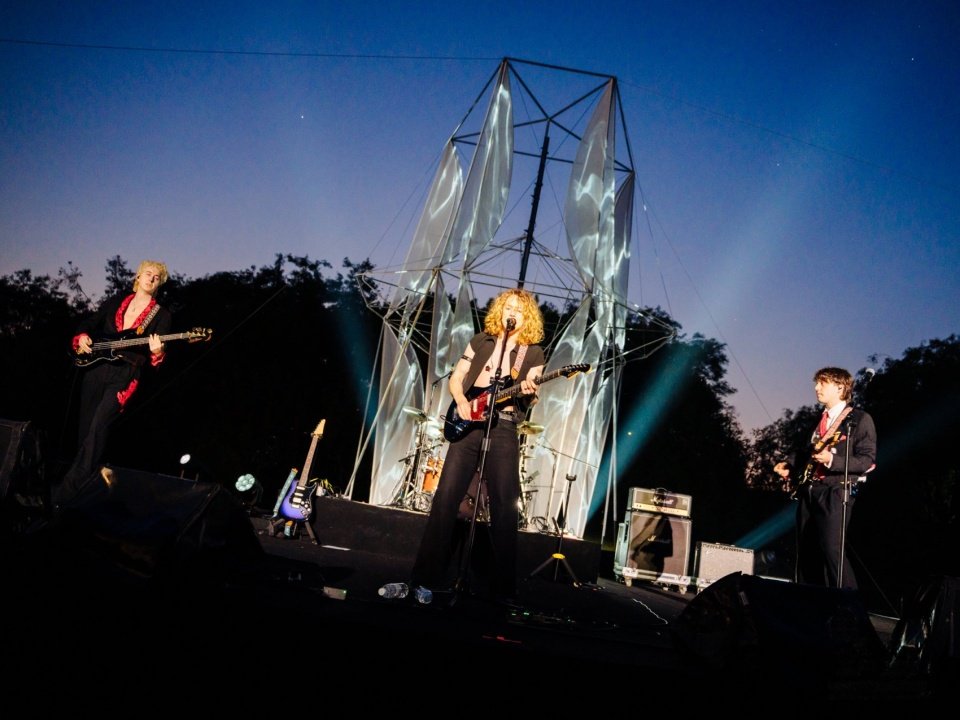
▼Oblique view at dusk, Reorientation, oblique view at dusk © Ren Shuang/ Waiting for Drinking Design Studio
▼The oblique device’s facade and luminous lines in the evening, Reorientation,
frontal view and luminous lines in the evening © Ren Shuang/ Waiting for Drinking Design Studio
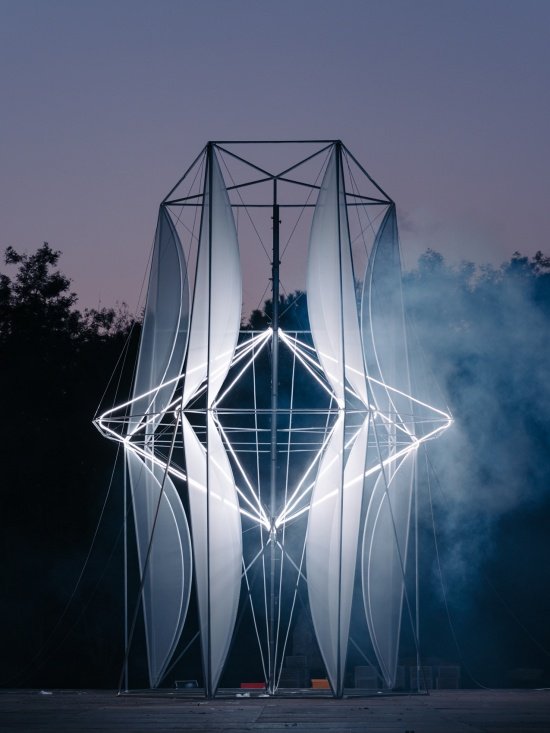

Night rendering of lines and surfaces
Lines and surfaces after dark
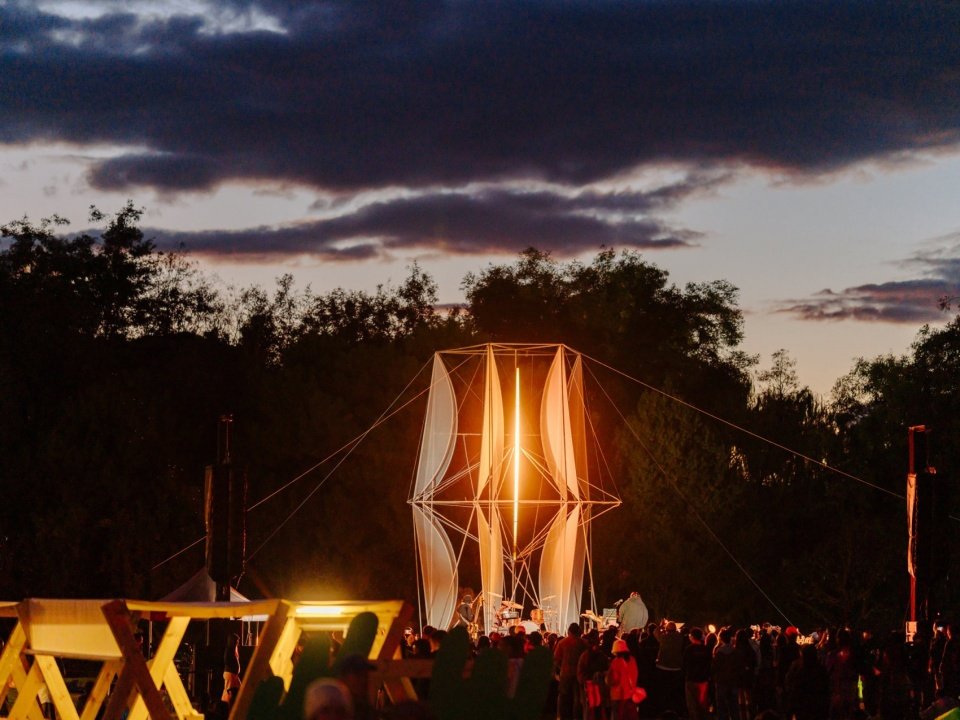
During the day, natural light makes the white curved surface, metal rods and cables appear, and the projection of the components further presents the superposition of lines and surfaces. After nightfall, the direct luminescence of the video light strip and the diffuse reflection on the non-woven surface work together to form clear linear light and soft surface brightness. The lateral night view especially reveals the depth of the structure: bright lines unfold along different levels, and the distance between the gauze surfaces and the front-to-back relationship of the central cable network are visible.
Daylight reveals the steel, cables and white curves, with shadows adding further layers. At night, direct light from video LED strips combines with diffuse reflection from the gauze. Side views reveal luminous lines extending through the structure’s depth and softly illuminated surfaces at different distances.
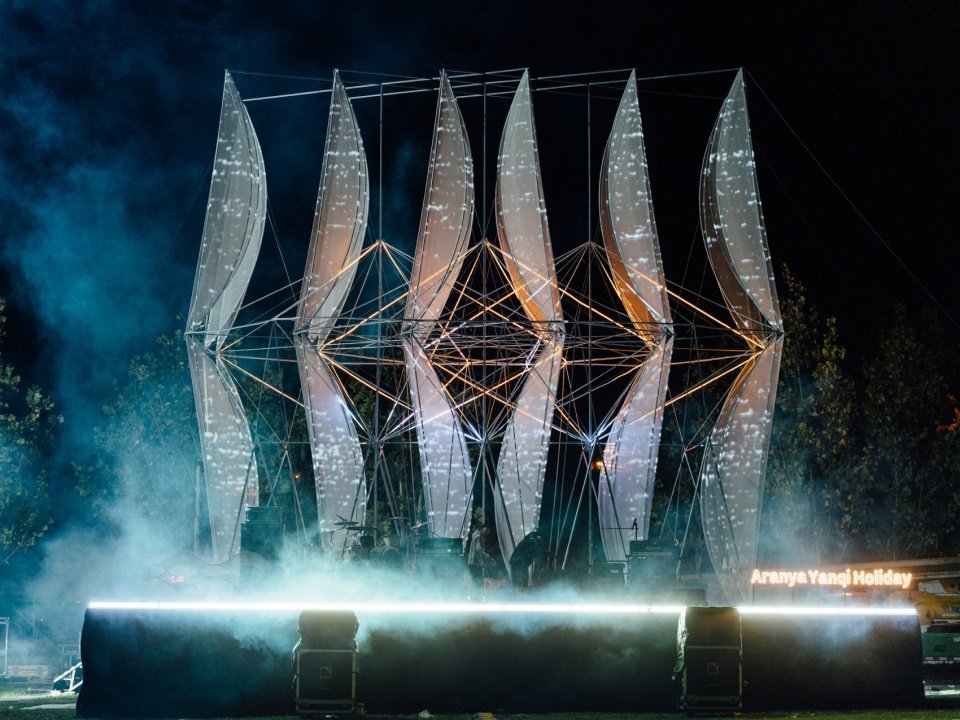
▼Assembly, luminous lines and gauze seen from the front © Ren Shuang/ Waiting for Drinking Design Studio
▼Assembly, illuminated structure seen obliquely © Ren Shuang/ Waiting for Drinking Design Studio
Ren Shuang pre-programmed more than a hundred video light strip effects for “Composition”. The programming is based on the three diamond-shaped compositions in the middle and their interspersed relationship before and after. It reorganizes the visual center of gravity of the space through combinations such as partial lighting in the center, surrounding rings, three groups of simultaneous light-emitting and dot-like light-emitting in the upper part. Points and lines located at different depths overlap in the field of view, forming a luminous composition that is clustered in the middle of the installation and resembles a star cluster. The resident or band lighting engineer selects and combines effects in real time according to the performance rhythm, and the system also has a sound trigger function.
“Oblique” follows this lighting logic and adds a row of high-brightness luminous units in the center to create a more concentrated visual center of gravity with a strobe effect. Ren Shuang pre-programmed more than 40 lighting effects for it, so that the center, peripheral sail surface and lines of the monomer form different light and dark levels.
▼Schematic diagram of the structure of the light strip in the middle of the combined device.
Assembly, central LED geometry diagram © Ren Shuang/ Waiting for Drinking Design Studio
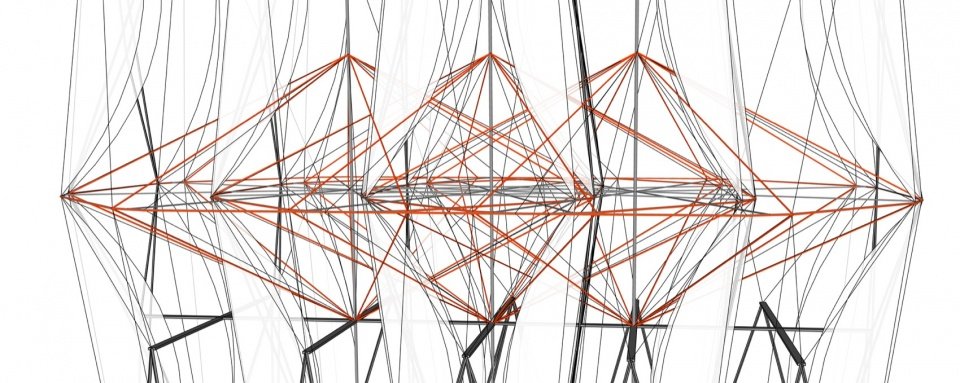

Ren programmed more than one hundred lighting effects for Assembly, using its three central diamond-like formations and their interwoven depths. Selective illumination, tracing of loops, simultaneous lighting of all three formations and points of light above them shift the visual focus. Points and lines at different depths overlap into a cluster resembling a star field. A resident or band lighting operator selects and combines the effects during performances; the system also includes a sound-triggered function. Reorientation uses more than forty pre-programmed effects and an additional row of high-intensity central light units, concentrating the visual focus through strobe effects.
▼Assembly, LED effects on the central diamond-shaped structures © Ren Shuang/ Waiting for Drinking Design Studio
▼Reorientation during a night-time performance of the tilted device © Ren Shuang/ Waiting for Drinking Design Studio
The gauze surface projection is activated after completely darkening, and the image is aligned through mapping so that the image corresponds to the non-woven gauze surface. The translucent gauze surface carries the image while retaining the components and light behind it, forming a translucent visual texture similar to dragonfly wings. Video light strips mainly organize luminous points and lines, while projections present images on curved surfaces; both participate in the presentation of nighttime space from different levels.
Projection begins only after full darkness. Mapping aligns imagery with the curved gauze surfaces. The translucent material receives images while allowing members and light behind it to remain visible, creating a visual quality reminiscent of dragonfly wings. The LED strips organize luminous points and lines; projection adds imagery to the surfaces. Together, they make different layers of the fixed structures perceptible at night.
▼Assembly, mapped imagery on translucent nonwoven gauze at night © Ren Shuang/ Waiting for Drinking Design Studio
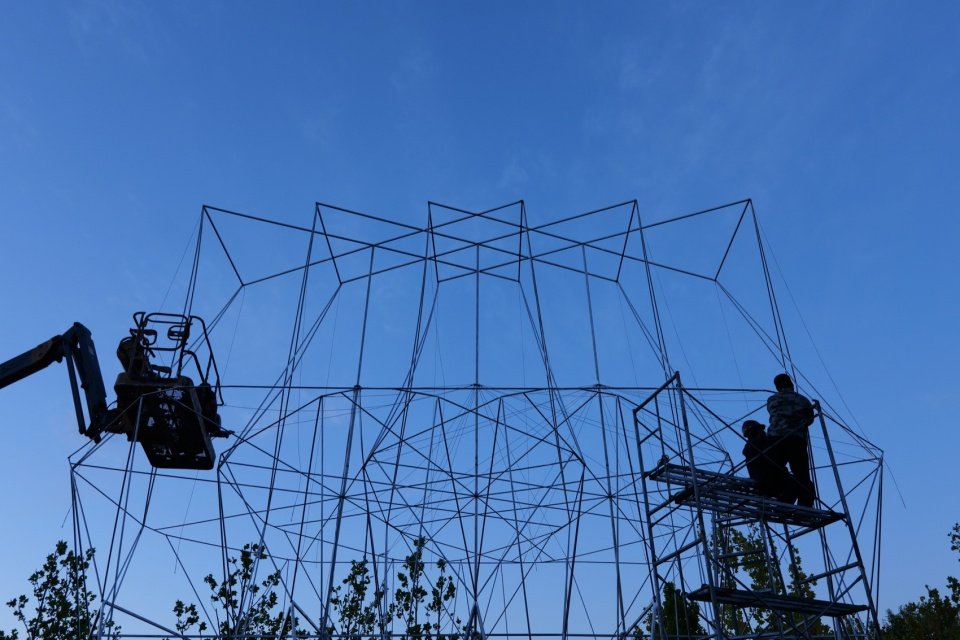
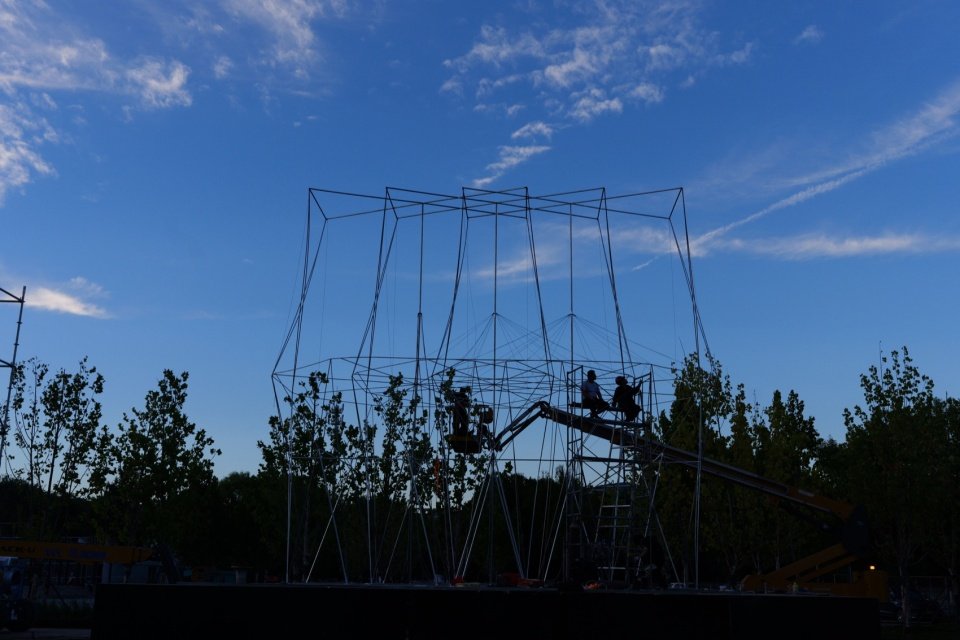
▼Construction process, Process of construction © Ren Shuang/ Waiting for Drinking Design Studio
▼The site plane relationship between the two installations,
The two installations, site plan © Ren Shuang/ Waiting for Drinking Design Studio

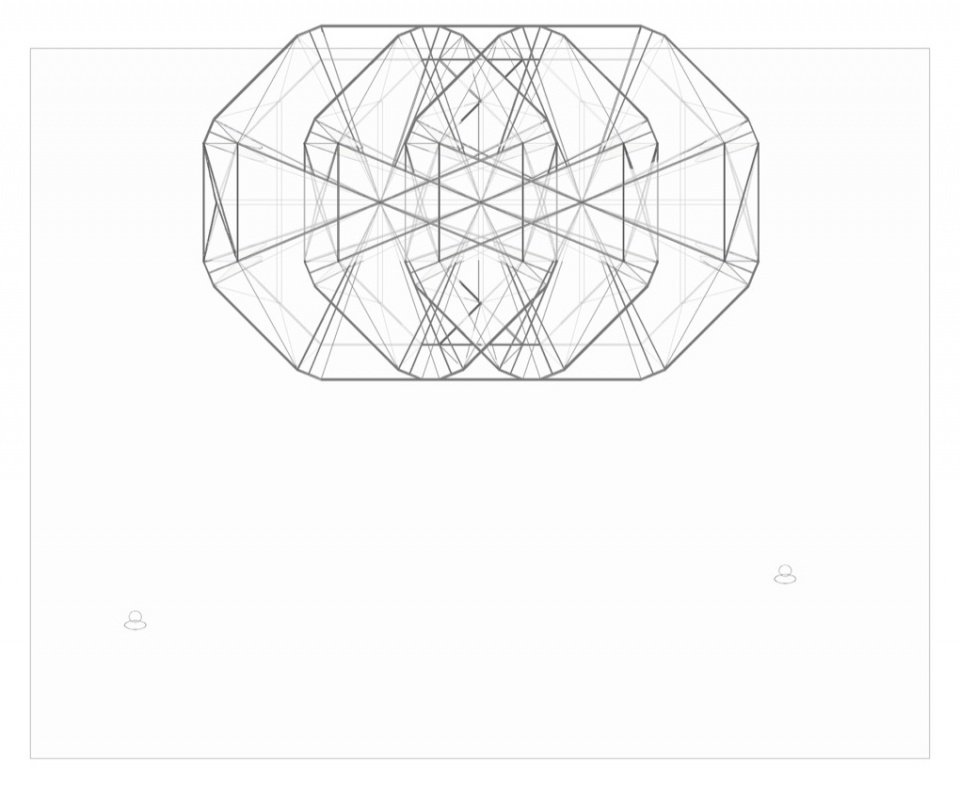
▼Plane line drawing of combined device,
Assembly, plan drawing © Ren Shuang/ Waiting for Drinking Design Studio

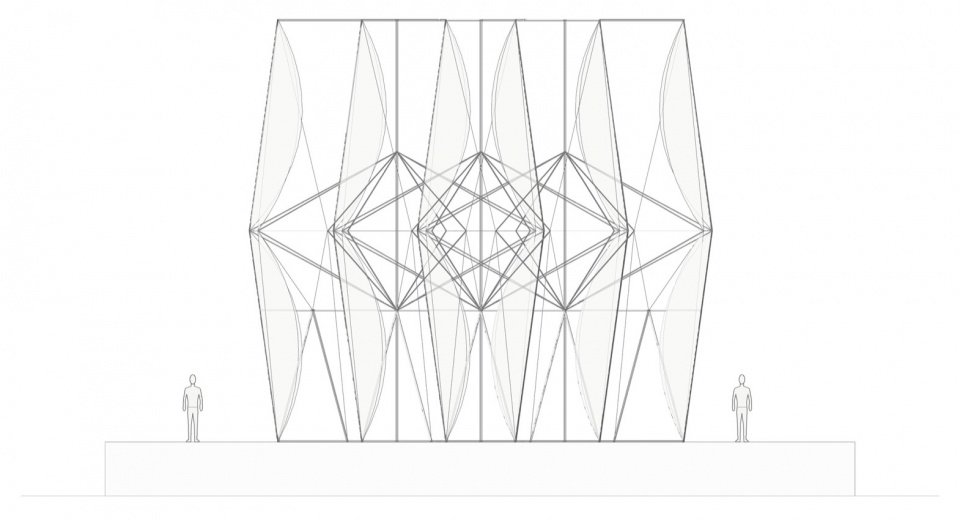
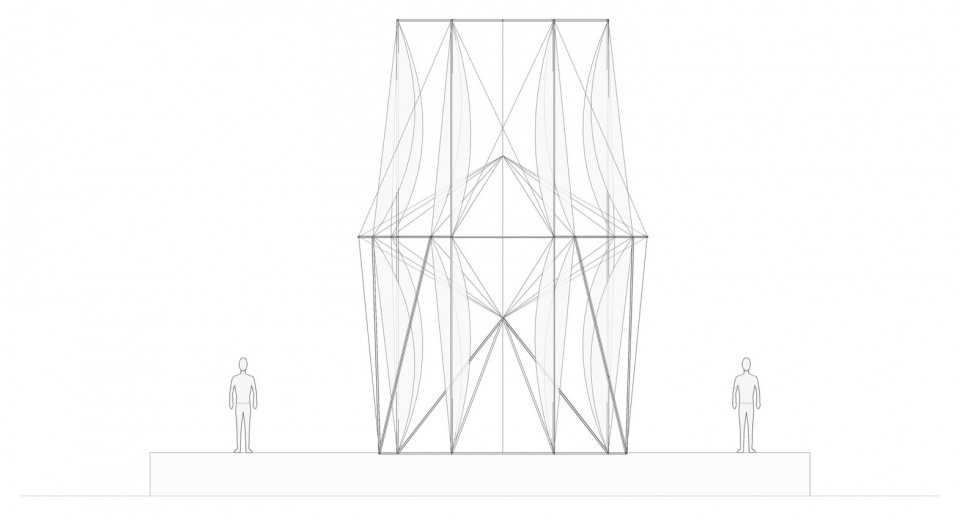
▼The combined installation focuses on the visual draft and character scale.
Assembly, front elevation with scale figures © Ren Shuang/ Waiting for Drinking Design Studio

▼Side view draft and character scale of the assembly installation, Assembly,
side elevation with scale figures © Ren Shuang/ Waiting for Drinking Design Studio
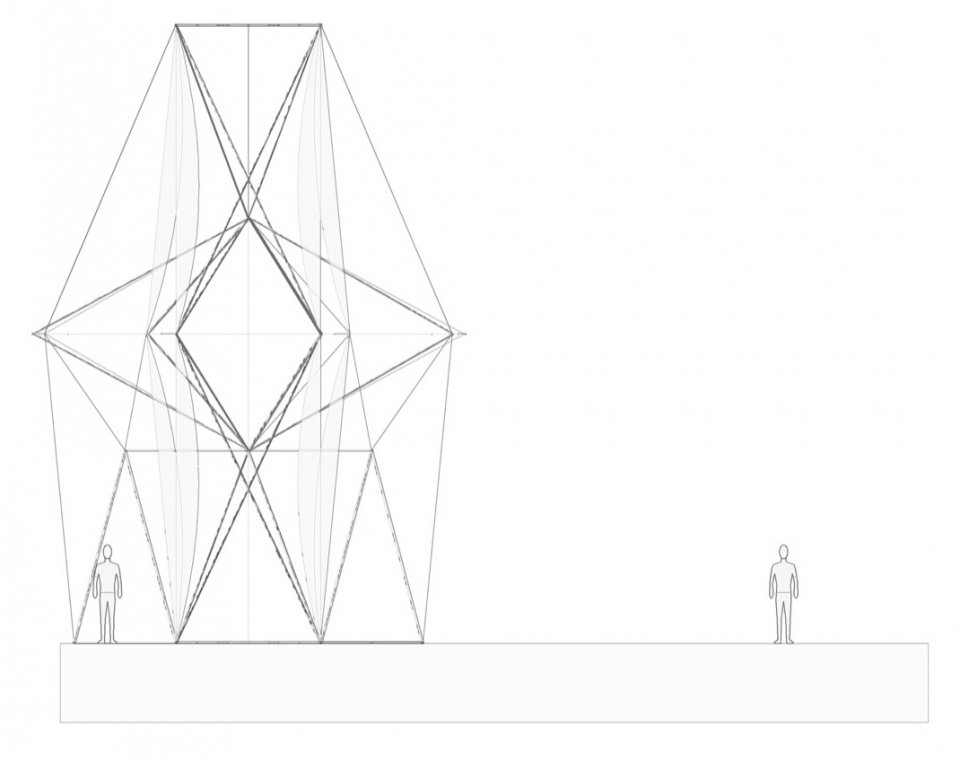

▼The oblique device focuses on the sight draft and character scale.
Reorientation, front elevation with scale figures © Ren Shuang/ Waiting for Drinking Design Studio

▼The oblique device disassembles the line draft on the yarn surface,
Reorientation, gauze-layer drawing © Ren Shuang/ Waiting for Drinking Design Studio

Creator and video light strip effect programming: Ren Shuang
Studio: Waiting for Booze Design Studio
Client: Aranya
Location: Yanqi Lake, Huairou, Beijing
Project background: Araya Yanqi Music Holiday
Construction: September 25–30, 2026
Showcase: October 2–4, 2026
Demolition: October 5, 2026
Main materials: steel components, steel wire ropes, non-woven yarns and lighting units
Work size:
The main body size of “Composition” is approximately 10.57 × 6.19 × 11.00 meters
“Tilted” is approximately 5.36 × 4.25 × 8.00 meters (read from the outer edge of the complete component of the model, and the height is measured from the top of the model table to the highest point)
Image copyright: Ren Shuang/Waiting for Drinking Design Studio
Contact: 854998194@qq.com | https://renshuang.studio
Artist and Video LED Effects Programmer: Ren Shuang
Studio: Waiting for Booze Design Studio
Commissioner: Aranya
Location: Yanqi Lake, Huairou, Beijing, China
Project Context: Aranya Yanqi Music Holiday
Installation: 25–30 September 2026
Presentation: 2–4 October 2026
Dismantling: 5 October 2026
Main Materials: Steel components, steel wire ropes, non-woven gauze and lighting units
Dimensions:
Composition: approx. 10.57 × 6.19 × 11.00 m
Oblique Placement: approx. 5.36 × 4.25 × 8.00 m (read from the outer edges of complete model components; height measured from the model base surface to the highest point)
Image Courtesy: Ren Shuang / Waiting for Booze Design Studio
Contact: 854998194@qq.com | https://renshuang.studio
More:Waiting for Drinking Design Studio. For more information about them, please go to:Waiting for Booze Design Studio on gooood
Source: gooood.cn