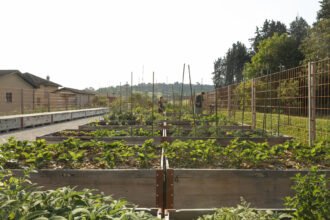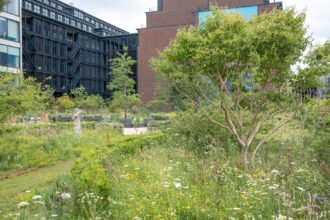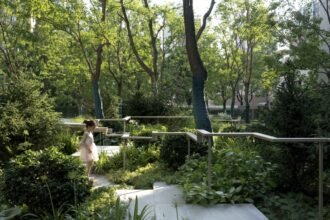

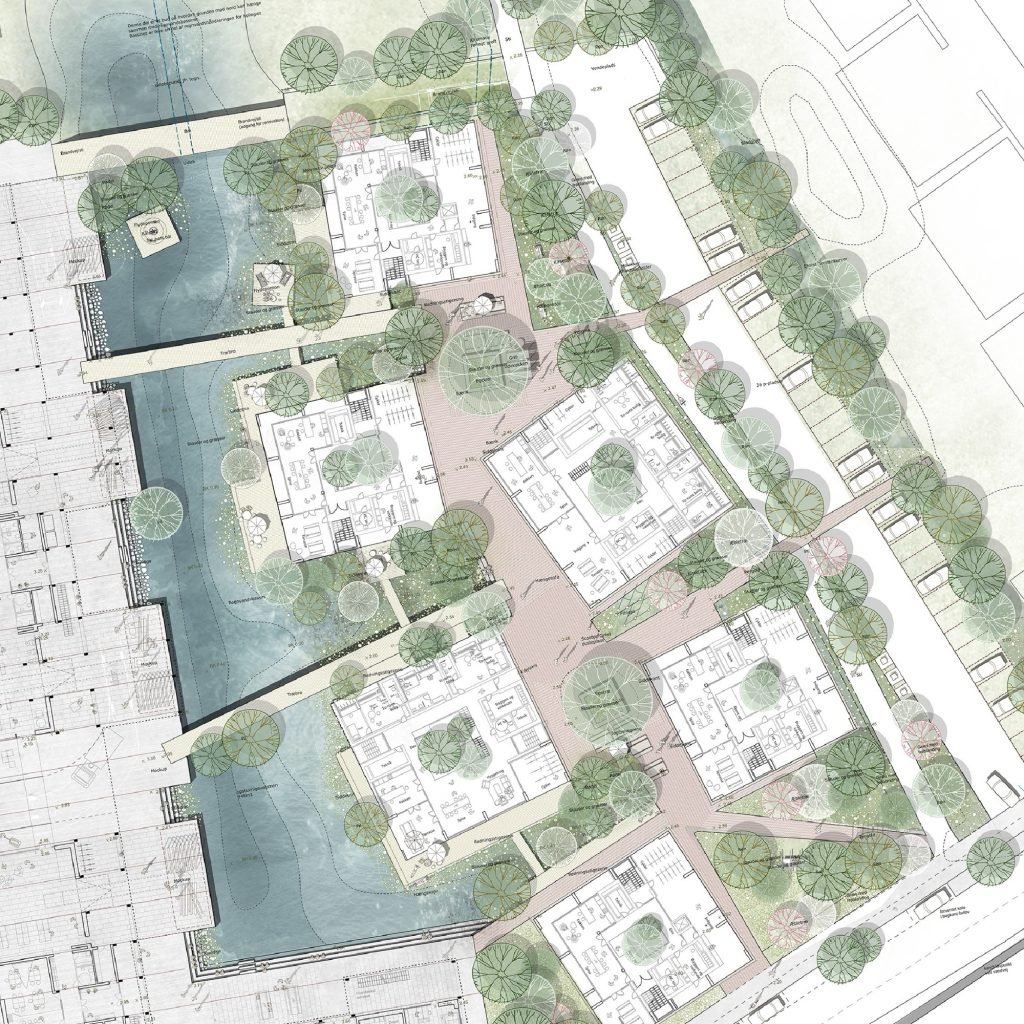

The Crafts College in Horsens, Denmark brings together landscape and building architecture in a unified structure where spatial organisation, materiality, hydrology and social life are closely intertwined. The housing complex is located on DSB’s (Danish State Railways’) former freight rail grounds and is anchored in the area’s industrial history with clear references to its structures and cultural heritage.
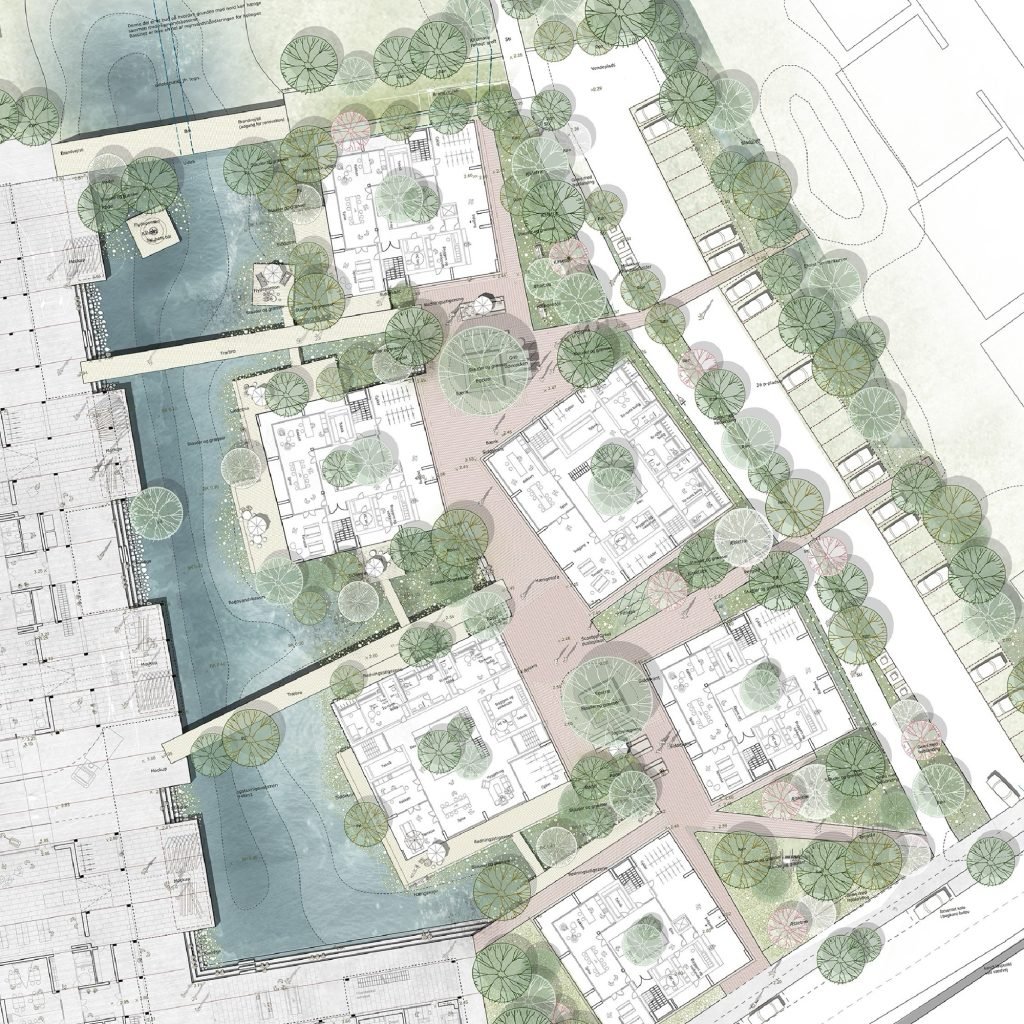
The Crafts College is a residence for young people aged approximately 18–28 who are undertaking a vocational training programme in a skilled trade in or close to the Danish town Horsens. Apprentices from different trades live here and are part of a community with workshops, professional mentoring, and social activities. The college is developed by the Foundation for Craftsmen’s Colleges and is funded by the BRF Foundation.
Schønherr has been responsible for developing the design of the landscape through all phases: concept design and programming of the overall landscape plan, detailed planning, and site supervision of outdoor campus functions, design of climate adaptation and water management.
The project unites beauty, durability, and community in an architectural concept that equally values the site’s character, material aesthetics, and social structures.
Schønherr has positioned climate adaptation and water management at the core of the project, reframing the campus programme. At the heart of the blue-green campus lies the central rainwater basin, which collects, delays, and filters surface water from the surrounding buildings and open spaces, while shaping the identity of the entire development. The basin establishes a shared ground between building architecture and landscape, where bridges, decks, and stepped edges create physical and visual connections across the site, linking public and private domains. Seasonal fluctuations in water level add a temporal dimension, making natural processes visible and engaging for residents and visitors alike.
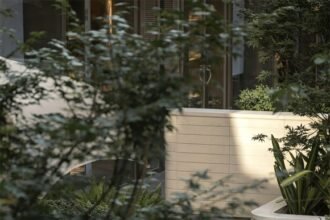
Beauty arises from the robust material choices and artisanal detailing, where classical building techniques and ornamentation are given new roles in both building architecture and landscape. Material continuity across buildings and landscape reinforces the architectural concept. The tactility of the facades and paving, the reused brick, and the articulated transitions between the buildings and the blue-green campus underline the project’s haptic and honest expression. Edges, thresholds, and transitions are carefully composed, allowing the landscape to extend into the architecture and vice versa.
Subtle surface articulations define zones for circulation, arrival, and informal occupation, supporting a seamless transition between buildings and outdoor spaces. Construction details are exposed and legible: how elements meet, drain, and age is made visible. The campus becomes a didactic environment where the processes of making are embedded in the spaces of learning and everyday use.
Socially, the student housing is organised around workshops, a community house, and green residential clusters. The stormwater landscape serves as the focal point of the community – a sensorial meeting place for informal encounters and larger events. In this way, the student housing offers not only residences but also an active, professional, and social environment for the craftsmen of the future.
Through this integrated approach, The Crafts College establishes a resilient and socially active environment where climate adaptation, craftsmanship, and everyday life are brought together. The landscape is not conceived as a backdrop, but as a fundamental structuring element that supports both the functional needs of the campus and the formation of a strong communal identity.
Project: The Crafts College in Horsens
Client: BRF Foundation – The Foundation for Craftsmen’s Student Housing
Role: Sub-consultant – concept design and programming of the overall landscape plan, as well as design, detailed planning, and site supervision of outdoor campus functions, including climate adaptation and water management.
Other partners: Cubo Arkitekter + DANØ Arkitektur, Tri-consult, Brdr. Thybo, Ejner Olesens Eftf., Bisgaard | Ejsing, and Hele Landet
Status: Inaugurated April 2024
Outdoor area: 15.000 m²
Awards: MIPIM Awards Best Cultural, Sports & Education Project 2025; Byggeri Magazine: Building of the Year 2024; Horsens Municipality Architecture Award: Best New Building 2025; DGNB Gold Certification, DGNB Diamond Distinction.
55.864608002045436, 9.83790392126735