


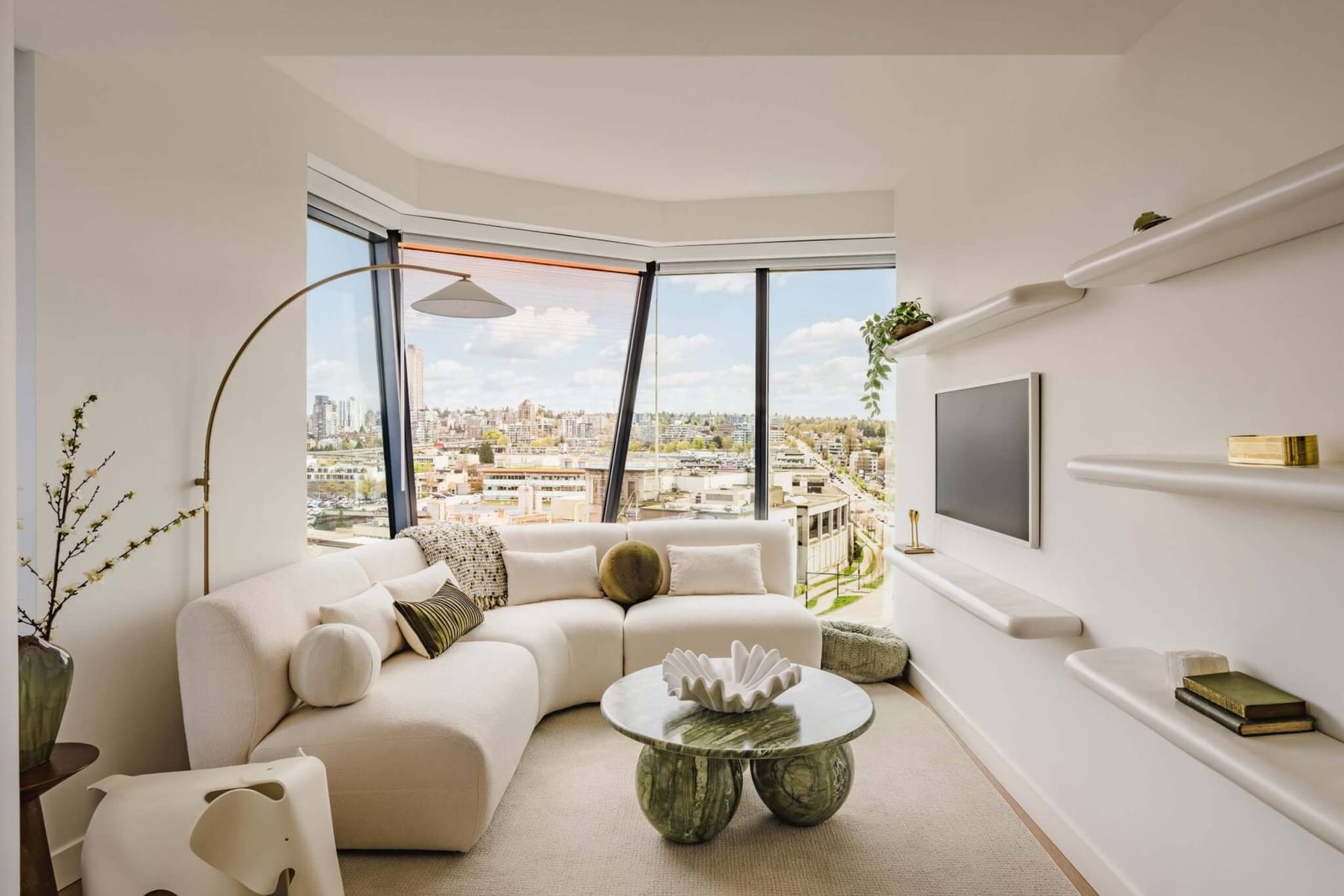

At the base of Vancouver’s Burrard Bridge, one of the most consequential urban developments in Canadian history is taking shape.
The first three towers at Sen̓áḵw, the Indigenous-led redevelopment by the Squamish Nation, are now complete. Together, they provide 1,409 purpose-built rental units, including more than 280 affordable apartments. Access is being phased, with Squamish Nation members and Indigenous applicants first, followed by the general public in early June.
It marks a major milestone in a project already reshaping conversations around housing, density, sustainability, and Indigenous sovereignty in North America.
At full build-out, Sen̓áḵw will include 6,000 rental homes alongside commercial, office, retail, and community uses, creating a dense mixed-use neighborhood on a compact 10.5-acre site directly beside downtown Vancouver.
Architecture Shaped by Place
For Venelin Kokalov of Revery Architecture, the project was an opportunity to create a contemporary Indigenous urban village rather than a conventional residential development.
“The project is deeply rooted in the history of the site and in the values of the Sḵwx̱wú7mesh Úxwumixw, whose connection to this land extends back thousands of years,” he said.
Kokalov and his team took a “village in the park” approach to the project. Ten residential towers ranging from 22 to 58 stories are arranged alongside a 12-story hybrid mass timber office building, mixed-use towers, and four commercial pavilions across an active urban landscape.
The towers are positioned to maximize light, airflow, and views. Kokalov said the architecture emerged from the site’s geography and history rather than being imposed onto it.
Two architectural typologies anchor the project: “Mountain Towers” with crystalline forms and copper-fritted glazing, and “Long Towers” inspired by the rectilinear longhouses that once stood in the village.
Mountain Towers incorporate balconies and glazing influenced by Squamish crescent and trigon motifs. Their angled rooftops point north toward the Twin Sisters mountains, which carry cultural significance for the Squamish Nation.
The Long Towers use a more linear form. Screens ripple across the glazed facades, referencing salmon moving through water while filtering light and providing privacy between units.
“We did not want to create literal historical replicas or superficial references. The goal was to translate Indigenous values and Coast Salish design language into a contemporary urban architectural expression,” said Kokalov.
At ground level, the scale shifts deliberately. Pathways, pavilions, plazas, and landscape spaces create a more intimate pedestrian environment beneath the towers.
The Bridge Becomes Infrastructure
The site’s relationship with Burrard Bridge heavily shaped the project. The bridge cuts directly through Sen̓áḵw, covering roughly 15 percent of the buildable land.
Rather than treating it as an obstacle, the designers took advantage of the bridge by incorporating it into the site and using the covered areas beneath it for recreation, gathering, and cultural programming.
The project also rethinks mobility at a scale still uncommon in North American developments. With parking provided for only about 10 percent of units, the site is organized around transit, cycling, and pedestrian movement rather than private vehicles.
Kokalov said the reduced parking footprint allowed more land and resources to be directed toward housing, landscaping, and public amenities while reducing excavation and underground infrastructure costs.
The project includes an underground bike network, storage and maintenance facilities, pathways, plazas, and extensive native planting integrated throughout the site.
The landscape strategy is intended to function both environmentally and socially, reconnecting the development to surrounding urban and ecological systems.
“We see the landscape as both ecological and social infrastructure,” said Kokalov.
Squamish Nation Chairperson Sxwíxwtn Wilson Williams said Squamish culture is embedded throughout the project, from the architecture and artwork to the planting and pathways.
“You can see our culture and traditions woven into every aspect of the interior and exterior design. Our language is throughout the site. You are exposed to our artwork and our history. You can see it in the restoration of native plants and the way the pathways reconnect people to the water and the land. It is absolutely everywhere,” he said.
Sustainability at Scale
Sustainability is integrated throughout Sen̓áḵw’s planning, from building orientation and material choices to energy systems and transportation infrastructure.
The project is targeting net-zero operational carbon performance. A central component is a low-carbon district energy plant that uses wastewater energy recovery to provide heating and cooling across the development.
Buildings are arranged to maximize sunlight and airflow, while high-performance glazing, renewable materials, stormwater integration, and extensive landscaping are designed to improve environmental performance and pedestrian comfort.
Mass timber is incorporated into key portions of the project, including the office building, to help reduce embodied carbon while introducing warmer material textures into the public realm.
The transit-oriented, low-car model also significantly reduces the environmental impact typically associated with parking infrastructure and automobile dependency.
“For us, sustainability is about creating a healthier and more resilient urban community that reflects Indigenous principles of stewardship, interconnectedness, and long-term responsibility to the land,” said Kokalov.
Unlike Anything Else in Vancouver
Sen̓áḵw differs sharply from most Vancouver developments in both density and governance.
Despite its relatively compact footprint, the project delivers a level of height and density rarely seen in the city, with much of the housing dedicated to rentals at a scale Vancouver has struggled to deliver.
Because the project is being built on Squamish Nation land, it operates outside Vancouver’s conventional municipal rezoning framework. That gave the Nation greater flexibility around height, density, parking, and long-term planning.
But according to Kokalov, the most important distinction is not simply jurisdictional. “Indigenous culture, history, and values are not being added onto the architecture afterward. They are embedded in the DNA of the development,” he emphasized.
What Comes Next?
The first phase establishes much of the project’s core infrastructure, including the Mountain Towers and district energy system.
Future phases will expand the landscape network, public realm, retail, office space, cultural amenities and residential community. The Long Tower typology will also be introduced more fully across the site.
Over time, pathways, plazas, and open spaces will increasingly connect the different parts of the development into a more integrated urban district.
Kokalov said the broader ambition was not simply to build towers, but to establish a new city-building model rooted in Indigenous leadership and long-term stewardship. “What will ultimately distinguish Sen̓áḵw as a vibrant, resilient, and inclusive community is its city-building model, rooted in Indigenous leadership, long-term stewardship, and a holistic connection between architecture, nature, mobility, and culture.”
Rebecca Keillor is a Vancouver journalist who writes on design, culture and arts. A weekly columnist for Canada’s Postmedia Network, her articles have appeared in The Globe and Mail, the National Post, House & Home, and others.