
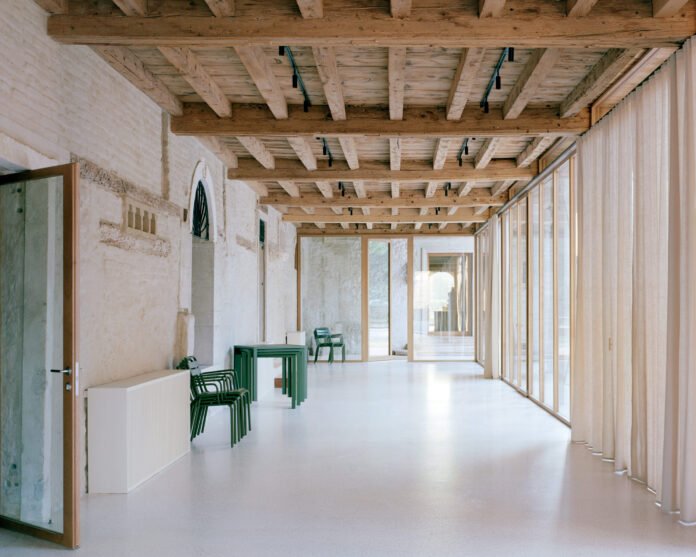


In Vicenza, Italy, the historic Villa Donà is now home to offices and a new cafe. RigonSimonetti, a Vicenza-based architecture firm run by Francesco Rigon and Margherita Simonetti carefully restored and renovated the villa. The office uses the striations of time exposed on the Venetian villa as a guide to carving out new spaces for work and gathering. Like the strata of sediment, Vis-à-vis, as the project is named, renders new and old changes to building changes over time, turning them both legible and coherent.
The site’s nearly 29,000 square feet (8,840 square meters) is divided into a main building; barchessa, the wing that connects the main building to the road; and a new annex which sandwiches a garden with the barchessa.
The barchessa, defined by its traditional row of arches, extends 3,000 square feet (926 square meters) from the main building. The facade bears the marks of multiple transformations over the centuries, from 18th-century modifications to 19th-century alterations. Of the three archways that line the barchessa’s exterior, the central arch stands apart, as a protruding wooden box suspends out over a glass opening. The interruption marks the new intervention in the site and hints at the new additions within.
Right around the corner, the barchessa unfolds with a new portico, made of a timber frame. It rests snugly within the stone colonnade, supported by slender iron beams which support the upper floor. While running parallel to the original stone columns of the barchessa, the new beams stand apart from the historic site but crucially support its weight.
The frame resolves a structurally and compositionally incoherent system resulting from years of abandonment. “The tension between the wooden facade and the 18th-century arches and columns conveys the sense of the project,” said Rigon and Simonetti. It blends “the need for a sincere, and therefore at times antithetical, dialogue between what we inherit from the past and what, on that basis, we can construct today.”
Within the portico, a new multipurpose hall is lightened by the wood and glass facade. It falls in contrast to the barchessa’s original plaster which was stripped to reveal an ancient timber structure embedded within the masonry, now treated with a lime-based finish.
Adjacent to the hall, a new cafe continues the raw-meets-wood language. The double-height space maintains the texture of the original masonry, revealing where a former hayloft used to be in the space. The main window frame of laminated and plywood okoumè wood continues in the interior, defining the new custom furnishings: the counter, benches, and a service block.
A new staircase made of concrete cast in MDF formwork with Vicenza gray stone treads leads upstairs to office and coworking spaces. One one side, a new glazed volume hosts communal work areas and meeting rooms. The space melds new black cabinets juxtaposed with the sloped wooden rafters and light from the top of the barchessa’s arches. On the other side, private offices are housed within traditional masonry and timber, separated by a corridor of wooden frames mounted on a reinforced-concrete structure. This move both resolves structural issues while intervening in the space in a way that maintains the legibility of the building’s history.
The offices continue in the new annex, a low-slung building with a sloped roof, to be in dialogue with yet still stand apart from the barchessa. Here, polished concrete floors and oiled wood surfaces create a luminous interior. Daylight filters in through glazing framed in wood, which responds to the language of the portico.
“Every intervention—whether related to the recovery of existing structures or to new insertions—is expressed through a specific material drawn from traditional craftsmanship,” continued the cofounders. Despite the visual contrast at the heart of Vis-à-vis, structural and material continuity form an underlying coherence.