
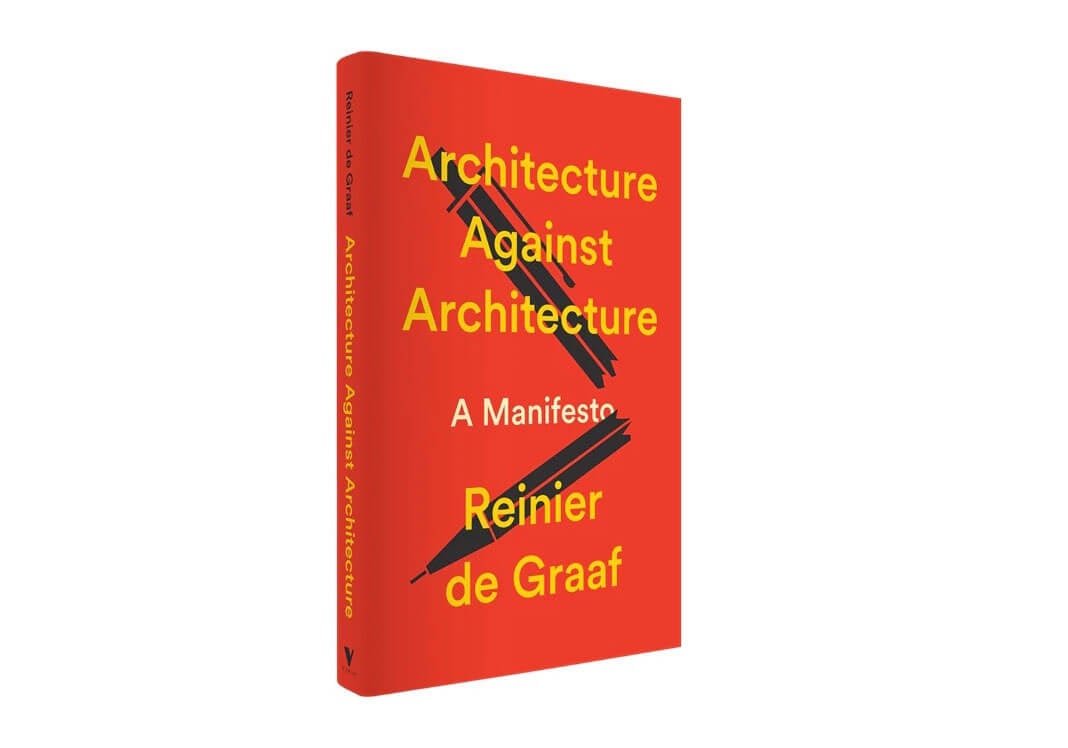

Architecture Against Architecture: A Manifesto by Reinier de Graaf | VersoBooks | $26.95
Since the publication of his first book, nearly a decade ago, the architect Reinier de Graaf has positioned himself as an insider-outsider, continually critiquing the architecture profession, all while maintaining a lucrative and successful role within it. Where his last book, architect, verb: The New Language of Building, seemed to be a list of reasons architects might throw up their hands and declare “I’ve had it” with the profession, de Graaf’s Architecture Against Architecture: A Manifesto, published in March, makes it clear that despite all its flaws, the author will absolutely not be abandoning the field.
Divided into two sections, the manifesto is meant to detail what is still wrong (e.g. long hours and unreasonable expectations) and what might be changed (less clear) about the profession. The opening chapter begins with a shaky call to consider firms over founders. Here, the author uses David Adjaye’s supposed ousting following accusations of sexual misconduct and “toxic work culture” as an example. de Graaf’s take reads more as a warning to said founders than an indication that their power has gone unchecked, and he notes that “when push comes to shove, the system can be as cruel” to those who have achieved great fame as those “condemned to live in the shadows.” In his reflection on the lack of legal charges pressed against Adjaye, the author offers a sympathetic perspective, “his big flaw might well be that he proved human after all, prone, like all of us, to the abuse of power when too much power is given.”
Across the book, it becomes clear that this is a manifesto written by a boss—a man in charge. While his past work indicated that he had an interest and understanding in notions of worker solidarity, socialism, and architecture that creates substance instead of waste, the reality of his stature places this book not in the category of revolution, but of continuation. Like the ramblings of a tech or finance founder on some unlistenable podcast, this boss’s conclusion is that he should continue being a boss.
The devil lies in the details, but here, the details are conspicuously missing. He wonders if architecture is art, and concludes that it is, simply because he wants it to be. He ponders the trap of “sustainability,” and he considers the need for more hands-on training, but fails to produce meaningful futures for either. He has long understood that his profession has been overtaken by developers, but the difference between this new entry into his oeuvre and his previous books is that he seems at peace with this now. In a confusing chapter on his belief that architects should unionize, he insists that architects realize themselves as part of “the working class, pure and simple.” As an addendum, he makes a small note that his own firm denied unionization. His notion of architects as the working class comes across therefore not as enthusiasm that such a distinction with broader material aims, but rather that of a bored substitute teacher organizing his class into groups for an activity that ultimately will be of no consequence to their grades or futures.
Later, in an unforgivable chapter that fails yet again to reach any concrete conclusions, he suggests a deal with artificial intelligence: “Rely on AI for matters of taste. Humankind’s ultimate liberation will be for the delegation of fun.” I read the chapter in a state of total gobsmack, unable to tell if he was joking. A quick search into his day job cleared up any ambiguity: the author designed a data center for a German artificial intelligence company in 2023, “a form in which geometry and economy meet in perfect synchronization.”
It is only in the second half of the book, when de Graaf moves away from whatever he remembers that architects are, to thinking about what exactly architecture is, that his previously demonstrated talent for criticism reemerges. Here, his best ideas are clearer and sharper—particularly in his insistence that we should stop building new structures at all and his emphasis on refurbishing over demolishing. But this reunion of focus and conviction is consistently undermined by his current role in the world he seeks to critique. His business, after all, relies on these ideas not coming to fruition. His firm, OMA, continues to build new buildings, including in places where labor practices are routinely criticized, and does not show any signs of stopping.
Likewise, where his reflections on social architecture have previously felt clearly in favor of building for the masses (his first book returned to Marxist theory so much one often forgot they were reading a book about building), his politics have been reallocated from the spatial and programmatic to that of the material scale, zooming in to circularity as a pathway to a more radical architectural future. Thus, a story that would have surely horrified the author of his old books—that of the destroyed Palast der Republik’s material being used to build Dubai’s Burj Khalifa—now seems to inspire him. In his new book, the two buildings do not represent opposite ends of the spectrum of how capital and labor and workers should be treated, but merely “the whim of the powers that be.” In convincing himself that all buildings are the same, regardless of how or by whom they’re constructed, he has convinced himself that all conditions are the same as well— it is only the choice of what comes out of these conditions that differs. In other words, there are simply other bosses, like himself, deciding things.
This is a nihilist proposition, and a tired one too. For de Graaf, the answer to how to continue building in a world where to act means to do more harm than good is to simply abandon the notion of good. “The true legacy of globalization is not global politics, or even global trade, but a world collectively beyond good and evil,” he writes at the end of his whimsical manifesto. “No longer does choosing where you will and will not work serve as proof of morality. Navigating the world a la carte in the hope of retaining a clean conscience is a hope in vain.”
There is a word for the type of person who thinks this way, and it is not artist. If de Graaf’s goal is to tear down and rebuild architecture entirely, he would need the masses—the workers— that he has long since lost touch with. Architecture Against Architecture is not a revolution, but a report on the field as it stands. To build is to earn a profit. There is nothing more, beyond construction of those four walls and their roof, to think about.
Lily Puckett is a writer based in New York City.
This post contains affiliate links. AN may have a commission if you make a purchase through these links.