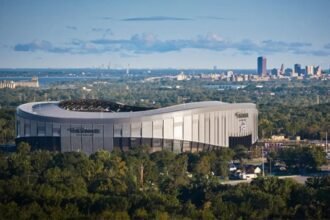






Inglewood, a low-slung Southern California city of roughly 105,000 residents, has been transformed in recent years by the emergence of the Hollywood Park entertainment district. Anchored by SoFi Stadium and Intuit Dome, the area now boasts venues with a combined seating capacity of more than 116,000 people, connected by vast expanses of asphalt. Within this landscape of oversized infrastructure, a standalone fast-food restaurant occupying a footprint of just 50 by 50 feet faced an obvious challenge: How could such a small building establish a memorable presence?
Donaldson + Partners looked to the region’s architectural history for an answer. Commissioned to design Raising Cane’s West Coast Flagship in between Intuit Dome and SoFi Stadium, the Los Angeles–based architecture firm drew inspiration from Googie architecture, the exuberant midcentury style that flourished across Southern California in the mid-20th century. Characterized by sweeping rooflines and oversized signage, Googie buildings were designed to capture the attention of motorists speeding past on freshly paved boulevards. The style embraced spectacle, making architecture itself a form of advertising.
The reference was especially fitting given Raising Cane’s own appreciation for the movement. The company previously purchased the iconic Norms restaurant on La Cienega Boulevard, to preserve its wedge-shaped roofline and adapt it for the brand. Donaldson + Partners sought to channel that same spirit, but through the lens of contemporary technology rather than nostalgic imitation.
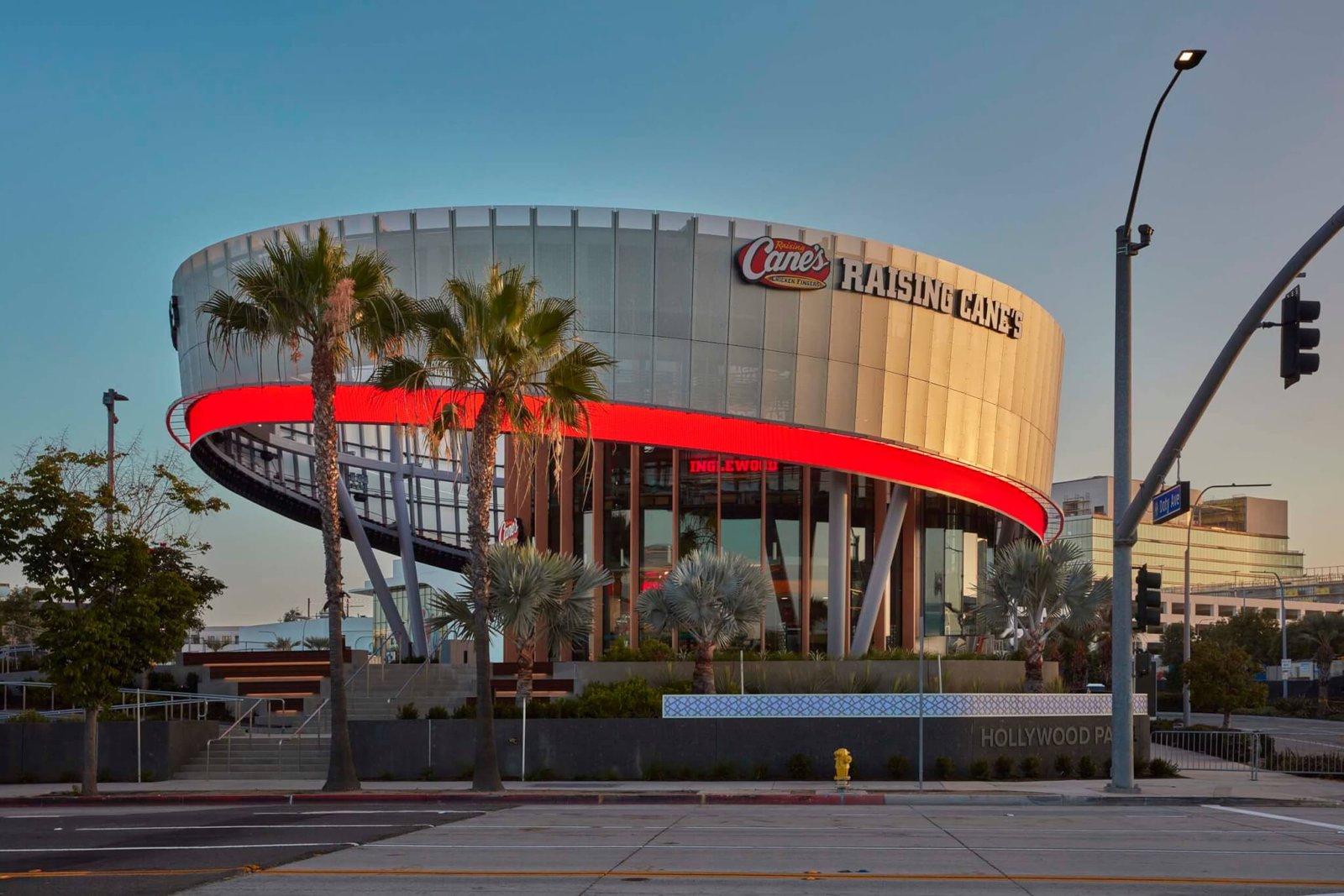
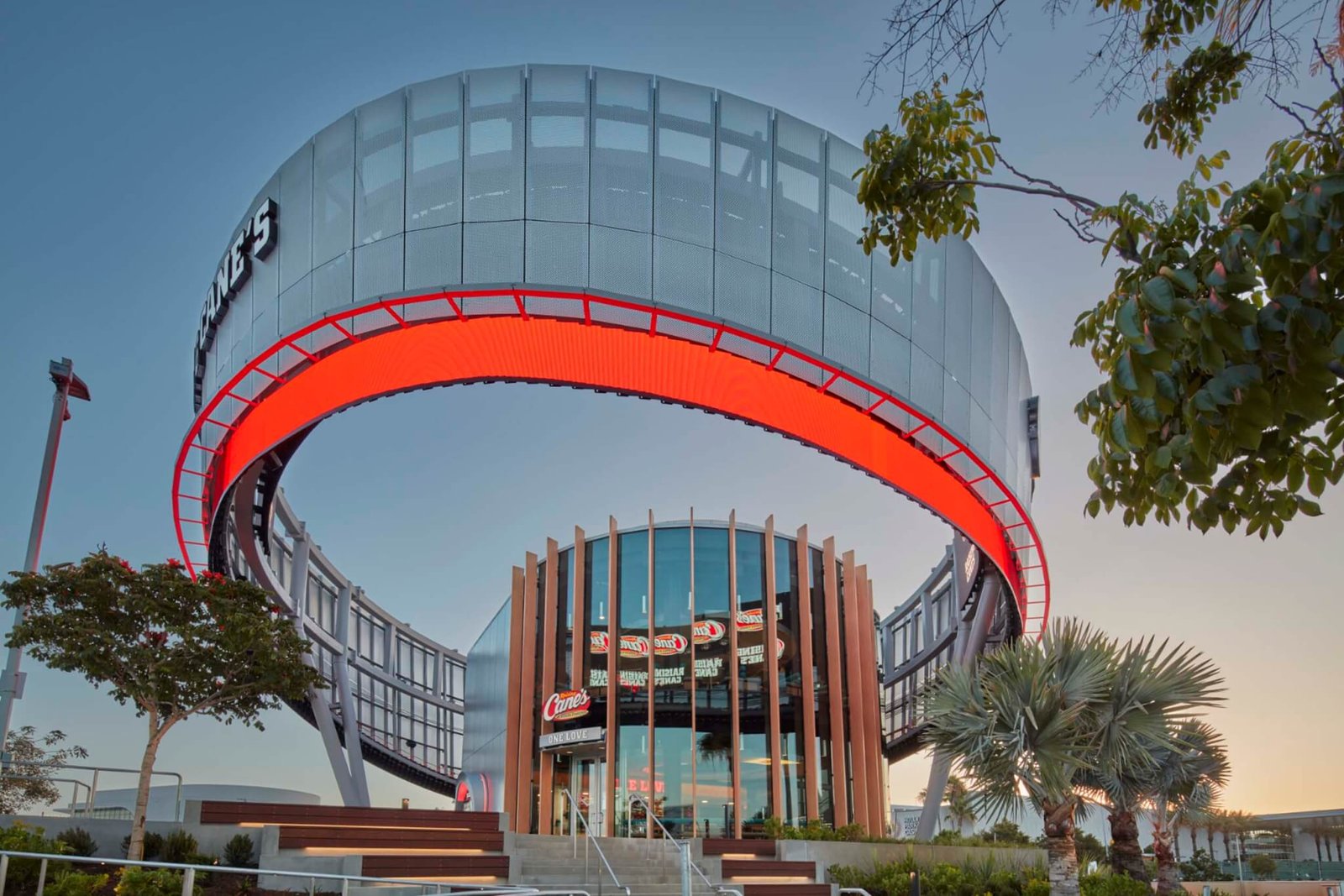
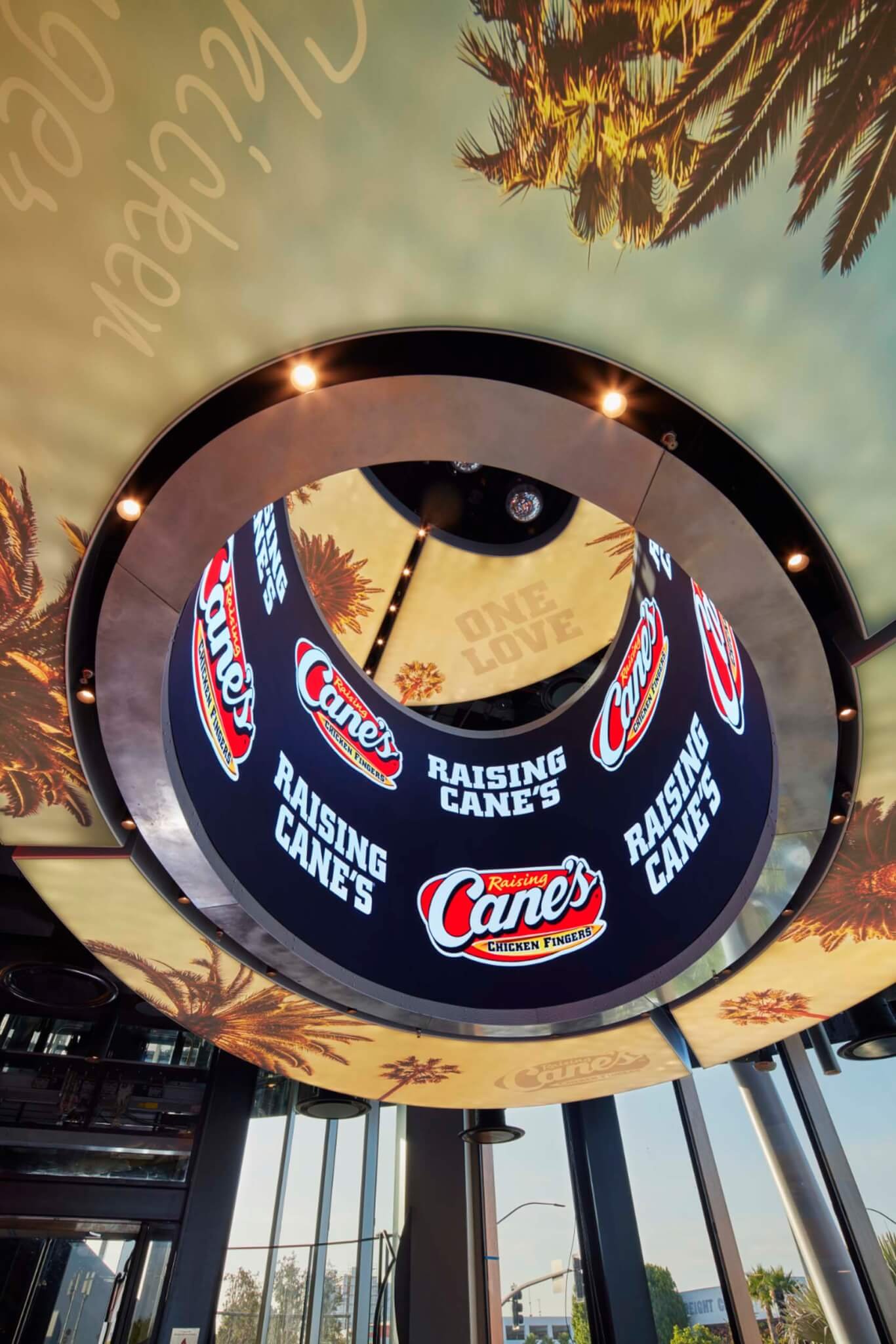
Where classic Googie diners relied on angular rooflines and towering signs to suggest speed and movement, the new flagship uses digital media to achieve a similar effect. A 108-foot-wide illuminated “halo,” fitted with nearly 200 LED panels, extends far beyond the restaurant’s compact footprint, creating an architectural presence that can be recognized from across the surrounding parking lots.
“Initially I thought about it simply as a sculptural object that could exist independently in the parking lot,” Robin Donaldson, founding partner of Donaldson + Partners, told AN. “Then the restaurant became something inserted within that sculpture. Even without graphics, the shape itself acts as an identifier, much the way the golden arches once did for McDonald’s.”
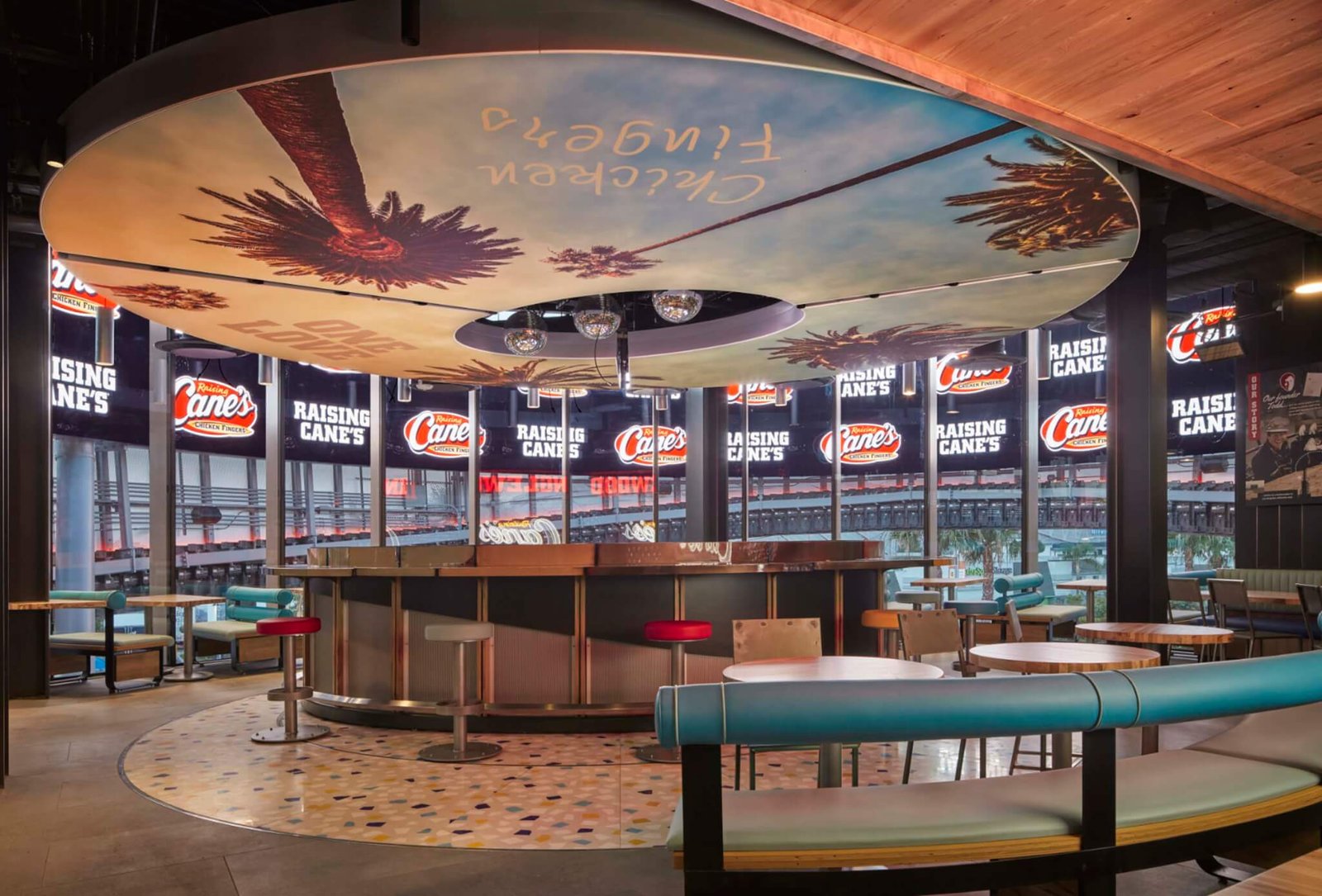
The halo is intended to function as a destination as much as a beacon. Beneath the halo, guests can gather on broad Spanish steps to watch live sports broadcasts streamed across the overhead displays, transforming what might otherwise have been a simple fast-food stop into a public gathering space.
The building’s perforated metal skin reinforces this sculptural quality while maintaining a visual relationship with its neighbors. Walter P Moore, the engineering firm responsible for portions of the exterior skins at both SoFi Stadium and Intuit Dome, collaborated on the enclosure to ensure the restaurant would feel like a sibling to its much larger neighbors. “While we wanted the restaurant to have its own identity,” Donaldson said, “there is an undeniable relationship between the three buildings.” The perforations partially veil the interior, offering only glimpses of the activity inside while contributing texture and depth to the exterior.
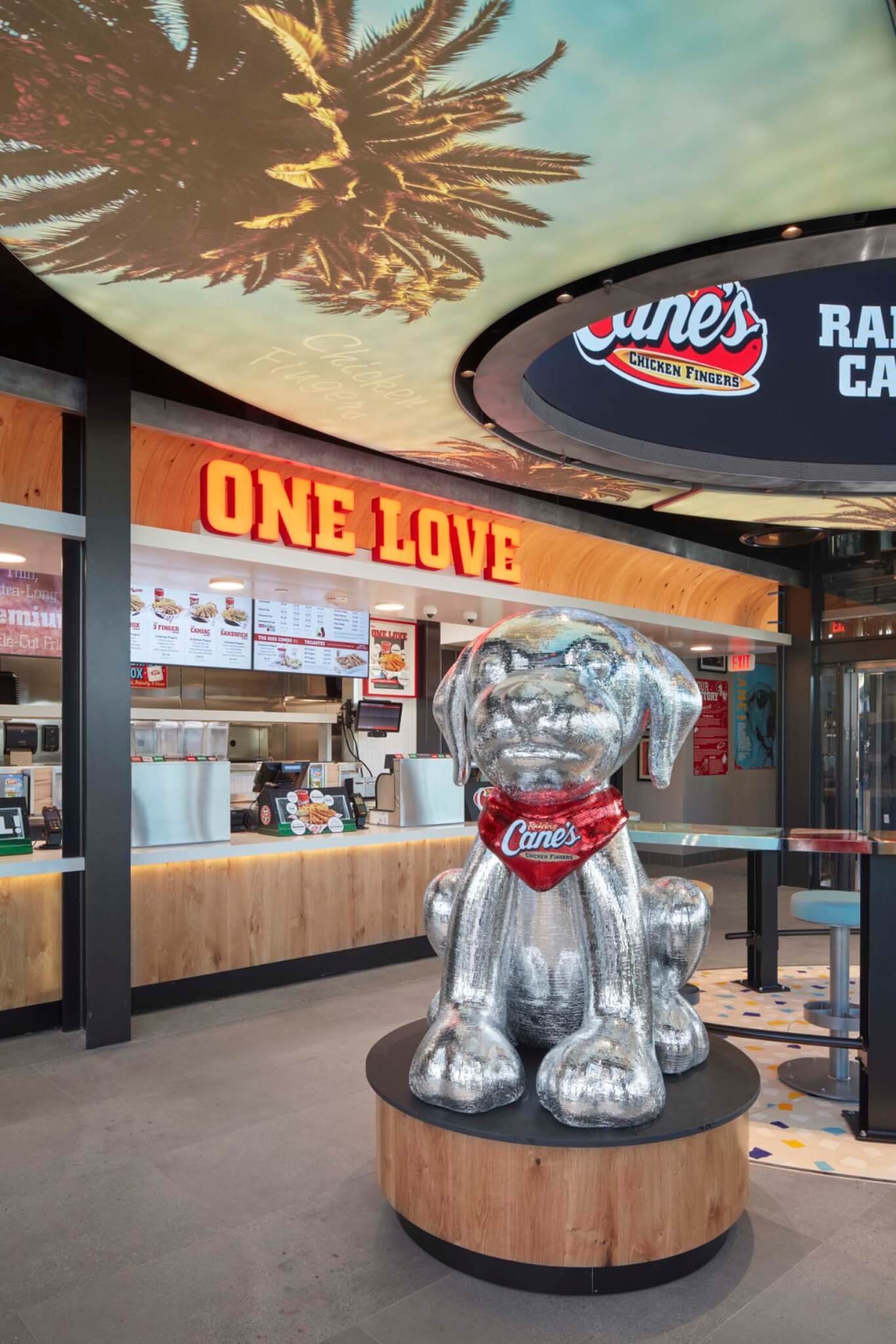
Digital spectacle continues inside. Customers queue beneath a cylindrical LED drum that connects the building’s two floors, enveloping visitors in a constantly changing display of graphics. A secondary screen capable of 3D visual effects and an integrated DJ booth further reinforce the atmosphere, blurring the line between restaurant and entertainment venue. These high-tech features stand alongside familiar Raising Cane’s design elements, including disco balls, exposed brick walls, and a large chrome sculpture of Raising Cane, the yellow Labrador Retriever that has served as the company’s mascot for more than three decades. Created by local artist Sofie Berarducci, the sculpture anchors the space with a distinctly playful identity.
These days, it’s rare to see a fast-food chain invest so much into its architecture, let alone a custom sculpture or a DJ booth. The exuberant roadside buildings that once defined chains like McDonald’s have largely given way to standardized boxes clad in muted colors, prioritizing efficient construction and flexible branding over memorable design. Against that backdrop, Raising Cane’s flagship represents a notable departure, rekindling fast-food architecture as an event in itself.
“The building may not immediately read as a Raising Cane’s from its architecture alone,” Donaldson said. “But once the signage, branding, and interior experience come together, it becomes unmistakably part of the brand while remaining completely unique to its location.”
Shane Reiner-Roth is a writer and lecturer on architecture and urbanism in Los Angeles.