



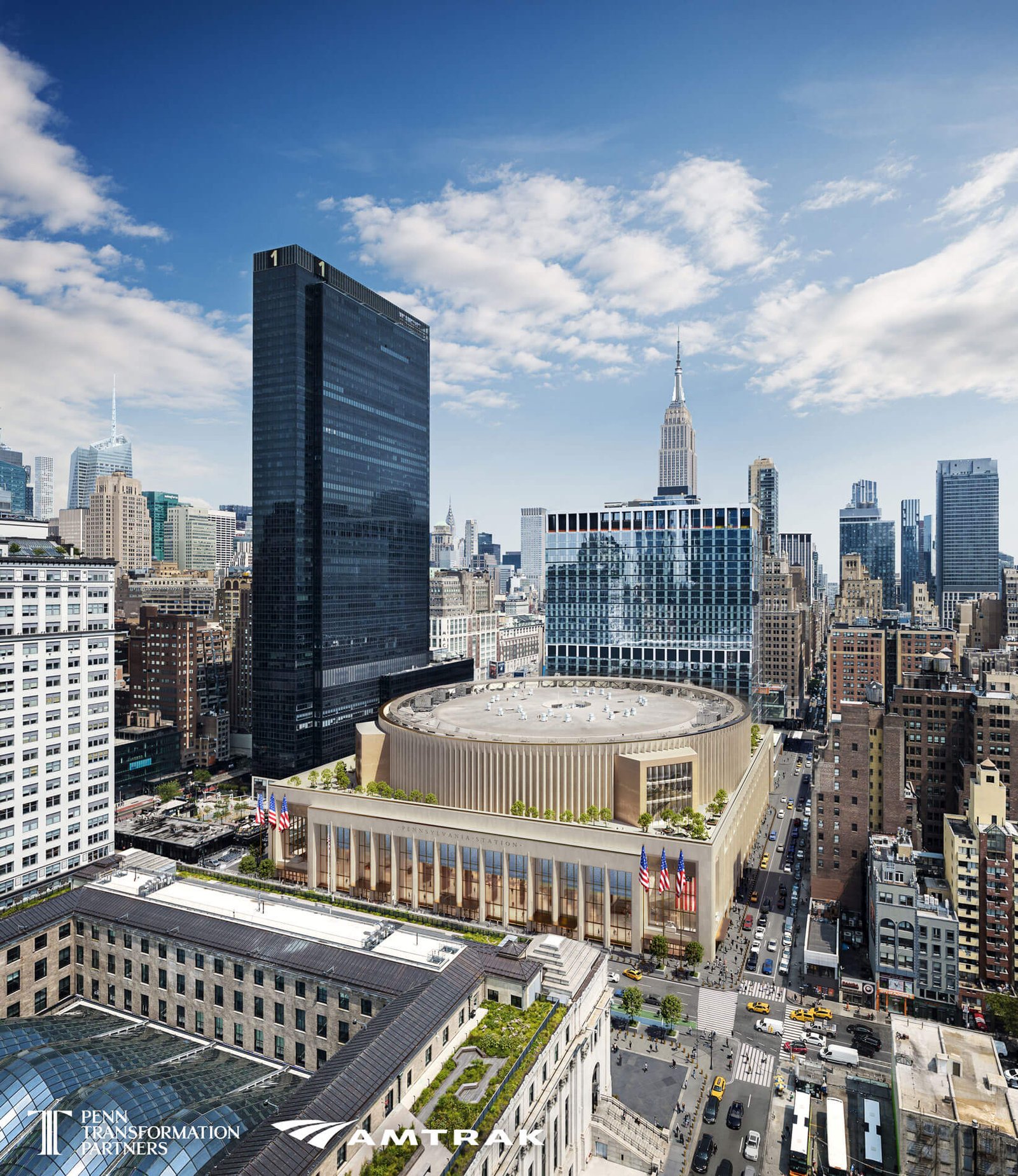
A press conference in New York City today shed light on Penn Station’s future, after Halmar International was named master developer for the hub’s overhaul last month.
The briefing was hosted at the office of Practice for Architecture and Urbanism (PAU), just a few blocks from Penn Station. PAU is the design architect, and HOK the managing architect.
PAU founder Vishaan Chakrabarti, Amtrak Special Advisor Andy Byford, and Peter Cipriano, of Halmar International, focused on architecture and operations, with an emphasis on through-running service.
Byford said the ballpark cost estimate for the project is $7 billion, a number prone to change. He aims to have shovels in the ground “by the end of 2027” and have construction “finalized” in six years.
“We’re hoping to get some early works underway and compress the construction schedule as much as we can, because, don’t forget, time is money,” Byford said.
Nate Sizemore, of the U.S. Department of Transportation, tuned in remotely and said the federal government is going to commit significant resources, to assuage concerns for New York taxpayers.
Here’s a breakdown of what they spoke about in more detail.
First Thing’s First
Byford started the conference dispelling what he called “myths” in regard to cost financing and transparency. Right off the bat he pledged that New Yorkers will not help pay for the project with fare hikes.
“There will be no fare hikes to pay for this project,” Byford said. “That’s not going to happen.”
The second clarification Byford made had to do with communications, after protesters mounted outside Penn Station yesterday to challenge the procurement process.
A spokesperson for Amtrak said that it cannot comment on the protests.
Byford affirmed “we’ve been as transparent as we can,” and emphasized that “we reconstituted the Station Working Advisory Group,” among other decisions to boost public confidence.
Byford further noted that the master developer team has no intentions whatsoever to tear down Block 780, a planning proposal that’s been on the table for years.
“People talk about Block 780 being under threat. No, it isn’t,” Byford said. “I just wanted to make those points, because it’s been very frustrating to me personally.”
Down to Brass Tax
After Byford brought reporters up to speed, Chakrabarti spoke at length about how Penn Station will be improved both operationally and experientially.
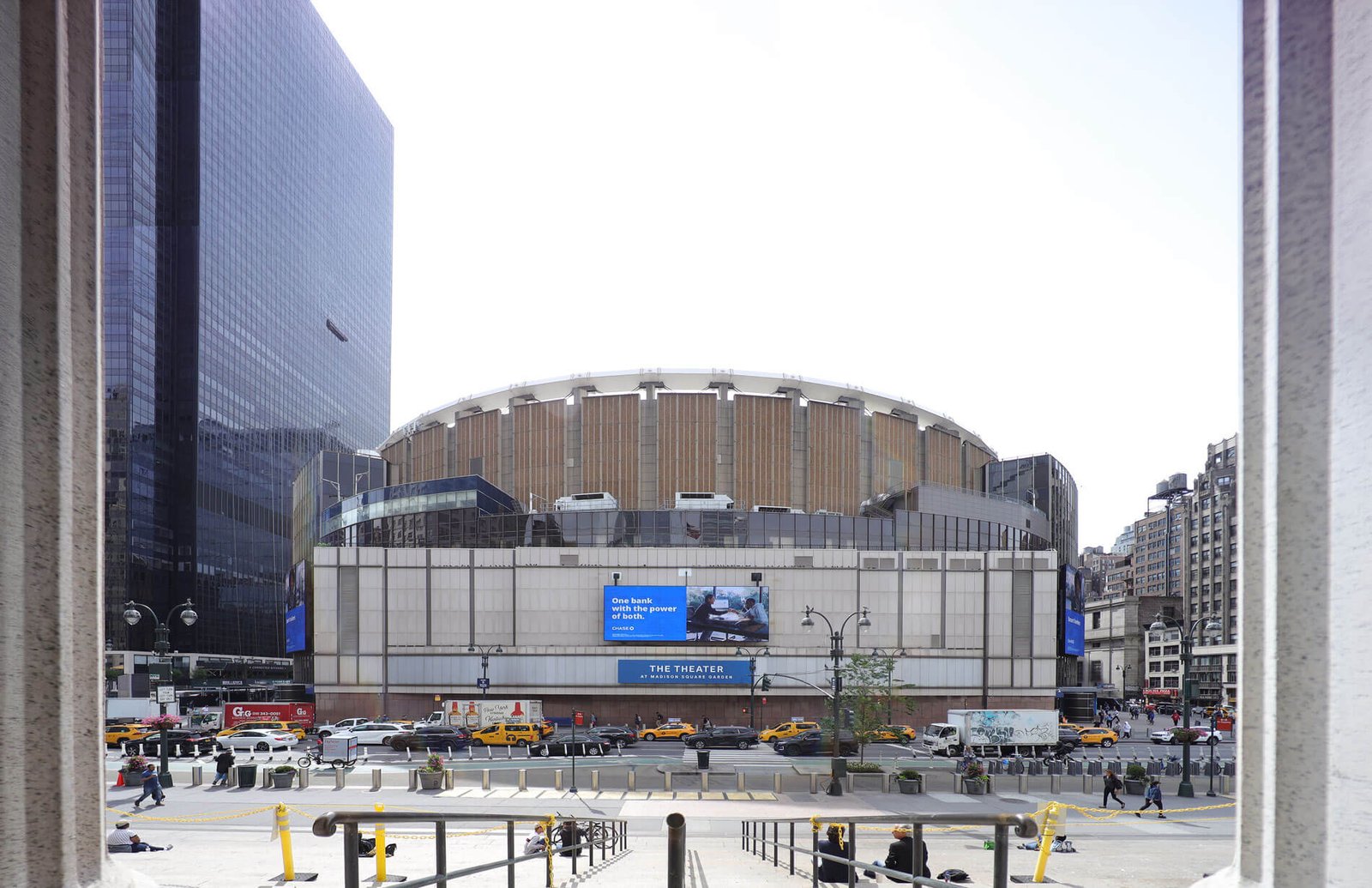
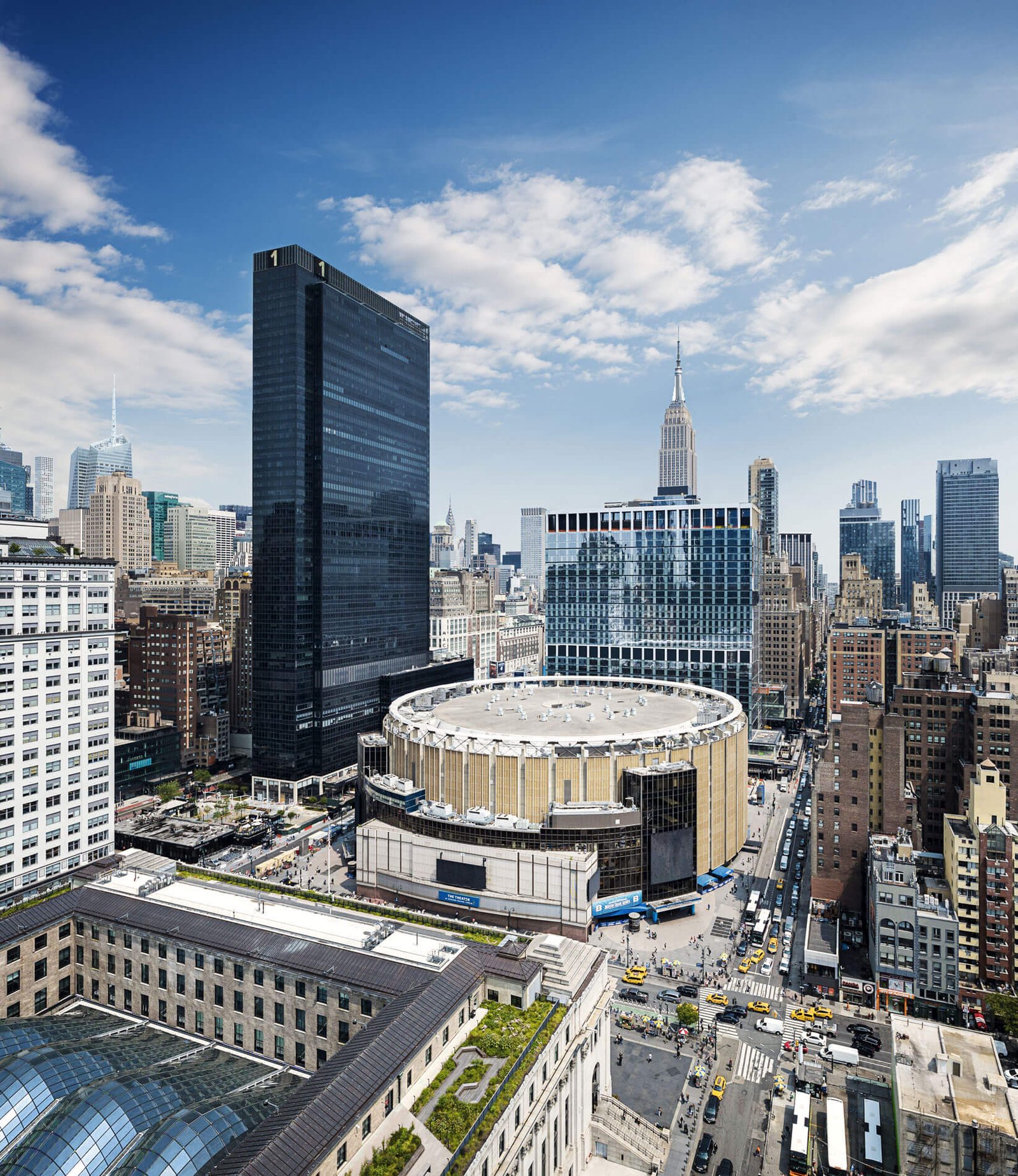
PAU’s design can be understood as follows: Madison Square Garden will remain in place, but Infosys Theater will be removed. This will open up all sorts of possibilities, Chakrabarti said.
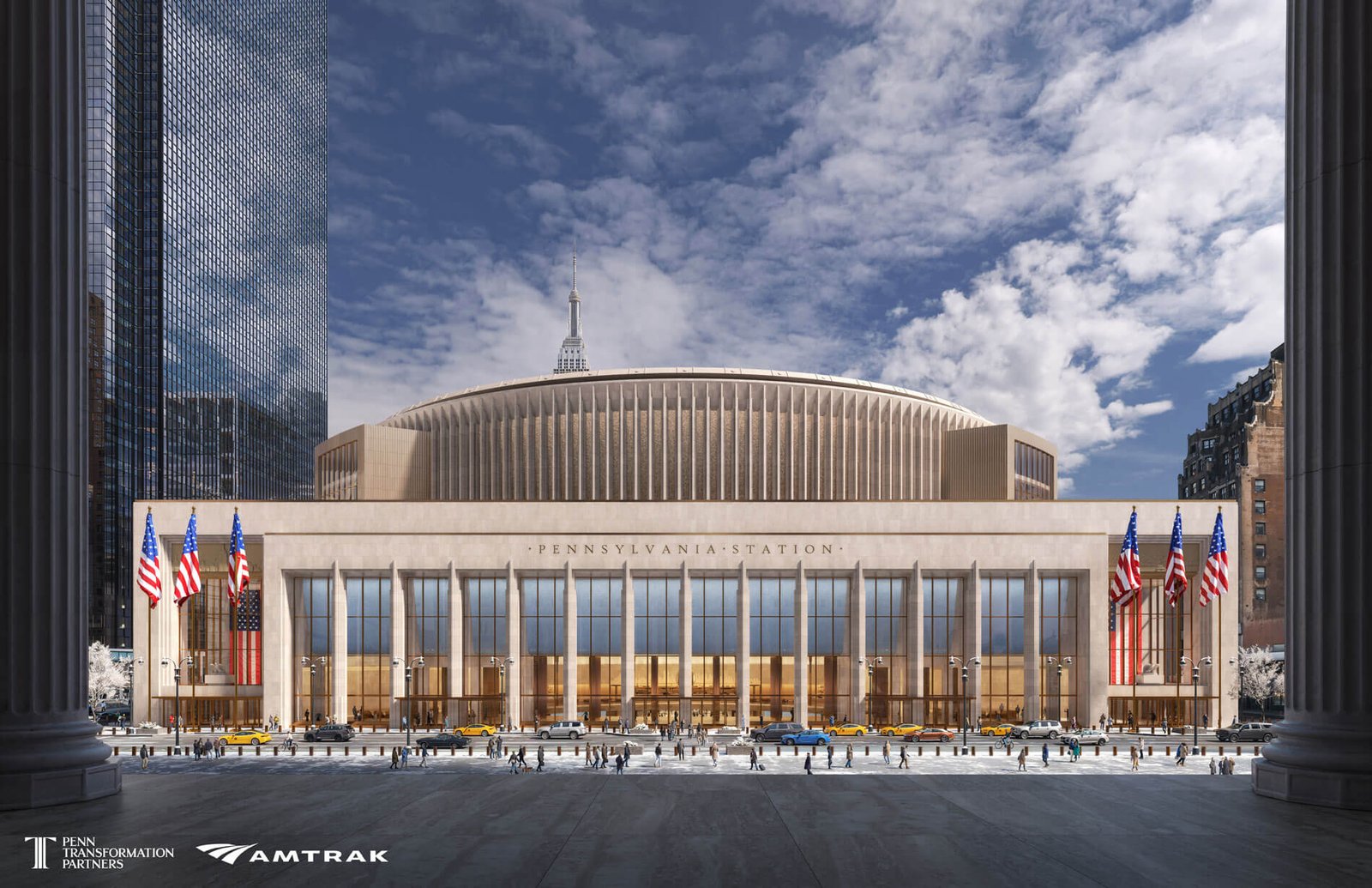
An orthogonal box will hug the street perimeter, creating a new monumental facade inspired by the original McKim, Mead, and White Penn Station, among other precedents.
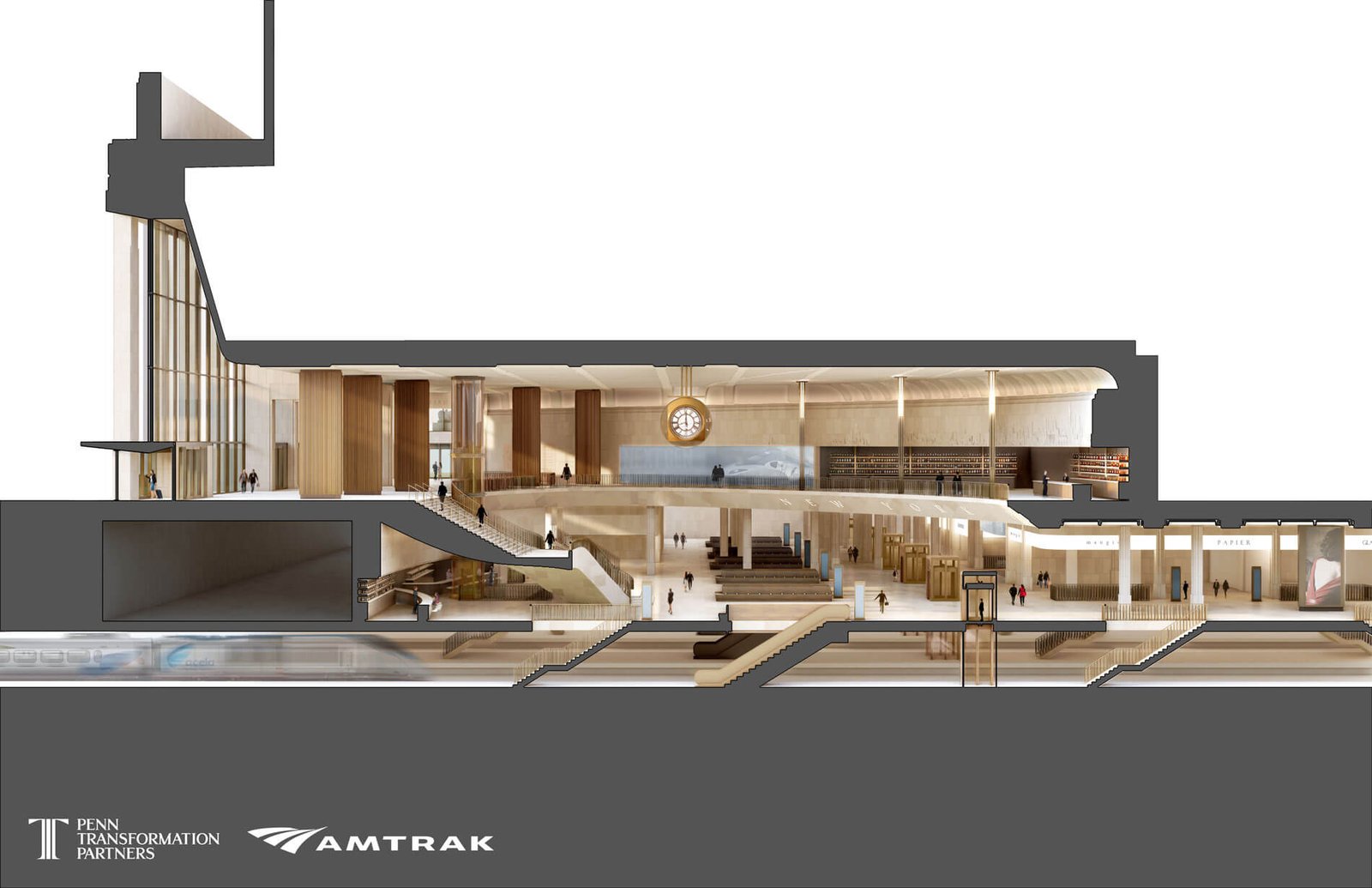
In section the theater is below the arena and above the track level. Removing the Infosys Theater, per PAU’s plan, will yield a 165 percent increase in public circulation space, Chakrabarti said.
The Dolan family owns Infosys Theater. Negotiations are now underway between the Dolans, Penn Transformation Partners, and Amtrak over the theater.
Outside, removing the “beige box” on Eighth Avenue that feeds visitors into the theater will allow for a new, monumental entryway to the station designed by PAU.
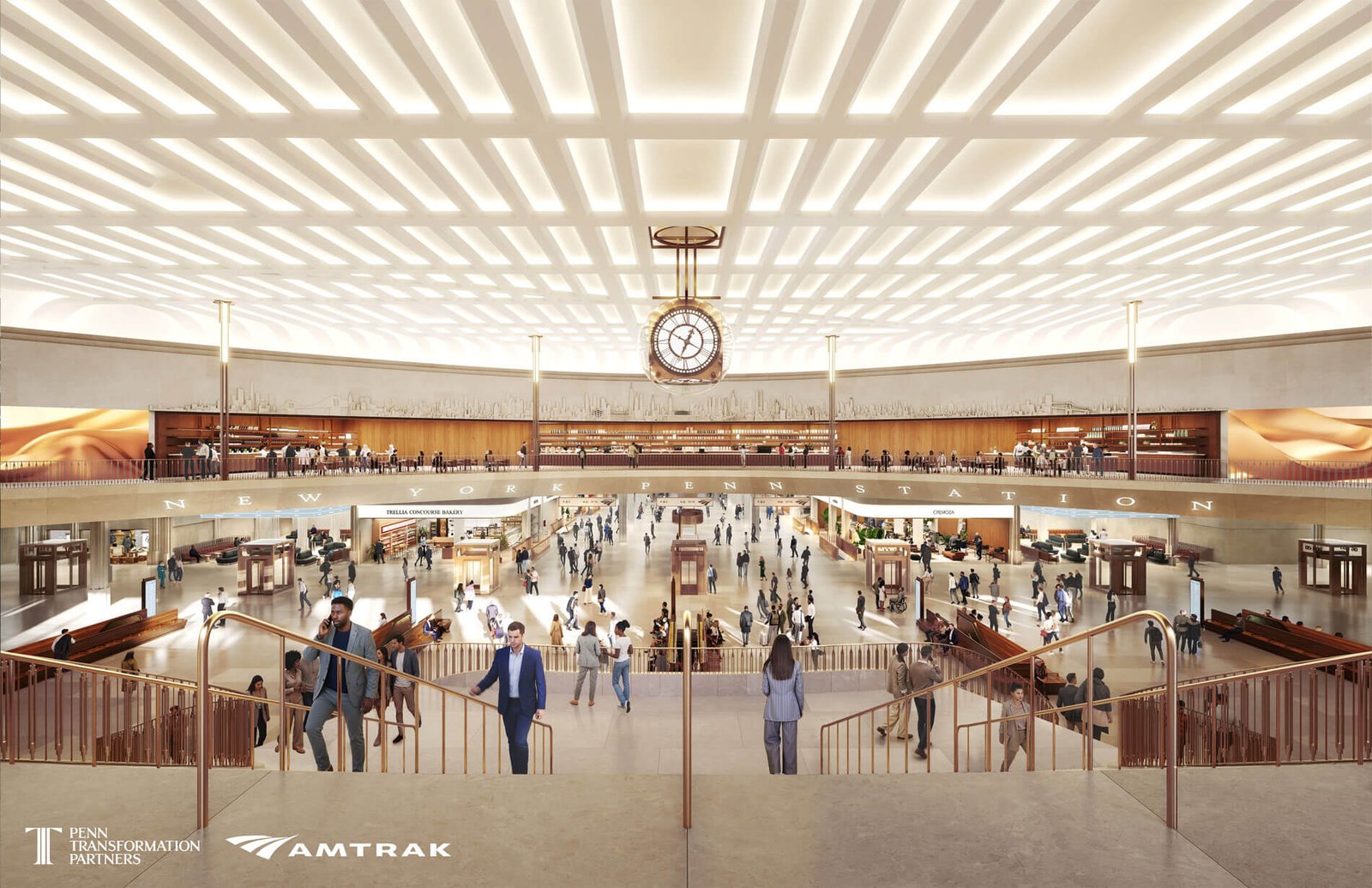
Renderings show a grand civic facade in lieu of the theater’s existing street front. A ceiling made of blue tiles will cascade behind the new facade, shimmering in the sun, directing passengers to a staircase that leads them below grade.
Proportionally speaking the staircase and its accompanying volume is inspired by Eero Saarinen’s TWA Terminal. Waffle slabs arranged to emulate Manhattan’s street grid will hover above head.
From the sculptural stair passengers can access a mezzanine-level restaurant inspired by Grand Central Terminal’s Oyster Bar, Chakrabarti added. The underside of the stair is meant to evoke the Oyster Bar’s Guastavino ceiling.
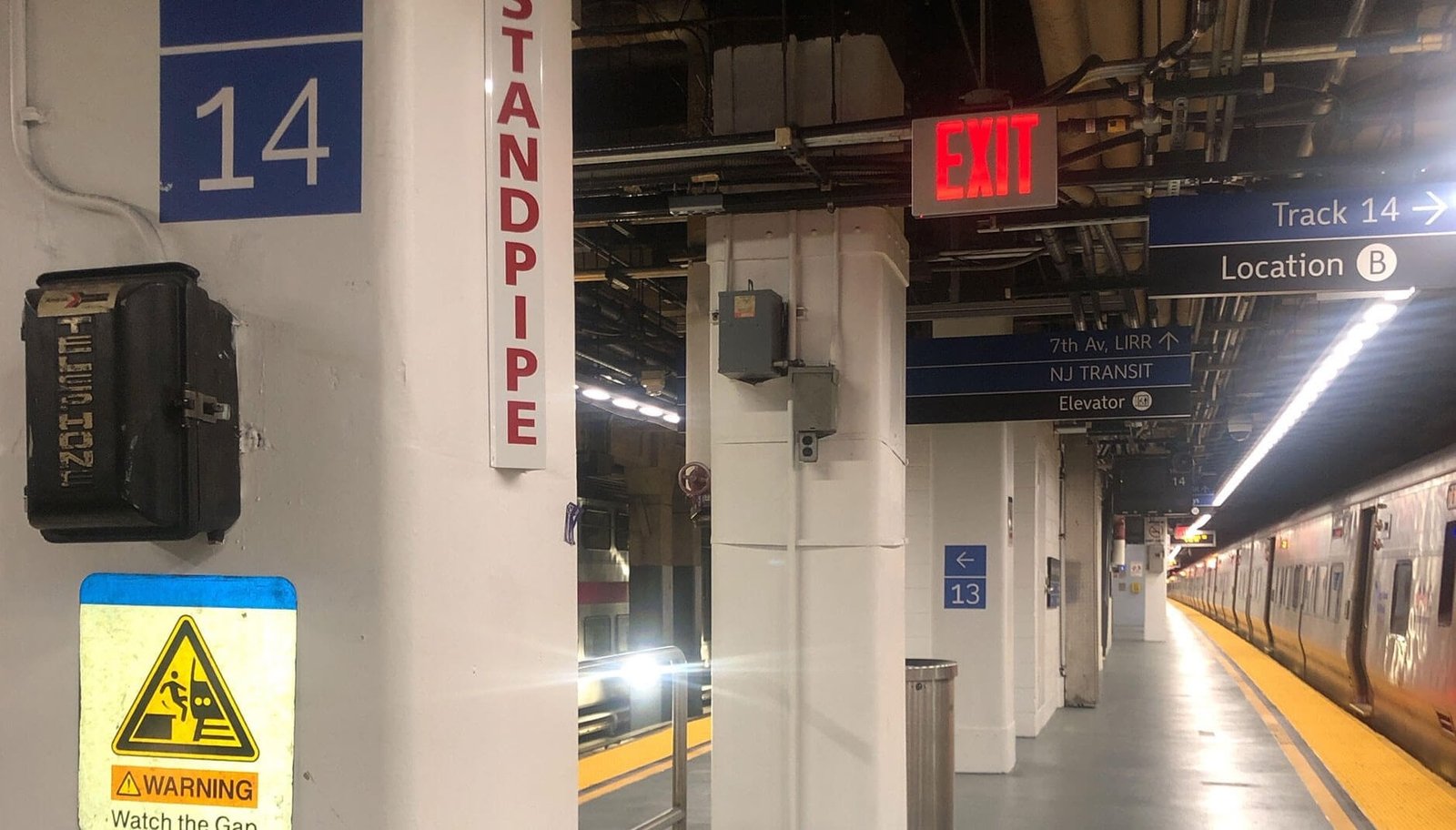
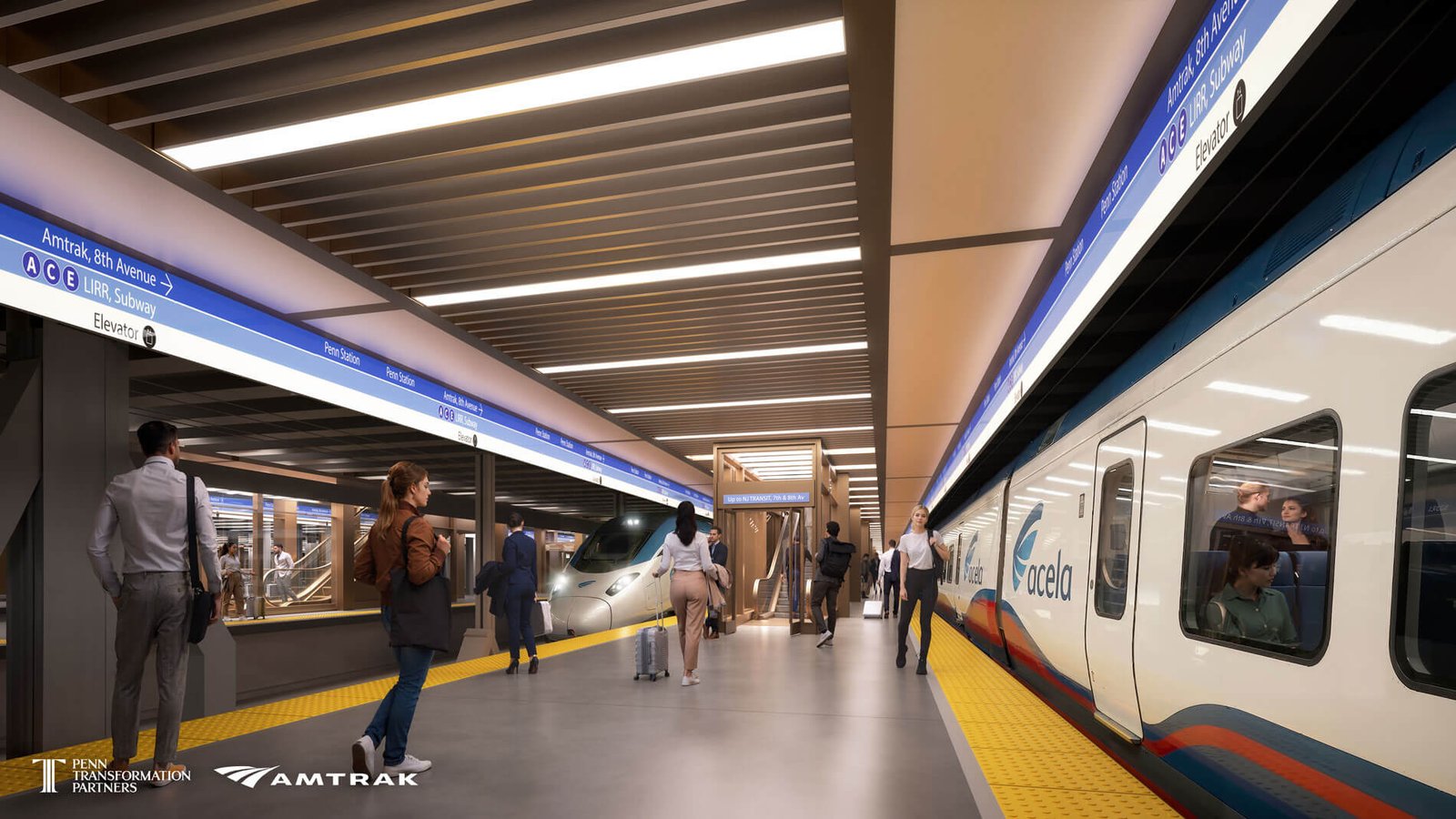
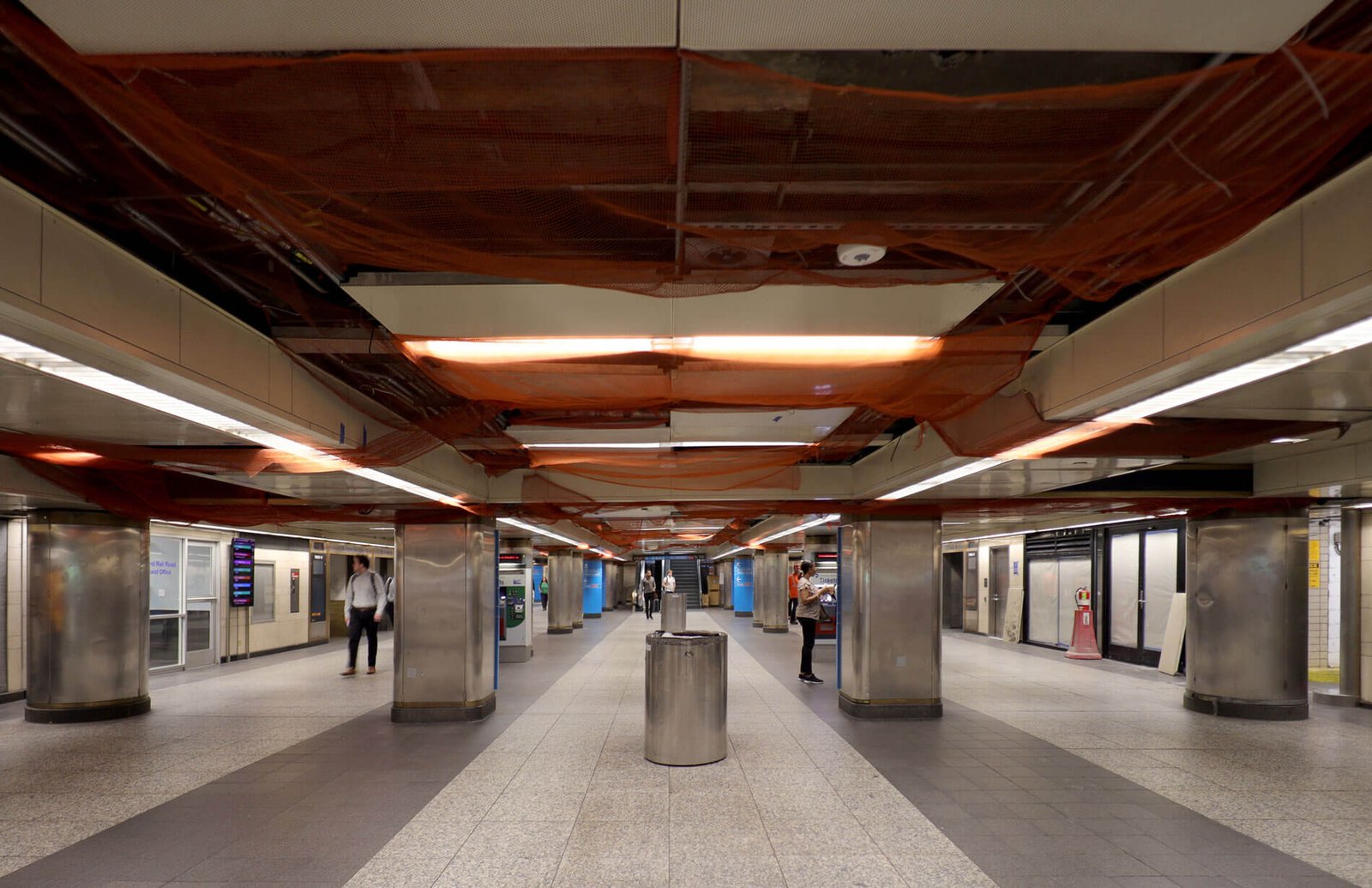
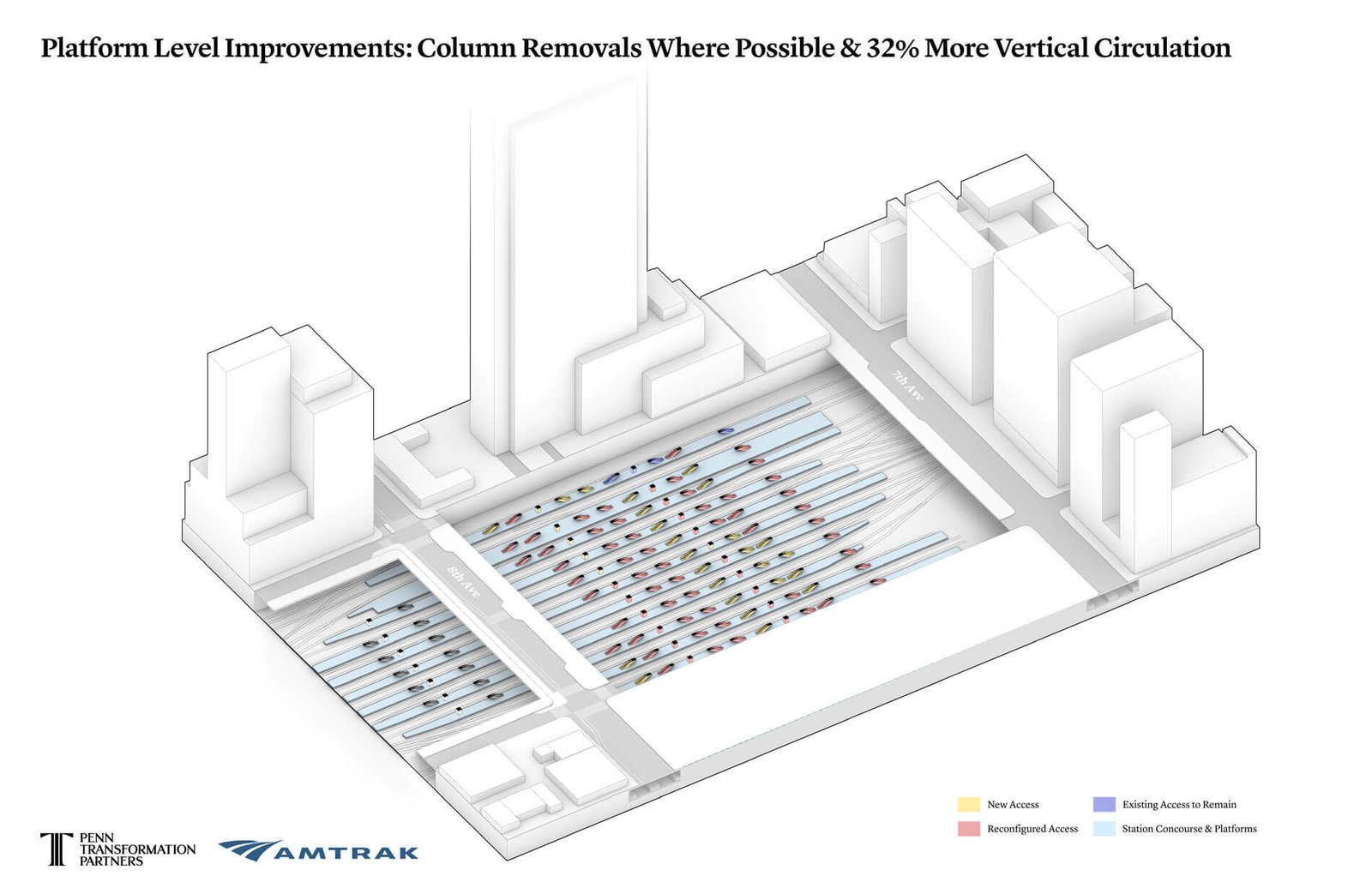
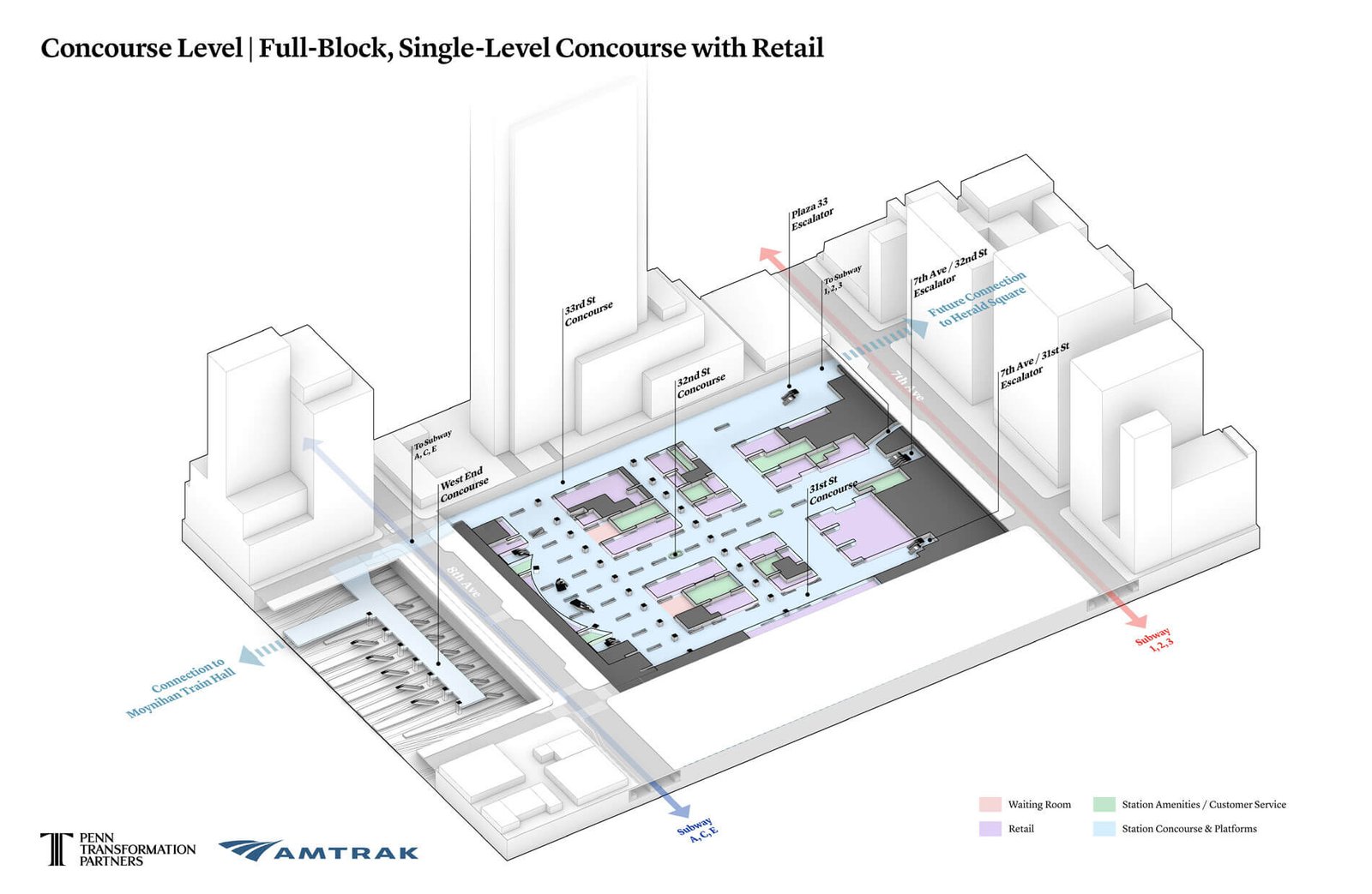
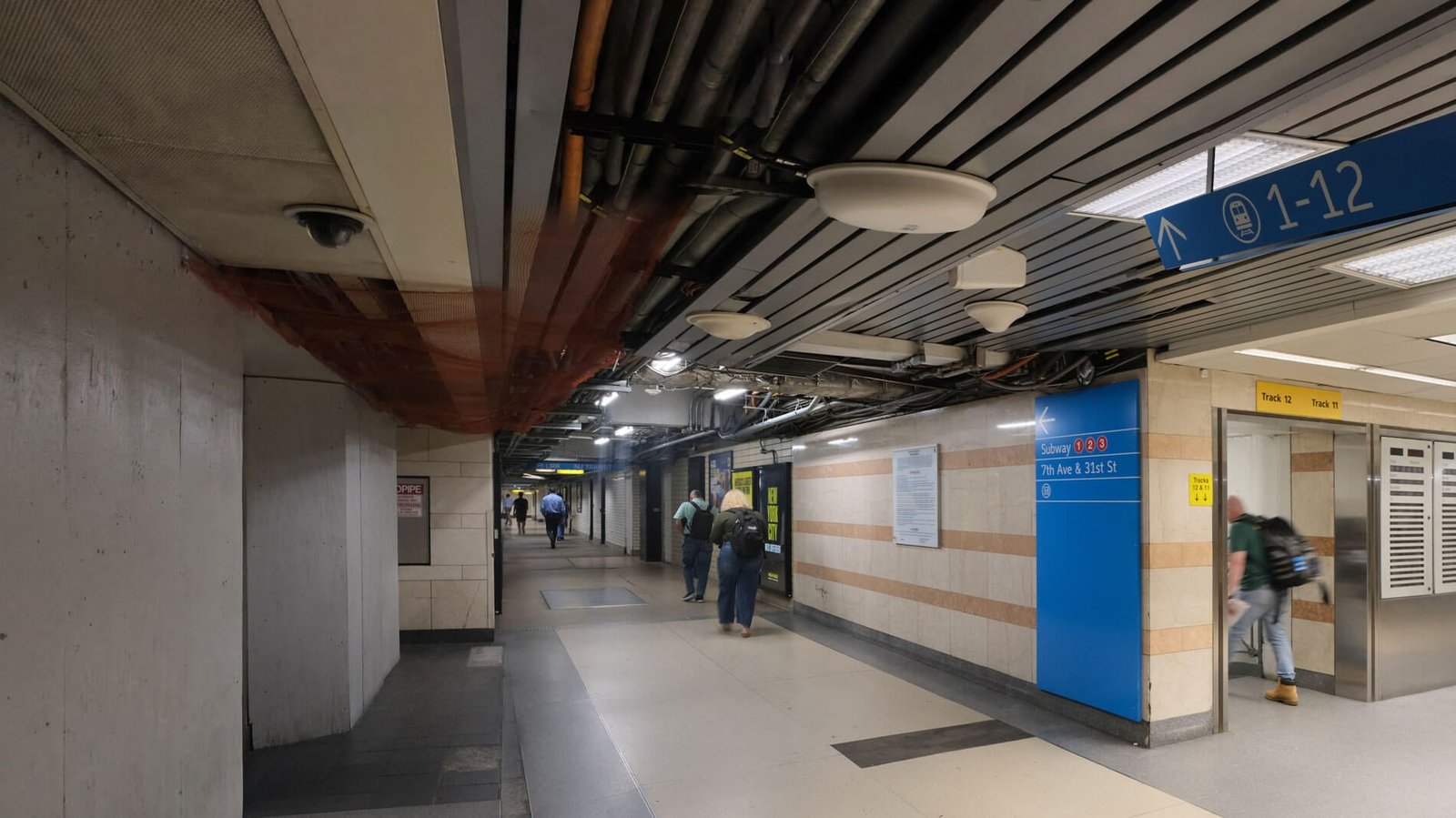
At the track level, plans call for more vertical circulation in the form of three times more escalators, stairs, and elevators, two of which ADA compliant; and far fewer columns, hopefully alleviating congestion. The goal is to remove up to 100 columns.
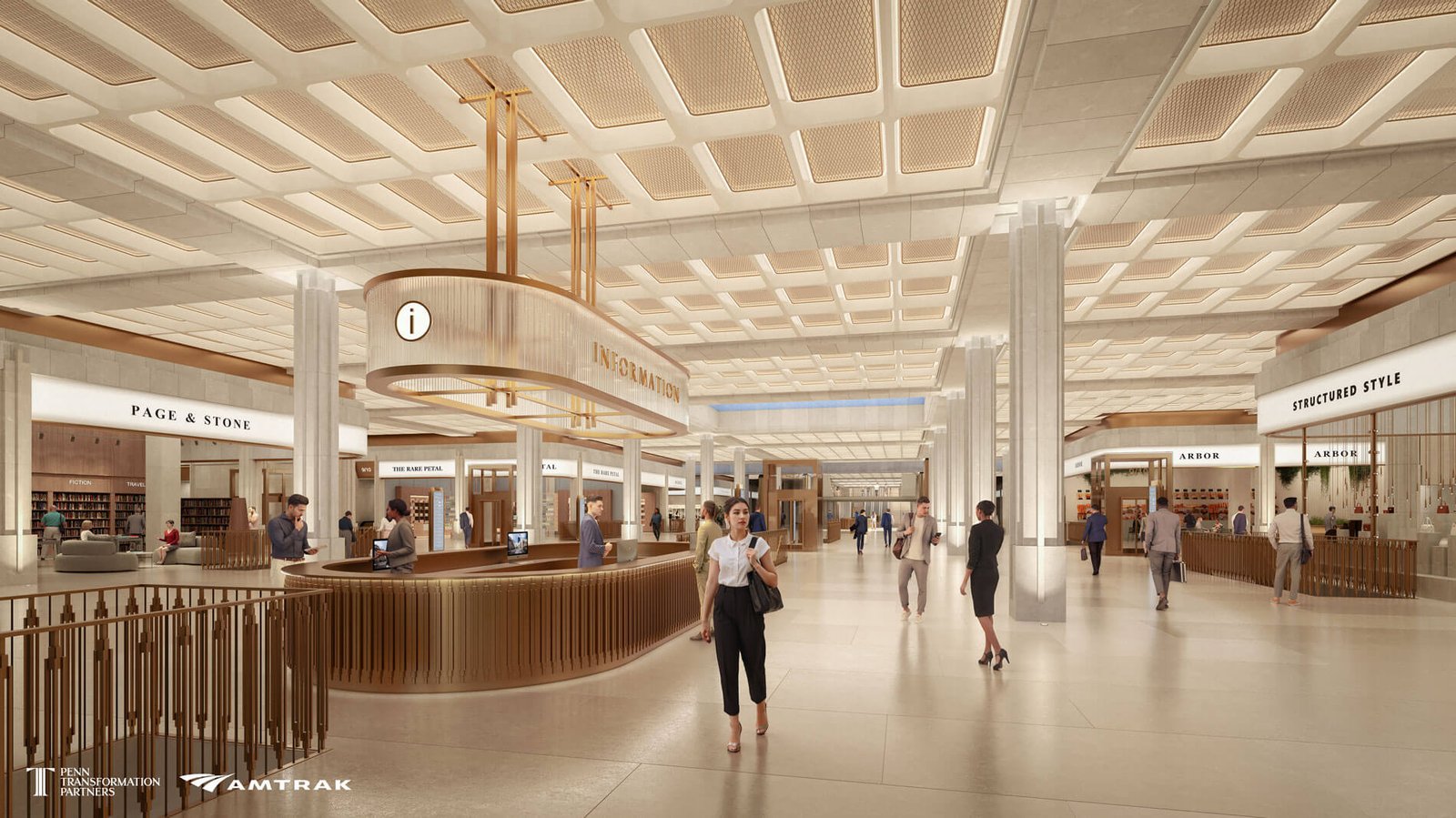
“You’re going to see one unified concourse, unified signage, unified graphics, unified announcements, clear and clean public bathrooms, waiting areas, and so forth, and retail amenities,” Chakrabarti said.
Tractor trailer trucks will now be able to unload inside of the belly of the station, pending the theater’s removal. This will alleviate street-level traffic.
Chakrabarti took time to clarify parts of the design after Gothamist leaked renderings last week and made several inaccuracies in its reportage. Bespoke hand railings and other elements will be made of brass, not gold, as was reported by Gothamist.
The architect also brought attention to bronze reliefs PAU proposes at the corners of the station’s exterior. Chakrabarti said too that eagle sculptures from the original Penn Station will be reincorporated into the overhauled station for passengers to enjoy.
Making the Station Better
Chakrabarti said his main inspirations are McKim, Mead, & White’s original Penn Station; Grand Central Terminal; Raymond Hood’s Rockefeller Center and Daily News building; WPA projects; and Eero Saarinen’s TWA Terminal.
“In our approach as a firm, there’s been this idea of palimpsest, of collective remembrance, of an architecture of memory,” Chakrabarti told AN. “I think that’s what people are looking for at this extraordinarily charged and important site in our city.”
The design, he continued, is about being “humble in the face of history.”
“There’s an extraordinary legacy here,” Chakrabarti said. “The reason I think we talk about McKim, Mead, & White; WPA; Saarinen; and Hood references is because the aspirations are so incredibly high. These are the kind of bars, or metrics, we hold ourselves to.”
“We make these comparisons very gingerly. But it’s what you have to hold yourself to,” he said. “I wanted to bring in the WPA because, I think their designs transcend politics, right?”
What’s Next?
Byford noted that the through-running study the Federal Railroad Administration was commissioned to perform last summer will soon conclude. He said he expects to have the report in the next few weeks.
Thameslink and Crossrail were two projects in London that Byford pointed to as case studies for New York to emulate in regard to through-running service.
Byford told AN that he is “a passionate believer in coordinated transportation government” because of his tenure leading Transport for London (TfL).
Speaking from experience, Chakrabarti told AN, “There’s always noise with these projects. What matters, always, is what endures. And what will endure for the traveling public is a solution, whether you’re coming from New Jersey, using Amtrak, or Long Island Rail Road, or just living in the neighborhood, that brings equality.”
Chakrabarti added, “That’s absolutely the aspiration we have here, without busting the bank, without creating a station that takes forever to build. And in Andy and Peter we have real partners who want to do this. And we have the support of the federal government who, by the way, from the beginning said design excellence is our baseline.”