

Framnäs Strandpark: reclaiming the horizon
The park’s role in the urban fabric
Framnäs Strandpark marks the inaugural chapter in Lidköping’s ambitious urban transformation, a strategic move to reunite the city with the expansive waters of Lake Vänern. Situated against the dramatic backdrop of the Kinnekulle plateau, the park acts as a vital link between the developing districts of Framnäs and Västra Hamnen. By transforming a previously underutilized shoreline into a multifunctional social hub, the project demonstrates how landscape architecture can serve as a powerful accelerator for civic identity and urban attraction.
Mediating the shoreline
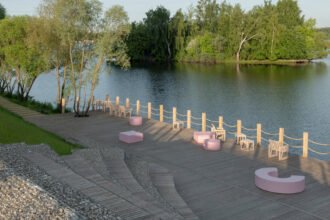
The project activates the liminal space between land and water, offering a contemporary, nature-inspired public realm. A defining strategic choice was the decision to reshape and relocate the shoreline rather than infilling the bay. This maneuver was instrumental in addressing critical issues of poor water quality, erosion, and sediment buildup. Central to the composition is an elevated, walled promenade that arcs gracefully across the former bay. This inner sanctuary, now a sheltered extension of the original cove, has been reimagined as a lush water park, a resilient landscape where boardwalks and seating nodes are delicately tucked into the reeds.
Ecological integrity and learning
Located within a UNESCO Biosphere Reserve, the project prioritizes both social and biological diversity. The newly engineered shoreline creates a stable, non-erosive foundation for the development of coastal meadows and wetland biotopes. Restored coastal meadows and open sand patches provide vital habitats, while specific zones remain protected from human activity to foster local flora and fauna. By working with, rather than against, the existing aquatic conditions, the design has transformed a problematic bay into a thriving ecological asset. The water park also serves a dual purpose as a sustainable drainage system (SuDS) for future surrounding developments.
A highlight of the park is the reed-thatched weather shelter, a nod to traditional lakeside craftsmanship, which functions as a BBQ area and an outdoor classroom for the neighboring the Museum of lake Vänern, bridging the gap between recreation and environmental education.
A coastal destination
On the lakeward side, a newly constructed artificial sandy beach, a large accessible timber deck, and a landmark pier offer diverse swimming experiences. The pier, with its integrated changing cabins and windbreaks, draws formal inspiration from the beacons and nautical markers of Lake Vänern. At the tip of the harbor pier, Eva Hild’s sculpture ”Hold” stands as a sculptural beacon, anchoring the park’s visual axis from both land and sea. Nearby, Kinnevik Square serves as a flexible urban plaza for events, currently hosting a popular pop-up restaurant that celebrates local gastronomy.
Materiality and collaboration
The material palette is restrained, defined by a limited number of carefully considered elements. Local materials, such as limestone from nearby Kinnekulle and sand from the Råda quarry, are combined with concrete, timber, and steel to create a muted, tactile aesthetic that responds to the shifting moods of weather and season. The planting is conceived as a form of curated nature, blending native and cultivated species.
The project’s success is rooted in an integrated “design-build” collaboration. By maintaining a prestige-free dialogue between the landscape architect, the municipality, and the contractor (NCC), the team identified innovative solutions to minimize carbon footprint, including optimized foundation methods and the circular reuse of soil masses from adjacent construction sites.
Since its completion in June 2025, the park has evolved into one of the city’s most vibrant and appreciated landmarks and has also received the Swedish Architects’ “Landmark” award for Landscape Architecture of the Year 2025.
Credits
• Concept & preliminary design: Sydväst arkitektur och landskap
• Landscape architect, implementation and lighting design: Liljewall
• Client: Municipality of Lidköping
• General contractor: NCC
• Artist: Eva Hild (“Hold”)
• Completion: June 2025 (final phase)
• Photography: Anna Kristinsdóttir and Joacim Winqvist
G47X+2M, 531 60 Lidköping