

本文由 junglecolor工作室 授权mooool发表,欢迎转发,禁止以mooool编辑版本转载。
Thanks Zhiwei Chen for authorizing the publication of the project on mooool, Text description provided by Zhiwei Chen.
junglecolor工作室:人类具有与生俱来的“亲自然性”(Biophilia)[1]。垂直花园作为亲自然设计在风景园林维度的实施模式,是近年来广受关注的一种城市设计手段。面对当前国内外城市普遍存在的绿地空间暴露水平低的痛点[2],这种“见缝插针、向空中借地”的置入型绿化结构,具备可达性强、轻量化和装配灵活等优点,能有效地适应现代城市高密度、紧凑发展的模式,为唤醒城市闲置空间活力、缓解城市核心区绿地空间不足问题提供可行方案。众多研究已证实,垂直花园的应用对改善城市生态、居民身心福祉和公共空间品质提升等具有积极的影响[3-4]。
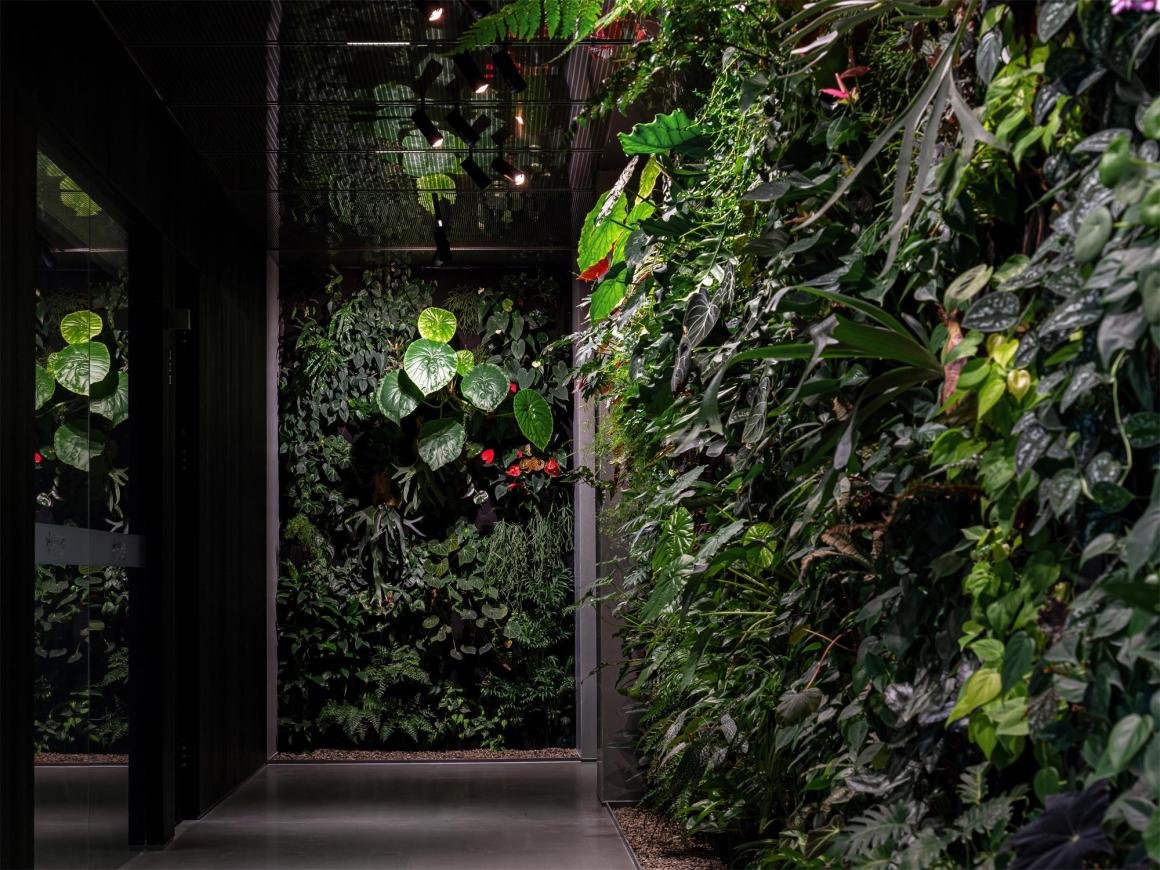
项目场地位于福州市,场地包括下凹空间和办公空间两个区域,分两个时间段安装完成。该项目基于亲自然性的生态美学认知,通过在建筑内部嵌入多个小微尺度的垂直花园,借此来柔化空间边界、激活立面呈现、增强空间绿色暴露量,从而鼓励和引导使用者与自然要素发生接触互动,使建筑环境更具体验和宜居品质。
Zhiwei Chen:Humans possess an innate “biophilia” [1]. As an implementation model of biophilic design in landscape architecture, vertical gardens are an urban design method that has garnered widespread attention in recent years. Addressing the widespread pain point of low green space exposure in domestic and international cities [2], this “crevice-filling, sky-borrowing” type of inserted greening structure has the advantages of high accessibility, lightweight construction, and flexible assembly. This greening approach effectively adapts to the high-density, compact development patterns of modern cities, providing a feasible solution for revitalizing idle urban spaces and alleviating the shortage of green space in urban core areas. Numerous studies have confirmed that the application of vertical gardens has a positive impact on improving urban ecology, residents’ physical and mental well-being, and enhancing public space quality [3-4].
Located in Fuzhou City, the project site includes a sunken space and an office area, with installations completed in two phases. Grounded in an ecological aesthetic understanding of biophilia, the project embeds multiple small-scale vertical gardens within the architecture. This strategy softens spatial boundaries, enlivens the facade, and enhances green space exposure, encouraging and guiding users to interact with natural elements and creating a more experiential and livable built environment.

设计依据
在森林和城市生态系统中,有大量的植物不需要与地面土壤接触,其生活史完全或部分时期依附在其他植物体、岩石或墙体等土层浅、土量少或无土的生境中生长[5-6]。例如,兰科、苦苣苔科、天南星科及蕨类等植物中拥有数量可观的附生、岩生类群[7-8],它们在漫长适应环境胁迫、资源异质性的生境空间中,进化产生了多样、独特的生理和形态特征,对维持生态系统的生物多样性、水分和养分循环、能量流动等方面有重要贡献[8-10]。这一大特殊植物类群的一系列生态适应策略是一个自然过滤演化过程,可为垂直花园的营造和植物设计提供科学依据和灵感。
Design Basis
In forest and urban ecosystems, numerous plants do not require contact with the ground soil. Instead, their life cycles are wholly or partially dependent on other plants, rocks, walls, or similar soil-shallow, soil-poor, or soilless environments. [5-6]. For example, the Orchidaceae, Gesneriaceae, Araceae, and Pteridophyte families have a considerable number of epiphytes and lithophytes [7-8]. Through prolonged adaptation to environmental stresses and heterogeneous resources in their habitats, these plants have evolved diverse and unique physiological and morphological characteristics. These are important for maintaining ecosystem biodiversity, water and nutrient cycles, and energy flow [8-10]. The ecological adaptation strategies in this unique group provide a natural filtration and evolutionary process that can offer a scientific foundation and inspire the plant design of vertical gardens.
▽喀斯特森林中拥有丰富的岩生植物,为垂直花园设计提供了灵感 ©陈志伟


垂直花园系统主要包括支撑结构、防水结构、种植毯、智能滴灌系统、补光照明和植物等。这种技术模拟了植物在自然生境的生长状态。PVC板材作为防水结构类似于自然中的岩石表面,而用于种植载体的种植毯类似于岩石表面的土层和苔藓层,植物的根系能自由在两层种植毯之间生长,并获取所需的水分养分。植物体基部和种植毯表面易于积累环境中的掉落物或腐殖质。这些有机物质作为养分载体在微生物作用下进行分解,其释放的养分可供应垂直花园内的植物使用。
Vertical garden systems typically include supporting structures, waterproofing, planting felt, intelligent drip irrigation, supplemental lighting, and plants. This technology mimics plant growth in natural habitats. Waterproof PVC panels resemble natural rock surfaces, while the planting felt acts as a growing medium similar to soil and moss layers. Plant roots grow freely between the felt layers, obtaining necessary water and nutrients. Debris and humus readily accumulate at the plant bases and on the felt surface. Decomposed by microorganisms, this organic matter releases nutrients that act as nourishment for the vertical garden plants.
▽垂直花园结构 © 陈菲菲

▽植物选择与设计 ©陈志伟

设计策略
项目伊始,我们对场地周边100公里范围的野外自然群落进行实地考察,并从中筛选出球兰、全缘贯众、尾花细辛、芒毛苣苔和珠芽狗脊等众多具观赏价值的乡土植物应用于项目中。项目共使用植物98种(含品种),隶属于30科50属。植物材料以小规格苗木移植为主,本土和非本土种类混合,设计的种植密度为20~30株/m²。
Design Strategies
From the start of the project, we conduct on-site surveys of wild plant communities within a 100-kilometer radius of the site, selecting numerous ornamental native plants, such as Hoya carnosa, Cyrtomium fortunei, Asarum caudigerellum, Aeschynanthus acuminatus, and Woodwardia prolifera, for the project. The project uses a total of 98 plant species (including varieties), classified into 30 families and 50 genera. Small-sized seedlings were the primary planting material, a mix of native and non-native species, with a designed planting density of 20-30 plants/m².
▽通过亲自然设计,将景观引入建筑空间,以使接触自然成为人们日常体验的一部分 © junglecolor 郭橘子

从植物气候适应性来看,福州地处东南沿海,尽管受海洋气候的调节,但夏季酷热、极端高温事件趋于频发。办公区域个别垂直花园处于通风不良位置,夏季非工作时间,这些位置的植物处在非空调条件的闷热环境中,植物的安全度夏面临高温胁迫。因此,在植物设计时,选用了胁迫耐受力强的种类用在这类环境,比如小天使鹅掌芋、袖珍椰子和非洲天门冬等。实践表明选用的大部分植物能够很好适应这种短期胁迫的环境波动。
植物色彩配置是影响景观视觉效果的重要因子。项目引入了开花明显、叶色丰富的观赏植物,以此提高群落的美观度。整体配色方案以绿色为基调色,增加红色、白色、黄色和蓝色等小面积点缀色,构成色彩斑块。例如,秋海棠属植物花叶兼美、叶片斑纹多样,包括白冰秋海棠的银白色斑点(花白色)、铁甲秋海棠的紫褐色斑纹(花黄色)等;花烛属佛焰苞形状独特且颜色鲜艳,包括粉冠军的粉红色苞片、婉尼拉的黄色苞片等。
在质感运用方面,不同质感的植物会使人们产生不一样的视觉感受和心理反应。植物的质感主要来自植物材料可触碰或可感知的直观特征,包括植物的形态、纹理和质地等。例如,选用的二歧鹿角蕨、立叶鹿角蕨和爪哇鹿角蕨等鹿角蕨属植物姿态优美,叶片被毛、质厚、直立或下垂,叶形变化大、宛如鹿角状分枝,给人以既粗犷又不失精致感。再如,金丝薹草的叶片窄长、柔软,质地细腻,株形飘逸;天南星科的龟背竹和橙柄蔓绿绒的叶片大、厚革质、表面发亮,叶柄质地坚硬粗壮,视觉上呈现硬朗粗野的质感。
Regarding the adaptability of plants to climate, Fuzhou is located on the southeast coast. Despite the moderating influence of the maritime climate, it experiences hot summers and increasingly frequent extreme high-temperature events. Some vertical gardens in the office area are in poorly ventilated positions. During non-working hours in summer, plants in these areas are in a stuffy environment without air conditioning, facing heat stress and challenging conditions for survival. Therefore, in plant design, we selected stress-tolerant species for these environments, such as Thaumatophyllum xanadu, Chamaedorea elegans, and Asparagus densiflorus. Practice has shown that most of the selected plants can adapt well to these short-term environmental fluctuations.
Plant color schemes are important factors influencing the landscape’s visual effect. The project introduces flowering ornamentals and plants with colorful foliage to enhance the beauty. The overall color palette uses green as the base tone, accented with small areas of red, white, yellow, and blue, creating patches of color. For example, Begonia species are prized for both their flowers and foliage, with diverse leaf patterns, including the silver-white spots of Begonia ‘White Ice’ (white flowers) and the purplish-brown patterns of Begonia masoniana (yellow flowers). Anthurium species have unique spathe shapes and vibrant colors, including the pink spathes of Anthurium andraeanum ‘Pink Champion’ and the yellow spathes of Anthurium andraeanum ‘Vanilla’.
Considering texture, different plants evoke diverse visual sensations and psychological responses. Plant texture stems primarily from the tangible and perceptible qualities of the plant material, including the plant’s form, texture, and consistency. For example, the selected Platycerium bifurcatum, Platycerium veitchii, and Platycerium willinckii staghorn ferns have elegant forms, with hairy, thick, erect, or drooping leaves. Their diverse leaf shapes resemble antler-like branches, conveying both ruggedness and refinement. Similarly, Carex oshimensis ‘Evergold’ has slender, soft leaves with a delicate texture and a graceful habit. The large, thick, leathery, and shiny leaves of Monstera deliciosa and Philodendron billietiae, along with their hard and thick petioles, create a visually tough and rough texture.
▽垂直花园能激活城市闲置空间,提高空间绿视率;经过6个月生长后,植物景观变得更加动态和自然 © junglecolor 郭橘子

▽垂直花园以绿色为主色调,色彩斑块来源以观叶植物为主、观花植物为辅 © junglecolor 郭橘子


在群落设计方面,注重植物间高低错落的层次对比,将整体分为两个层次进行构建。上层为结构层(>50cm),呈散点分布种植,主要选择株高较高、体量较大或叶面积大的草本植物和灌木形成空间的结构骨干,例如花烛属、草珊瑚属和肋毛蕨属等植物。下层为基底层,该层物种多样性丰富、植株密度大、生物量高,主要为中等大小、株形紧凑和成簇生长的植物,例如秋海棠属、草胡椒属和铁角蕨属等植物;下层的物种也包括了呈匍匐状或附生习性的植物种类,它们充当动态填充层,例如喜林芋属、丝苇属和芒毛苣苔属等植物,这些植物既能保持种植表面湿润、抑制杂草入侵,也能在景观的建植早期较快地覆盖慢生植物间的空隙,从而缩短景观成景时间。
For community design, we emphasized stratified plant heights, dividing the planting into two levels. The upper layer, or structural layer (>50cm), features scattered plantings, primarily selecting taller, larger-bodied, or broad-leaved herbaceous plants and shrubs to form the structural framework of the space, such as Anthurium, Sarcandra, and Ctenitis. The lower layer is the base layer. This layer exhibits high species diversity, dense planting, and significant biomass, mainly consisting of medium-sized, compact, and clustered plants, such as Begonia, Peperomia, and Asplenium. The lower layer also includes prostrate or epiphytic species that act as dynamic fillers, such as Philodendron, Rhipsalis, and Aeschynanthus. These plants not only maintain surface moisture and suppress weed invasion but also quickly cover the gaps between slower-growing plants in the early stages of landscape establishment, reducing time to maturity.
▽不同植物间的个体大小、株形、叶形和质感带来了差异化的视觉对比 © junglecolor 郭橘子

景观动态变化
对垂直花园而言,经过一段时间的适应生长后,墙上的植物开始通过互相接触遮蔽、改变自身形态、调整生物量分配等方式争夺资源和生态位,个体间竞争会逐渐加大,较强势植物常常会排挤其邻近一些竞争力弱的个体,此时会出现植物死亡现象;而随着群落的发展和植物个体大小的增加,生态位进一步分化,植物间的竞争强度呈现先增大后减小的特点,这时个体的生存压力也慢慢得到纾解。在这一动态进程中,我们通过定期跟踪和适度的维护干预,适时进行植物减补和优化,从而维持景观的健康状态。同时,依靠植物本身的光合作用和垂直花园内部形成的微生态循环可实现植物自养、营养循环和群落的自我重建,以此逐步促进一个相对稳定的植物群落结构形成,最终使植物死亡率保持在低位。
再者,项目中还加入了许多可自播繁衍或无性繁殖的植物种类。例如,全缘贯众、披针贯众和铁线蕨等蕨类植物的孢子能借助风或重力扩散到种植毯上定居并能发育成新个体;蝴蝶花具有克隆繁殖能力,其根状茎可横走或斜伸生长,并形成独立的无性系分株,完成植株的迁移与复制。这些植物可以最大程度地从生境中获取资源和逃避胁迫,实现风险分摊,在一定程度上增强了垂直花园的抗扰动和自我恢复能力。总的来说,垂直花园景观的动态变化是一个以自然做功为主导、人工调控为辅的成长过程。
Dynamic Changes in the Landscape
In vertical gardens, after a period of acclimation, plants compete for resources and niches through shading, morphological adaptations, and biomass allocation. Competition between individuals gradually intensifies. Dominant plants often outcompete weaker individuals nearby, resulting in mortality. However, as the community develops and plant size increases, niches further differentiate, and competition initially increases but then subsides. This gradually alleviates survival pressure on individual plants. Throughout this dynamic process, we maintain a healthy landscape by regularly monitoring, making moderate maintenance interventions, and carrying out timely plant reductions, supplements, and optimizations. At the same time, photosynthesis and the micro-ecological cycle formed within the vertical garden enable plant autotrophy, nutrient cycling, and community self-reconstruction, gradually promoting the formation of a relatively stable plant community structure, ultimately keeping the plant mortality rate low.
Furthermore, many plant species capable of self-seeding or vegetative propagation were incorporated into the project. For example, spores from ferns such as Cyrtomium falcatum, Cyrtomium devexiscapulae, and Adiantum capillus-veneris can be dispersed by wind or gravity, settling, and developing into new individuals within the planting felt. Because Iris japonica has the ability to reproduce clonally, its rhizomes can grow horizontally or obliquely, forming independent clonal ramets and completing the plant’s migration and replication. These plants maximize resource acquisition from the habitat, avoid stress, and achieve risk sharing, enhancing the disturbance resistance and self-recovery ability of the vertical garden to a certain extent. In general, the dynamic change of the vertical garden landscape is a growth process led by natural processes and supplemented by artificial regulation.
▽以多年生草本植物为主,不同植物种类高低错落、相互拼贴嵌合 © junglecolor 郭橘子

▽使用具有匍匐或附生习性的种类作为填充层,它们对垂直面生境具有天生的适应性 © junglecolor 郭橘子


使用后观察
项目建成后,通过与委托方沟通,项目后期维护采用由工作室负责、业主参与的模式。工作室负责每半年一次的修剪、植物优化调整、设备检查维护;业主负责日常枯落物清理、液体肥填补、病虫害预防等。截至目前,该项目已健康运行4年半和2年半。
在项目推进过程和多次回访中,我们发现了一些值得研究的问题。例如,减少维护频率带来的植物生长状况略显凌乱,个别位置甚至会因植物的死亡出现空白区,进而影响了使用者观感体验。这种近自然化的景观经营模式与已经普及的高度人工化、精致化景观形式形成了鲜明对比,往往被视为疏于管理、看起来不安全、不美观或不受欢迎,在短时间内也较难获得公众的理解或认可[11-12]。有研究显示,降低维护强度对增强群落结构复杂性、维持生物多样性和促进生态系统功能等方面具有正向作用[13],植物自然生长和竞争导致的群落外貌轮廓变化正体现了生物的秩序美和群体美[11]。也有研究发现,通过自然教育引导、景观美学质量优化以及景观可达性和功能性改善等方式能提升公众对近自然化景观的接受度,使公众喜好发生变化[14-15]。因此,如何弥合公众审美偏好与景观生态特征间的需求错位,如何有意识地引导公众接纳和认同生态系统服务价值成为生物多样性友好型景观管理面临的挑战。作为一种缓解或折中的策略,工作室在项目后期维护实践中,采取的调整措施是:适度替换掉侵略性强的种类(例如,长叶肾蕨),增补了株形丰满紧凑或者生长速度较慢的种类(例如,花烛属、秋海棠属、丝苇属植物等)和观花种类(例如,石斛属、君子兰属植物等),以此来更好地缓和“生态—审美冲突”,构建植物景观有限度的“野”。
Post-Implementation Observation
Following completion and consultation with the client, subsequent maintenance was structured with the studio responsible for maintenance with client participation. The studio handles pruning, plant optimization, and equipment inspection every six months, while the client manages daily litter removal, liquid fertilizer replenishment, and pest and disease prevention. The project has been operating healthily for four and a half years and two and a half years for office, respectively.
Through continuous operations and regular assessments, we identified noteworthy issues. For example, the reduced maintenance frequency resulted in slightly disorganized plant growth, and blank areas even appeared in some locations due to plant mortality, affecting the user’s visual experience. This near-naturalized management model stands in contrast to the prevalent highly artificial and refined landscape styles. It is often seen as poorly managed, unsafe-looking, unattractive, or unpopular, and it is difficult to gain public understanding or recognition in a short period [11-12]. Research indicates that reduced maintenance intensity positively impacts community structural complexity, biodiversity, and ecosystem functions [13], and the natural dynamics of plant growth and competition reflect the aesthetic of natural biological order and group formations [11]. Additional research suggests that public appreciation for near-natural landscapes can be improved through nature education, improvements to the aesthetic qualities of the landscape, and improvements to accessibility and functionality [14-15]. Therefore, a key challenge in biodiversity-friendly landscape management is how to reconcile the conflicting demands of public aesthetic preferences and ecological characteristics of the landscape, as well as how to consciously guide public acceptance and appreciation of ecosystem service values. As a mitigation strategy, in the later stages of maintenance, the studio adopted measures such as selectively replacing highly invasive species (e.g., Nephrolepis biserrata) and adding species with fuller, more compact growth forms or slower growth rates (e.g., Anthurium, Begonia, Rhipsalis), along with flowering species (e.g., Dendrobium, Clivia). We hope to ease the “ecological-aesthetic conflict” and to build a more naturalized plant landscape with limited “wildness.”
▽经过10个月的生长,植物已能较好的覆盖表面空间 © junglecolor 郭橘子

又如本项目的植物补光方案只是依赖经验评估和灯具供应商的建议进行规划,并未根据不同光照环境、不同植物采取科学的差别化设置。同时,由于灯具与墙体的距离是固定的,随着植物生长的变化,受照的空间内光强分布和光质分布也随之改变,体积较大的植物势必会对其下层植物形成遮挡。这种情况将引起垂直花园的补光照明均匀性和光能利用率受影响,最终可能导致植物品质参差不齐,并且无形中增加了管理成本。意识到此,我们在第二阶段办公区的补光设置时,将天花板上的灯具轨道方向调整成与墙面成垂直的方向,以此来实现灯具与墙面的距离可调。现阶段关于植物照明系统的研究主要集中在设施园艺生产上,有关垂直花园人工补光系统的研究国内外仍鲜有报道。为了更好地满足同一植物在不同生长阶段或不同植物生长的光照需求,有必要设计出一套能准确识别植物种类或生长阶段的智慧植物光源系统,从而实现植物补光的多样化和植物光源的准确控制[16]。
The plant lighting scheme was initially designed using empirical judgment and input from suppliers, rather than employing a scientific, differentiated approach that considers the needs of specific plants under various lighting conditions. Additionally, because the lights were installed at a fixed distance from the wall, changes in plant size inevitably alter the light intensity and quality distribution. Larger plants will naturally shade those beneath them. This situation affects the uniformity of supplemental lighting and the light energy utilization in the vertical garden, which may ultimately lead to inconsistent plant quality and increased management costs. Acknowledging this, we adjusted the ceiling lamp tracks to be perpendicular to the wall in the second-phase office area, enabling adjustable distances between the lamps and the wall. Currently, research on plant lighting systems primarily concentrates on facility horticultural production, with little coverage of artificial supplemental lighting systems for vertical gardens, both domestically and internationally. To better accommodate the lighting requirements of plants at various growth stages or different plant species, it is essential to design a smart plant lighting system that accurately identifies plant species or their growth stages, thereby achieving diversified plant lighting and precise control of light sources [16].
▽对植物景观进行持续观察、跟踪和记录,能为初始的设计和思考提供验证,有助于理解群落的构建机制与生长动态,并为后续实践提供经验 ©陈志伟

6、结语
在全生命周期维度综合考量下,本项目采取了增加本土物种、水肥一体化、允许外来自生植物入驻、发挥植物自养能力和减少维护投入等措施来实现景观的可持续性。同时,项目施工中,我们并未盲目地随大流采用大规格植物材料和密植的方式来造景,而是给予植物充足的时间和空间来回应场地特性,即从景观的“时间性”(Temporality)角度来理解和看待植物变化。时间性为设计师提供了一个机会,从时间维度了解植物在生长过程中如何发展变化、如何被引导、如何形成复杂的具有吸引力的植物景观,从而提供社会和生态服务价值[17]。垂直花园设计说到底是一种植物设计表现,作为实践者需秉持向自然学习智慧的态度,从自然中捕获灵感,并借力于对自然的观察、模拟和再设计,目标是使项目经得起时间的考验。
在全球气候变化影响下,人类正尝试用各种新的技术来解决城市面临的诸多环境挑战[18]。垂直花园作为一种基于自然的解决方案,尽管其并非是缓解城市生态问题最高效的方式[19],但它是城市刚性物理空间中的“柔性缓冲器”和生物多样性的“踏脚石”,对增强城市绿地生态网络的连通性和构建多样互补的宜人环境有着迫切的现实意义。未来,伴随着“气候变化”与“韧性城市”议题的不断交汇,城市绿色基础设施的社会效益和生态效益表现将日渐得到关注,与新能源、新材料、智能化等技术的结合也会渐成趋势。
Conclusion
Considering the full life cycle, this project has adopted several measures to achieve landscape sustainability, such as increasing the use of native species, integrating water and fertilization, allowing the natural establishment of non-native plants, leveraging plant autotrophy, and reducing maintenance inputs. During project construction, we avoided the common practice of using large-sized plant materials and dense planting schemes to create landscapes. Instead, we provided plants with ample time and space to adapt to the site’s characteristics, embracing a perspective of landscape “temporality.” This concept of temporality allows designers to understand and appreciate how plants develop and evolve over time. It involves guiding plants to form complex, aesthetically pleasing landscapes that offer valuable social and ecological benefits [17]. In essence, vertical garden design is an expression of plant artistry. As practitioners, we must maintain a learning attitude that seeks wisdom from nature, derive inspiration, and leverage the processes of observation, simulation, and redesign to make projects that withstand the test of time.
Driven by the impacts of global climate change, society is actively exploring innovative technologies to address the numerous environmental challenges faced by urban areas [18]. As a nature-based solution, although vertical gardens are not the most efficient means of mitigating urban ecological issues [19], they serve as “flexible buffers” and “stepping stones” for biodiversity within the rigid confines of urban physical spaces. This role has significant practical importance for enhancing the connectivity of urban green ecological networks and creating diverse, harmonious environments. Looking ahead, the ongoing convergence of “climate change” and “resilient cities” will increasingly emphasize the social and ecological benefits of urban green infrastructure. This trend is likely to be complemented by the integration of emerging technologies such as renewable energy, new materials, and intelligent systems.
参考文献
[1] Gunnarsson, B., & Hedblom M. (2023). Biophilia revisited: Nature versus nurture. Trends in Ecology and Evolution, 38(9), 792-794.
[2] Chen, Y., Rosa, D.L., & Yue, W. (2025). Does urban sprawl lessen green space exposure? evidence from Chinese cities. Landscape and Urban Planning, 257, 105319.
[3] Treder, M,, Joedecke, V., Schweikert, K., Rosenkranz, P., Ruttensperger, U., & Traynor, K. (2024).Vertical greening systems serve as effective means to promote pollinators: experimental comparison of vertical and horizontal plantings. Landscape and Urban Planning, (243), 104951.
[4] Gamal, A., Eleinen, O.A., Eltarabily, S., & Elgheznawy, D. (2023). Enhancing urban resilience in hot humid climates: A conceptual framework for exploring the environmental performance of vertical greening systems (VGS). Frontiers of Architectural Research, 12, 1260-1284.
[5] 王艺宸,邓芝燕,张守信,等. 海南热带云雾林附生维管植物对宿主的选择性.植物生态学报,2022,46:405-415.
[6] Miao, X., Pan, Y., Chen, H., Zhang, M.-J., Hu, W., Li, Y., … & Teng, S.N. (2023). Understanding spontaneous biodiversity in informal urban green spaces: A local-landscape filtering framework with a test on wall plants. Urban Forestry & Urban Greening, 86, 127996.
[7] 符龙飞, Monro A K,韦毅刚. 中国喀斯特洞穴维管植物多样性.生物多样性,2022,30:21537.
[8] 戴梓潇, 陈国科, 张乃莉, 等. 中国森林附生维管植物多样性数据集.生物多样性,2022,30:22332.
[9] Nardy, C., Furtado, S.G., Menini Neto, L., & Ramos, F.N. (2024). Vertical explorers: unraveling vertical and horizontal patterns of vascular epiphyte diversity in a dwarf cloud forest. Flora, 310, 152442.
[10] Francisco, T.M., Couto, D.R., Garbin, M.L., Misaki, F., & Ruiz-Miranda, C.R. (2021). Role of spatial and environmental factors in structuring vascular epiphyte communities in two neotropical ecosystems. Perspectives in Plant Ecology, Evolution and Systematics, 51, 125621.
[11] 李慧, 李春义, 何伟. 自然野态的植物景观营造的理论与方法.中国园林,2018,34(5):94-98.
[12] Hwang, Y., Tan, C., & Lu, Y. (2025). Impact of urban green spaces and maintenance regimes on flora and fauna diversity. Urban Forestry&Urban Greening, 104, 128678.
[13] Hu, X., & Lima, M.F. (2024). The association between maintenance and biodiversity in urban green spaces: A review. Landscape and Urban Planning, 251, 105153.
[14] Fischer, L.K., Neuenkamp, L., Lampinen, J., Tuomi, M., Alday, J.G., Bucharova, A., … & Klaus, V.H. (2020). Public attitudes toward biodiversity-friendly greenspace management in Europe. Conservation Letters, 13, e12718.
[15] Hwang, Y.H, Yue, Z.E.J., Ling, S.K., & Tan, H.H.V. (2019). It’s ok to be wilder: Preference for natural growth in urban green spaces in tropical city. Urban Forestry&Urban Greening, 38, 165-176.
[16] 王安,陈湛旭,孔景徐,等. 基于改进ResNet18的植物生长阶段识别方法及智慧植物补光的实现[J].作物杂志,2025,(1):250-259.
[17] (美)马特·达洛斯 撰文.佟思明 译.植物与时间:关于慢速植物知识的探讨[J].中国园林,2024,40(5):26-33.
[18] 俞孔坚.技术“敌托邦”的解药-基于自然治愈地球的中国模式[J].景观设计学,2023,11(2):4-9.
[19] 史宝刚,尹海伟,孔繁花.南京市新街口地区垂直绿化发展潜力评价[J].应用生态学报,2018,29(5):1576-1584.
项目地点:福建省福州市
项目面积:117 m²
项目委托:福建 吴航不锈
设计时间:2020年10月、2022年11月
建成时间:2021年1月、2023年4月
植物设计:陈志伟
项目施工:junglecolor
室内设计:东形西见
图片来源:陈志伟,陈菲菲,郭橘子
“ 设计以亲自然性的生态美学为基础,通过小尺度垂直花园的植入,实现建筑空间与自然要素的融合互动,从而提升城市高密度场地的生态韧性与宜居体验。”
审稿编辑:Maggie
更多 Read more about: junglecolor工作室
Nguồn: mooool