


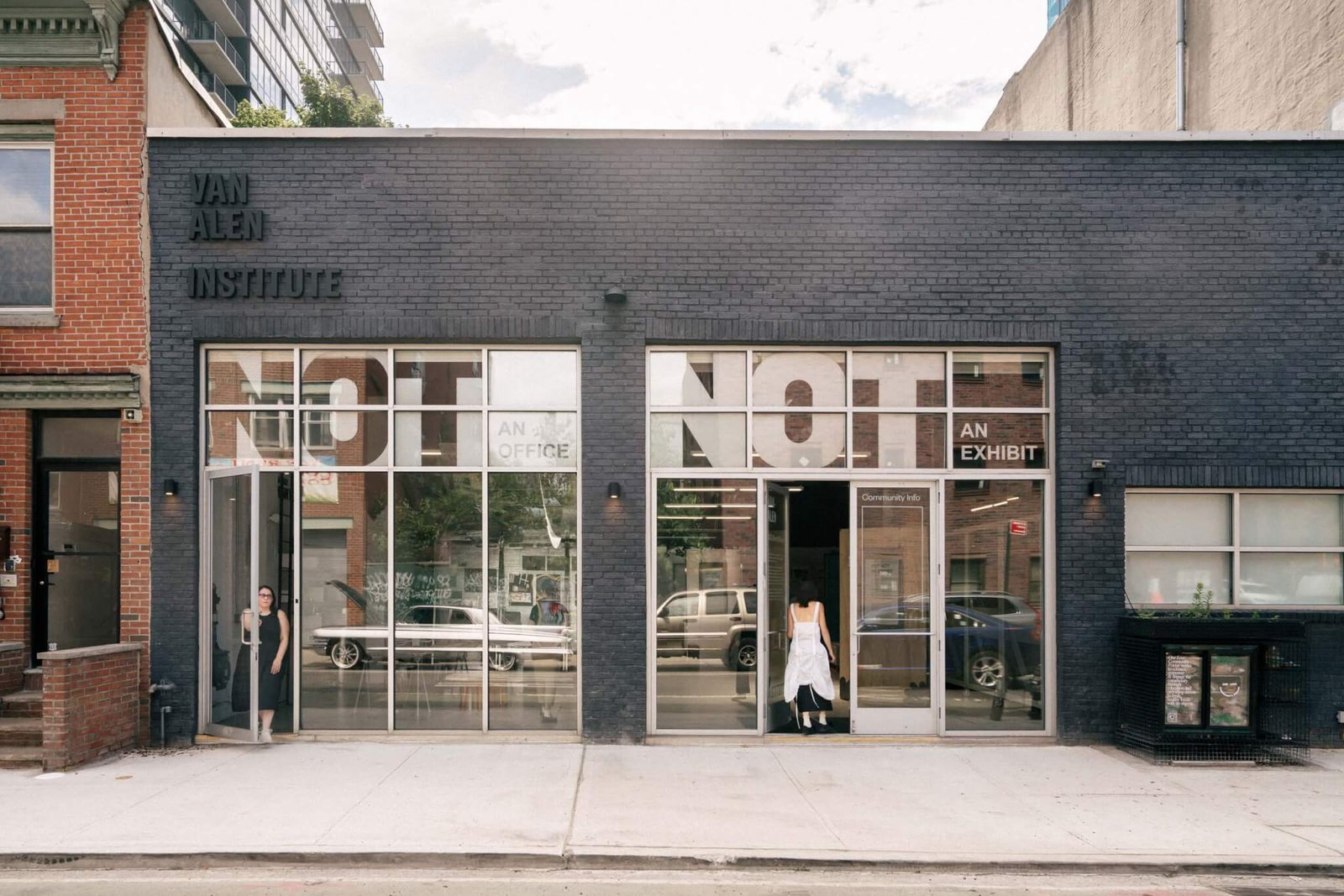
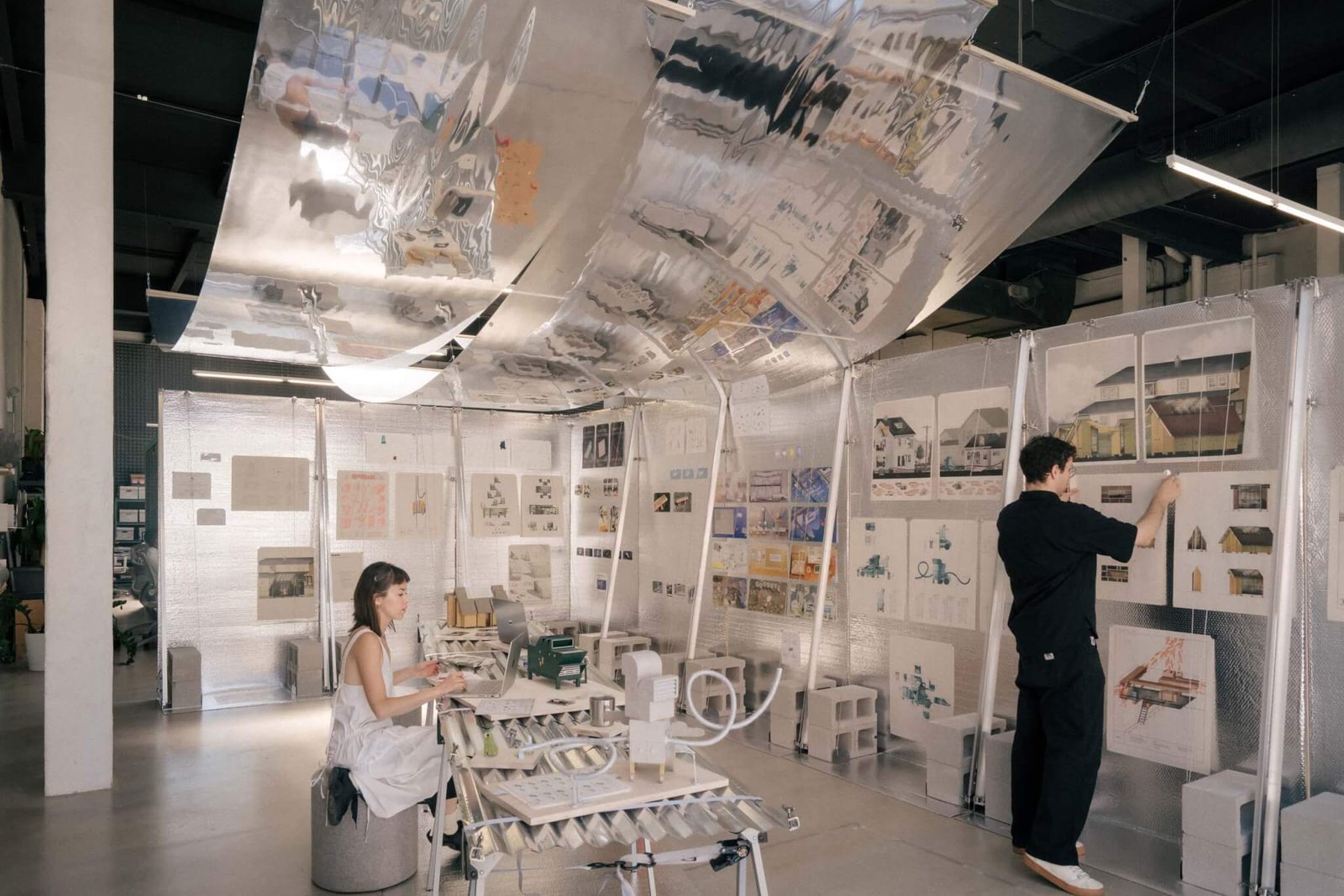
What do you call an exhibition opening that can’t decide if it’s an exhibition opening, or a party, or the inauguration of an office space? Ekin Bilal and Celia Chaussabel of the newly launched design practice NOT NOT have turned the Van Alen Institute’s Urban Room and its double storefront into a temporary office space and eponymous exhibition.
Bilal and Chaussabel describe NOT NOT as a studio that explores the margins and “overlooked dimensions of architecture as sites for political and creative inquiry.” Inspired by the work of artists like Rirkrit Tiravanija and Cameron Rowland, alongside designers such as New Affiliates and Xavi Aguirre, Bilal and Chaussabel are using their time at the Van Alen storefront to probe ambiguities within architectural practice.

At Van Alen, NOT NOT is part performance, part workspace, part event, and part exhibition, but also a refusal to be typecast. The double-negative in the name of their studio and the exhibition itself, represents a resistance to being pigeonholed. “I think words can sometimes bind us to something,” said Chaussabel. Bilal noted that the “cleanliness of descriptions of an exhibition opening not being a party is already dishonest. I think we all go to these things because we hope it is a party.”
Throughout their tenure at the Van Alen Institute, the duo will work out of a small space within a modular exhibition layout which showcases their work, ranging from interactive video games, comics, and architectural drawings to material design objects like benches, models, and furniture.
Is It An Exhibition?
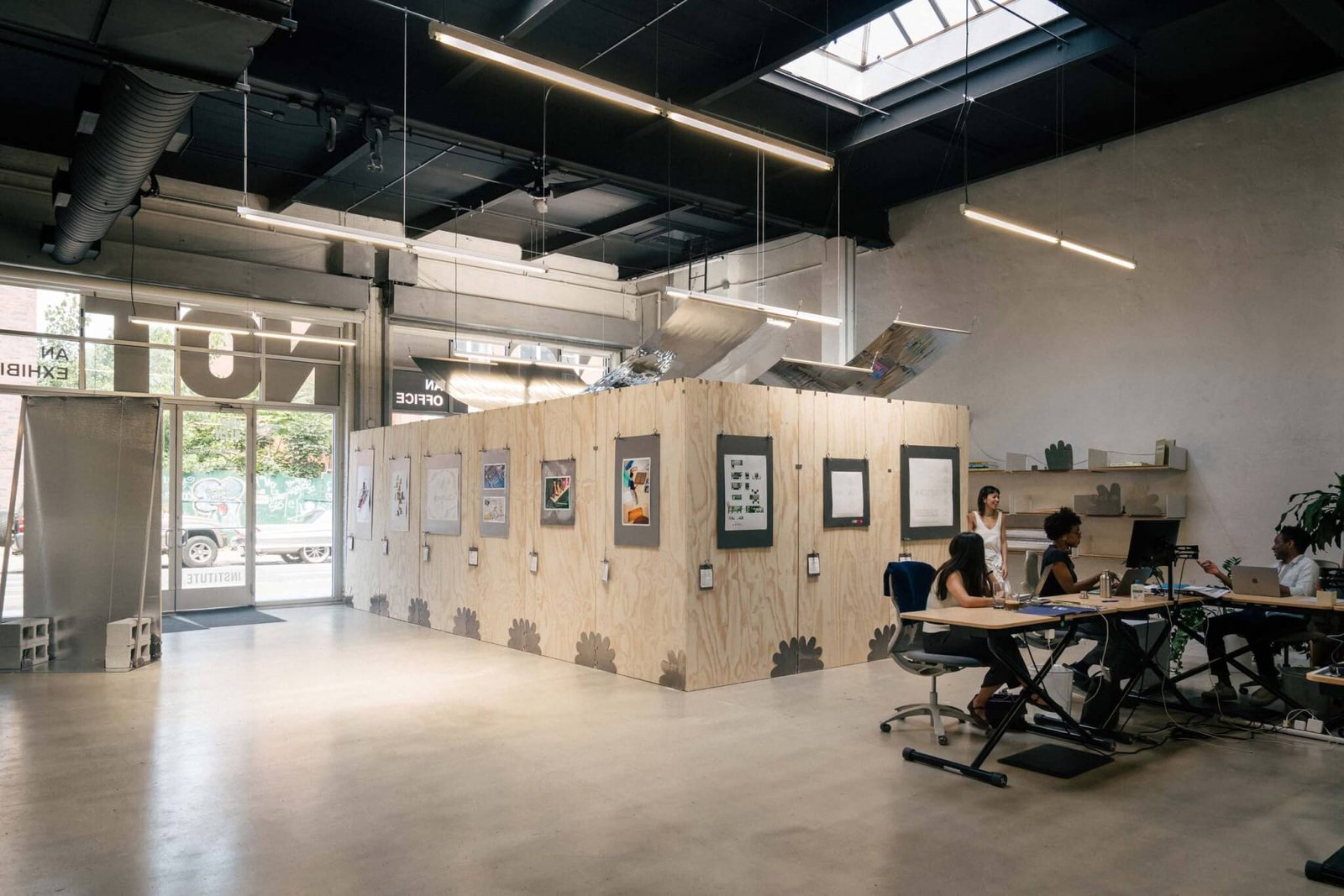
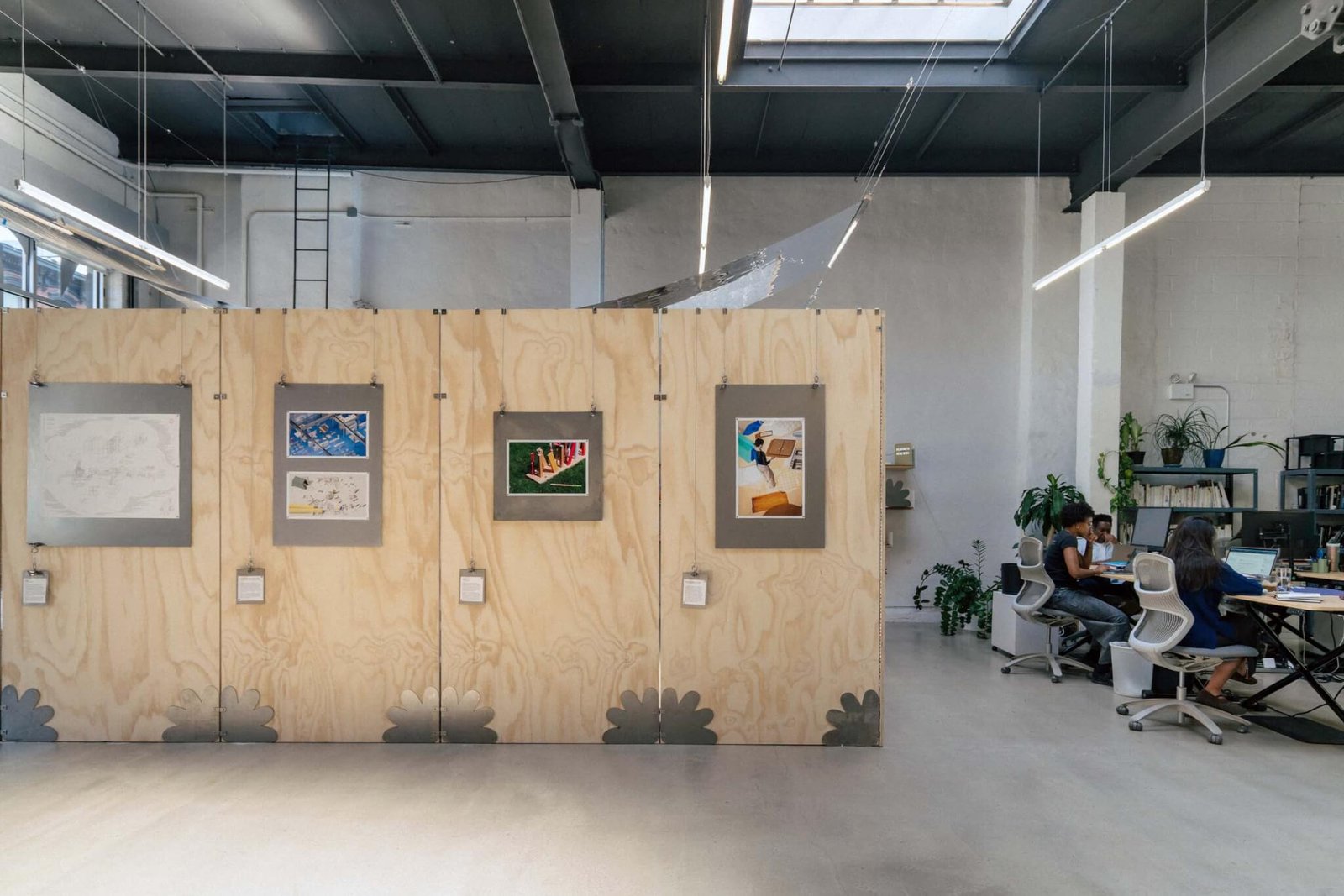
On opening night, the mood in the Urban Room was somewhere between a design crit and a celebration. Suffice to say, NOT NOT were not beating the party allegations. Visitors flooded the Urban Room, sipping drinks while wandering through the exhibition’s enclosure, an assembly of off-the-shelf modular plywood panels, metal sheets, and cinder blocks, held together by hand-shaped metal clamps. The panels, some of which are covered in shiny mylar insulation sheets, have drawings pinned up on them, showcasing projects ranging from Bilal’s “Sheddy”proposal for an accessory dwelling unit as an act of maintenance to extend a building’s lifespan, to Chaussabel’s “Legslie,” which is a bench that examines how perceived “misuse” can unlock new purposes and afterlives for objects.
Broadly, there are three categories of projects on view. These include Bilal’s “Office of Back of House” series that explores maintenance objects, Chaussabel’s “Objectiles” series that narrativizes design objects and materials as experiencing journeys through space, time, and cycles of use, and finally, commissions that the duo are presently working on. The ideas on view are broad, incisive, and imaginative, but some of the exhibition text employs language that might not be accessible to those unfamiliar with the more technical side of architectural practice.
The exhibition, supported by the Architectural League’s Independent Projects grant program, also responds to the realities of setting up an office in a city like New York, where rents are high, space is scarce, and competition for commissions remains fierce. Chaussabel and Bilal are part of the inaugural cohort of the Van Alen Vanguard—an initiative to reimagine cities and the role of designers in public life—which helped them secure the space. “It’s this really amazing thing to have a physical space in New York City as a young practice,” said Bilal.
Or Is It An Office?
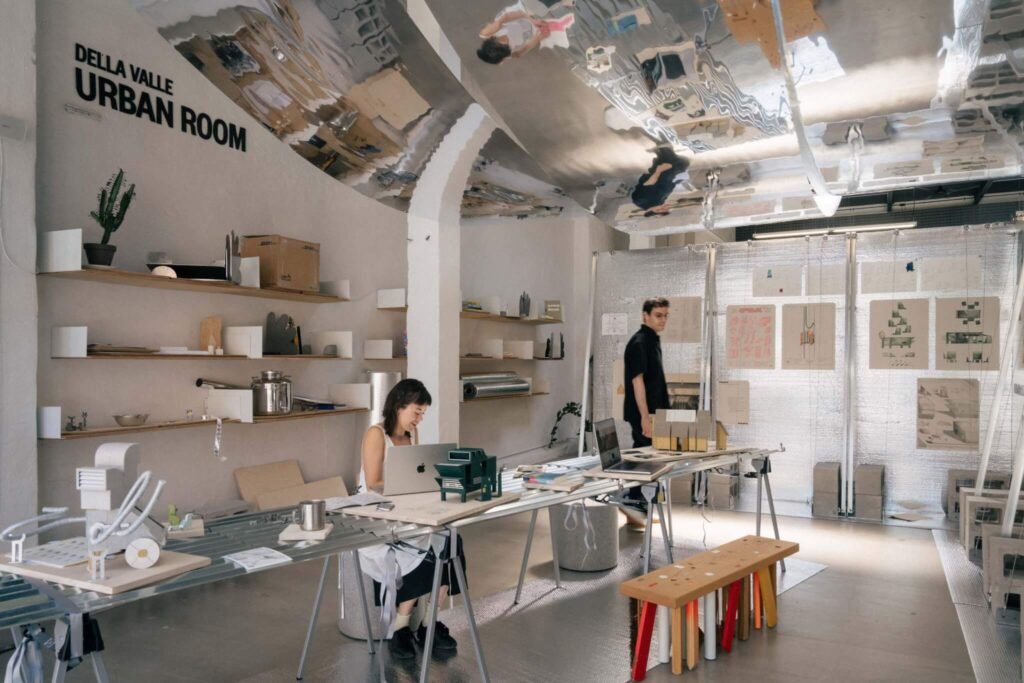
Their workspace setup in the Urban Room consists of a long table with a corrugated metal top. On it, a series of interchangeable plywood panels accommodate laptops, working models, coffee mugs, and books.
A set of translucent reflective sheets droop from the ceiling at varying depths, refracting views of the ceiling and skylights. Designed for easy disassembly and reuse, Bilal and Chaussabel plan to return the panels and most of the other materials to vendors once the show is over, to eliminate waste as much as possible.
As proof of this, one of the exhibition enclosure walls at the storefront’s entrance is decked with receipts detailing each material and item purchased for the project from The Home Depot in Gowanus and other stores.
“As someone who runs exhibitions, I see all of the waste that happens when an exhibition gets torn down. Seeing Celia and Ekin approach that question creatively was cool,” said Emily Conklin, the network and public programs manager at the Van Alen Institute. “I think this is going to be a great platform for young practitioners to come together and see the real nuts and bolts of what it means to start your own thing.”
At its core, NOT NOT is an invitation to walk in and engage with design and designers in their natural habitats. The tradeoff for having access to a prime storefront office space, is having people outside surveil them as they work. Bilal and Chaussabel see this as a means to demystify the mundanities of architectural practice, welcoming the public to engage with them in the process—and also draw some attention to their practice. When asked how they feel about being surveilled as they work, Chaussabel joked: “I would love to be surveilled.” Bilal added: “We are very excited about that. Surveil us, we need the exposure.”
Through open office hours, community workshops, and tours, Bilal and Chaussabel hope to reach more diverse audiences. “We’re disinterested in ‘architecture for architecture’s sake,’ or a purely architectural discourse, but we get really excited when a 10-year-old can walk up to the bench,” said Bilal. “We produce work that should be, and hopefully is, accessible to anyone.”
NOT NOT is on view and open at the Van Alen Institute in Gowanus, Brooklyn, through August 15.
Jerry Elengical is a journalist who has covered art, design, real estate, and politics for The Architect’s Newspaper, The New York Times, STIRworld, The Intercept, and City Limits.