




Jessor
Citygroup
Through May 23
Contemporary visions for decommodified, collectively managed housing in the United States don’t hold a candle to what one architect and his labor union clients achieved in New York City. Between 1925 and 1974, Herman Jessor designed at least 300 cooperatively-owned residential buildings with more than 40,000 units. Today, his light-filled apartments, in buildings that offer plentiful common spaces and verdant landscaping, continue to provide generous homes for the working class. Today, more New York City residents live in a building designed by Jessor and his colleagues than by any other architect.
Compare that to the latest schemes to address our housing crisis with ever-shrinking micro-units, built as quickly and cheaply as possible. Even progressive speculative designs can fail to imagine the scale or level of quality that Jessor achieved in his buildings. Our current dreams for architecture and housing justice pale in comparison to the reality that Jessor helped shape.
Jessor, on view at Citygroup through May 23, offers not only what is possible, but what has already been achieved in our own backyard. Presenting multimedia research-in-progress for a future book on Jessor’s work and the limited-equity cooperative living movement, the exhibition is curated by photographer Zara Pfeifer, designer Brad Isnard, and AN news editor Daniel Jonas Roche, and designed by Geoff Han with research support from Katie Ladd. This is the second exhibition in an ongoing research and design project; Pfeifer and Roche were also behind the 2025 Cooper Union show, Thank you, Herman Jessor.
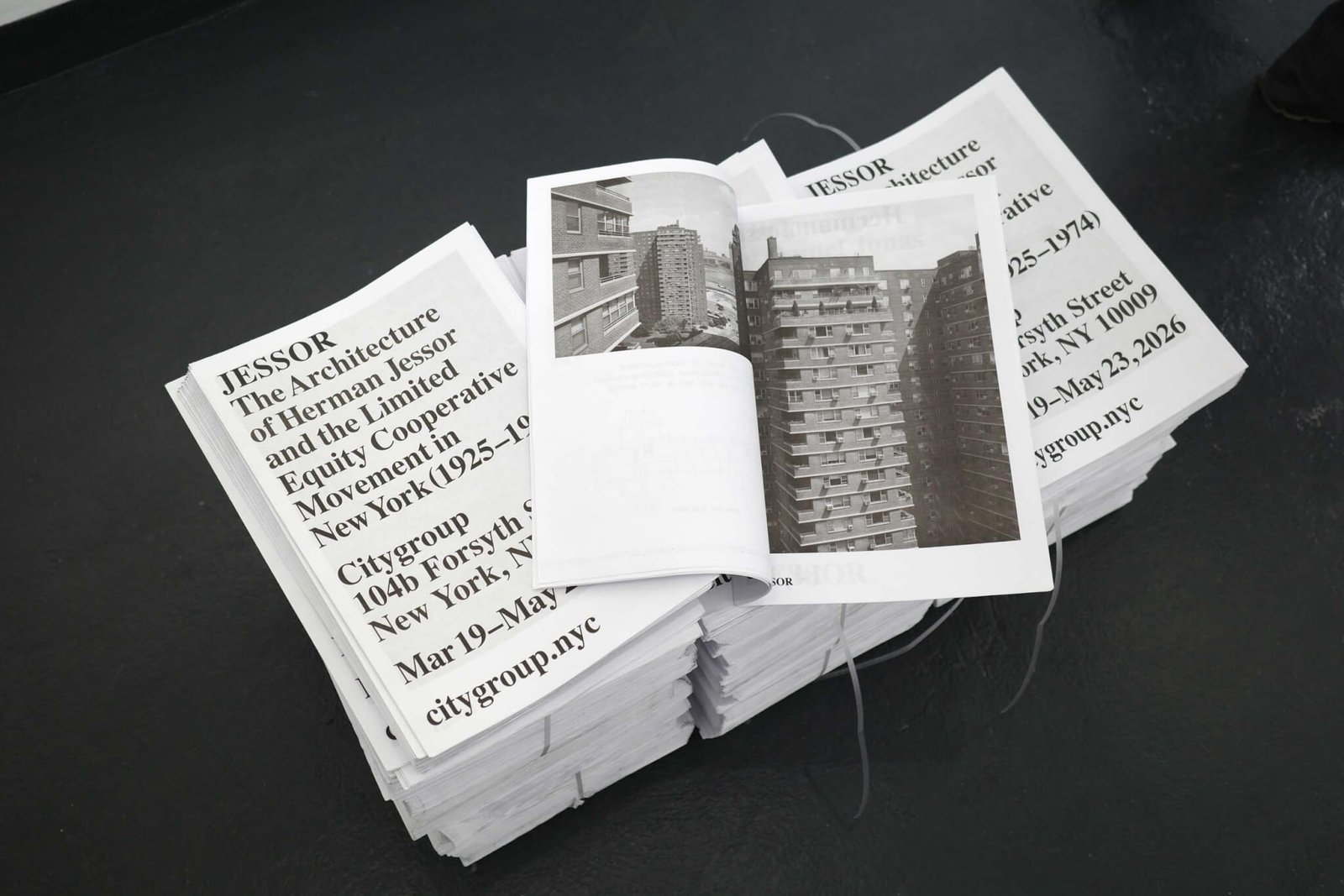
At the center of the current exhibition is a deeply researched, brilliantly curated, 32-page broadsheet, which can be found in formidable stacks on the gallery floor. Texts by Isnard and Roche present Jessor’s work and the history of limited-equity cooperative housing, alongside the political and economic, and spatial contexts that made them possible: briefly powerful labor movements, federal funding for social housing, and an expanding subway.
A clever “retroactive manifesto” by Isnard channels Jessor through five principles combining architecture and social justice, from “Improve Quality of Life” to “Cooperation is Leverage.” Roche’s riveting biography of Jessor tells the story of the Jewish immigrant architect who “survived the Pale [of Settlement], worked his way through night school [at Cooper Union], and helped house a large portion of working-class New York.” The broadsheet also features intimate photographs of Jessor buildings by Pfeifer, archival images, and Denise Scott Brown and Robert Venturi’s 1970 review of Jessor-designed Co-op City, paired with Jessor’s response.
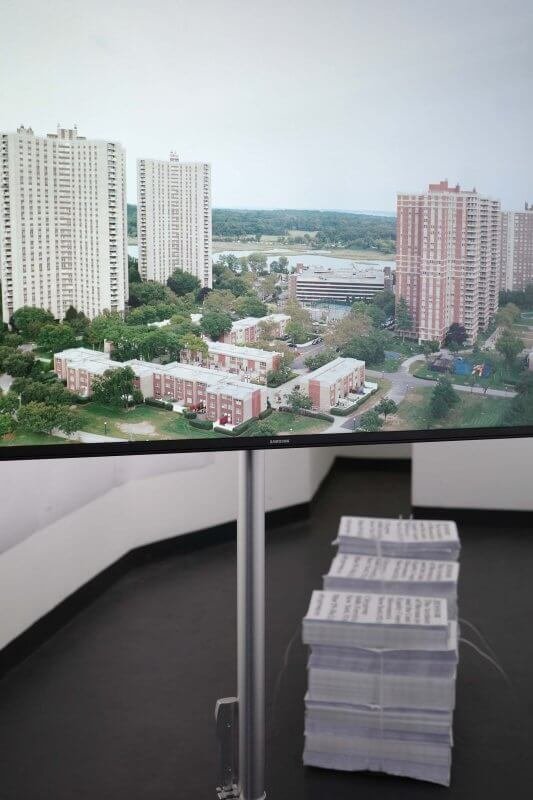
By digging through historical archives and cataloging Jessor’s work for the first time, the curatorial team has done a huge service for housing researchers, architects, and advocates. Exhibition photographs and drawings celebrate the park in Jessor’s tower-in-the-park schemes, fighting the common conception that open areas in housing estates constitute “underutilized” space. Flat screens in the front and back of the gallery show Pfeifer’s photographs on loop and a video of an interview with a Co-op City resident. The walls of the tiny space are filled with site plans and architectural drawings of Jessor’s designs, redrawn by Isnard, alongside construction costs and other project data. Pfeifer’s images highlight residents’ social life outdoors and Isnard’s figure-ground site plans, on close inspection, include every tree. I left the exhibition wishing it were a book (with drawings showing the common spaces and more interior apartment photos, please!), which I guess is the point.
Jessor worked with Springsteen & Goldhammer before going on to found his own firm, Herman J. Jessor Architect, which collaborated with labor union clients: the International Ladies Garment Workers’ Union (ILGWU), the Amalgamated Clothing Workers Union (ACWU), and the United Housing Foundation (UHF). The ILGWU and ACWU successfully advocated for the New York State Housing Act of 1926, whose incentives made possible the limited-equity cooperative housing model. The coops that Jessor designed are primarily limited-equity, as opposed to private, meaning that there are limits on how much residents can profit from selling their apartments. This keeps housing costs below market-rate. Jessor’s racially integrated developments, designed in collaboration with working mothers—hence the coops’ kindergartens and communal kitchens—included the Amalgamated Cooperative Apartments in the Bronx (1927), Manhattan’s Penn South (1961), and Rochdale Village in Queens (1966).
The cooperative movement and Jessor’s architecture reinforced each other. Interpreting for the late architect, Isnard writes, “Use the community organization to lobby city, state, and federal governments for concessions in the form of zoning adjustments, tax subsidies, land acquisition, and direct financing. Use architecture to expand the community organization.” The cooperatives’ shared-profit development model allowed investment in higher-standard apartments. In turn, simple, replicable units and buildings were adapted for sites across New York, resulting in construction efficiencies that fed into shared profits. Nixon’s 1973 moratorium on new social housing put an end to the work, but the physical and social legacy remains.
Herman Jessor provides an architecture to the claim that housing is a human right. As he wrote in Progressive Architecture in 1970, “[Housing for the masses] is too vital for the needs of the people to be subject to the profit motive.” His well-located, healthy, affordable homes continue to offer a high quality of life for working-class New Yorkers. Current proposals for a New York State Social Housing Development Authority and 6,000 “Mitchell-Lama-style homes” at Sunnyside Yards represent rare chances to further Jessor’s legacy. As social housing reemerges in the United States through initiatives like the Seattle Social Housing Public Development Authority and Montgomery County, Maryland’s revolving public housing loan fund, along with actionable reports like Pathways to Social Housing in New York from the Community Service Society and Green Social Housing at Scale from the Climate & Community Institute, Jessor’s work offers a powerful example of the scale and quality we should fight for. I can’t wait for the book.
Karen Kubey is a New York– and Toronto-based urbanist, Assistant Professor of Architecture at the University of Toronto, and founding director of the Architecture and Housing Justice Lab.