






Bahrain was once paradise—literally. The tiny island nation in the Persian Gulf is believed to be the real Dilmun, a land depicted in ancient Sumerian texts that inspired the biblical Garden of Eden. Its inhabitants made a living diving for naturally occurring pearls in freshwater springs with abundant oyster beds. Traders who purchased the pearls, what these texts called the “plant of immortality,” came home with tales of a lush oasis where people lived forever. Until the 20th century, Bahrain was the world’s leading pearl supplier. One necklace took 30 years to assemble and was so precious it could be bartered for a building on Fifth Avenue in 1917.
In the 1930s, the country’s fortunes abruptly switched when the Japanese invented cultured pearls and explorers struck oil in Bahrain. The age of Dilmun was long forgotten by then, but oil ushered in modernity, finally eating away the vestiges of the country’s way of life.
Bahrain has long been a scorching place: Summer highs reach 100 degrees Fahrenheit, and the humidity makes the heat feel hotter. During the pearl boom of the 18th and 19th centuries, Persian merchants introduced the barjeel, or wind chimney, as a way to keep cool. This is a slim tower with vents at the top that captures wind and channels it toward the ground, where a pool of water cools the air, which then circulates throughout the building. It performs practically the same function as an air conditioner, but harnesses natural energy.
Modern, electricity-powered air-conditioning arrived in the country along with the petroleum industry. Soon after oil first spurted out of a well in 1931, the petroleum company Bapco was founded to profit from the seminal discovery. To make the move to the desert palatable for Western experts and their families, the new expat colony of Awali was equipped with cutting-edge technology. This included some of the first AC units in the Middle East, which were made possible by funds and power from the newfound oil.
“It’s really connected,” said architect Andrea Faraguna, the designer of the Bahrain Pavilion at last year’s Venice Biennale. “The energy produced by the oil is then used for powering the air-conditioning.”
Air-conditioning was not just a novelty in Bahrain. The first AC unit had been installed in a printing press in Brooklyn in 1902 to address the problem of sheet sizes and inks being distorted by changes in indoor temperature. Inventor Willis Carrier came up with the machine, which could exchange hot air for cold as well as control humidity thanks to the introduction of electricity.
But the technology developed slowly and was largely limited to industrial use. The first window-mounted units came onto the market in 1931 and could cost upward of a million dollars in today’s money. When the oil-industry expats moved to Bahrain, air-conditioning was still unheard of in most American households, and most weren’t wanting for one either. Today’s most AC-dependent megacities didn’t exist: Phoenix, for instance, had fewer than 50,000 residents in 1930; Las Vegas had all of 5,000.
Since its arrival, air-conditioning has upended both where and how we build. It is the precondition for the glass skyscraper, for the mazelike shopping mall, for the McMansion in the desert. Contrary to earlier passive cooling methods, ACs consume energy and work best when the living space is closed off from the outdoors. These technicalities have far-reaching consequences: Living space suddenly comes with a running cost, and somebody is always bound to be left outside.
This was clear as soon as the first ACs were installed in Bahrain. Access to the air-conditioned offices, mess halls, buses, schools, and cinemas was governed by a strict classification system: American and European workers had unlimited privileges, Asians and other expats had limited use, and native Bahrainis, many of whom labored in the oil fields all day, were banned from entry, following the logic that they were accustomed to the heat.
Although less codified, the caste system persists in the Gulf to this day. While locals move from air-conditioned towers to air-conditioned malls in air-conditioned cars, in a kind of cold chain for humans, it is the Indian and Bangladeshi guest workers who build all the glass skyscrapers that sleep crammed into unventilated shipping containers.
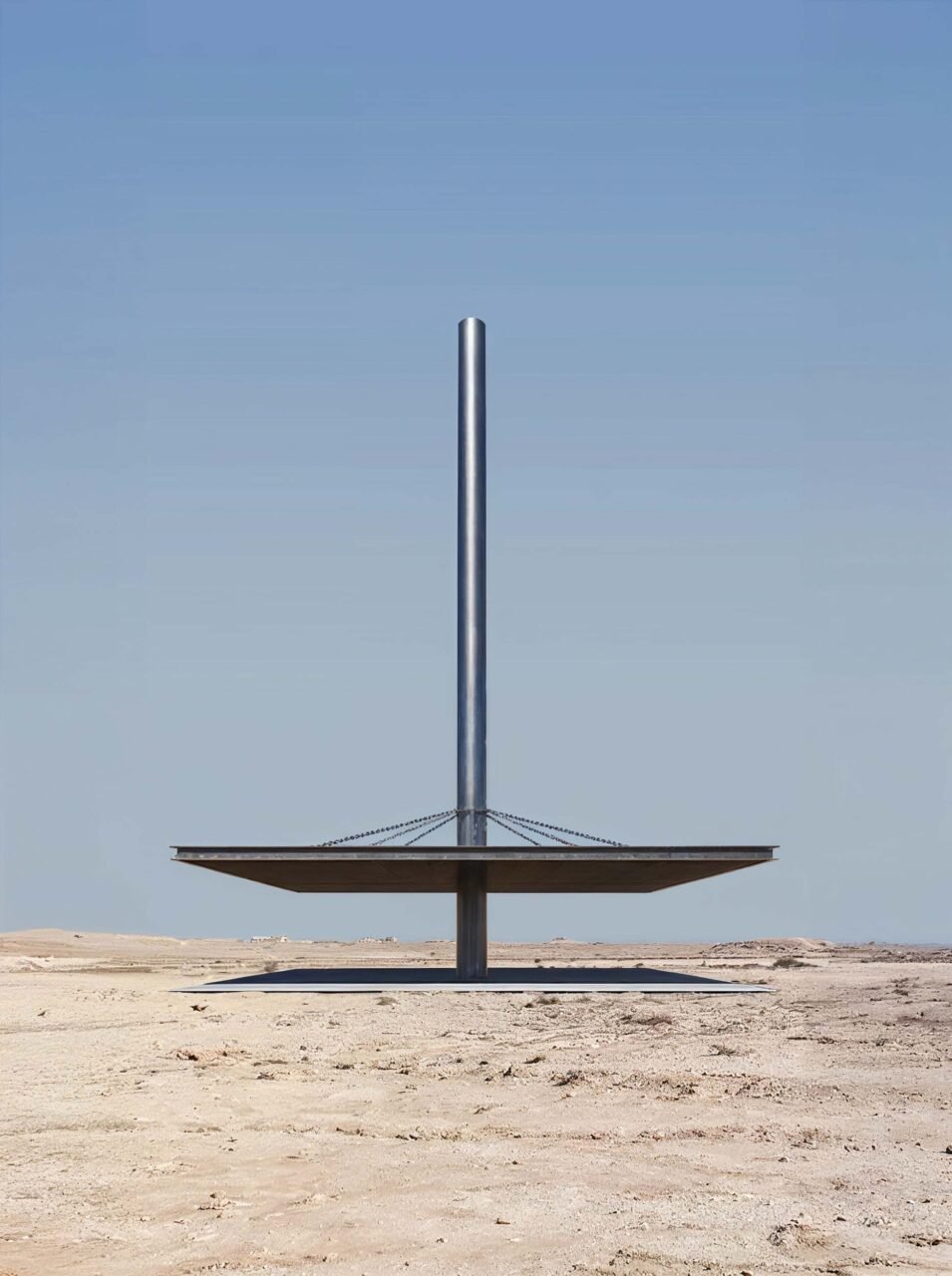
This was the issue at the center of Faraguna’s proposal for the Bahrain Pavilion, themed “Heatwave,” at last year’s Biennale. “In the Gulf, you are always surrounded by a regulated environment, and this relies, obviously, on high energy consumption and a machine cooling system,” he said. “The idea was to create a thermodynamic system with very little energy consumption.
Faraguna’s design is a square canopy that stands on one central column that bores down about 20 meters into the ground. Air is channeled down through the column, where it is chilled by the cool soil. That colder air then travels back up and is distributed as a mist through “air showers” from the roof. People under the canopy enjoy pleasant temperatures without being shut out of the outdoors; it is easy to imagine the pavilion installed on a public square or temporarily on the edge of a construction site.
This minimalist construction was a revelation. Especially since most building regulations, including ones claiming sustainability as their goal, push in the direction of the cold-chain lifestyle. One of the core requirements of LEED, the gold-standard green-building certification, is that a building be as insulated as possible from the outdoors. This minimizes energy loss when heating a house in winter, but the side effect is that it discourages passive cooling methods such as cross-ventilation or perforated screens, making mechanical AC inevitable.
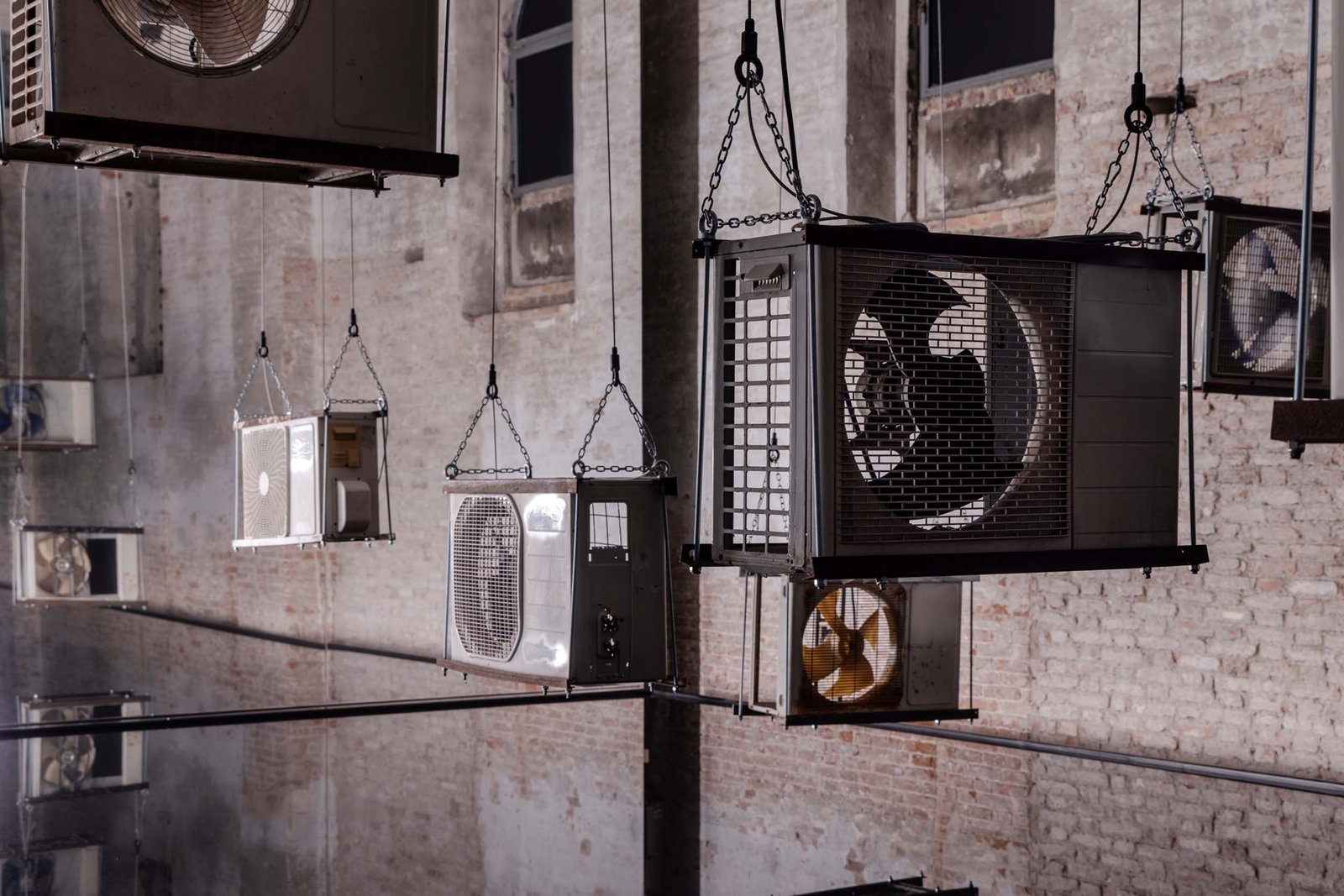
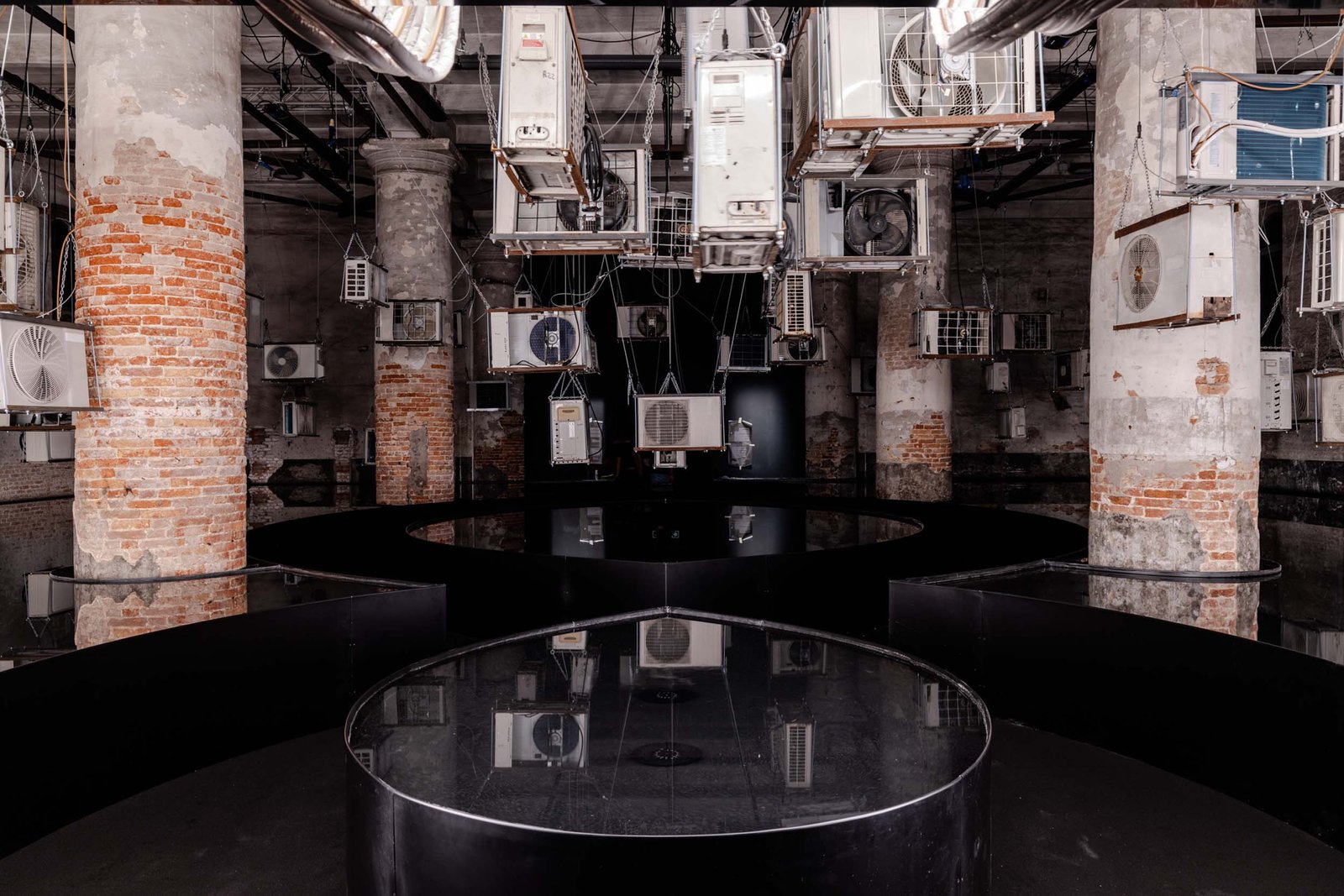
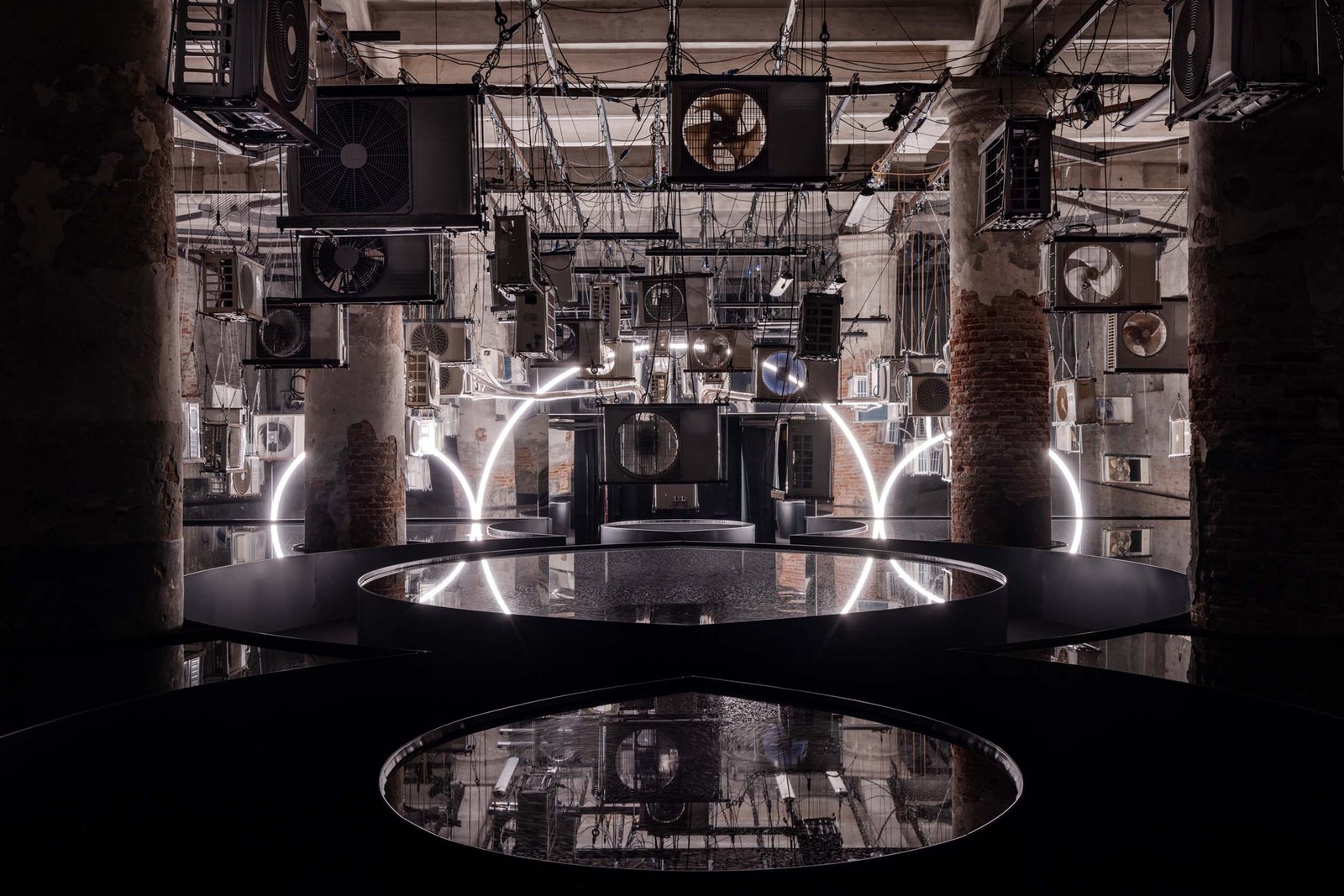
Air-conditioning’s omnipresence was felt elsewhere at the Biennale, when visitors entered the Arsenale through “Terms and Conditions,” an installation by Transsolar with Bilge Kobas, Daniel A. Barber, and Sonia Seneviratne. In the low-lit room, broken AC units were suspended from the ceiling. As people approached the other end of the room, the air became increasingly warm and more suffocating. Here, visitors were confronted with the environmental by-product of artificial cooling: hot, cast-off air from a dozen ACs working to cool down the following room.
Still, “Heatwave” was one of the first real solutions for cooling a place effectively without heating up its surroundings. The pavilion ended up winning the Golden Lion, the Biennale’s highest honor. “It’s a question that I think can always be solved: How can I live in a place without damaging it?” said Faraguna. “We need to negotiate with the environment, rather than treat it as an enemy.”
These existential questions prompted by AC are not limited to the Middle East. It is easy to see air-conditioning as a kind of original sin: world-changing, impossible to backtrack, irresistible, but ultimately destructive to mankind. Bahrain somehow went from being actual Eden to hosting a jumble of heavy industry and American military bases. And the planet is hurtling toward climate catastrophe, all the while becoming increasingly addicted to a technology that accelerates its arrival.
As I began writing this piece, it was 95 degrees in New York, in May. The streets of Manhattan were even hotter because of the urban heat-island effect, made worse by tens of thousands of AC units fanning warm air onto sidewalks. I started out working at the desk in my studio apartment, next to an ancient window-mounted AC unit loudly racking up my electricity bill. I had to keep it on all night. Later, I moved to a desk at my university, where the building’s centrally controlled air-conditioning had me freezing in my summer dress.
Then came summer, with its attendant deluge of heat. One particularly big wave rolled across continental Europe, pooling over France for weeks on end. In Paris, Haussmann-era attic apartments became uninhabitable: Somebody used the heat radiating off his zinc roof to fry a crepe. American newspapers, which already have a funny predilection for depicting France as a perpetually failing state (example headline from The New York Times: “France Is in a Deep, Deep Hole”), now had the opportunity to report that the country was, in fact, the inferno. In June, The Washington Post announced that France, which had previously seemed well insulated from the worst of climate change, was now hotter than virtually anywhere else on Earth—including Phoenix!
Where warm places like the Middle East and the American Southwest have already accepted that air-conditioning draws invisible borders for everyday life, the French generally view air conditioners as a symptom of American-style social atomization and obliviousness to the environment. This stance suddenly seemed quite indulgent as morgues in Paris started turning away corpses. No matter how begrudgingly purchased, AC units, previously owned by less than a quarter of households, had sold out everywhere.
After this summer, even die-hard critics have ceded some ground. Earlier this year, New York’s city council passed a bill making it mandatory for landlords to provide AC units to all tenants who request them. The measure is intended to smooth out huge disparities in access: One in three residents in Flatbush, Brooklyn, for instance, don’t have air-conditioning in their homes, according to city data (on the Upper West Side, it is one in 20). The legislation has been hailed as a pro-equity effort, although it raises questions about who would be footing the electricity bill—ACs are energy intensive, and therefore expensive—and how an already overloaded grid could withstand more usage on peak days without life-threatening blackouts.
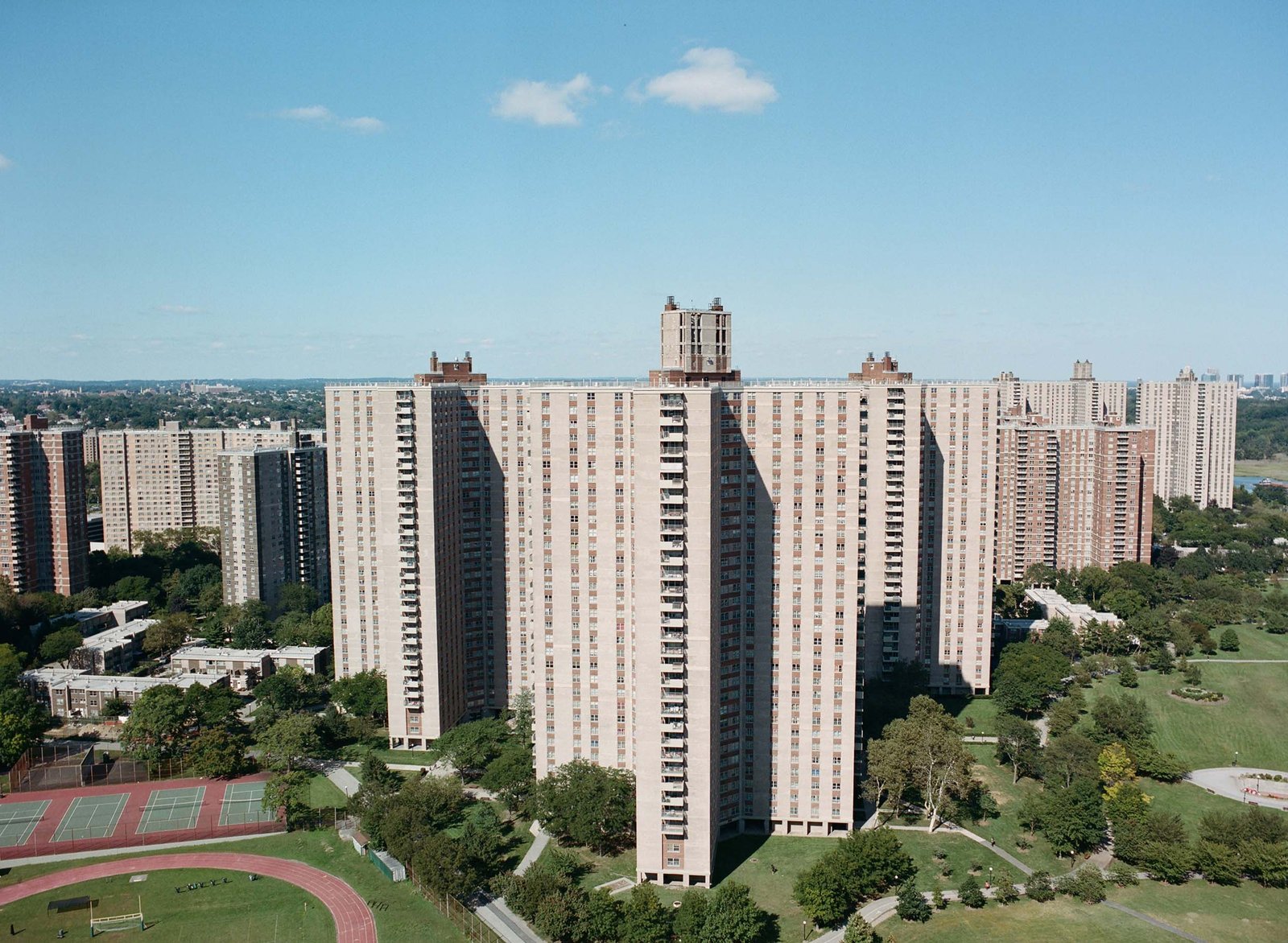
These problems are not theoretical. This summer, I met Egan Anders, a quick-talking, floppy-haired engineer in his 30s. Anders has the unique job of running the independent power plant of Co-Op City, a 1970s high-rise development in the Bronx that houses almost 40,000 people. Although the power plant is connected to the city’s wider electrical grid, most of the energy for heating and cooling comes from three massive boilers, powered mostly by natural gas, that Anders is responsible for running.
Anders told me, quite casually, that he finds himself in a tricky double bind. The city council has passed Local Law 97, which requires all buildings in the city to phase out fossil fuels, like oil and natural gas, or pay hefty fines. The trouble is that Con Edison does not have nearly enough capacity in its electrical grid to provide all the necessary energy. Because Co-Op City’s residents pay a flat fee for utilities, Anders doesn’t have much hope for reducing consumption. “People just aren’t made to work that way,” he said. “My biggest problem is that people leave their windows open and blast the AC.” In a few years, Co-Op City will be held liable for millions of dollars in fines if Anders keeps the boilers on. The summers won’t be any less scorching. The city’s recommendation? That Anders build a miniature nuclear reactor.
On an individual level—that of the person stewing in their inner-city apartment—a bulky, whirring machine on the windowsill seems like the obvious answer. On a community level, not to mention a planetary one, the problems it causes reach absurd proportions. Rem Koolhaas saw this, with almost oracular clarity, on the hot, sleepless night that I imagine he spent writing Junkspace, a postmodern tirade about architecture in the 21st century. In one quick, free-associative tangent, Koolhaas articulates the dilemma that defies all moral judgments or realistic solutions:
“[A]ir-conditioning—invisible medium, therefore unnoticed—has truly revolutionized architecture. Air-conditioning has launched the endless building. … Because it costs money, is no longer free, conditioned space inevitably becomes conditional space; sooner or later all conditional space turns into Junkspace….”
Stella Roos is a Finnish writer living in Berlin. She is the design correspondent for Monocle, an editor at Berlin Review, and a contributing writer for Konfekt, Architectural Digest, TON, and others. She spent the past year in New York as a Fulbright scholar at the CUNY Craig Newmark School of Journalism.