

In 2014, Lower East Side artist Jane Greengold floated an idea to her neighbors: What if we took down the fence?
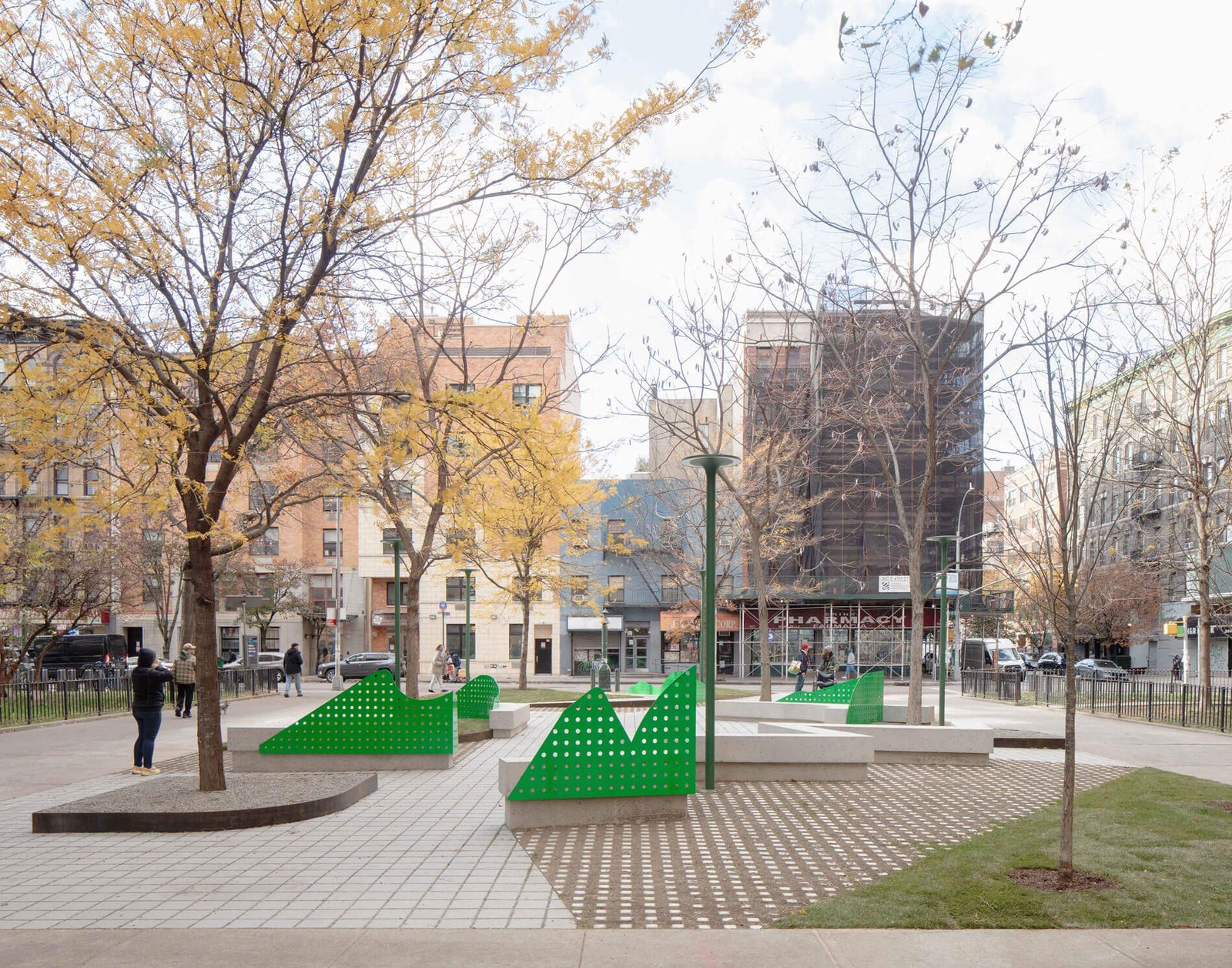
Flash forward, a new park in Alphabet City at Avenue D and East 3rd Street designed by Davies Toews Architecture—a New York office on AN’s 2026 Twenty to Watch list—and community members is now open where a fenced-off grassy area previously sat underused.
The 4,000-square-foot park serves NYCHA Lillian Wald Houses residents, and the Lower Manhattan community more broadly, thanks to a long-term initiative called Opening the Edge. It was built in tandem with NYCHA, PARC Foundation, and Design Trust for Public Space.
Mollie Serena, a Design Trust fellow, Rosa Rodriguez and Destiny Mata of Lillian Wald Houses, and others steered the resident-led, participatory design project, which entailed 25 meetings and dozens of outreach events. The workshops were funded by the New York State Council on the Arts.
For Mata, a photographer and filmmaker, the park “already feels like our backyard,” she told AN. “Residents don’t have full access to parts of East River Park since Hurricane Sandy and the reconstruction, so spaces like this become important for the neighborhood.”
“Rather than a purely passive green space,” Serena added, “we envision it as an active social infrastructure where residents can gather, learn, and celebrate together. In the warmer months, we hope to activate it with classes, workshops, small performances, celebrations, and community gatherings that allow the space to be used as freely and creatively as a community room.”
A Collaborative Effort
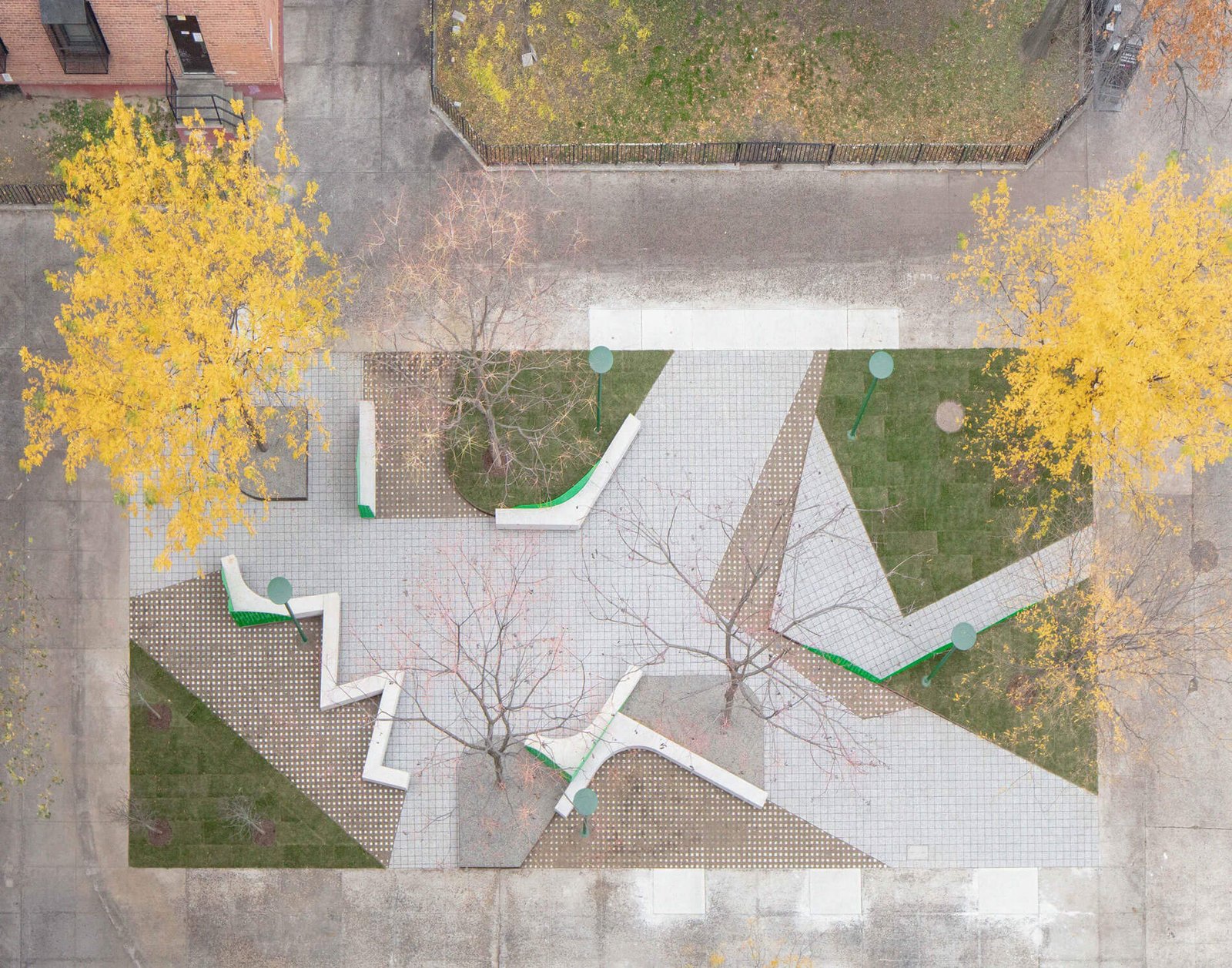
From a bird’s eye view, the design by Davies Toews Architecture and Lillian Wald residents is as exciting in plan as it is pleasurable to relax in.
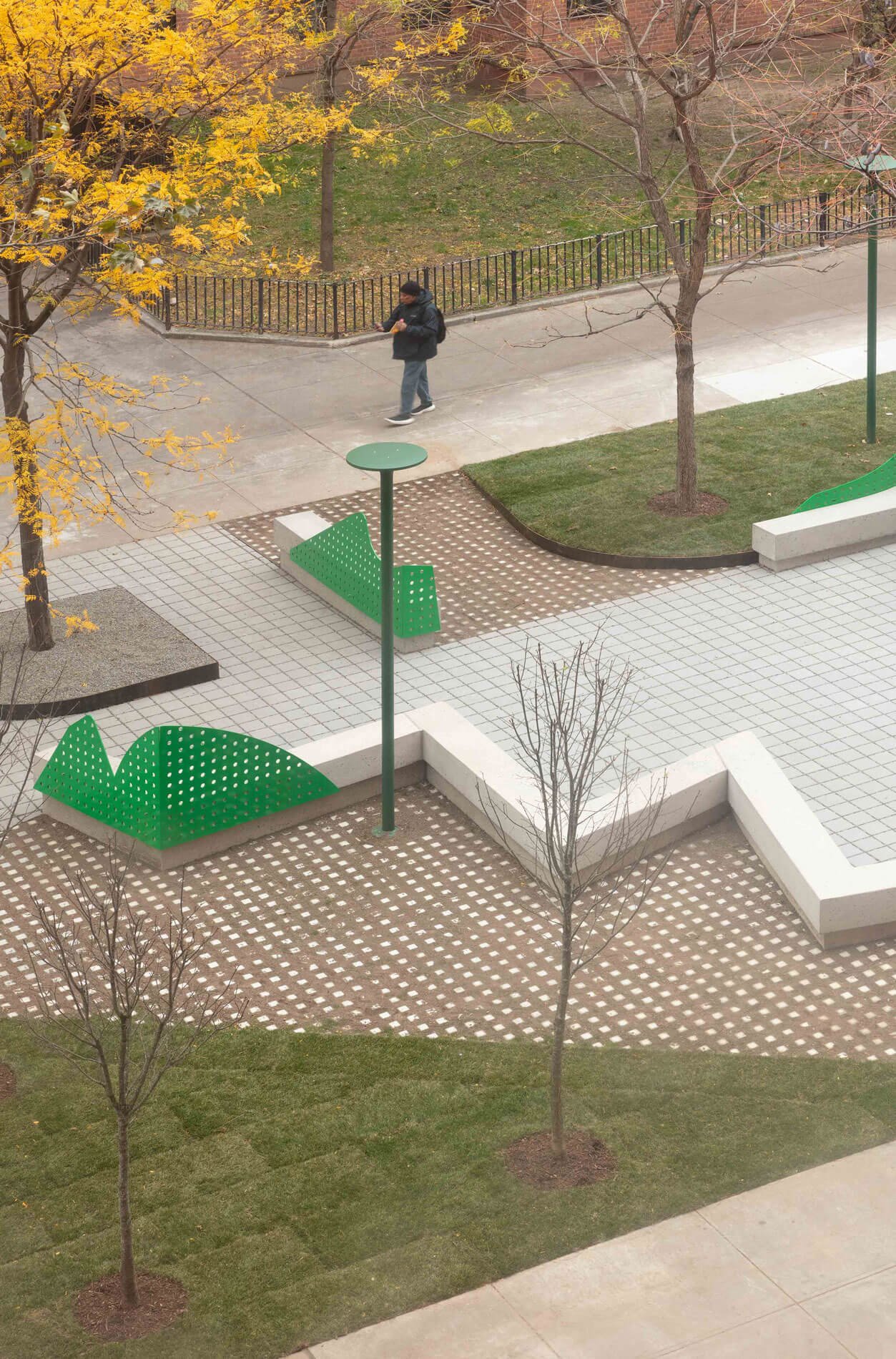
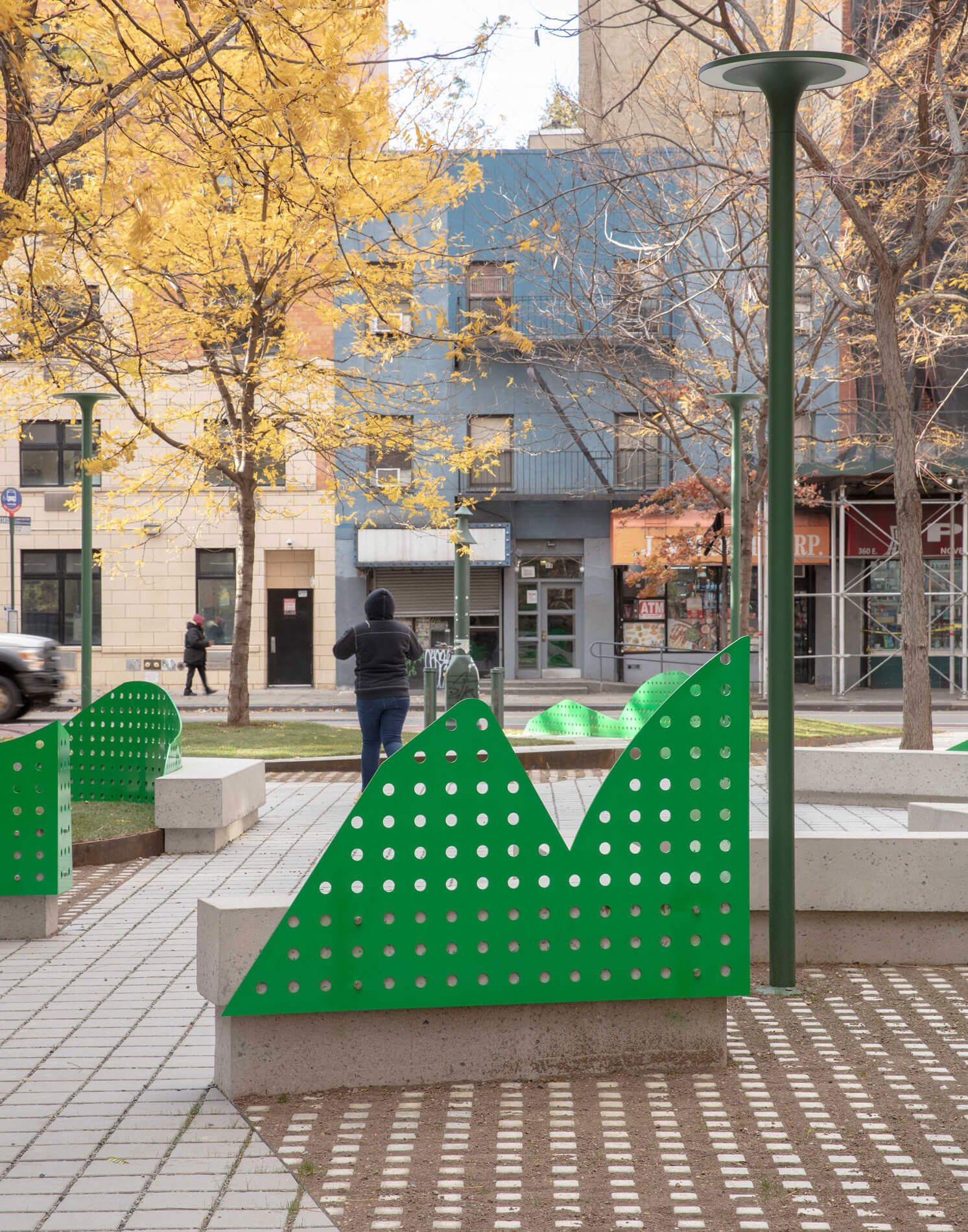
Jagged concrete benches (constructed by Dubner) topped with green, perforated backs (fabricated by OnSite FX) with equally expressive profiles denote the park’s defining architectural features.
The park’s irregular geometries contrast nicely with the more orthogonal “towers in the park” that make up Lillian Wald Houses, completed in 1949 by Frederick Ackerman and Lafayette A. Goldstone Architects.
Small tables make for good spaces where residents can pull up chairs. A subtle platform off of Avenue D rises just a few inches from the park that offers a slightly elevated space for community meetings, open mics, musical performances, whatever folks please. A diagonal pathway offers a shortcut through the park for anyone passing by.
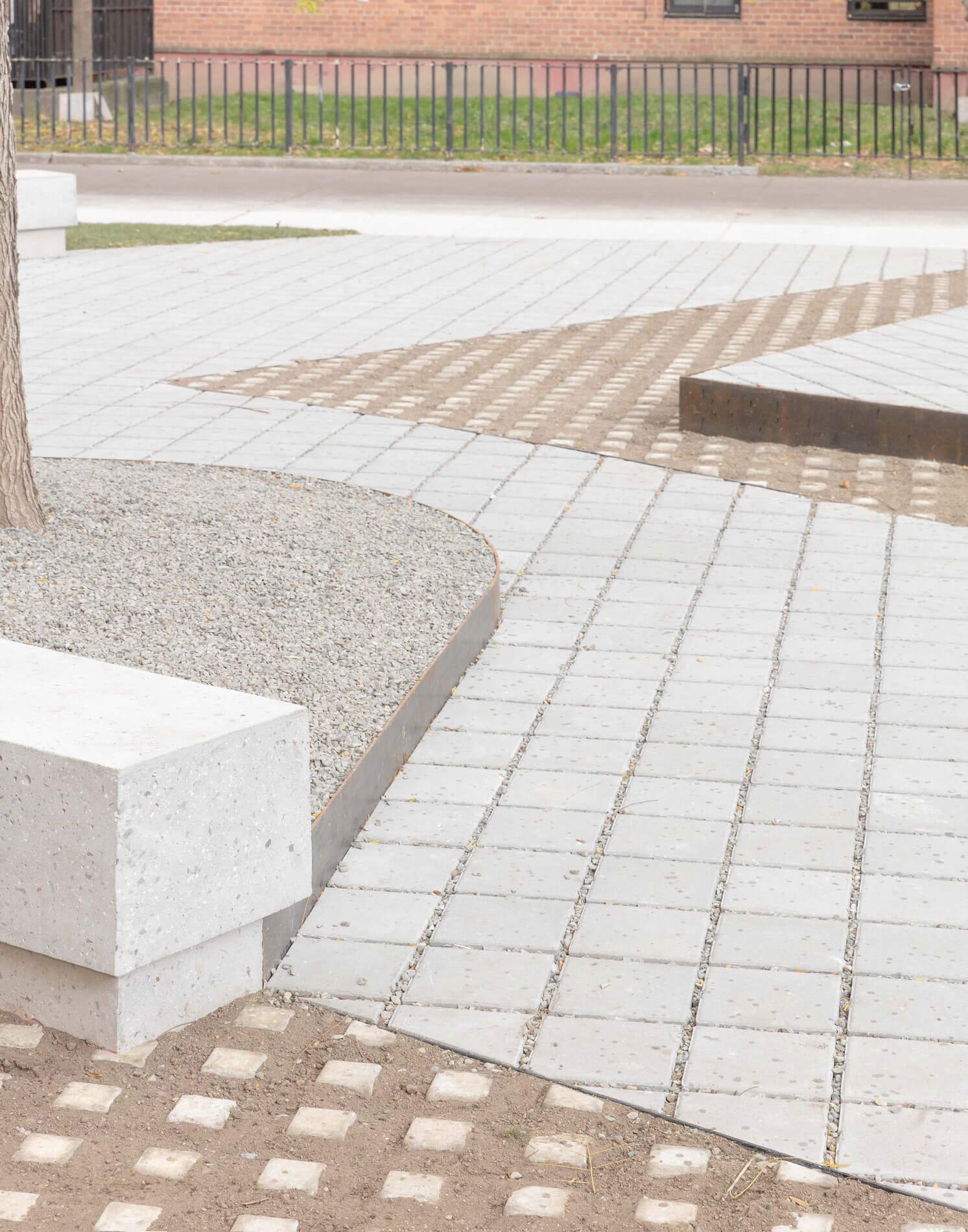
Custom weathered steel landscape edging (also fabricated by OnSite FX) delineates grass and paved areas in the park, which is home to six existing honey locust and pagoda trees, and three new Japanese lilacs.
Light areas designed by Dwaal Lighting Design, and manufactured by Forms + Surfaces, illuminate the surroundings with fixtures whose tones match the perforated backs. Concrete, permeable and grass pavers were manufactured by Nicolock.
Opening the Edge
Greengold first proposed removing a hip-height fence at 34 Avenue D in 2014, to make way for a new park. In 2016, residents of Lillian Wald Houses formed a Community Design Team (CDT) which met with the Design Trust for Public Space in a series of workshops.
CDT members were Rodriguez, Dave Brasuell, Amanda Betancourt, Maddy Caban, Ryan Lugo, Krystal Mejias, Steven Ponce, and many others.
The park project was awarded city funding in 2019. Greengold was appointed as a participatory art fellow, and Immanuel Oni became an active design fellow. Community engagement fellows were Mata, Serena, and Javan Blackshear. Rebecca Hill served as landscape architecture fellow.
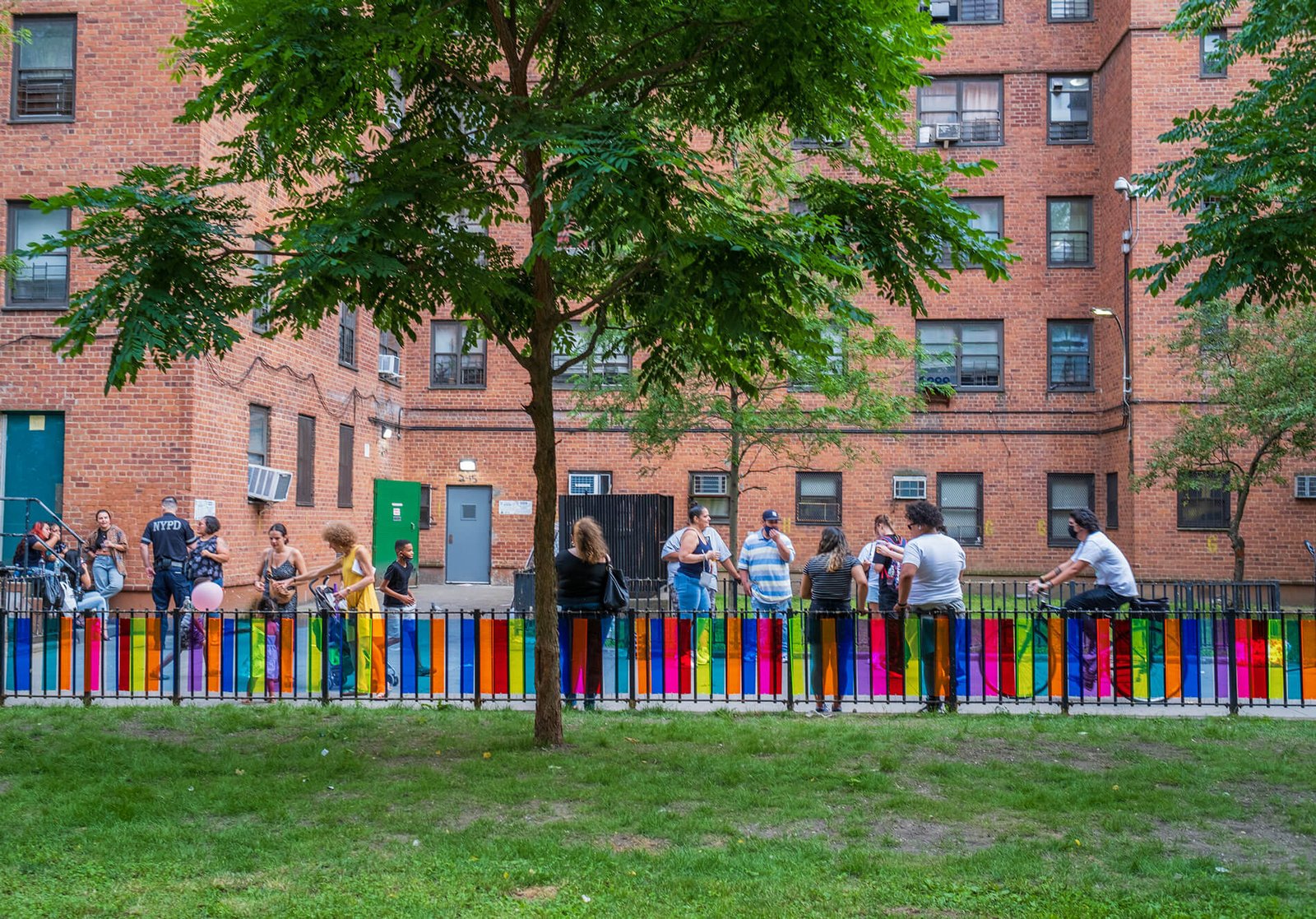
A plexiglass artwork by Serena called Lighting the Edge was installed in the fence that would eventually come down to make way for the new park. The installation helped maintain momentum and community interest in the project, years after it started.
Davies Toews Architecture joined the project team in 2021; the PARC Foundation sponsored the New York office’s services. TYLin Group joined the consortium as the engineer, and Cosentini Associates as the MEP consultant.
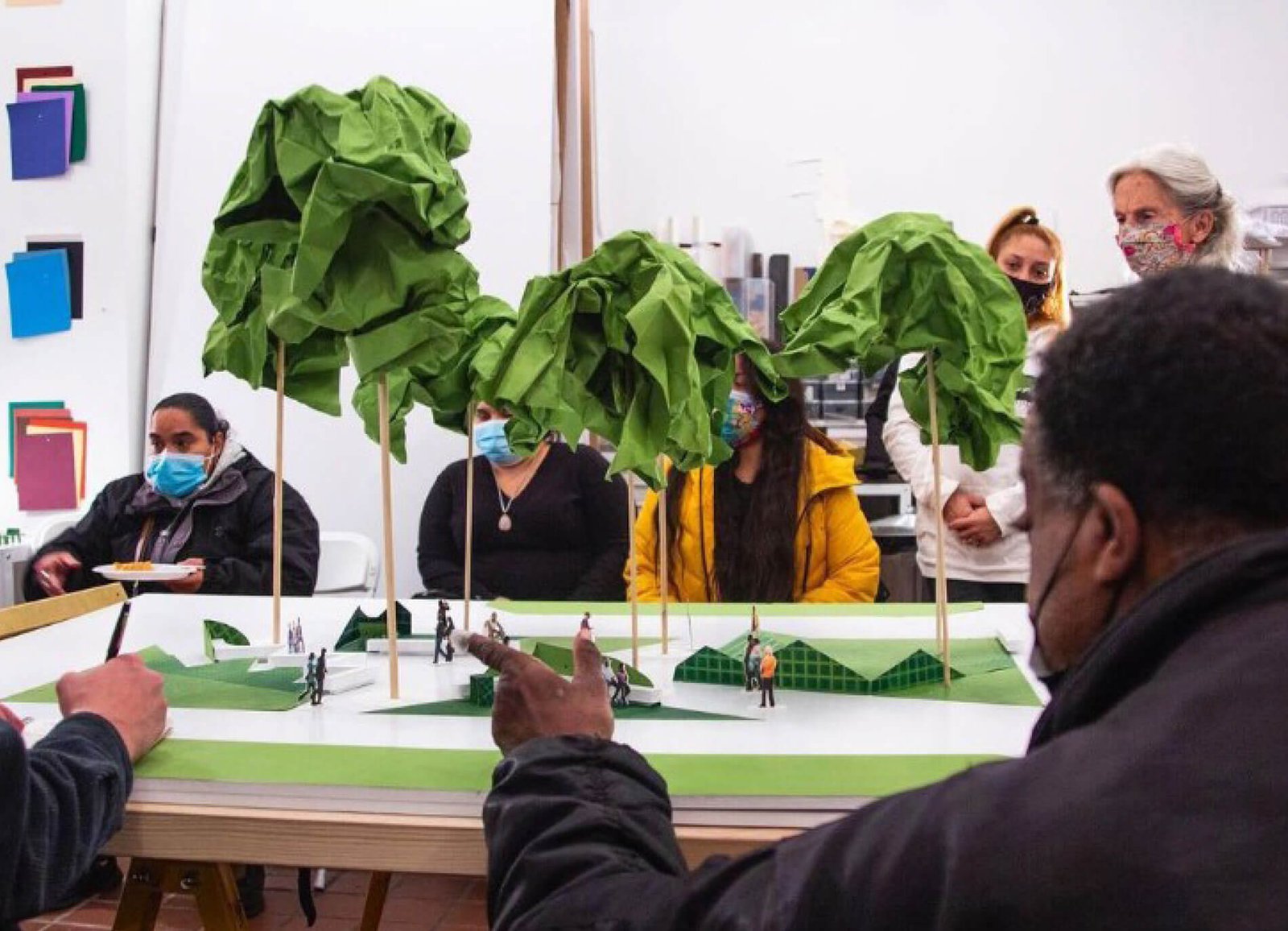
More design workshops followed, where architects and residents cut up pieces of paper and cardboard to brainstorm how the park should look. Davies Toews Architecture is based in the East Village, which made trips back and forth between the office and site relatively easy.
“We would have these meetings at night. It was always a scramble to pull together all the chairs,” Jonathan Toews told AN. “Our first meeting was in the park, in what felt like candlelight.”
Construction on the park started in February 2025, and a ribbon cutting ceremony to inaugurate the space happened the following November.
The People’s Park
In May, to accompany Lower East Side History Month, CDT members will collaborate with Councilmember Harvey Epstein and the Lower East Side Yearbook Committee, another project Mata leads, to bring food, music, and events to what folks are already starting to call the People’s Park.
“I imagine the People’s Park being a place where everyday community life happens,” Mata said. “I can picture elders sitting together playing capicu, families celebrating birthday parties, kids running around, and neighbors enjoying the spring and summer weather together.”
“More than anything, I see it as a place where people can gather, celebrate each other, and just enjoy being outside together, a real community space that belongs to the people who live here,” Mata elaborated.
Moving forward, the model that was cultivated as part of Opening the Edge will be deployed at more NYCHA campuses around the city, where other fence demolitions can make way for vibrant urban living rooms.
As part of NYCHA’s Connected Communities Guidebook and Open Space Masterplan, the Design Trust for Public Space is scaling up its toolkit deployed at Opening the Edge with four other NYCHA sites in the Bronx and Brooklyn.
“I don’t think we had some magic formula,” Toews noted. “We just had resources—the space, chairs, food. And we had a group of people from the Community Design Team who were just really committed.”