
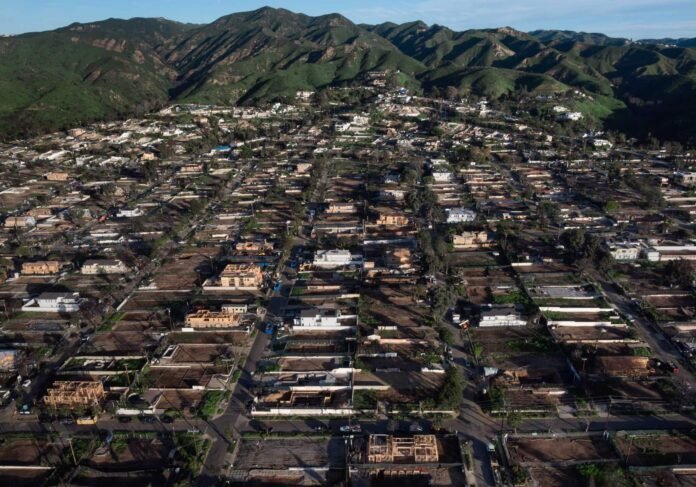

When real estate veterans Dylan Hart and Conor O’Donovan started Village Rebuild in Los Angeles’s Pacific Palisades neighborhood after last year’s fires, they knew their mission to help rebuild the neighborhood would be a challenging one. Insurance payouts, permitting, finding labor—the list of obstacles in the way of building new homes for those displaced by the Los Angeles wildfires was already long enough before tariffs became an issue.
While many of the group’s projects—it has five homes in process, with one framed and two in permitting—still remain under construction, Hart and O’Donovan are trying to figure out how to time their purchases of appliances, fixtures, and unfinished goods. The consistent back and forth of tariff threats has become another challenge for them to navigate in an already difficult economic environment.
“You have a dynamic-priced thing you’re trying to build with a fixed set of proceeds from insurance,” said Hart. “That hurts.”
Not all homes being built today face these challenges. But tariff uncertainty remains a constant, especially for smaller, custom single-family homes. While larger homebuilders like D.R. Horton and Lennar have supply chain specialists on staff and greater means for raising capital, regional, local, and custom homebuilders simply don’t have the resources to be as nimble.
Hart said the models he and O’Donovan used in the Palisades included hefty contingencies, which have helped absorb some of the impacts of rising prices. They haven’t had to make any material changes yet, but still haven’t gotten to the decorating and finishing phases.
Many economists and industry analysts agree that tariffs only exacerbate the larger challenge homebuilders face around financing and capital. Stubbornly high mortgage rates and a softening labor market mean weak buyer demand for existing and new homes. There are also persistent labor shortages in the construction industry, made worse by the government deportation agenda, driving up construction costs.
“Tariffs right now are real, and they’ve changed significantly in the last year or so,” said Rob Nixon, senior vice president at Walton Global, which among other things sells land to large-scale homebuilders and developers. “But it’s still premature to understand how things will shake out [and] how it would look if we didn’t have tariffs. Over the last four and a half years, total building material cost is up about 42 percent. So there are a lot of factors influencing the cost of construction, but tariffs are a smaller component than you’re hearing about.”
Data shows a relatively small increase in prices for materials and services in 2025; according to Homes.com, residential construction costs have only gone up 2.8 percent, a relatively slim bump considering the fear that hit during the early days of President Trump’s trade wars last spring. At the time, the National Association of Home Builders predicted a $10,900 tariff cost per new home.
Since the tariff rates and their impact have been a bit of an enigma—some announced levies never went into effect, and in other cases substitutions were used to skirt tariffs—they’re not having as appreciable an impact as many expected, said Brad Case, chief residential economist at CoStar. Looking at the Producer Price Index of Construction Materials data from the Federal Reserve, there isn’t yet a significant post-tariff spike.
But that relatively moderate impact is spread across the entirety of the supply chain. Nearly every item in homebuilding has the potential to be impacted by tariffs. Tariffs on Canadian lumber, which constitutes a majority of the wood used to build American homes, have hit 45 percent, and a recent tariff on cabinets and upholstered furniture makes furnishing a new home more expensive.
Nixon said for high-end homes, which may be looking to use European marble or top-shelf imported appliances, there’s a potential for rising costs, though there’s also room for substitutions. (He has seen a sharp rise in the use of synthetic materials, which can be made in factories in the U.S.) Buyer behavior has quickly changed, he said, and large homebuilders aren’t canceling any plans to build this year—they’re simply not expanding their plans to build more.
Architect Allegra Kochman, whose firm, AKA Insight, specializes in renovating classic New York City structures, said she focuses on transparency and does budgets ahead of time based on forecast prices. Tariff announcements made that process challenging this year, but the end result, especially when it came to final costs, wasn’t very impactful. There were plenty of local substitutions and changes she was able to make, and the 20 percent contingency she added to projects over the last year helped clients not to feel unmoored by the uncertainty.
She said she hasn’t seen any decline in the volume of business she’s done this year, either. But she’s also worried that continued uncertainty isn’t going to make things easier. “Uncertainty is inflationary,” she said.
The pace with which tariffs were announced and instituted in early 2025 meant that much of the economy had a chance to front-run them, said Elena Patel, a senior fellow at the Brookings Institution, stockpiling foreign goods and starting to adjust their supply chains to lower future costs. This dynamic favors larger players in homebuilding; developers with the means and scale to adjust supply chains have a much easier path to mitigating these costs than a smaller, custom homebuilder.
Sadly, homebuilders may need to factor in uncertainty for a much longer period of time, Patel said. The business community, unmoored by a relatively unsettled tax policy environment, suggests that a wait-and-see attitude is prudent. Even if the Supreme Court decides the president overstepped his bounds by unilaterally establishing emergency tariffs, Patel believes the administration will simply use other means to levy tariffs, creating additional uncertainty.
“We’re still in a ‘What do we expect to happen when we see the full impacts of the tariffs?’ moment,” said Patel.
Patrick Sisson is an L.A.-based writer and reporter focused on the trends, tech, and design behind cities today.