
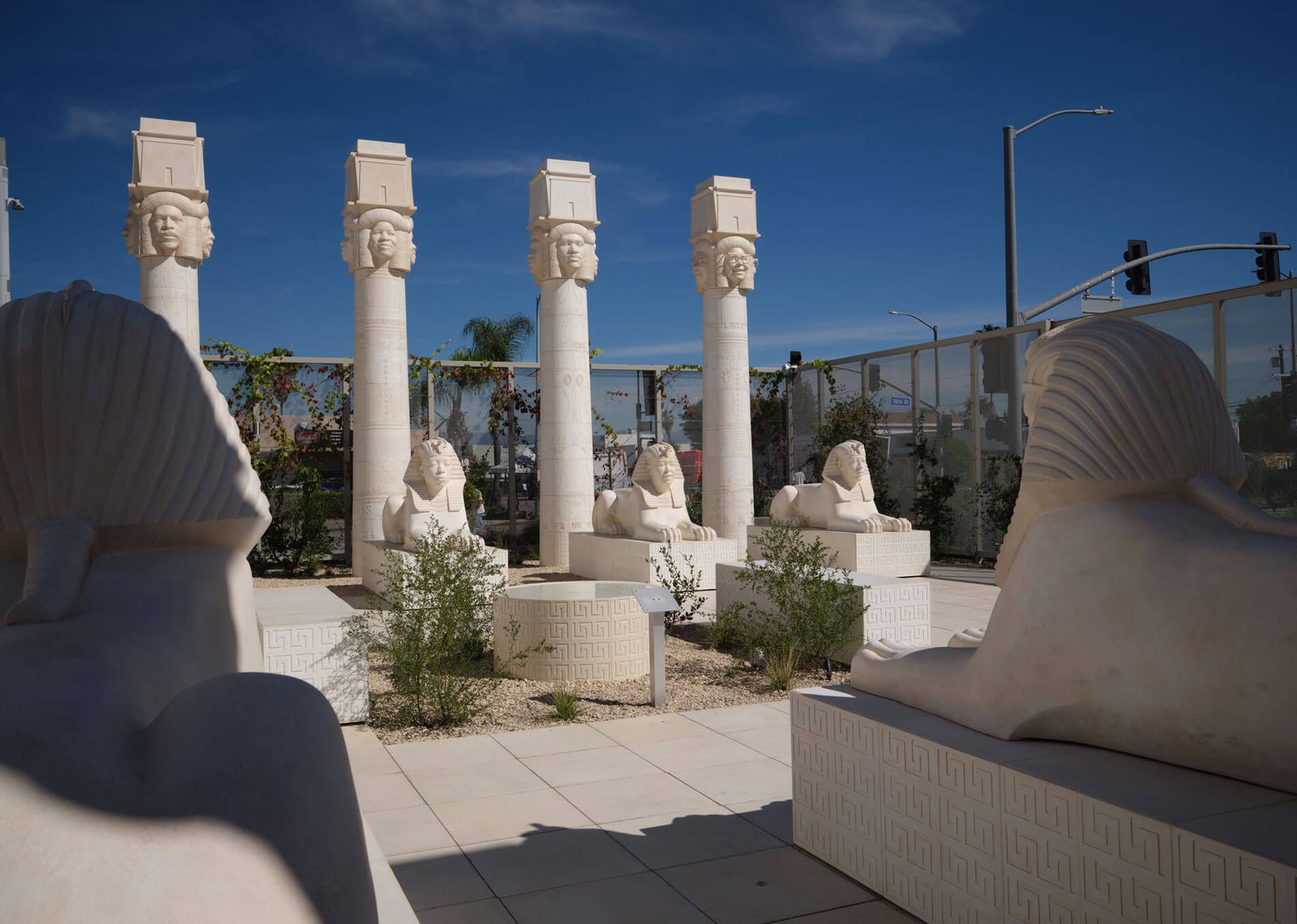

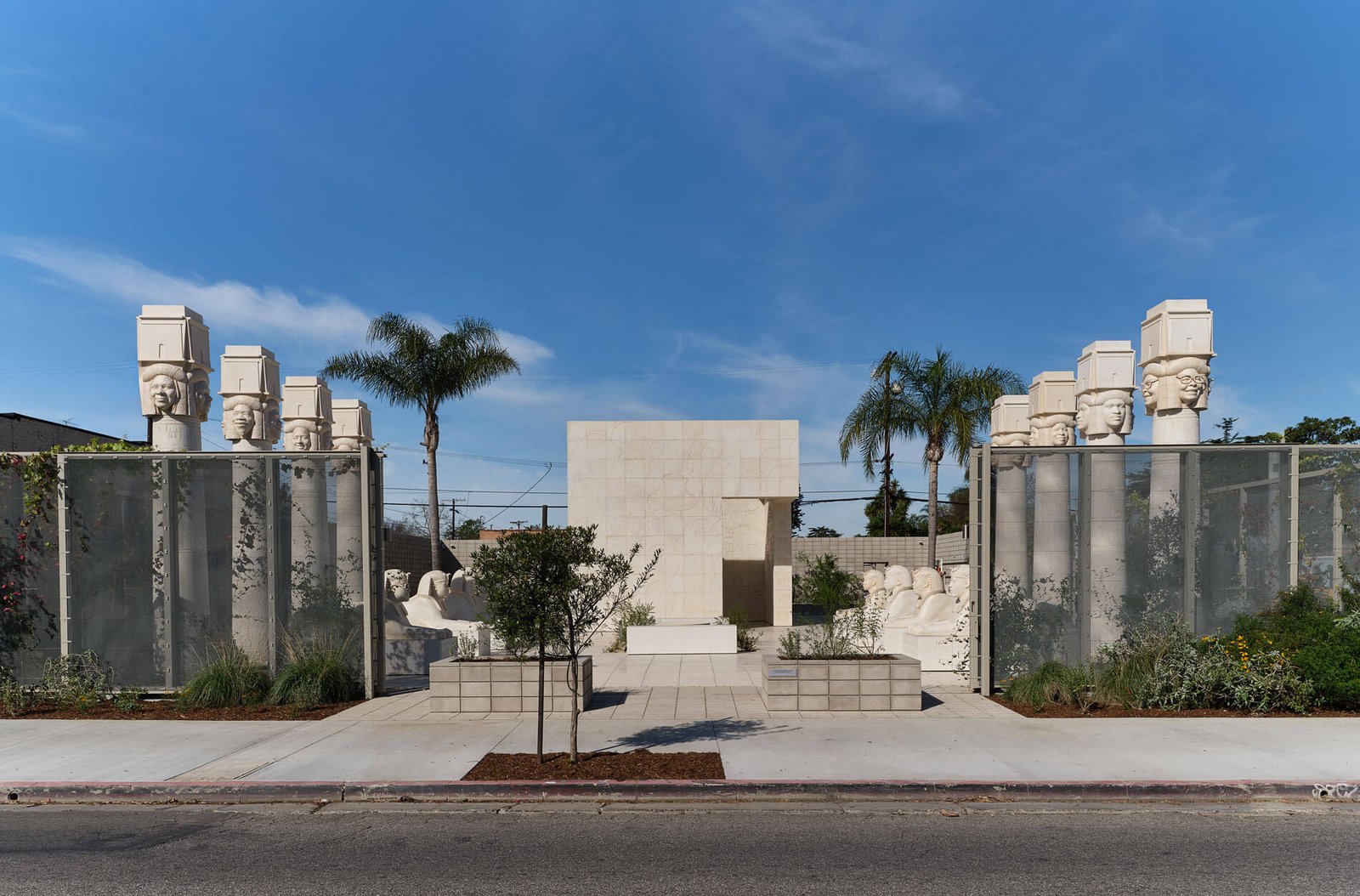
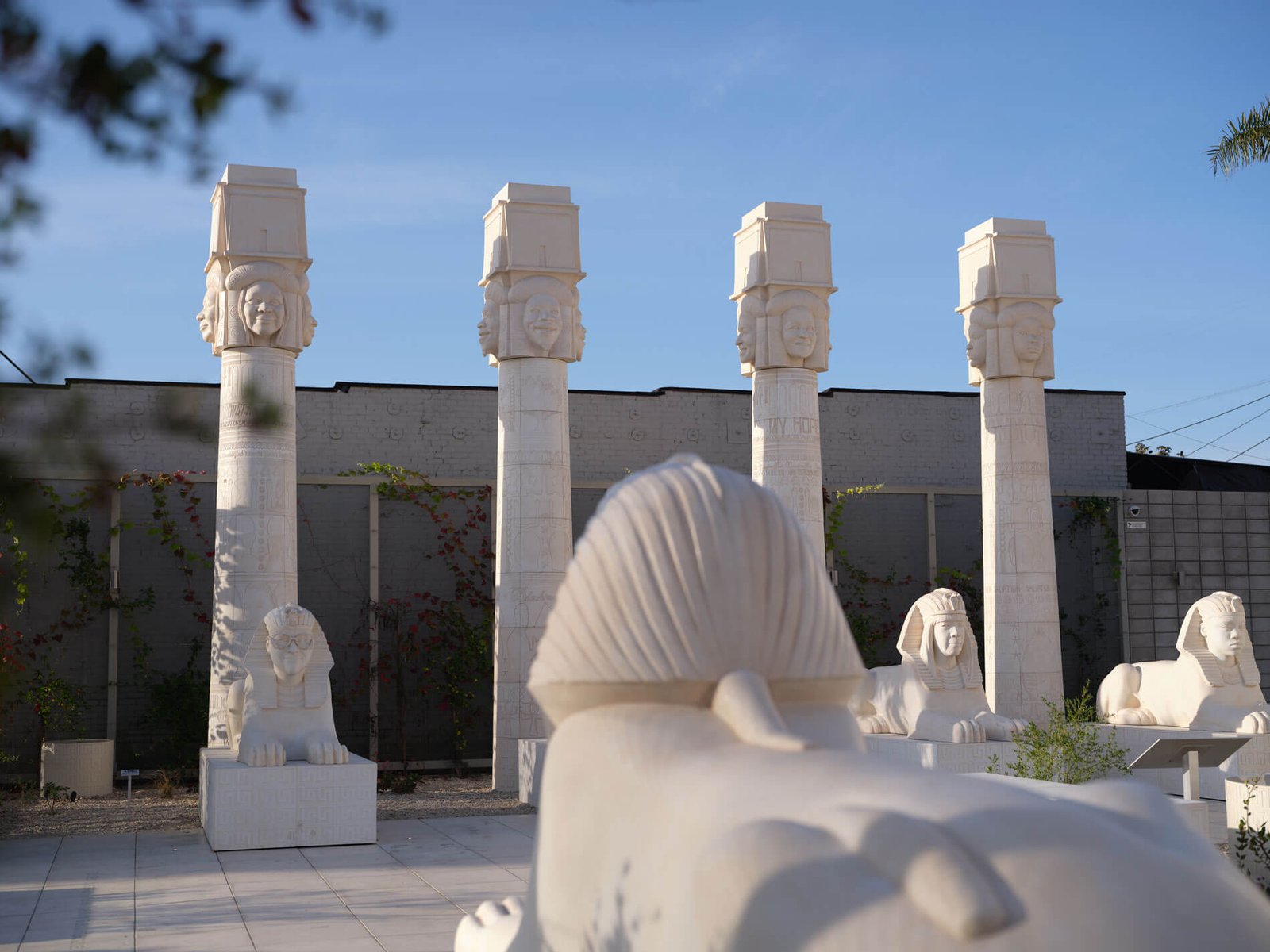
The columns of the sculpture park and monument sister dreamer lauren halsey’s architectural ode to tha surge n splurge of south central los angeles, rise above the 1-story auto repair shops and single-family homes of its surrounding South Central Los Angeles neighborhood.
Located on the corner of Western Avenue and 76th Street, the project is a tribute to the neighborhood’s community and a testament to Halsey’s upbringing and family history in the area. Halsey was inspired by the community’s improvisation in activating vacant lots across the neighborhood.
“Throughout my life, many buildings were burned down, abandoned, left empty,” Halsey said in a statement, “Yet what always stood out to me were the people who informally activated these open spaces: selling Christmas trees, running ad-hoc barbecue pop ups, holding church services, or using it as an ephemeral space to sell hundreds of mix CDs. The community understood that these empty lots could be used for different functions and needs.”
With sister dreamer, Halsey transports her monumental Afro-funk-futurism sculptures, which have previously been shown in museum settings such as the Hammer Museum and the Metropolitan Museum to the place that inspired them.
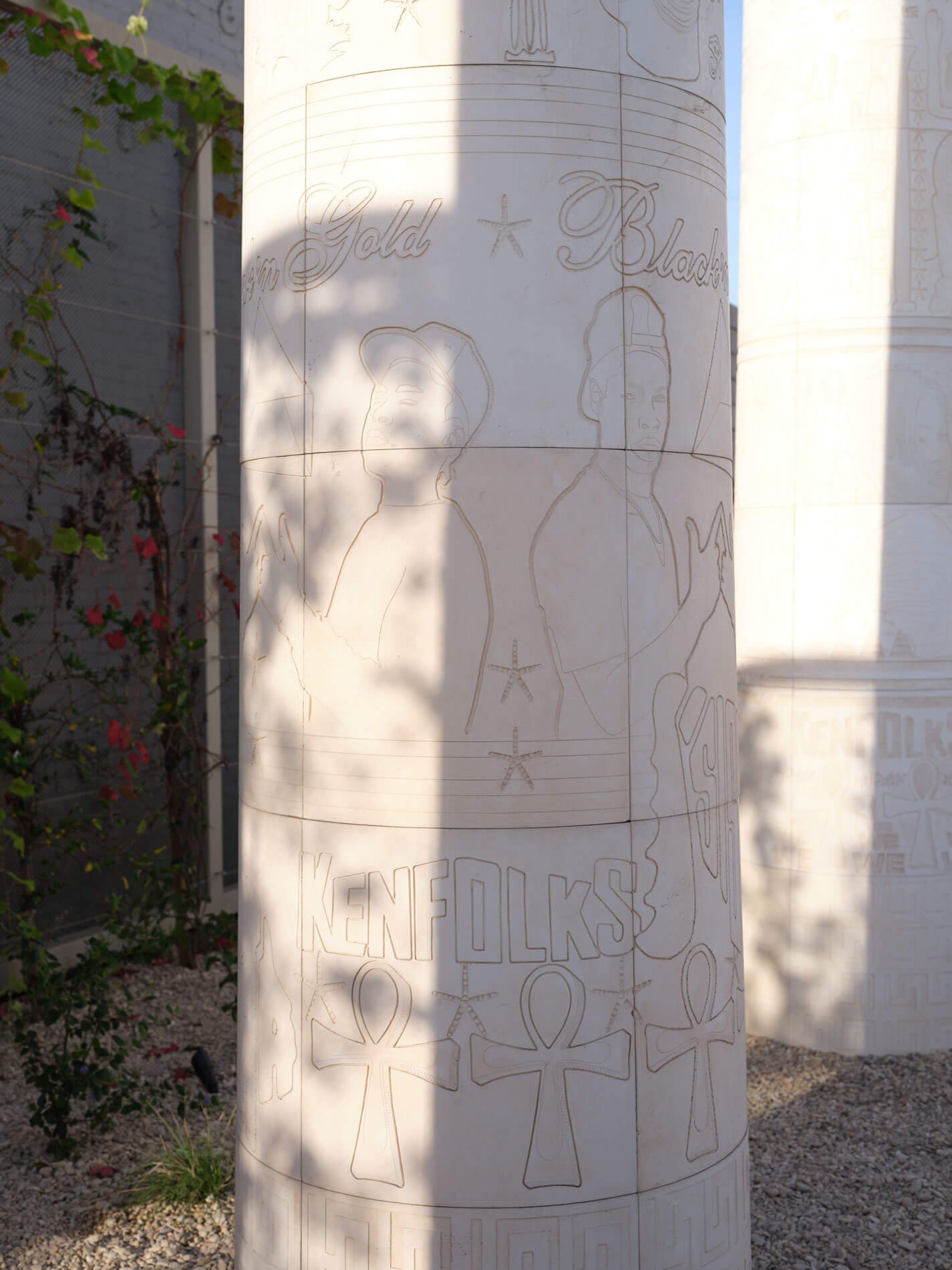
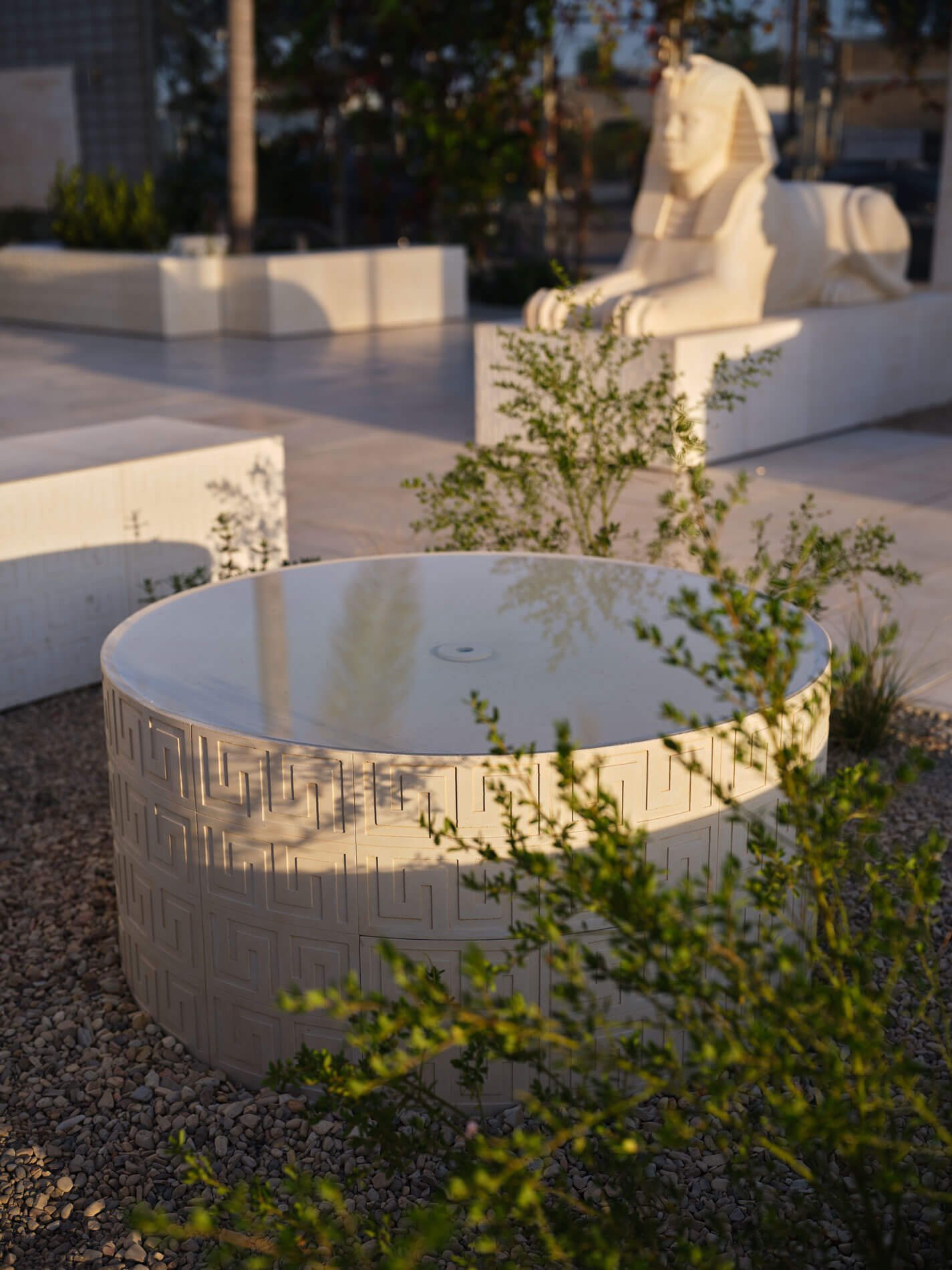
Columns and sphinxes are adorned with the sculpted faces of Halsey’s family and neighbors. They, along with the large rectangular structure, were originally shown as a part of Halsey’s 2023 installation on the Met’s roof garden, the eastside of south central los angeles hieroglyph prototype architecture (I).
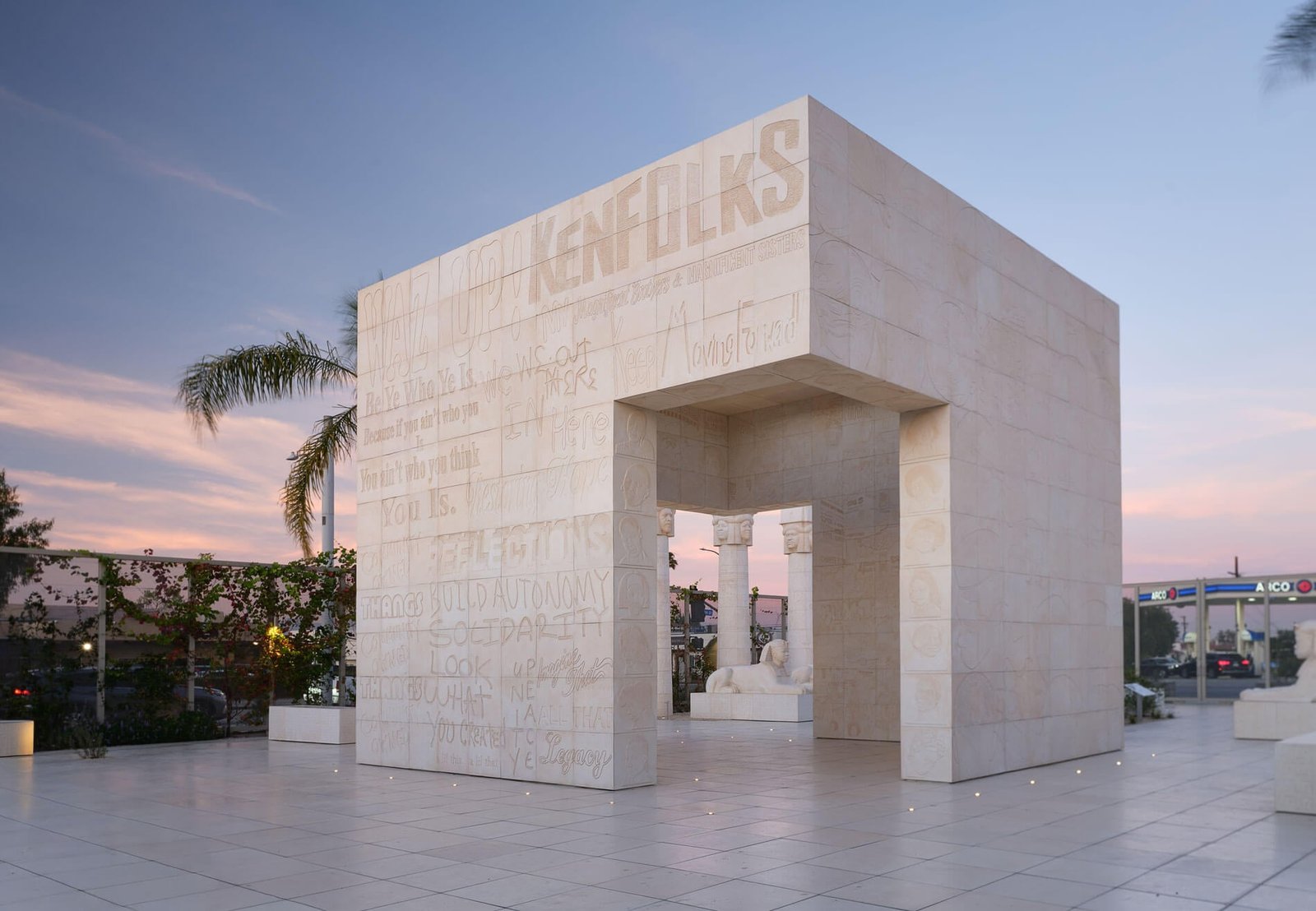
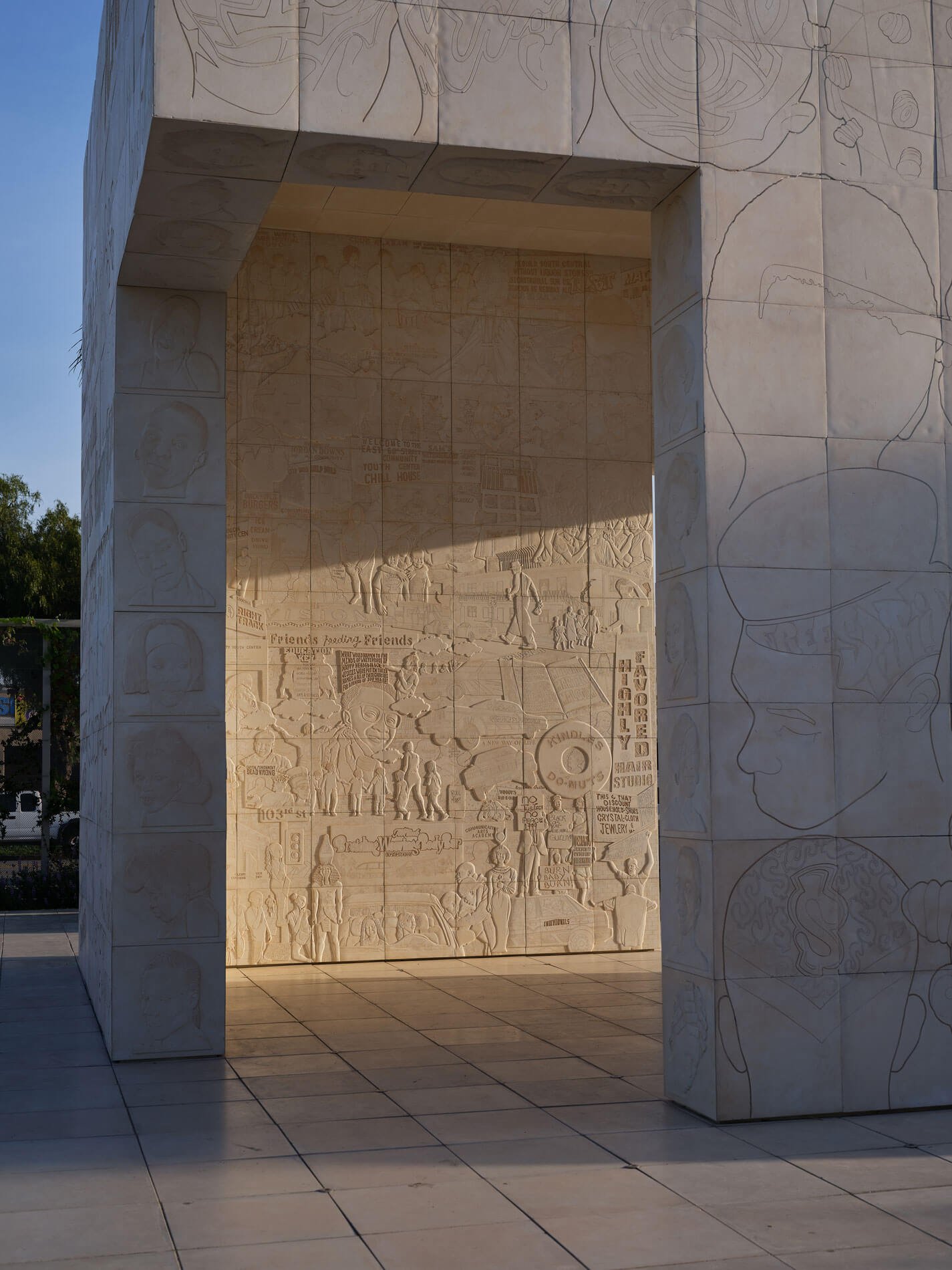
The architectural structure dominates the center of the park. It remixes the visual vernacular of Ancient Egyptian hieroglyphics, and Halsey has inscribed the surface with sayings and scenes that reflect graffiti tagging and provide commentary on how people make public spaces their own.
Halsey envisioned the sculpture garden to act as a “sanctuary” for South Central’s predominantly Black Manchester Square neighborhood. To help with making this a reality, she recruited Current Interests, an architecture studio led by Matthew Au and Mira Henry, to site, permit and coordinate the design of the project’s infrastructure. (The firm made its debut on AN Interior’s Top 50 list last year.) The project is also presented by Los Angeles Nomadic Division, curated by Christine Y. Kim, and includes landscape design by Phil Davis of Green House.
Private Publics
The central challenge for Current Interests was using design to create an inviting space for communal gathering while also providing necessary security for Halsey’s sculptures. They started by figuring out the municipal logistics of the permitting of the space, which was originally zoned for C2 commercial development intended for mostly retail shops.
“The park was permitted under ‘by-right’ development guidelines for privately held properties. This is a bit of a gray zone in the code. It is technically a private park, but open to the public,” Au said in an interview with AN explaining the how it did not require additional or formal reviewing beyond meeting basic zoning regulations. He added, “It was able to move through the review process without the prohibitive costs and constraints that otherwise would have ended the project if we tried to permit it as a ‘public’ park.”
Because of the park’s private nature, plant-covered metal mesh fences and back and side concrete walls were installed to envelop the space.
However, to ensure that the space welcomed the surrounding neighbors to enter, Current Interests set the front gates 8 feet back from sidewalk, using that extra space to create an interstitial “front yard” of concrete planters, which also act as crash barriers. They designed the gates of the main entrance on Western to create a 30-foot-wide entry when opened.
The gates on the residential 76th Street are smaller in respect for the street’s residential character. They divided the site into the entry, an open plaza of sculptures, and a more private anterior area, which holds an updated version of the architectural structure from the Met, and the community garden where intergenerational community can hold multipurpose events and activities.
Garden of Delights
The plaza—with its concrete pavers, crushed limestone gravel, portable circular water fountains, benches, plants, and Halsey’s sculptures—brings delights that are mostly visual and tactile. Current Interests faced the technical challenges of organizing the land grading and drainage for the park. Except for the structural slabs underneath the sculptures, the plaza sits light on the site. There is “only 6 inches from the compressed dirt to the top of the tiles,” said Au.
Along the back portion of the site, the project balances the site’s built and natural environments. Current Interests designed a 50-foot-long concrete seating bench and linear water feature along the back wall, which includes a staging area for edible plants and herbs, a landscape from Green House.
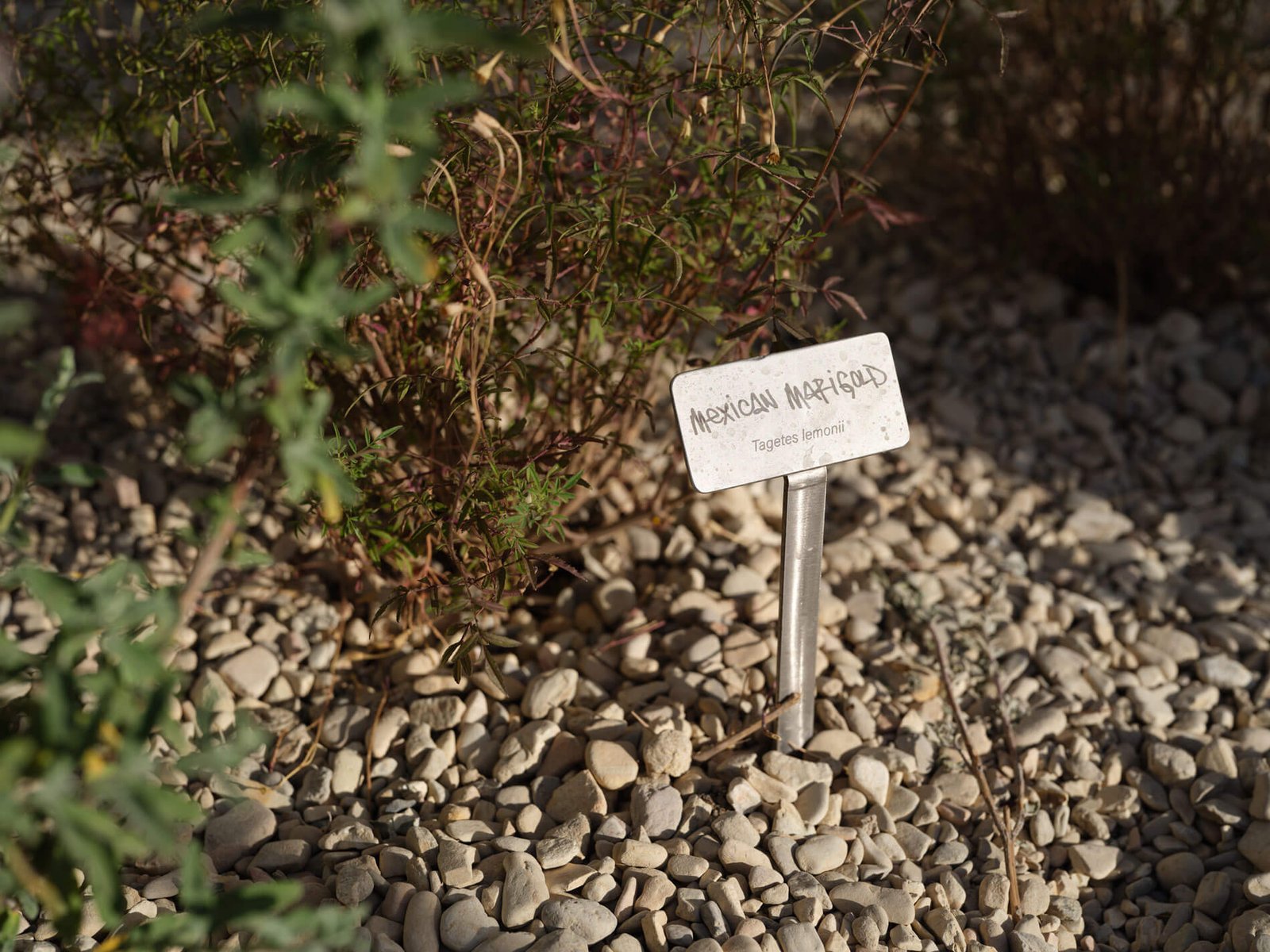
According to Henry, Halsey placed an emphasis on the site’s sensorial aspects, “Lauren and Phil selected a host of fragrant plants for the site.” She added, “If you sit in the space and allow the environment to surround you, you can smell the plants and hear the water. It is very calming.”
An Infrastructure for Black Public Joy
With sister dreamer, Halsey aims to cultivate an homage to the tradition of Black placemaking she experienced growing up in South Central. To ensure the space’s activation, Halsey’s Summaeverythang Community Center is programming year-round, community-led activities and events.
Halsey’s work recalls a remark from Jamaican-Canadian public space practitioner and researcher Jay Pitter; she recently told me that “Black public joy is infrastructure, not just expression.” In her book, Black Public Joy, Pitter draws on her extensive research and public space projects spanning North America to describe the ways in which Black communities pursue belonging, safety, and joy in public spaces.
Halsey, with expert support from Current Interests, has created an ideal setting for Black belonging and safety through this sculpture park. Whether sister dreamer becomes a true site of Black public joy depends on how the surrounding community engages with it.
Dori Tunstall is an award-winning design anthropologist and author, who consults with organizations seeking to practice liberatory joy in their work with cultural communities.