
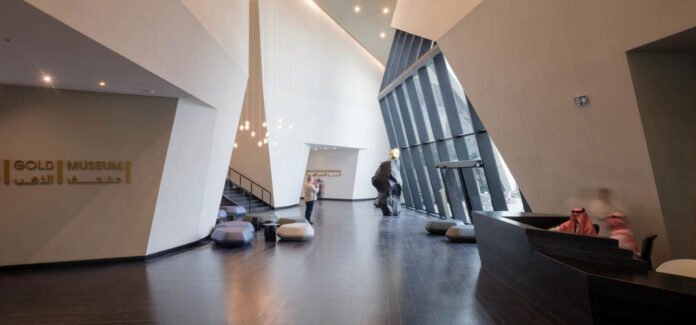

Few materials have shaped the modern world quite like oil, or black gold as it has come to be known. Since the mid-19th century, it has powered industries and redrawn trade routes, fueled the aesthetics of entire eras, and shaped the course of civilization. In April, Riyadh’s Black Gold Museum opened doors to sit within the full complexity of that history of transformation, tracing its arc from pre-discovery to today through the lens of modern and contemporary art.
Housed within the Zaha Hadid-designed King Abdullah Petroleum Studies and Research Center (KAPSARC), the museum is one of the most ambitious adaptive reuse projects the Kingdom has undertaken to date. Leading the revitalization of what was formerly an energy research library into an immersive place of cultural research and thinking, is designer DaeWha Kang who oversaw the building’s design with Hadid nearly two decades ago.
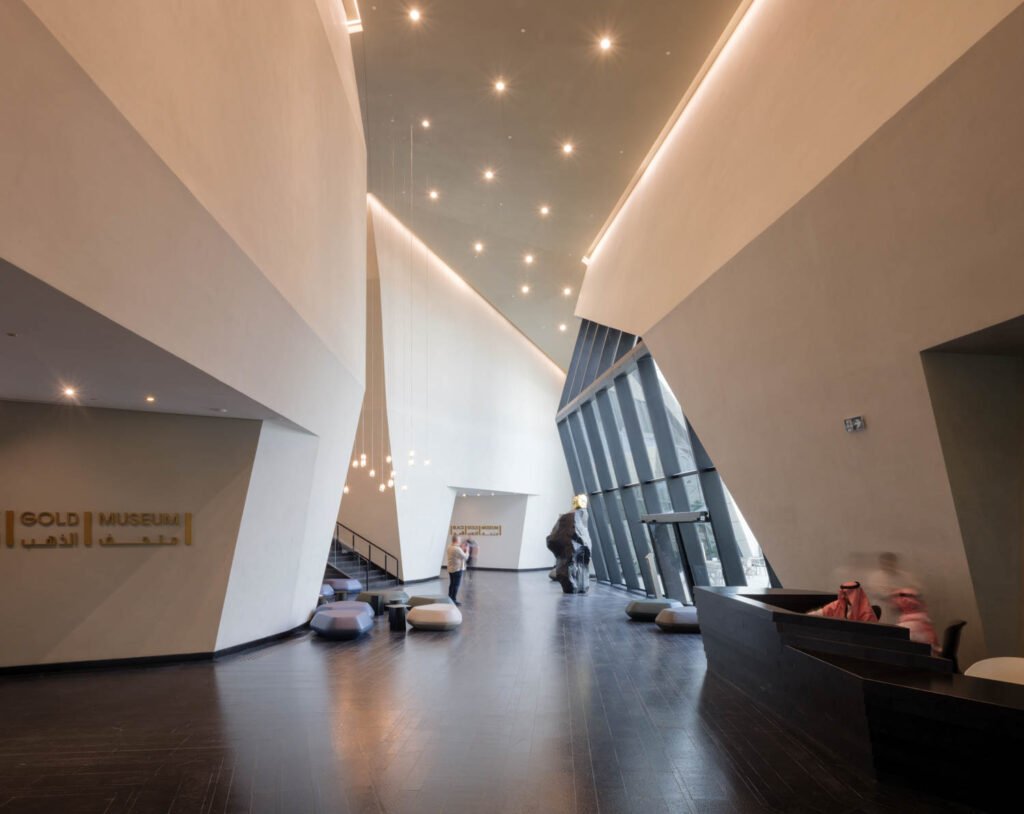
Much like the story of oil, the idea of transformation and regeneration forms the core of the London-based architect’s practice, and instinctively, everything here was rebuilt around what already existed, with only six percent of new structure introduced across the 6,800-square-meter space. Working with the quintessentially Hadid-esque geometries that were originally drawn from biology, snakeskins, leaves, and the repeating patterns of natural organisms might have proven difficult for a museum reliant on straight walls to display works. Kang resolved this by selectively straightening only the interior-facing walls, leaving the striking angularities of the facade and atria intact.
Inside, the once open library was almost entirely reconfigured into a sequence of atmospheric galleries, its original stark white replaced by a far more evocative material world nodding to the layers and expanses of Saudi Arabia’s wadis and canyons. “There’s a kind of tension between the richness and the calm,” Kang says, reflecting on the atmosphere calibrated to slow people down and encourage reflection upon the complexity of the themes they encounter.
To house more than 350 works, the museum is organized around four thematic sections each tracing a different chapter in humanity’s relationship with oil, from its discovery and the era of possibility that it unleashed, through the doubts that came to shadow it, to a vision of what lies ahead. “It’s very exciting that the museum is collecting all of the profound thinking that artists have explored over these decades about humanity’s relationship with oil and energy, and where we’re all going,” says Kang.
Walk Through The Black Gold Museum
Source: https://interiordesign.net