

The Edith Farnsworth House, in Plano, Illinois, is famous as a pristine, silent, perfect object. But in reality it has always been a leaky, gendered, and contested mess. New York architect Nile Greenberg has decided to turn the volume up.
Architecture of Noise, his exhibition there, opened on April 19. It’s the final project of his 2025–26 Douglas A. Garofalo Fellowship at the University of Illinois Chicago, a nine-month research fellowship at the UIC School of Architecture. The show runs through the house and across the lawn in a five-part argument: Mies van der Rohe’s glass house was never silent. The noise was inside the building the whole time.
Mies designed the house between 1946 and 1951 as a weekend retreat for Dr. Edith Farnsworth, a Chicago nephrologist. One room, all glass, raised on stilts in a floodplain along the Fox River. It’s the picture of midcentury modernism in every architecture textbook, less is more compressed into a single buildable diagram. It also floods, boils in summer, and ended in a lawsuit between Mies and Edith. The National Trust formally renamed the house for her in 2021, after fifty years of people assuming she was a man, a Mies invention, or both.
Greenberg, a founding partner of the New York firm Abel Nile New York and architecture editor at The Brooklyn Rail, has been thinking about that gap for a while. His thesis comes wrapped in a German word: gesamtkunstwerk, total work of art. It’s the modernist fantasy of a building as a sealed, controlled object where the architect designs everything down to the doorknobs and the dining chairs. Mies was a gesamtkunstwerk guy. And so is Greenberg, as it turns out.
Here is what’s in the show.
The Counter-cabinet
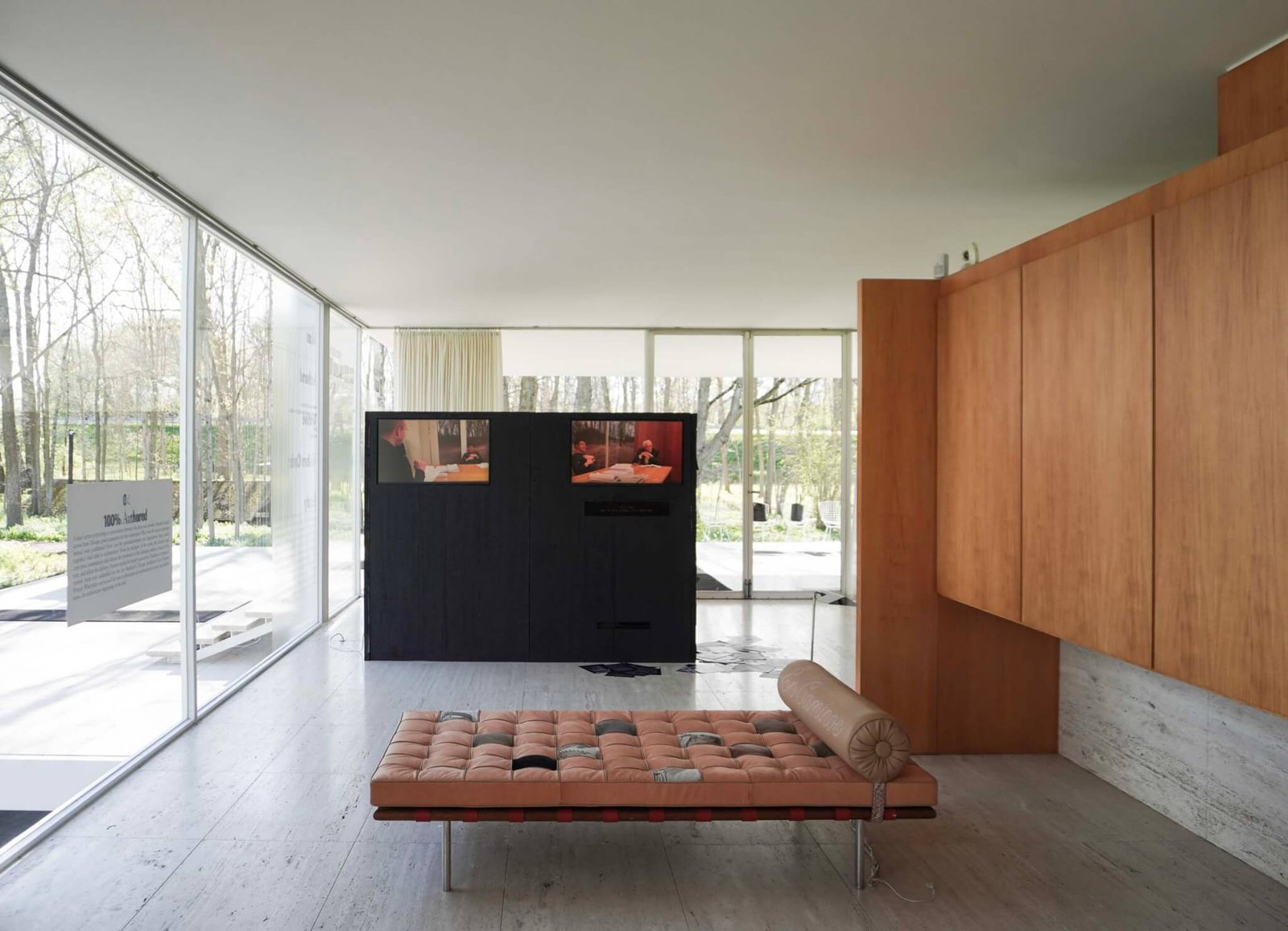
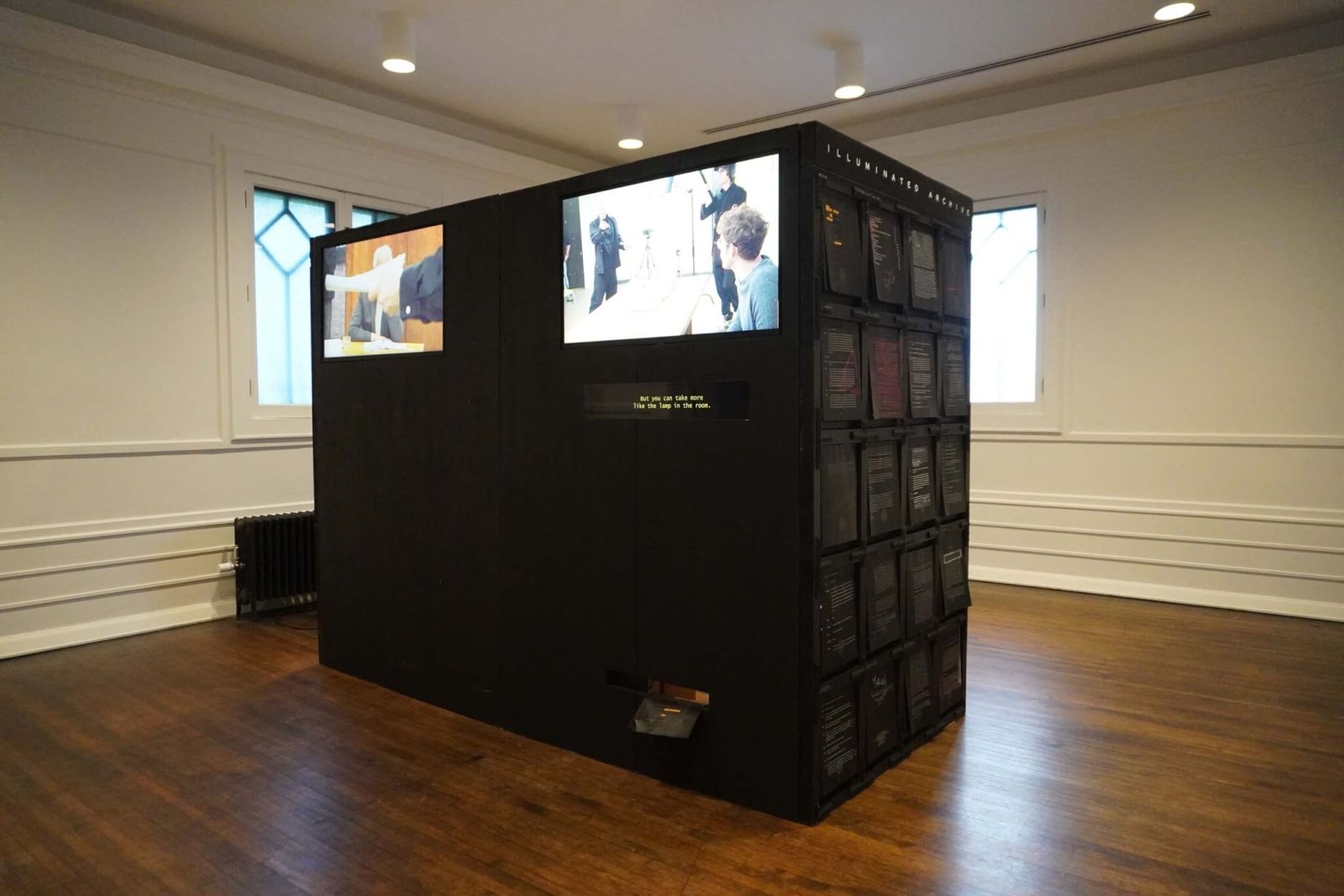
Edith owned one piece of furniture inside the glass box that broke the spell: a wooden cabinet that held her clothes, a speaker, a record player, and a radio. Greenberg has built a black box the same size as Edith’s, sitting right on her dining table. It plays a film on one face and displays a hand-marked archive of 2,000 pages of Chicago architecture history on another.
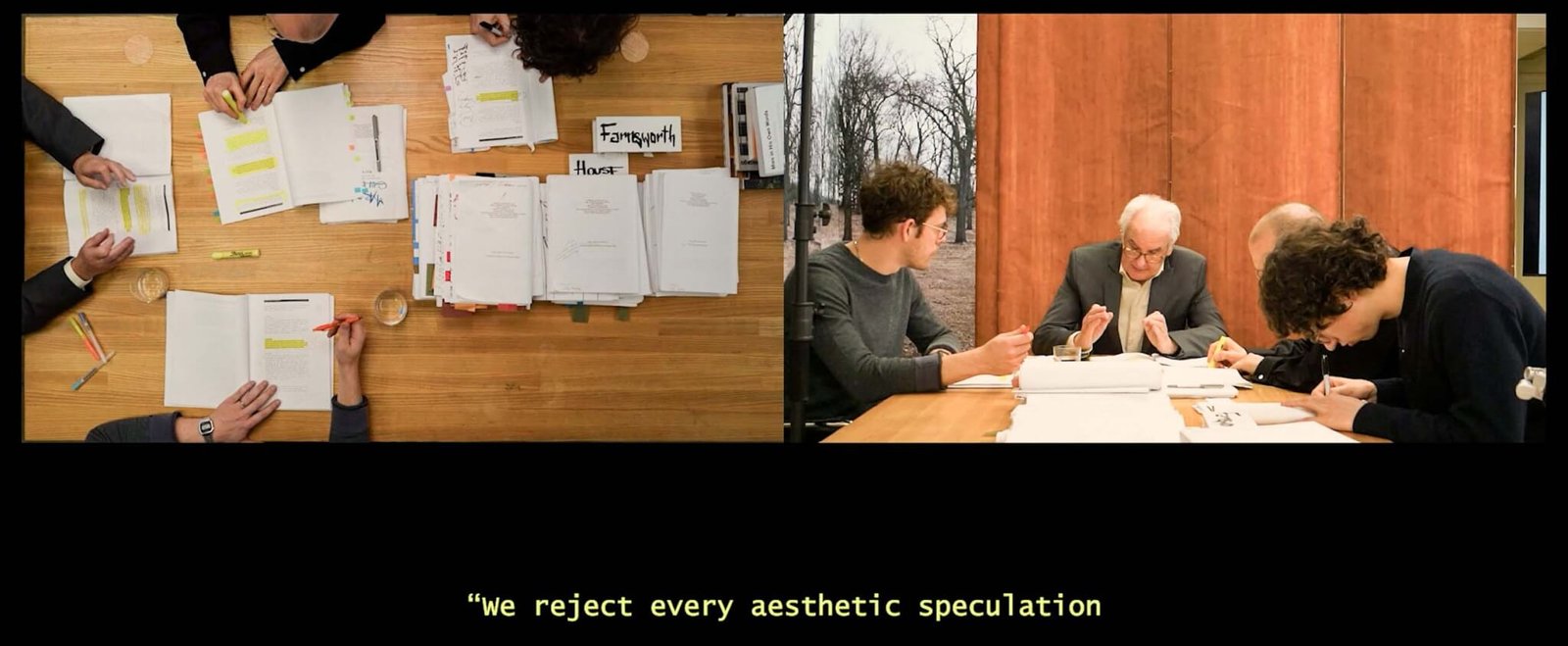
A Film, titled 100% Authored
In the moving picture two actors sit across from one another at a table. One plays “Chicago,” not a real architect but a composite ghost of every great Chicago one, Sullivan and Wright and Mies and Goldsmith collapsed into one character.. The other plays “the Present,” a confused contemporary architect standing in for anyone alive now. They argue, and the title is the joke––the present claims to be authored by no one (everything is supposedly chaotic, decentered, market-driven), and the past claims to be authored by great men (the heroic individual genius architect). Greenberg says both are lies.
The Speculative Mass Dossiers
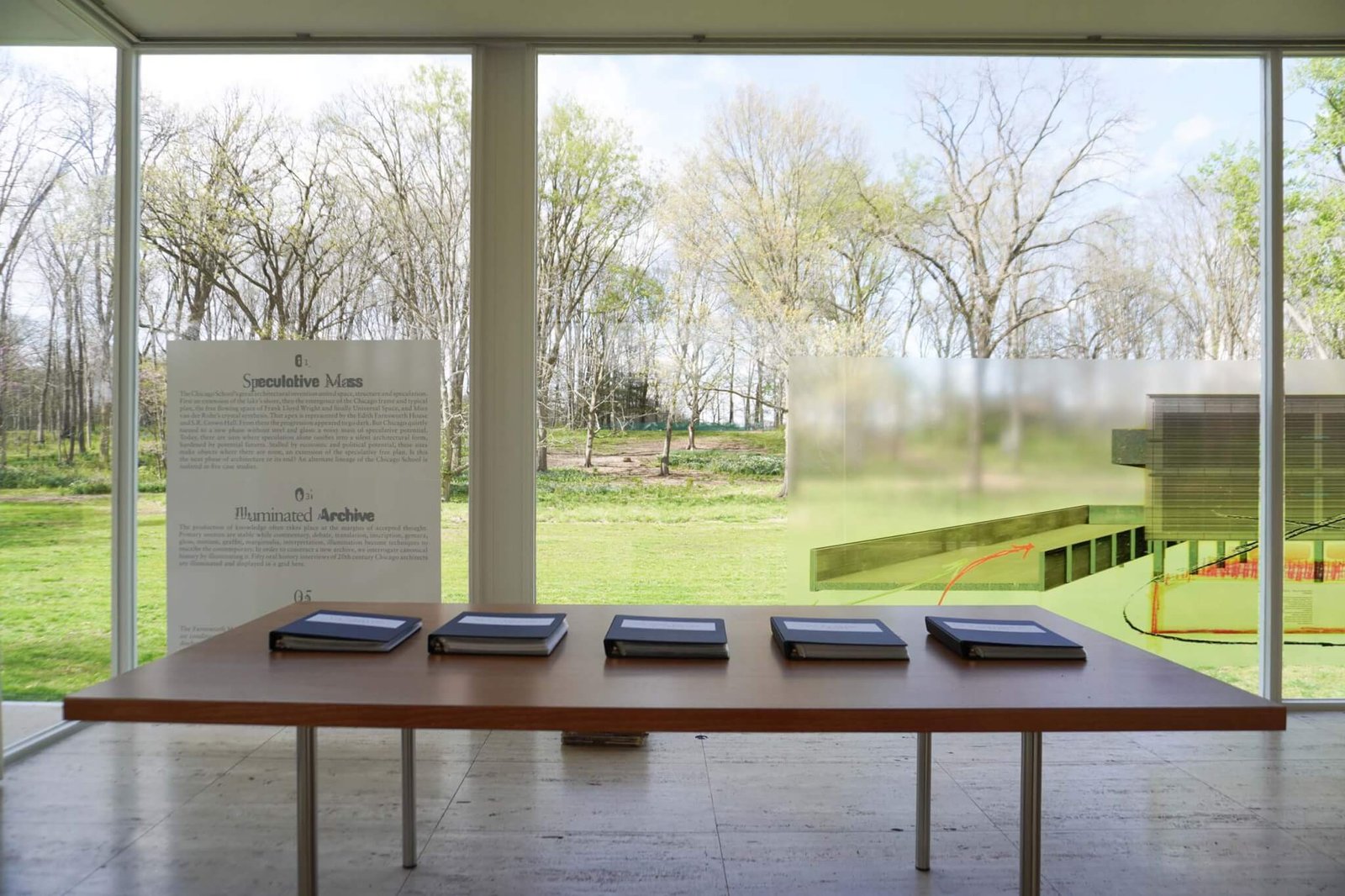
Five black binders are laid out on the dining table, each dedicated to a different Chicago site. Here Greenberg makes his most interesting claim. The Chicago School—Sullivan, the skyscraper, the steel frame, eventually Mies—is usually taught as a story about formal invention: the structural grid, the free plan, universal space, glass curtain walls. Greenberg argues all of it was actually driven by land speculation.
The tall building exists because Chicago land got expensive after the fire. The free plan exists because flexible office space rents better. So the great Chicago invention wasn’t the steel frame; it was the financial bet that produced the steel frame. Speculative Mass is Greenberg’s name for what came next: sites purchased, demolished, fenced off, and held in suspension for decades by stalled deals, zoning fights, and political holdups. The real architecture of late capitalism is the deal, not the building.
A Proposed Visitors Center
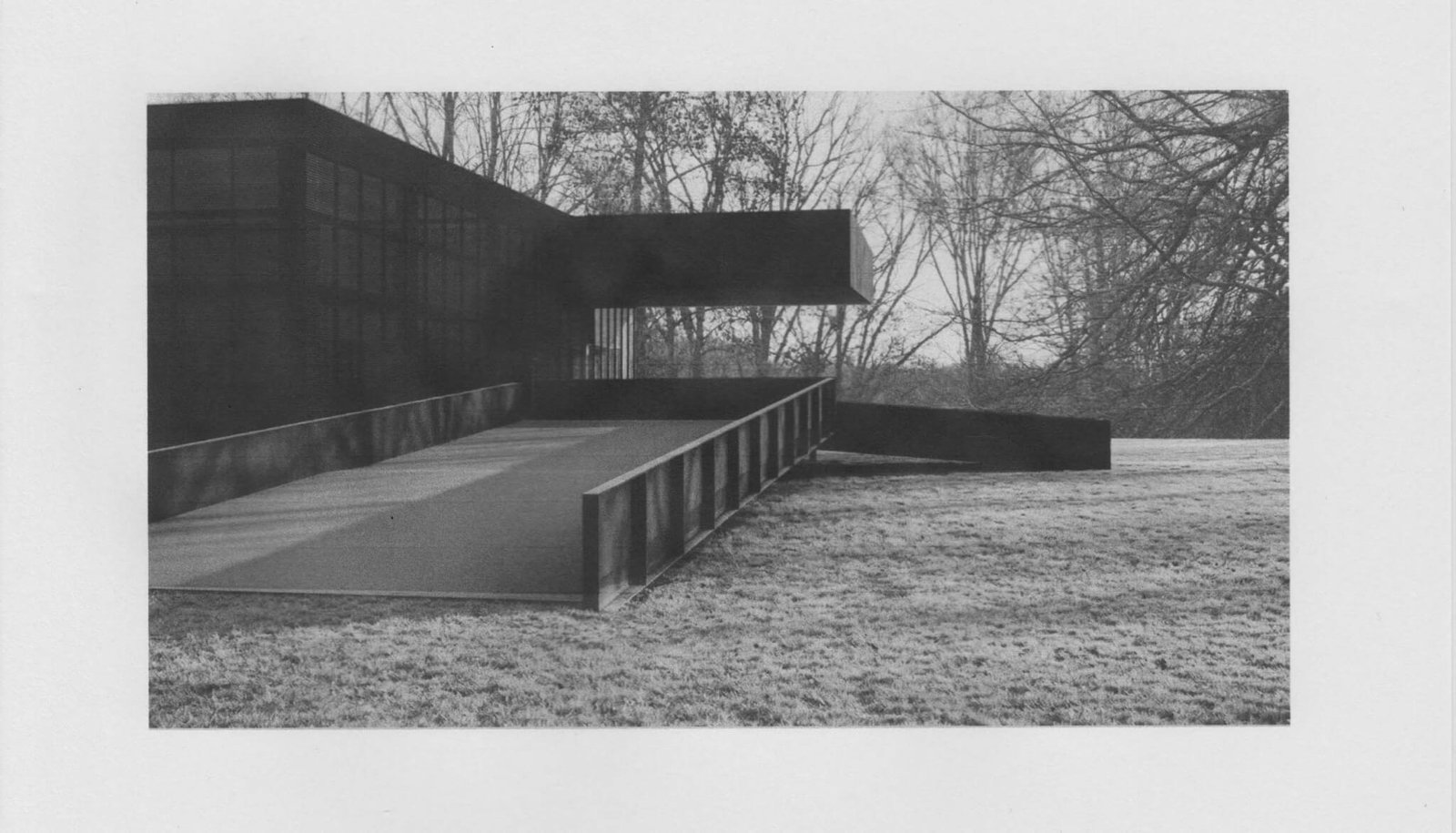
With the National Trust, Greenberg drew up an architectural project, the starting point for the house’s visitors., Like the house, it’s raised on concrete stilts above the flood line, but programmed with ramps, a cafe, an exhibition space, and a gift shop—which is either an intentional punchline or an accidental one.
The Secret Fountain
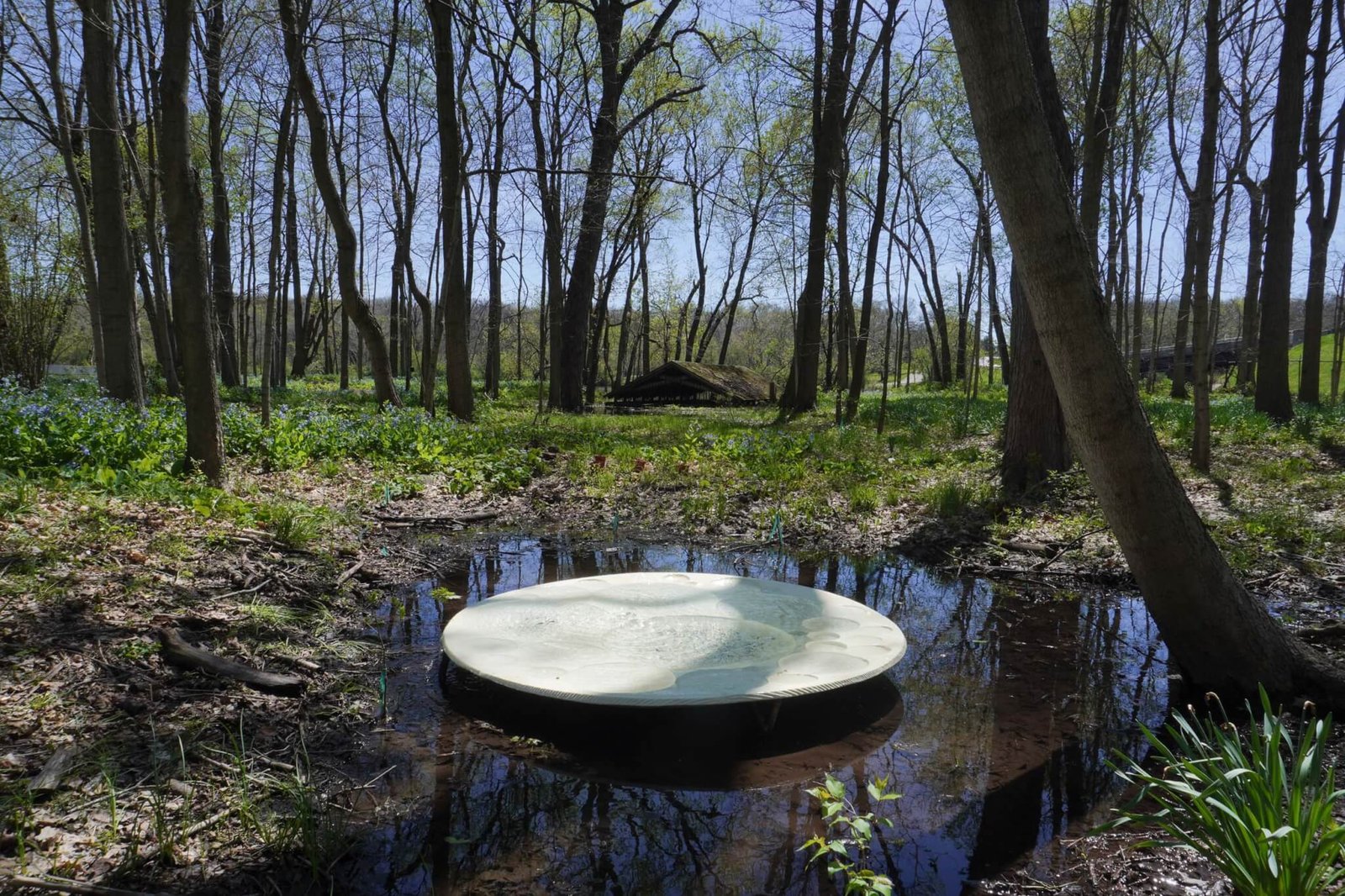
A small white disc set in a marshy clearing behind the house, fed by runoff from the air-conditioning system was added to the glass house decades after it was built, to make summer in Illinois survivable. The disc fills, ripples, and overflows into the marsh. It makes the hidden discharge from cooling the supposedly perfect building visible.
Others Cutting Through the Noise
The Edith Farnsworth House has hosted artists for years, and they tend to fall into two camps. Some have recovered what the house silenced, Nora Wendl refurnished the rooms as Edith actually lived in them, Selva Aparicio honored the maple tree that was cut down because its roots threatened the house’s structural integrity. Others amplified what the house already does, David Wallace Haskins put a reflective glass cube in the woods and a stone monolith by the river, asking us to slow down and look at the sky.
Greenberg is doing something else. He’s not recovering what was silenced and he’s not amplifying what was already there. He says the silence itself was a lie.
The proof was sitting in the house the whole time. Edith’s cabinet was full of radio static, music, and clothes. The air conditioning produces excess water that has to be dumped in a field. Mies’s pure architectural language was made possible by Chicago land speculation, by industrial steel manufacturers, by mechanical systems he politely refused to draw. Even the house’s history (the lawsuits, the affair rumors, the floods, Edith’s erasure) is a kind of noise the building was supposed to keep out and couldn’t.