


On the left bank of the Rhône in Lyon, the riverbanks form a vast crescent covering nearly 10 hectares and stretching over 5 km in length, in the heart of the city. In 2002, the Communauté Urbaine and the City of Lyon initiated a project to reclaim this site to return these former quays, gradually taken over by car parking (1,600 spots), to pedestrian use.

We developed a continuous project that unfolds a ribbon of public spaces and nature along the river’s arc, stretching from the Tête d’Or park to Gerland. Being within the riverbed itself, the site was subjected to flooding rhythms. Consequently, we developed a fluid and dynamic lengthwise design, where various pedestrian and cycle paths diverge, widen or converge, mirroring the Rhone’s characteristic “braiding” phenomenon. These soft mobility paths form a long promenade along the river.
At the foot of the long stone embankment and the row of plane trees on the high quays, the Bas Ports area features highly variable widths (between 5 and 75 m). These arrangements create clearly distinct areas, ranging from the most natural upstream and downstream to the most urban in the central section.
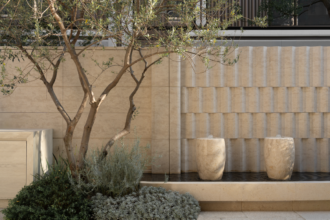
The mooring of the thirty or so boats on site was secured by installing mooring dolphin pillars. These corten steel pillars, sunken into the riverbed, were designed to withstand the Rhone’s violent and sudden floods and act as genuine pieces of street furniture, providing lighting for the docks at night.
Extensive consultation with residents, houseboat dwellers and maintenance services helped to define the purpose and uses of each of the seven sections that follow one another along the course:
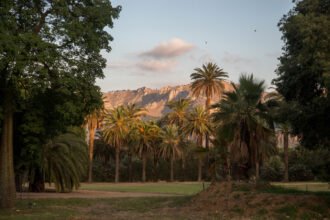
-Upstream, the ‘brétillod’ and riparian vegetation were the focus of ecological restoration work
-Further downstream, planting grassy islands and clusters of willows and poplars created alluvial gardens alongside the inhabited houseboats, all of which have been grouped.-In the central section, where the river is at its widest, the great Rhône meadow offers an open, unobstructed space adjacent to the restaurant boats, where terraces extend. It is also a popular spot for picnics on the grass.
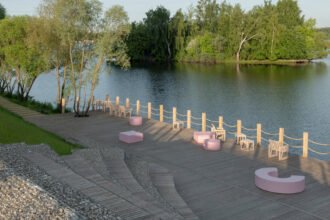
-Just past the Guillotière Bridge, at the heart of the river’s bend, the quayside was redesigned to create spacious, landscaped terraces and tiered seating, overlooking the Rhône, the peninsula and Fourvière. This distinctly urban stretch links the upper quayside with the lower docks. Adjacent to the Rhône swimming pool, sports fields and skate parks reinforce the area’s sporting character.
-The jetty at the water sports centre was extended by a long cantilevered deck over the river.
-The University Harbour accommodates cruise ships. Planting three rows of oak and elm trees created a long tree-lined esplanade, whilst boules courts and a street workout area offer further uses.
-Downstream, the existing quay, barren and concrete-bound, underwent a major riverbank restoration project. Installing green corridors created a botanical walkway that reflects the diverse ecosystems of the Rhône region.
This ‘promenade park’ is a course that links various locations and environments running by the river. It is also a multi-purpose area and neighborhood that blends the urban city scale with that of the neighborhoods it passes through, offering spaces for events and more intimate places to rest. This flexible yet sustainable project also incorporated a long-term maintenance and management strategy for the different spaces.
This landscape has become a wonderful, bustling place to live, a space for movement but also an unmissable meeting place where people gather on the grass.
“Under the cobblestones, the beach” … Beyond the many uses on offer, we city dwellers also need places of freedom that are not landscaped.
Counts carried out a few years ago also show ever-increasing visitor numbers throughout the year, reflecting the success of this project, which has largely “paid for itself”.
The flooding constraints, which effectively prevented installing low-lying areas and fences, also made creating very fluid and open spaces possible. These spaces offer a home to wildlife – the non-human inhabitants who must not be forgotten.
It is surprising to note that most current users have forgotten the river of cars that occupied the area for some fifty years. It would now, however, be advisable to renew and supplement certain plantings to provide more shade and help mitigate ongoing climate change. This simple, fluid design allows for this evolution over time.
Client: Greater Lyon, Public Spaces Department
Lead Landscape Architect: InSitu Paysages et urbanisme
Architect: F. Jourda
Lighting Designer: Les Eclairagistes
Quantity Surveyor: GEC Rhône Alpes
Civil Engineering Consultant: Sogreah
Landscape Architecture Consultant: Biotec Berges
Structural Engineering: Agibat
Soil and Landscape Engineering: Sol paysage
Photographers: IN SITU / Margerie Alavolee / Karolina Samborska
45.75702209028733, 4.840197561772831