

本文由 平介设计+上瑞元筑 授权mooool发表,欢迎转发,禁止以mooool编辑版本转载。
Thanks Parallect Design + s5 design for authorizing the publication of the project on mooool, Text description provided by Parallect Design + s5 design.
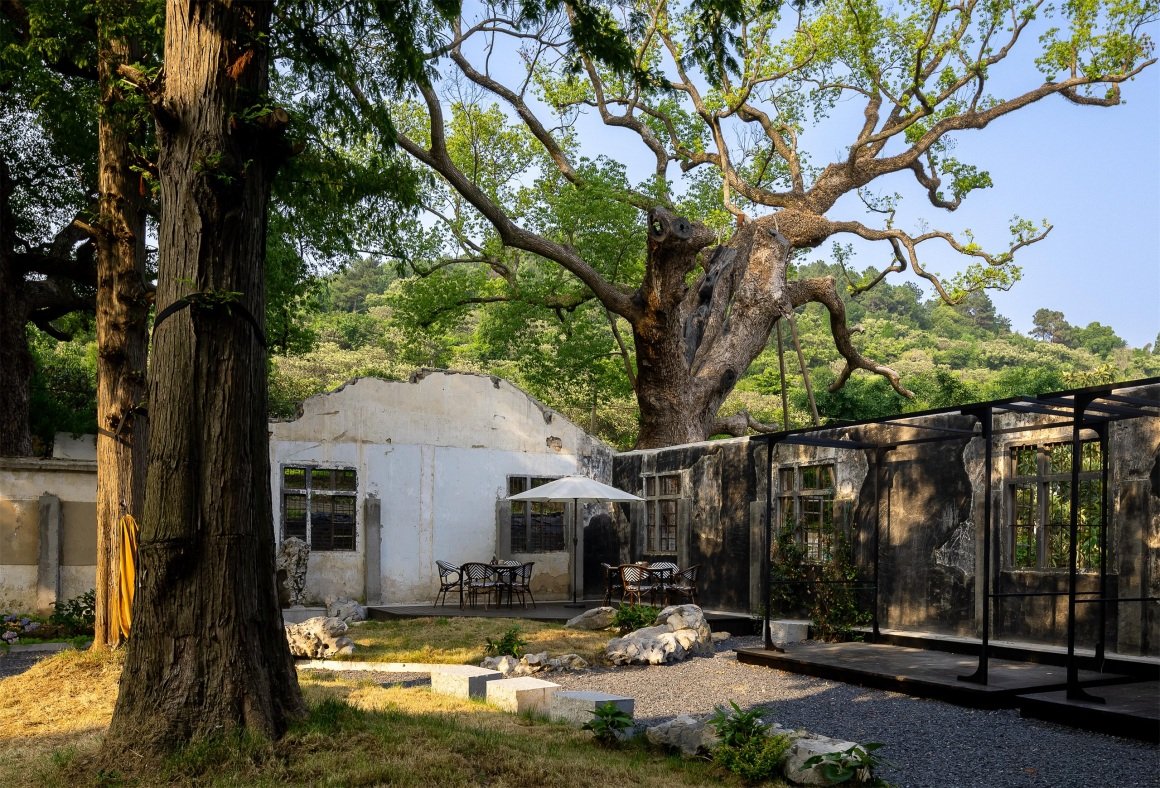
平介设计+上瑞元筑:建筑占地约1.5亩,房屋面积600平方米,是一个本土合院式建筑,目前处于废弃状态。由于年久失修,旧有砖混结构房屋的屋面、横梁、内墙已经大面积坍塌,存在一定程度的安全隐患。房屋外墙由于采用西山传统的石砌基础,只有局部破损,整体较为完整。在合院内庭有四棵高大挺拔的水杉,合院墙外有五棵生长期约500年的古樟,被列为国家一级保护古树,是当地人纳凉、闲聊的好去处。
Parallect Design + s5 design: The site currently covers an area of about 1.5 mu (approximately 1,000 square meters), with the building occupying 600 square meters. It is a local courtyard-style structure that is now abandoned. Due to years of neglect, the roof, beams, and interior walls of the old brick-and-mortar structure have largely collapsed, posing some safety hazards. However, the exterior walls, built with traditional stone foundations from Xishan, remain mostly intact, with only partial damage. Within the courtyard, there are four tall and straight metasequoia trees, and outside the courtyard walls, there are five ancient camphor trees, approximately 500 years old, listed as national first-grade protected ancient trees. These trees provide a popular spot for locals to cool off and chat.
▽建筑位置,architecture position

▽建筑鸟瞰,Bird’s-eye view

设计定位 Design Positioning
五樟庭的名字也因场地而得名。项目的意义是以记忆与场地为基础的。历史、当下与未来之间的并置探讨,并不只是对废墟与新生的考量,而是一种重叠与重构。当新的变旧(废弃的村塾小学),旧的消融进时光(老的服装厂外墙),更新的(五樟庭文化会客厅)又再会出现后,此时的新旧又是怎样的一种姿态,这便是这个项目的挑战。设计基于苏州的江南水乡村落文化与古典园林文化特点,尊重历史、融入当地、传承文化、创造价值,打造西山地域文化传承与发展的乡村会客厅。
The project is named “Five Camphor Courtyard” after the site. Its significance is based on memory and the site itself. The juxtaposition of history, present, and future involves more than just considerations of ruins and renewal; it is about overlap and reconstruction. As new becomes old (the abandoned village school), and the old merges into time (the old garment factory walls), the newer (the Five Camphor Courtyard Cultural Salon) will reappear. This raises the challenge of the relationship between the new and old. The design is based on the characteristics of Jiangnan water village culture and classical garden culture in Suzhou, respecting history, integrating into the local context, inheriting culture, and creating value, to create a rural salon for the inheritance and development of Xishan’s regional culture.
▽建筑夜景,night view


设计策略 Design Strategy
记忆是乡村项目里的文化话题。乡村项目里总讨论文化传承,修复传统建筑保留其外壳或许是保留了物质遗产,但非物质的记忆或许更加需要被延续。乡村未来或许会进入预制化建造、节能环保、社区集中规划等自上而下的建设模式,但同质化、产品化是需要警惕的。因地制宜,制造差异化生活方式的场所,或许是这个项目能够实现的一个探索策略。
Memory is a cultural topic in rural projects. While discussing cultural heritage and restoring traditional buildings to preserve their shells may retain tangible heritage, intangible memories might need more attention. The future of rural areas might see prefabricated construction, energy conservation, environmental protection, and top-down community planning, but homogenization and commercialization are risks that need vigilance. Adapting to local conditions and creating places for differentiated lifestyles could be a strategy for this project.
▽庭院东侧,East side of the courtyard

▽树枝伸到院子,The branches overhang the yard

▽庭院景观,courtyard landscape


▽院中茶台,Tea table in the courtyard

老墙、古樟、圣堂寺旧址、服装厂、村属小学等要素叠加起来是一代代西山人的文化记忆。旧有建筑虽主体结构坍塌但是围墙基本完整,且在百年古樟的掩映下极具地域特色。与现状互动,在任何建筑中都是极其重要的。场地自有气场,在丰富的现状条件下做建筑是令人欣喜的,周边的道路、古树、老墙、太湖、山等都被考虑在设计中,从而打造出属于这个地域适合的建筑。基于老房子的现状与场地的文化记忆,设计采取保留老墙、内部新建的设计策略。从老墙里生长出具有苏州传统民居特色的新建筑。
The elements such as old walls, ancient camphor trees, the site of the Sheng Tang Temple, the garment factory, and the village school collectively form the cultural memory of generations of Xishan people. Although the main structure of the old buildings has collapsed, the surrounding walls are mostly intact, and the century-old camphor trees lend significant regional character. Interaction with the existing state is crucial in any architecture. The site’s unique atmosphere, along with the surrounding roads, ancient trees, old walls, Taihu Lake, and mountains, are considered in the design to create a building suitable for this region. Based on the current state of the old house and the site’s cultural memory, the design adopts a strategy of retaining the old walls while constructing new interiors. The new buildings will grow from the old walls, embodying the traditional residential characteristics of Suzhou.
▽老墙新生,old wall and new building

▽老墙新生,old wall and new building

▽加固后的老墙,The reinforced old wall


设计说明 Design Description
将新的建筑内退为老墙加固提供条件;北侧靠近古樟的部分完全退让满足古树保护要求并留出庭院空间让来客可以感受古樟之美;南侧靠近太湖部分设两层层高以观太湖美景;为守住庭院中四棵挺拔的水杉保留了旧有建筑的合院,根据建筑使用需求植入一字型体量并采用折形屋面建立整个建筑的形式契合江南水乡特色,整个建筑以谦恭的姿态融入老墙、古樟与村落。
The new building is set back to provide conditions for reinforcing the old walls. On the north side, near the ancient camphor trees, the building is entirely set back to meet the protection requirements of the ancient trees and to create courtyard space for visitors to appreciate the ancient camphor trees. On the south side, near Taihu Lake, the design includes a two-story height to capture views of the lake. To preserve the courtyard with the four tall metasequoias, the old courtyard structure is retained, and a linear volume is inserted according to building usage needs, with a folded roof to match the characteristics of Jiangnan water towns. The new building integrates humbly into the old walls, ancient camphor trees, and the village.
▽老墙和新生的建筑,Bird’s-eye view


为了减少开挖深度影响古树根系,建筑采用筏板基础并高于原有地面三个阶梯高度,一定程度实现了防潮功能。建筑与老墙脱开最少处六十公分的距离,一方面保证新建建筑筏板基础与原有老墙加固的基础互相脱开,同时保证施工作业的空间,另外也是我们对历史的尊重与致敬;一层内部有窗户,建立起与原有风化残破的砖墙的联系。建筑采用反梁结构,保证二层空间室内在混凝土脱模后呈现完整的素模折面效果。
我们基于古树保护要求,保留院内的水杉及在硬化基础上设置休息区,供人们休息和活动。新建的建筑皆采用白色艺术外墙漆和深灰色铝镁锰屋面,以当代的方式回应江南水乡的粉墙黛瓦。
To minimize excavation depth and avoid damaging the roots of the ancient trees, the building adopts a raft foundation elevated by three steps above the original ground level, which also provides some moisture-proofing. The new building is separated from the old walls by at least 60 centimeters to ensure the new raft foundation and the reinforced foundation of the old walls do not interfere with each other, providing construction space and showing respect for history. Windows are included in the interior to connect with the weathered brick walls. The building uses a reverse beam structure to present a complete concrete folded surface effect on the second floor after the formwork is removed.
Based on the requirements for protecting the ancient trees, the metasequoias within the courtyard are retained, and hardening of the foundation is carried out to create a rest area for people to relax and engage in activities. The new buildings use white artistic exterior paint and dark gray aluminum-magnesium-manganese roofing, responding to the white walls and black tiles of Jiangnan residences in a contemporary way.
▽二楼窗外,Second story window

▽保留的院内水杉,Reserved Metasequoia in the courtyard


▽庭院,courtyard


在室内空间上,一体浇筑的混凝土反梁让二层空间获得更大的挑空并且不再需要额外的装饰,一层空间则保留裸露的混凝土结构营造乡野空间的朴素感。基于这样“诚实的”建构裸露效果,空间内的空调则放置在飘窗下方进行侧出风的设计,同时照明则是叠加了一个老木梁的装饰构件弱化”灯具”的装饰性。
In the interior space, the concrete inverse beam cast in one piece allows the second floor space to gain more space and no additional decoration is needed, while the first floor space retains the exposed concrete structure to create a simple sense of rural space. Based on this “honest” architectural exposure effect, the air conditioning in the space is placed under the bay window for side air design, while the lighting is superimposed with an old wooden beam decorative component to weaken the decoration of the “lamp”.
▽室内空间,interior


▽一层空间氛围,First floor space atmosphere

▽挑空楼梯间,Empty the stairwell

▽包间,compartment

古树往往具有独特的场域感,当这个具有历史记忆属性的建筑和五棵古树并置时,创造了不同场域的交叠,因而产生了更多趣味性的空间,这种由并置而产生的交集传达了不同历史记忆的关系,也是一种建筑与环境间的关系。而选择以退让的处理方式(退在老墙内,退到树荫外),一方面是对历史和环境的尊重与保护,同时也意在弱化新建建筑的形式感,使其外部简单化而增强内部空间的多样性,以趋于景观化的姿态融在历史和环境中。
Ancient trees often have a unique sense of place. The juxtaposition of this historically memory-rich building and the five ancient trees creates an overlap of different spaces, generating more interesting spaces. This intersection conveys relationships between different historical memories and reflects the relationship between architecture and the environment. The choice to set back (within the old walls, outside the tree shade) shows respect and protection for history and the environment, while also aiming to weaken the formality of the new buildings, simplifying their exterior while enhancing the diversity of the interior space, integrating the buildings into the landscape with a humble posture.
-
▽南立面的老墙和新墙,old facade and new facade at south side
© 王尚 ▽建筑鸟瞰图,Bird’s-eye view
©卢小平 ▽夕阳下的建筑,building under sunset
©卢小平


▽日落时刻,Sunset time

▽总平面,Plan

▽一层平面,1F Plan

▽2层平面,2F Plan

▽轴测爆炸图,Axonometric explosion pattern

▽剖透视图 Profile view

▽剖面图,Section

项目名称:五樟庭文旅生活馆
设计年份:2021.06-2023.01
设计团队:
上瑞元筑:郑鑫旸,洪晨建,梁科程,白翔文,费宁,吕恺
平介设计:吴斯,景万谦,李宗键,肖明峰,吴江,王海东,李文靖
苏州大学:杨楠,肖湘东
江南大学:孟磊
业主:苏州金满庭现代农业发展有限责任公司,苏州五樟文化管理有限公司
策划团队:昊骐品牌运营管理(苏州)有限公司,苏州不多酒店管理有限公司
项目地址:江苏省苏州市金庭镇东村村张家湾
设计面积:1000㎡
摄影师:卢小平,王尚,王召楼(它集空间视觉)
合作方:苏州六度建筑设计研究院,上海衡泰建筑设计咨询有限公司,上瑞元筑
材料:铝镁锰板、混凝土、真石漆
Project name: Five Camphor Courtyard
Design year: 2021.06-2023.01
Design team:
S5 Design: Fei Ning, Lu Kai, Zheng Xinyang, Hong Chenjian, Liang Kecheng, Bai Xiangwen
Parallect design: Wu Si, Li Zongjian, Xiao Mingfeng, Wu Jiang, Wang Haidong, Li Wenjing
Soochow University: Yang Nan, Xiao Xiangdong
Jiangnan University: Meng Lei
Owners: Suzhou Jinmanting Modern Agriculture Development Co., Ltd., Suzhou Wuzhang Cultural Management Co., Ltd.
Planning team: Haoqi Brand Operation Management (Suzhou) Co., Ltd., Suzhou Buduo Hotel Management Co., Ltd.
Project location: Zhangjiawan, Dongcun Village, Jinting Town, Suzhou City, Jiangsu Province
Design area: 1000 m2
Photographer: Lu xiaoping, Wang Shang, Wang Shaolou
Partners: Shanghai Hengtai Architectural Design Consulting Co., Ltd., Suzhou Liudu Design Institute, s5 design
Material: Aluminum magnesium manganese plate, concrete, real stone paint
“ 老宅新生下的乡村会客厅。”
审稿编辑 Maggie
更多 Read more about:平介设计 Parallect Design
Nguồn: mooool