

Flow at Dusk is a built landscape project located in the Plakias region of Rethymno, Crete, Greece. Completed between 2020 and spring 2021, the project covers approximately 2,226 m² on a hillside at an elevation of 82-91 meters above sea level, overlooking the dramatic landscape of southern Crete with panoramic views across valleys, olive groves, rocky hillsides, and the Libyan Sea.
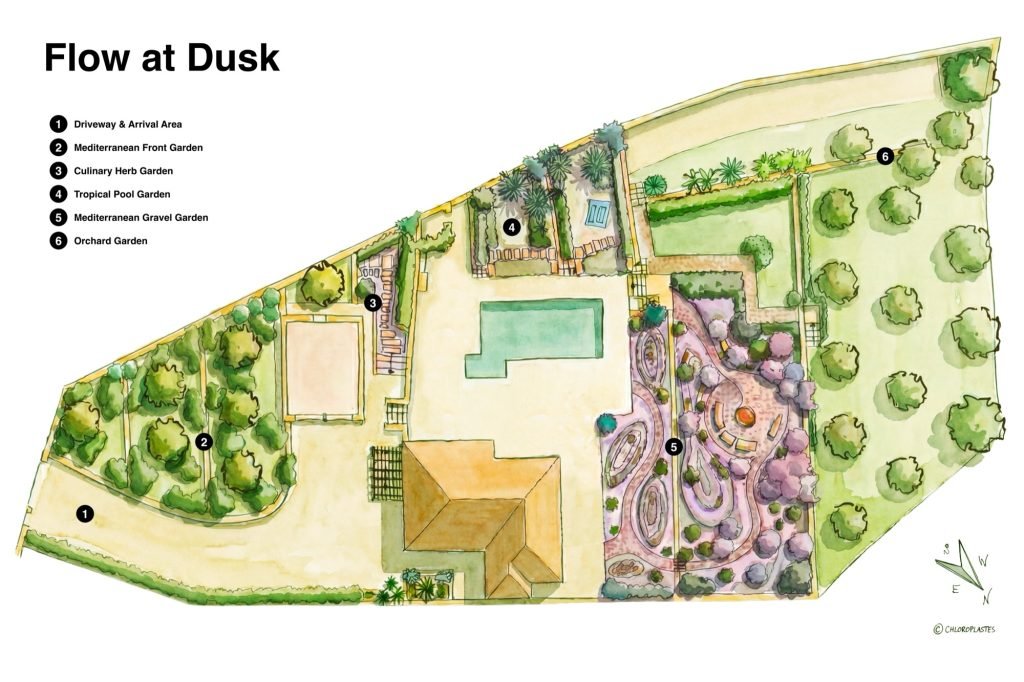
The project which was once a monotone lawn garden, began with a complex design challenge: to fulfill the client’s desire for a natural Mediterranean garden that would remain visually lush and fresh throughout the dry summer months, while simultaneously creating a landscape that is environmentally responsible and deeply connected to its surroundings.
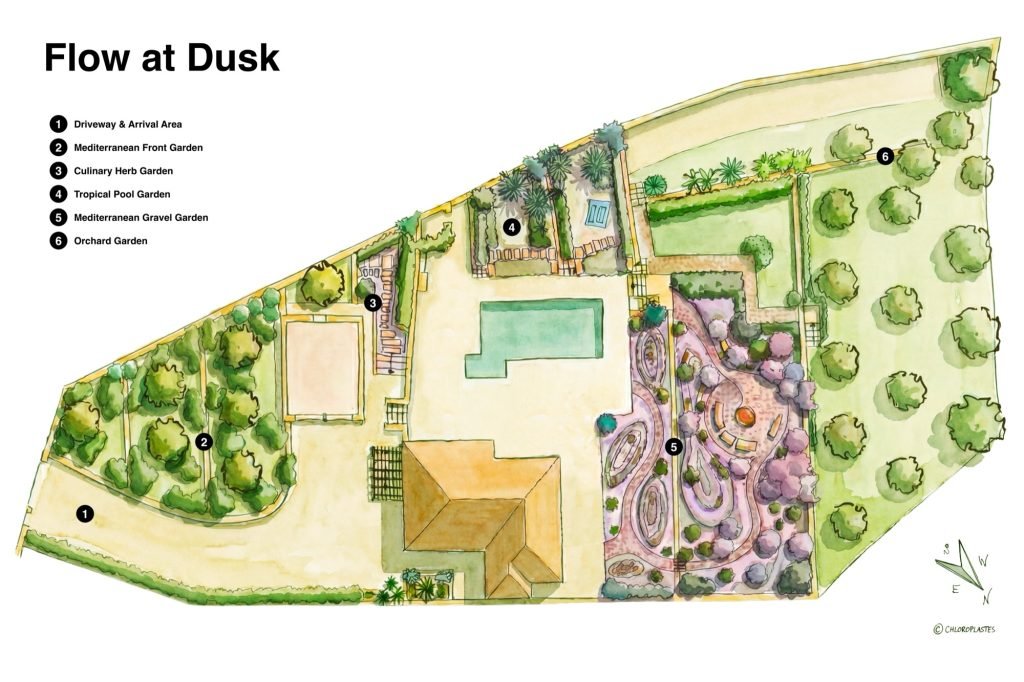
The site itself presented significant topographical and climatic constraints. From the entrance at the upper boundary, the land descends continuously toward a natural water-bearing trench at the lower edge of the property, while the house and garage are positioned at the center of the site. In addition, the exposed hillside is subject to extreme seasonal downslope winds, making plant selection, spatial organization, and microclimatic design particularly demanding.
Although the garden had already been divided into distinct spatial zones, the landscape design redefined each area with a clear identity, function, and planting character.
At the upper boundary, a white flowering oleander hedge creates privacy from the neighboring semi-detached property while establishing an elegant and welcoming entrance sequence. The sunken entrance courtyard is planted with sculptural succulents that emphasize the architectural threshold and create a calm arrival atmosphere.
Six mature olive trees were introduced near the upper entrance and underplanted with a Mediterranean flowering meadow that creates seasonal dynamism and establishes an immediate connection to the surrounding agricultural landscape. Adjacent to the garage, a sheltered corner accommodates a lemon tree and a small herb garden planted with native thyme, introducing productive elements into the daily life of the residents.
South of the pool, a recreational green area with Mediterranean lawn alternatives was combined with lush flowering species with subtle subtropical characteristics, responding directly to the client’s desire for a fresh summer atmosphere while remaining spatially contained.
The main garden norththwest of the house forms the emotional and spatial centerpiece of the project. Here, the surrounding landscape was abstracted and reinterpreted through softly modeled hills that mirror the wider topography of southern Rethymno destrict. Their upper slopes were planted with native and endemic species, including Ebenus cretica, Lomelosia minoana and Phlomis lanata, reinforcing the project’s strong ecological identity and celebrating local biodiversity.
Along the lower pathways, a targeted ring irrigation system supports carefully selected flowering and evergreen species that maintain visual freshness during the peak summer months. This strategy responds directly to the surrounding landscape conditions, where the nearby watercourse creates a naturally green corridor through an otherwise dry environment. Rather than opposing this context, the garden extends and interprets it.
Standing or sitting within the main garden, visitors experience an intentional sense of immersion – as if being visually pulled into the surrounding landscape. The design carefully frames long views toward the Libyan Sea while dissolving the boundaries between private garden and wider territory.
At the lowest part of the site, near the trench, a productive orchard garden with edible olives and fruit trees references traditional Cretan agricultural landscapes and creates a meaningful connection between contemporary living and regional land-use traditions.
The project demonstrates that sustainability does not require aesthetic sacrifice. Instead of replacing one resource-intensive garden model with another, it develops a nuanced landscape strategy that balances ecological responsibility, seasonal beauty, user comfort, and strong spatial storytelling.
Flow at Dusk merits recognition in the Built Landscapes category because it redefines what contemporary Mediterranean residential landscapes can be: climate-responsive, biodiverse, emotionally immersive, and deeply rooted in place. It transforms a conventional private garden that was once dominated by lawn into a layered landscape experience where design enhances – not competes withthe powerful beauty of Crete’s natural environment.
Project Credits:
Designed and constructed by Landscape Architecture Chloroplastes