
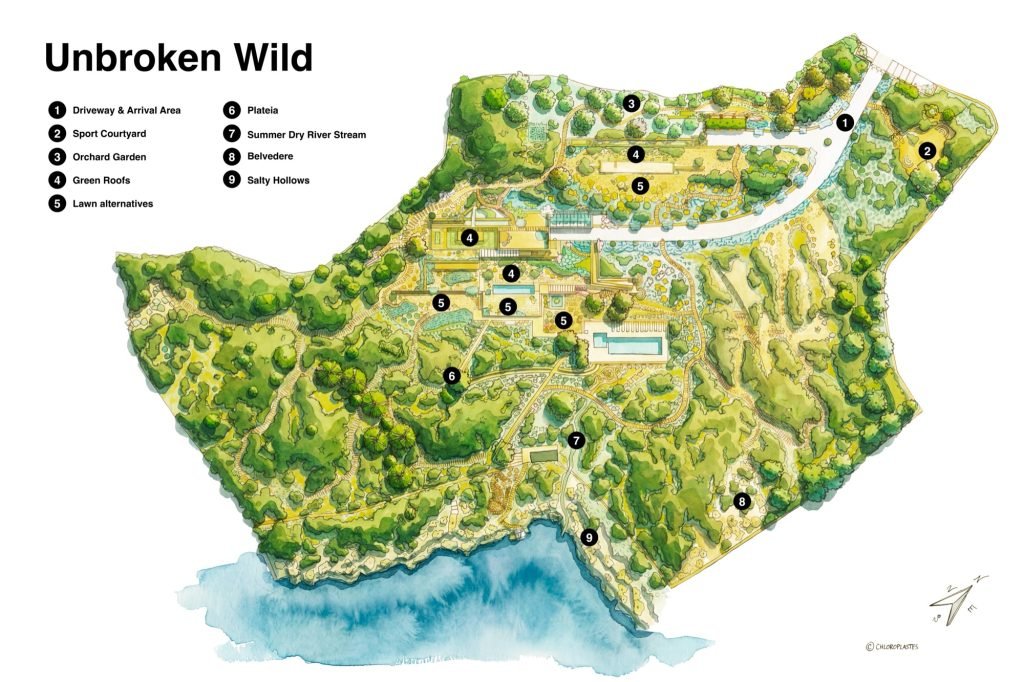

Unbroken Wild is a large-scale landscape project, located on the coast of Western Crete, Greece. Developed between 2020 and 2023 in two phases, the project spans approximately 40,000 m² across a dramatic coastal site rising from sea level to 35 meters in elevation, with panoramic views toward the Cretan Sea and the White Mountains.
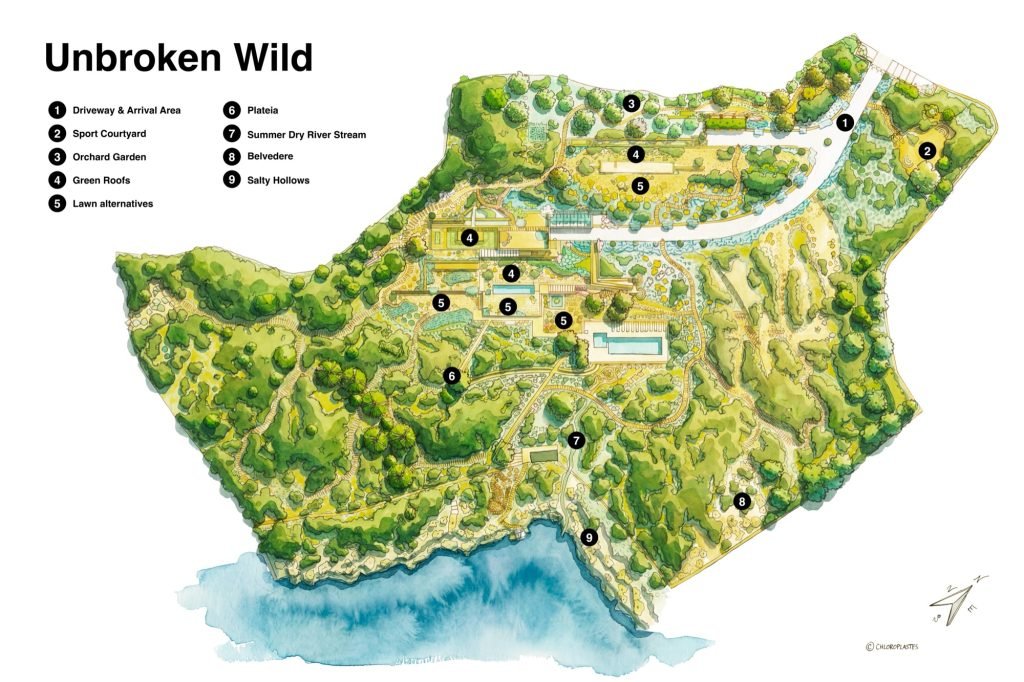
The project was conceived as a seamless dialogue between architecture and landscape. Two earth-integrated cave houses, were carefully embedded into the terrain, while the landscape was developed in parallel to ensure that architecture and nature form one coherent spatial experience. Rather than creating a conventional ornamental garden, the ambition was to shape a contemporary Mediterranean landscape park that feels inseparable from its surrounding environment.
Sustainability was not treated as an additional feature, but as the foundation of the entire design process. Located in a region defined by extreme solar exposure, strong winds, saline air, and annual rainfall of only approximately 330 L/m², the project required a highly site-specific and resource-conscious approach.
From the earliest construction phases, half of the excavated soil generated through the building process was retained and reused on site. Excavated rocks, stones, and large boulders were repurposed to create retaining slopes, rock gardens, and topographical transitions that stabilize the terrain while preserving its natural character. All pathways throughout the garden were constructed entirely by hand using local stone and traditional dry-stone techniques, without the use of cement, significantly reducing the project’s material footprint while reinforcing local craftsmanship.
Preservation and restoration of the existing ecosystem were equally central to the design. Approximately 65% of the original vegetation was carefully preserved during construction. Disturbed areas were re-naturalized using the same native plant communities that originally existed on site. In several cases, plants were specifically propagated from locally collected native seeds exclusively for this project, ensuring genetic adaptation to the site’s climatic conditions.
The planting strategy is based predominantly on native, endemic, and climate-adapted Mediterranean species that require little to no irrigation. Instead of conventional lawns, areas close to the residential terraces were planted with Mediterranean groundcovers and drought-tolerant species. These limited irrigated zones represent only approximately 9% of the entire property and are maintained through an underground irrigation system that reduces water consumption by more than 30%.
The landscape architectural design actively increased the biodiversity by creating year-round habitat and food sources for pollinators, including bees, butterflies, and numerous other beneficial insect species. Seasonal flowering sequences, layered habitats, and resilient planting communities contribute to a landscape that is both ecologically productive and visually dynamic throughout the year.
A technically complex roof garden with over 1.5 meters of soil depth was developed above the residences, involving more than 4,000 m³ of earthworks and further dissolving the visual boundary between architecture and terrain.
The project challenges a dominant model of high-end residential landscapes in Greece, where extensive lawns and water-intensive ornamental planting often define prestige developments. Instead, it proposes an alternative vision: one in which luxury is expressed through ecological intelligence, restraint, authenticity, and a profound respect for place.
Unbroken Wild demonstrates how contemporary landscape architecture can create beauty through restoration rather than imposition. It transforms a fragile coastal site into a resilient, low-water, biodiversity-rich landscape where architecture quietly recedes and nature becomes the primary experience.
Project Credits:
Designed and constructed by Landscape Architecture Chloroplastes