
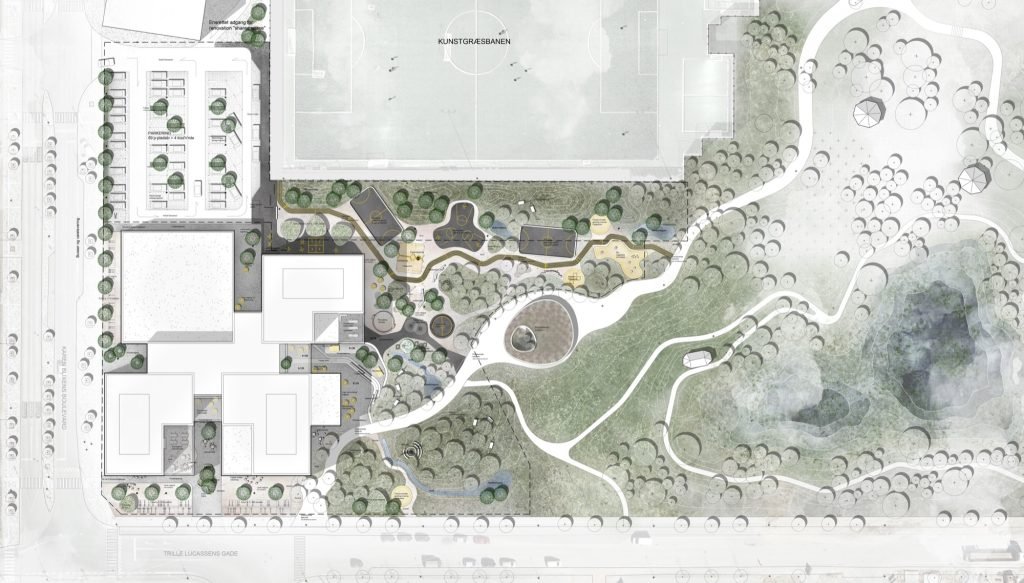

The new Kløverskolen is a unified educational campus distributed across two distinct building plots. The school is accommodating a four-track primary school with integrated after-school facilities (SFO), alongside a three-track lower and upper secondary school with associated leisure and community functions. Located in Gellerup, Aarhus, the project forms an integral part of the Municipality of Aarhus’ strategic urban framework, aimed at transforming the area into an attractive and diverse neighborhood.
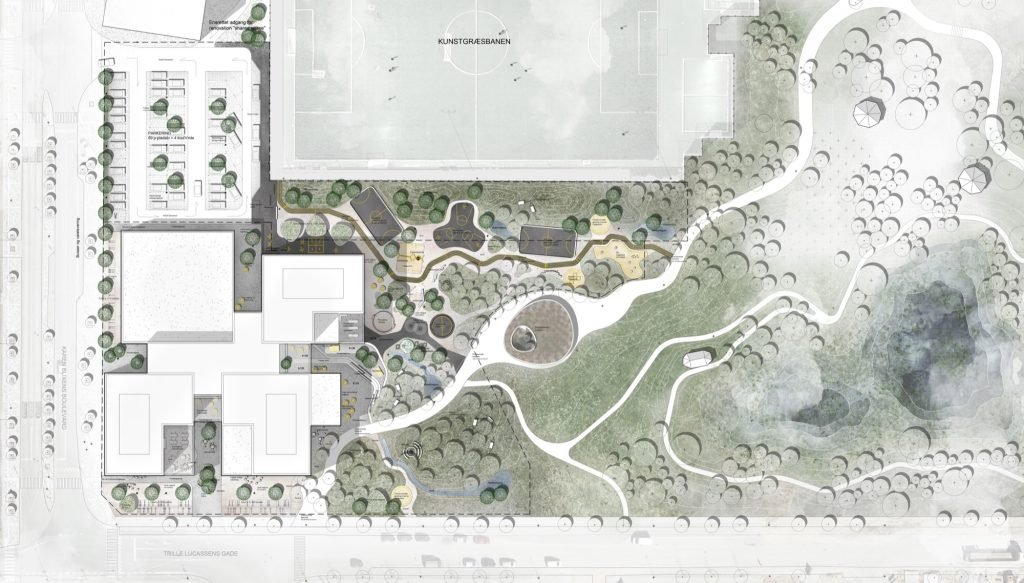
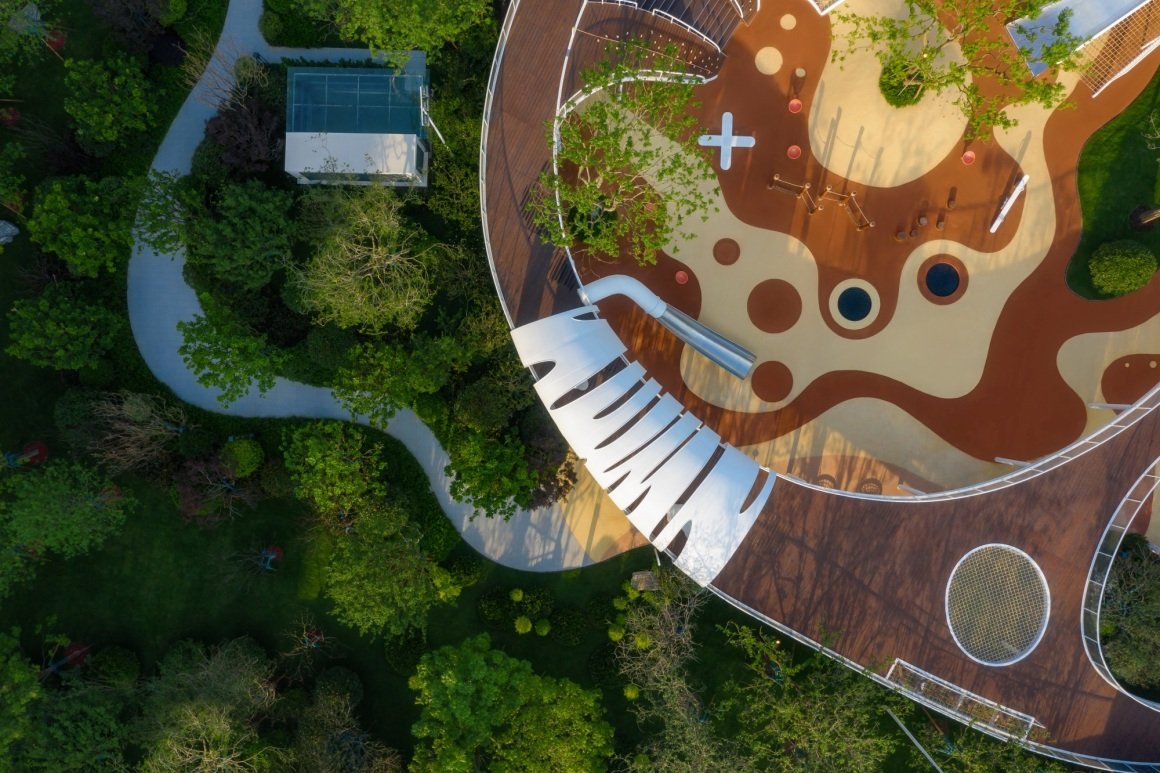
The masterplan of the school and its surroundings is structured around a new connective system of paths that both links and clearly differentiates the site into three principal zones. The first zone is the urban zone defined by infrastructure and access, a sports and cultural campus with associated forecourts and shared facilities. The second zone is the activity zone where most activities of the area are located to foster synergies between school, campus, and informal leisure environments when educational, recreational, and civic functions overlap. The third and last zone is the nature zone characterized by its urban nature and green pockets that support biodiversity and space for people to meet, stay and hang out.
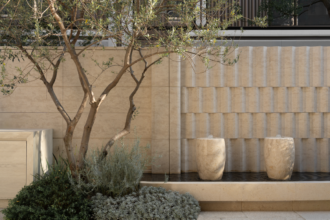
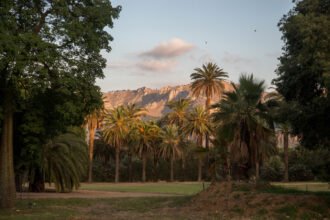
A central architectural ambition is the seamless integration between built form and landscape. The school’s ground floor is an open, permeable interface, visually and physically connected to a series of internal courtyards and the surrounding park. This spatial continuity extends the pedagogical environment beyond the classroom, allowing the park to function as an active learning landscape. The overlap between playground and park generates activity across extended hours of the day, reinforcing a sense of collective ownership and social presence. This, in turn, enhances perceived safety and supports inclusive use of both the school grounds and nearby public spaces.
The project establishes a clear spatial hierarchy that separates vehicular movement from pedestrian domains, ensuring a safe environment. The distinction between the urban edge and the inside landscape is articulated through both planning and architectural expression, creating a coherent transition from city to park.
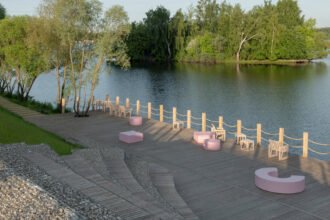
An integrated water management strategy is embedded within the landscape design, reflecting the broader ecological ambitions of the project. Surface water is retained and managed on-site through visible, didactic systems, including shallow swales and linear channels that guide rainwater through the playground and into a series of local retention basins. These elements are designed not only as technical infrastructure but as experiential and educational features, supporting the development of micro- biotopes with aquatic vegetation. The water landscape thereby becomes a resource for play, exploration, and environmental learning, reinforcing awareness of natural cycles and climate-responsive design.
Kløverskolen is designed to meet the DGNB Gold standards, with sustainability principles integrated holistically across technical performance, materiality, and spatial experience. The DGNB standard is not treated as an add-on, but as a generative framework informing both the architectural design and the pedagogical vision. As such, the building and its landscape become active tools in the educational environment, supporting teaching, awareness, and everyday engagement with sustainability.
Credits:
Partners and Collaborators: AART architects, Sweco Danmark, Proces Arkitekter and MT Højgaard.
Pictures: Jacob Christensen, MT Højgaard Danmark AS and VEGA Landskab.
https://maps.app.goo.gl/3vdLcC7zqxKHBKus5