

Heldenplein in Vilvoorde has undergone a complete transformation: from a congested traffic junction and parking area into a green, safe and characterful public space. The introduction of the Ringtrambus created a unique opportunity to combine necessary mobility interventions with an integrated redesign of the square — an approach that not only improves traffic flow, but also enhances liveability and reinforces the identity of this central place.
Located next to the Church of Our Lady of Good Hope, Heldenplein was for many years defined by two busy roundabouts where traffic from the N1 and N211 converged. Public transport vehicles were caught in congestion, while pedestrians and cyclists had little space or comfort. What could have functioned as the civic heart of the city instead lacked spatial quality, clarity and identity.
As part of the redesign, the two roundabouts were replaced by two smart, signal controlled intersections that communicate with each other. This reorganisation distributes traffic more efficiently and creates a safer, more comfortable environment for trambuses, cyclists, pedestrians and cars alike. Where cars once dominated the space almost entirely, the redesign restores balance across the full width of the square. Heldenplein now functions as a fully fledged mobility hub, equipped with generous covered bus platforms and bicycle parking. Waiting and transferring become pleasant daily experiences, embedded within a green and legible public space. Wide crossing zones give pedestrians clear routes, while logically organised cycling paths connect the square seamlessly with the surrounding streets and the city centre, making the shift to sustainable transport intuitive and accessible.
Along the entire Ringtrambus route, stop infrastructure was developed with a clear identity and architectural quality. The shelter system was conceived as a modular structure of extruded aluminium panels, adaptable to the scale and context of each location. At Heldenplein, this translates into an elegant aluminium canopy designed as an urban roof, offering protection from wind and rain while giving the square a recognisable signature. The interplay of daylight and artificial lighting creates a dynamic atmosphere throughout the day and evening, enhancing the experience of public transport and reinforcing the presence of the stop within the square.
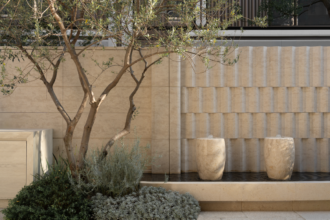
The transformation extends beyond the stop itself. The former grey expanse has been reshaped into a green urban square with additional trees, seating areas and a redesigned setting around the church. The square once again functions as a gateway to the city and as an inviting place to stay, rather than merely a space to pass through.
Greening plays a structuring role in the project and is explicitly designed with the climate of 2050 in mind. A total of 59 climate resilient trees were planted in a range of species and sizes, selected based on research by Wageningen University. By grouping single stem and multi stem trees in compact arrangements, a generous canopy will gradually develop, providing shade, cooling and seasonal variation. De sealing, new underplanting and the preservation of valuable existing trees contribute to a robust and diverse green structure. The redesign also encouraged the City of Vilvoorde to upgrade the adjacent church garden and tree pits, strengthening ecological continuity beyond the project boundary.
Beneath the square, a root friendly structural soil buffers rainwater, promotes infiltration and supports deep root growth, making the planting system resilient to both drought and intense rainfall events. These nature inclusive measures ensure that Heldenplein is not only visibly greener, but also structurally prepared for a changing climate.
Developed within the broader programme ‘Werken aan de Ring’, the transformation of Heldenplein demonstrates how investments in high quality public transport can act as a catalyst for urban renewal. By coupling mobility infrastructure with a qualitative redesign of public space, a necessary technical intervention became a lever for improving liveability and strengthening urban identity. Heldenplein illustrates how infrastructure, landscape and urban design can work together to create resilient, inclusive and meaningful public spaces in the heart of the city.
Project Credits
Client: De Werkvennootschap
Urban & Mobility Design, Engineering: Tractebel
– Mobility study, spatial framework for the Ringtrambus corridor, technical design and permitting
Public Space & Planting Design: Bureau Bas Smets
– Design of the public realm and landscape structure, including planting design
Stop & Canopy Design, Structural Engineering: Ney & Partners
– Design and technical development of the canopy and public transport stop infrastructure
Main Contractor: Viabuild
Area: 13,500 m²
https://maps.app.goo.gl/1CNV54A19wP2sAuaA