

Building B at Towarowa 22 reimagines a former industrial site in central Warsaw as a contemporary urban garden district, where landscape becomes the primary framework for urban life. As the first completed phase of the wider Towarowa 22 masterplan, Building B establishes the environmental and spatial principles for the transformation of the entire post-industrial area. The project includes both the office building and the surrounding public realm, demonstrating how landscape can define identity and quality of life from the very first stage of development.
The wider masterplan envisions eight urban quarters organized around a central green core. Building B is the first of these eight blocks to be realized and acts as a prototype for the future district – introducing a network of accessible exterior spaces, integrated planting systems, and climate-responsive public environments that will eventually extend across the entire development. Through this first intervention, the former closed industrial site begins its transformation into an open, walkable, and ecologically connected part of the city.
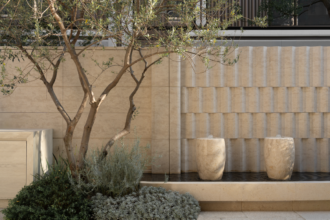
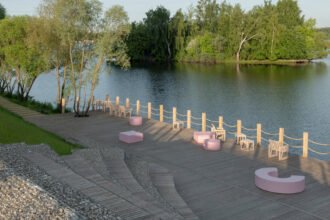
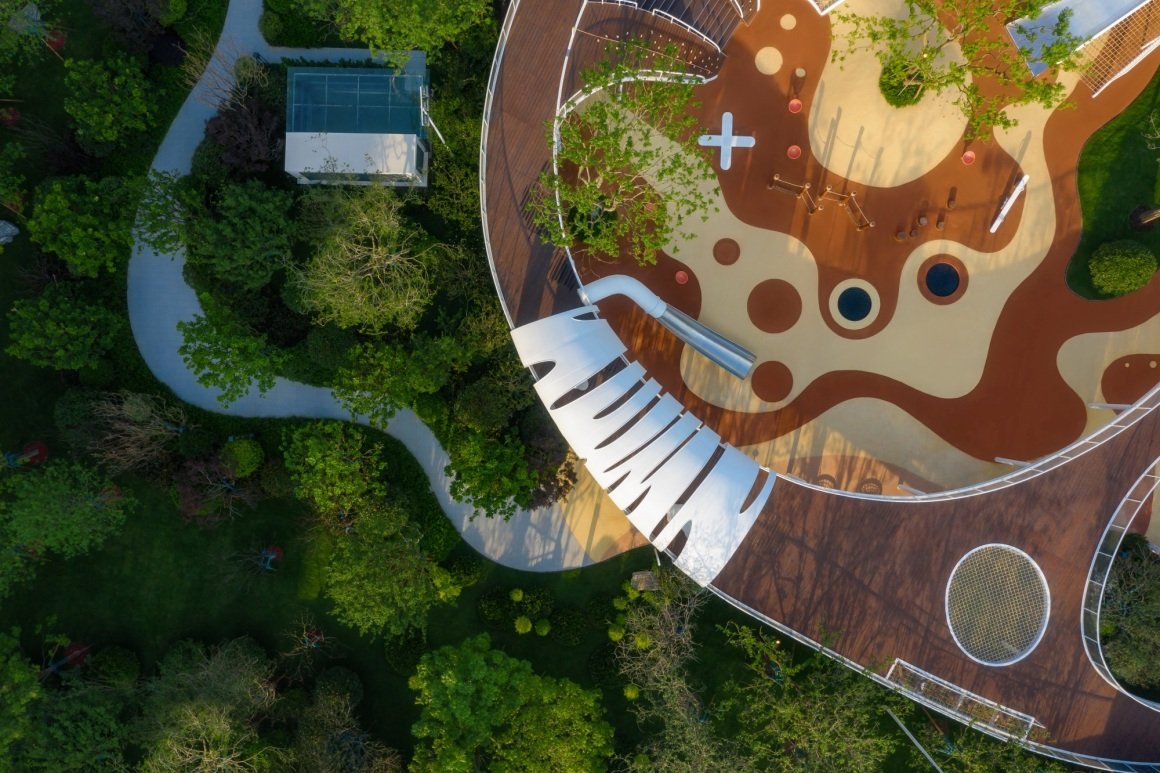
The landscape strategy is based on the idea of a “downtown garden city” – a network of interconnected green spaces integrated across the entire site rather than concentrated in a single park. Public squares, intimate courtyards, planted passages, roof terraces, and green facades form a continuous ecological and social system that extends pedestrian movement through the block and creates new urban shortcuts between surrounding streets. The project increases permeability at both the human and environmental scale, transforming a formerly inaccessible plot into a vibrant urban destination. The ground floor public realm was designed to prioritize pedestrians and informal use, encouraging everyday occupation through shaded seating areas, generous planting, and a diversity of spatial atmospheres.
At the heart of the future development lies the adaptive reuse of the former printing hall of Dom Słowa Polskiego (House of the Word), planned as a multi-level public park. Rather than erasing the site’s industrial memory, the landscape concept incorporates the existing structure as a framework for new ecological and social functions. This strategy of upcycling significantly reduces embodied carbon while preserving the identity and historical continuity of the place. References to the industrial character of the site are embedded throughout the landscape through robust material choices, reused aggregates, and spatial compositions inspired by the former production halls and infrastructural layouts.
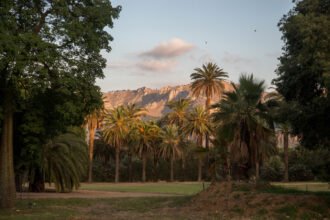
Climate resilience and environmental performance are fundamental to the landscape concept. The project responds to urban heat island effects through extensive tree canopies, shaded public spaces, permeable surfaces, and integrated stormwater retention systems. Planting strategies prioritize biodiversity, seasonal variation, and drought resilience, creating habitats for birds and pollinators while improving thermal comfort for users. Rainwater is managed visibly across the site through bioswales, retention gardens, and water-sensitive planting areas that support microclimatic regulation and reduce runoff into the municipal network. The introduction of extensive greenery within such a dense urban context significantly improves environmental conditions while strengthening users’ daily connection with nature.
Greenery is treated as an architectural material that shapes identity and experience throughout the development. Landscaped courtyards, roof gardens, terraces, and facade planting create a layered environment where built and planted elements are inseparable. Seasonal planting compositions were carefully designed to provide year-round variation in color, texture, and atmosphere, reinforcing the identity of the district while enhancing user wellbeing. Inspired by the industrial history of the site, the landscape also incorporates recycled demolition materials as paving aggregates, concrete components, and site furnishings, reinforcing both sustainability and cultural continuity.
Towarowa 22 proposes a new model for high-density urban development in Central Europe: one in which landscape is not residual space between buildings, but the organizing structure of the city itself. Through adaptive reuse, ecological integration, and a continuous public realm, Building B demonstrates how the first phase of a large-scale regeneration project can already establish a resilient, socially inclusive, and environmentally regenerative urban district.
ARCHITECTS – JEMS architekci (lead architect)
AREA – 1 ha
CLIENT – Echo Investment, AFI
YEAR – 2022-2025
PHOTOGRAPHS – Marysia Kot courtesy of JEMS architekci
52.229957, 20.988349